Location: Auditorium, Fédération des Entreprises Romandes
98 rue de Saint-Jean, 1201 Genève La date de l'événement:
Vendredi 13 novembre 2015
Sur le thème: L’art & le blanchiment d’argent Money Laundering in the Art Market
Événement en français
Programme et l'inscription:
On or by 3 November 2015
Le marché de l’art n’est pas épargné par les questions de blanchiment d’argent. L’actualité en a fait la démonstration. Les nouvelles recommandations du GAFI en matière de blanchiment qui seront mises en oeuvre en Suisse à compter du 1er janvier 2016, le phénomène malheureux du financement de l’État islamique par la vente de biens culturels et les réflexions entourant la règlementation des ports francs soulèvent des questions importantes pour le domaine de l’art sous l’angle de son exposition aux risques de blanchiment d’argent. Alors, mythe ou réalité: l’art est-il un moyen de blanchir des avoirs criminels?
Le but de cette journée est de faire un panorama de la problématique, d’exposer les règles qui s’appliquent au blanchiment d’argent dans le marché de l’art et d’esquisser des solutions pour prévenir les risques correspondants.
La professeure:
Ursula Cassani (Université de Genève), Jean-Bernard Schmid (procureur), Thomas Seydoux (Connery Pissarro Seydoux), Solange Michel (Interpol), le professeur Xavier Oberson (Université de Genève), Yan Walther (SGS Art Services) et Laurent Crémieux (Inspection fédérale des finances) comptent parmi les intervenants à cette journée.
Cet événement est organisé par la Fondation pour le droit de l'art et le Centre du droit de l'art.
In the public realms of law and the art world, a ‘connoisseur’ must be recognised as being an expert, as being capable of giving credible testimony regarding the subject, and as remaining actively engaged with the world in which attributions and authentications are made. This public recognition takes years of work and is hard-won.
Yet, does this public recognition of expertise signify accuracy or truth in the claims that a connoisseur makes about art? This one-day conference investigates the always-interrelated and often mutually-troubled processes by which connoisseurship is constructed in the fields of art and law, and the ways in which these different fields come together in determining the scope and clarity of the
connoisseur’s ‘eye’.
Speakers Include:
Martin Eidelberg (Rutgers University), Charles Hope (Warburg Institute), Nicholas Eastaugh (Art Analysis and Research Ltd.), Irina Tarsis (Center for Art Law), Brian Allen (Hazlitt Ltd.), Tatiana Flessas (LSE), Megan E. Noh (Bonhams) and Michael Daley (ArtWatch UK).
This event is organised at the The Society of Antiquaries of London by ArtWatch UK, the Centre for Art Law, and the London School of Economics and Political Science.
The only full-time municipal law enforcement unit in the United States devoted to the investigation of art crimes, the Los Angeles Police Department’s Art Theft Detail, was founded in 1984. From 1993 to 2008 alone, LAPD’s Art Theft Detail recovered $71 million in stolen art. During the same period, the approximately 90 burglary detectives in the entire LAPD recovered about $64.5 million in stolen goods. Current recoveries for the Art Theft Detail total more than $81 million.
In 1992, oil paintings by Claude Monet and Pablo Picasso worth $13 million were stolen from a Brentwood ophthalmologist’s home and discovered five years later in a Cleveland, Ohio storage facility by the LAPD Art Theft Detail with the help of the Federal Bureau of Investigation (FBI).
In 1999, a handyman was arrested on a charge of grand theft for stealing 7,500 animation film cells valued at $1 million from a Sherman Oaks animation company; the suspect stole the pieces over time and sold them all over the country. The LAPD art theft unit found the art through searches on the Internet.
Detective Don Hrycyk (pronounced her-ris-sik) has worked on art theft and forgeries since 1994. He has a temporary partner, Mark Sommer, who has been filling in since 2009.
The website for the LAPD Art Theft Detail reported examples of a few art crimes:
One suspect posed as an independent art dealer visiting art galleries to obtain consignments of art to sell. After gaining the trust of a gallery owner, the suspect secreted the paintings out of the gallery during business hours without the owner’s knowledge. Three paintings were taken from the unsuspecting art gallery over the period of two years.
In August 2008, a burglary at the home in the Encino area of Los Angeles of 9 paintings by artists Hans Hofmann, Lyonel Feininger, Chaim Soutine, Emil Nolde, Marc Chagall, Kees van Dongen, Diego Rivera and Arshile Gorkey resulted in a $200,000 reward offer for information leading to the recovery of the paintings and apprehension of the suspects.
In 2004, a suspect, a former physician and Harvard professor, was arrested by LAPD’s Art Theft Detail after selling a fake Mary Cassatt painting for $800,000 to undercover officers. The suspect possessed numerous other fake artworks. A few years earlier, the suspect had reported the theft of an artwork by Willem de Kooning valued at $1.5 million yet determined to be a fake and still in the suspect’s possession. The suspect had moved to California following a criminal conviction for selling fake art in Massachusetts in 1989. He was also the subject of a federal civil case alleging sales of fake art in 1985. The suspect used brokers to sell art to private parties and to invest money in his art collection. He avoided major auction houses and art dealers and preyed on people less knowledgeable about fine art.
In October 2010, a TV auctioneer who from 2002 to 2006 sold $20 million in forged art, including works falsely attributed to Pablo Picasso and Salvador Dali, was sentenced to five years in prison in a Los Angeles court. Two other conspirators were sentenced to four and seven years for claiming to sell genuine works found in real estate liquidations and forging certificates of authenticity on some artworks sold to more than 10,000 US customers through DirectTV and Dish Network.
Detective Hrycyk had previously worked in homicides and robberies. In 1997, Hrycyk and his predecessor, retired detective Bill Martin, were featured in a television show, “The Hunt for Amazing Treasure” on the Learning Channel, trying to recover $9 million in stolen artwork.
ARCA: How did you become involved in art crime investigation?
Detective Hrycyk: In the mid-1980s, I got tired of working homicide in South-Central L.A. and applied for an opening in a specialized burglary division in downtown L.A. After getting the spot I learned I would be working the newly formed Art Theft Detail. I developed an interest in art theft and art fraud investigations and took over the unit in 1994.
ARCA: What is the current focus of the LAPD Art Theft Detail Unit after more than 25 years in existence?
Detective Hrycyk: With only two detectives handling all art-related crimes in a city that is the second largest center for the visual arts in America, our focus is to be able to continue to do quality crime investigations with the resources available. Having a dedicated art crime unit has allowed us to professionalize and develop contacts in the art community that are essential to successful investigations.
ARCA: How big of a problem is art crime in Los Angeles?
Detective Hrycyk: Out of necessity, we handle not only traditional art but also a wide array of historical and cultural property, from Hollywood movie props to rare books and fossils. We just recovered a comic book valued at $1 million. When you think about it, most homes contain either an artwork, antique or collectible. Art theft is often a hidden crime because art objects are stolen all the time in routine burglaries along with cash, jewelry and other personal property. As a result, there are no accurate statistics on the prevalence of art thefts. There is no tracking of art thefts nationally. Added to this is the huge area of art fraud. Combined, these crimes keep us busy all the time.
ARCA: Is the trafficking of looted antiquities a problem in Los Angeles? What are the significant routes? Which other agencies do you work with on this problem?
Detective Hrycyk: In a city as diverse at L.A., smuggled antiquities is bound to be a problem but is primarily handled by federal law enforcement agencies that protect our borders and have international treaty obligations. Sales are often back room, private transactions. However, we often work with the agents from the FBI, DHS, ICE, Interpol and others when we receive actionable intelligence.
ARCA: Is working with international agencies important to the success of the LAPD Art Theft Detail Unit?
Detective Hrycyk: Stolen and fraudulent art often crosses international boundaries so it is important to have contacts in other countries who can work with us on difficult investigations. In a like manner, we often conduct investigations for foreign law enforcement agencies when an L.A. connection develops. It is important to convince thieves and con men that no safe haven exists for those who deal in stolen or fake art.
ARCA: What is the biggest challenge the LAPD Art Theft Detail faces in recovery a stolen work of art?
Detective Hrycyk: Finding the stolen artwork is the biggest challenge. A stolen painting sold in a private sale may hang on a bona fide purchaser’s living room wall for a decade or more before it comes up for sale again in a venue where it will come to our attention.
ARCA: What do you do with confiscated fake artworks after the suspect has been convicted?
Detective Hrycyk: We try to ensure that fake artworks never reenter the legitimate marketplace. This is easier said than done. Unlike illicit drugs and counterfeit currency, fake art is not illegal to possess. As a result, there is no consistency in how fraudulent art is disposed of at the conclusion of a criminal case. We have encountered great resistance on the part of judges to authorize the destruction of fake art and some pieces have actually been returned to suspects by the courts.
ARCA: How have you been working with the association of art dealers or other members of the art community in stemming the flow of forgeries or thefts?
Detective Hrycyk: Most of the intelligence information I receive about suspicious activities and unsavory characters comes from artists, dealers and galleries that I have established a relationship with over the years. The art community can be very closed mouth unless you are trusted.
ARCA: What piece of advice would you offer to individuals interested in pursuing a career in art crime investigation?
Detective Hrycyk: Unfortunately, there are few career opportunities presently available in the United States in the public sector. I get inquiries all the time from people who would love to investigate art crimes but at present, the pickings are slim. It is tough to break into this field. This situation is bound to change but we aren’t there yet.
ARCA: What would you most like to see the LAPD Art Theft Detail achieve in the next five years?
Detective Hrycyk: Right now, we have an open position in the Art Theft Detail that needs to be filled but we are unable to do so because of personnel shortages and budgetary considerations. With 37 years on the job, I need to find a permanent replacement that I can train before retirement. Art investigation is a specialty requiring great skill. However, there are few training opportunities in this field. I teach one of the few courses available to burglary detectives throughout the state of California.
This interview is published here with permission from The Journal of Art Crime published by ARCA. This interview will also appear in the Spring/Summer 2011 issue of The Journal of Art Crime. For more information or to subscribe to The Journal of Art Crime, click here.
Here are the nominees for ARCA's 2014 Award for Art Protection & Recovery, which is usually given to a police officer, investigator, lawyer, security director or policy-maker. This year ARCA has combined two of the previous year’s awards categories as more often than not, individuals were double nominated in two award categories.
Past winners have included: Vernon Rapley and Francesco Rutelli (2009), Charlie Hill and Dick Drent (2010), Lord Colin Renfrew and Paolo Giorgio Ferri (2011), Karl von Habsburg, Dr. Joris Kila Ernst Schöller (2012), Sharon Cohen Levin and Christos Tsirogiannis (2013).
The Nominees for the 2014 Award for Art Protection & Recovery Award are:
Monica Dugot, Senior Vice President and International Director of Restitution, Christie’s Auction House. Nominator's Synopsis: "In her more than 17 years of practice in the restitution field, Ms. Dugot has been instrumental in resolving major claims and in developing international policies in this area. Under her guidance, Christie’s was one of the first auction houses to publish on its website a detailed explanation of its practices with regard to claims to artworks consigned for auction. In so doing, Ms. Dugot has led the way in prescribing for claimants and possessors alike the manner by which claims could be resolved without the need for litigation, especially in emotionally fraught cases involving Nazi-looted art. She would be a worthy addition to ARCA’s illustrious list of past recipients of this award."
Monica Dugot is responsible for coordinating Christie's restitution issues globally. She and her team of researchers vet nearly every lot Christie’s offers at auction, which means somewhere in the region of 200 sales a year, from Old Masters and Books to Impressionist and Modern Art focusing on provenance between 1933 and 1945; to identify possibly spoliated but unrestituted objects; and to help in resolving restitution claims for works consigned for sale.
Prior to joining Christie's, Ms. Dugot served for almost eight years as Deputy Director of the New York State Banking Department's Holocaust Claims Processing Office, where she coordinated the Art Claims branch of the HCPO's work and assisted owners and heirs in seeking to recover art collections that were lost or looted during the Nazi era. She has represented New York State on art restitution matters at many venues including the 1998 Washington Forum on Holocaust-Era Assets and the International Conference on Holocaust Era Looted Cultural Assets in Vilnius, Lithuania. Ms. Dugot is on the Advisory Board of Claremont McKenna College’s Center for Human Rights Leadership, and the Society of American Friends of the Jewish Community Vienna. She is currently a member of the Art law Commission of the Union Internationale des Avocats (UIA). She also served as a member of the NYC Bar Association's Art Law Committee.
Martin Finkelnberg – Special Investigating Officer, Art and Antique Crime Unit of the Netherlands. Nominator's Synopsis: "Martin was the only art detective in the Dutch police force, and was assigned, pretty much on his own, to set up the force’s first arts unit. He runs it now with several part-time officers who are art historians, and yet he has great success in coordinating art-related cases from throughout the Netherlands and abroad."
Martin Finkelnberg is the Head of the Art and Antiques Crime Unit of the National Criminal Intelligence Division which is part of the recently reorganized National Police Force of the Netherlands. He joined the police force in 1976 as a junior intelligence officer and for roughly 30 years was mainly involved in firearms investigations and counter terrorism.
In 2006 he was asked to build a national database on stolen works of art. At the same time he also had to restart the Art and Antiques Crime Unit that had been discontinued in 2002. Today this unit is composed of four individuals.
Over the course of the years Finkelnberg also felt necessity to establish contact points within each police region. In 2013 this led to the appointment of not only ten dedicated police officers -- one in every region -- but also to a dedicated national public prosecutor. These are however not experts and they are being trained on a regular basis by Finkelnberg and others on legislation, awareness of the importance of preserving cultural heritage, and on criminal trends and activities. The unit, in principal, is not an investigating body itself but an intelligence hub for the regional police forces who are responsible for carrying out criminal investigations.
However, because of the complexity of Dutch legislation regarding illegal trade in cultural property, Martin Finkelnberg occasionally goes out on the road himself. During several of these occasions and in close cooperation with the Cultural Heritage Inspection, he recovered more than 70 items from Iraq, some of them dating back to 5,000 B.C.. He and his unit also proved to be instrumental in solving many major museum break-ins such as the Hofje van Mevrouw van Aerden Museumin 2011 in which case the police recovered a 15 Million euro painting by Frans Hals; and the Museum Gouda where in 2012 the burglars used an explosive device to blow up the front door of the museum (In this case the unit was also able to establish links between these suspects and another museum break-in in 2009 and to them identifying several other museums as possible targets).
(Jointly) Dr. Daniela Rizzo and Mr Maurizio Pellegrini, Soprintendenza Beni Archeologici Etruria Meridionale. Nominator’s Synopsis: "Pellegrini and Rizzo are well known for their groundbreaking forensic work from for the Italian government. During that period, they were responsible for identifying dozens of looted and smuggled masterpieces for the Italian judicial authorities from the confiscated archives of illicit antiquities dealers Giacomo Medici, Gianfranco Becchina, and Robin Symes, etc. Based on Pellegrini and Rizzo's meticulous research, the Italian state managed to repatriate numerous stolen treasures of antiquity and to have solid evidence for the prosecution of several members of the international illicit antiquities network. Their more recent work, while less well known to the general public, involves ongoing negotiation with museums around the globe encouraging them to return looted objects found in their collections."
Dott.ssa Daniela Rizzo and Maurizio Pellegrini are employees of Italy’s Ministry of Cultural Heritage and Activities and Tourism (MiBACT) who work directly for the Soprintendenza for Southern Etruria's Archeological Heritage which covers the archaeological territories of Cerveteri, Tarquinia, Vulci, Veio, Lucas Feroniae, Civitavecchia, Sutri , Tuscania, Pyrgi, Volsinii and San Lorenzo Nuovo. Dr. Rizzo oversees the department of Goods Control and Circulation with the assistance of Massimo Pellegrini. Their offices are located at the National Etruscan Museum of Villa Giulia.
One of the main commitments of their department and the Soprintendenza overall is the fighting of criminal activities and illegal traffic of archaeological objects from the southern territories.
In 1985 the Soprintendenza set up a special service, "The Office of confiscation and illicit excavations" (ufficio sequestri e scavi clandestini), which constantly monitors the phenomenon of illegal excavations and the finds of illegal trafficking.
To achieve this goal, their office began working closely with Italy’s National Judicial Authority and the security forces (Carabinieri TPC and Guardia di Finanza), which work together in this sector. This collaboration aims to recover Italian archaeological materials that have been taken away illegally from the national territory and often have ended up in important foreign collections. Since 1995, their work has achieved very positive results and has resulted in the identification of numerous archaeological objects taken illegally and found in a number of American and European museums or in private collections abroad. Based on the inspection of and matching between confiscated photographs and documents, their investigations have facilitated negotiations between American and European museums which have often concluded in important cultural agreements rather than lengthy judicial prosecutions.
Thanks to these agreements, archaeological finds are regularly being returned to Italy from places like New York and Boston.
Through their in-depth work, the famous Euphronios crater, now on display in the new rooms of Villa Giulia, has been recognized as property of the Italian state and was returned to Rome in 2008 from the Metropolitan Museum in New York. Similar agreements have been concluded with the Princeton University Art Museum, the Cleveland Museum of Art and the J.P. Getty Museum of Malibu.
In cases where traffickers have been identified their work with the "Procura della Repubblica" (Italian prosecutor's office) and the Court of Rome has made it possible, in some circumstances, to try specific cases associated with illegal trafficking of antiquities within Italy. Cases of note include the exemplary punishment imposed by the Court of Rome on an Italian trafficker, who operated in Switzerland and the 2005, criminal proceedings that were initiated against Marion True, the former curator who purchased trafficked archaeological objects for The Paul Getty Museum, and cases involving Robert Hecht.
As a result of their work and the recovery of objects, a room in the Villa Giulia has housed a temporary traveling exhibition to increase the public’s awareness to the impact of trafficking, the significance of the problem and what is being done to combat it. The carefully curated exhibition included numerous objects which have been repatriated from Southern Etruria as well as examples of documents used in their ongoing investigations and prosecutions by the Italian authorities.
Roma Antonio Valdés– Public Prosecutor, Carrera Fiscal,
Fiscalía de Santiago de Compostela, Spain
Nominator’s Synopsis – "A public Prosecutor for the Government of Spain, he is an expert in legal international cooperation and crimes against cultural heritage. He was the public prosecutor in charge of the successful recovery of the Codex Calixtinus, a 12th-century illuminated manuscript from the cathedral of Santiago de Compostela. The Codex was stolen in July 2011, and successfully recovered in 2012 in the garage of a former employee of the Cathedral."
Roma Valdés holds a Licentiate in Law from the University of Alcalá, a PhD in Archaeology from the University de Santiago de Compostela, and a diploma in advanced studies in criminal law from the Universidad Nacional de Educación a Distancia, Spain. He has been a prosecutor since 1994 and specializing in crimes against cultural Heritage since 2004. He also serves as a professor in procedural Law at the University of A Coruña and serves as a representative to Spain in some international conventions.
He is the author of 5 Law books, 48 Law papers, 7 History books, and 43 History papers. Some of these documents can be accessed at: https://coruna.academia.edu/AntonioRomaValdes.
Below are a listing of significant art crime cases he has been a part of:
- 2011-2014 Theft and recovery of the Codex Calxtinus. Investigation and prosecution of the theft of one of the main medieval books of Europe.
- 2008-2014 Affaire Patterson II. The collection above was exported without authorization from Spain to Germany. The case implies another precedent, in this case of use of the most recent Framework Decisions of mutual recognition of judicial resolutions principle in Europe. Other cases were open to prosecute cases of illicit trade of cultural heritage. Now, there is a non guilty decision pending appeal.
- 2007-2009 Affaire Patterson I. The case, followed mainly by Latin American media, implies the judicial international cooperation between the Republic of Peru and the Kingdom of Spain to send more than two thousand of Pre-Columbian objects, some of the with a great historic importance. After the Republic of Peru, other Latin American states claimed successfully another pieces. The case is the main precedent in legal cooperation among judicial authorities in the field of the restitution of cultural heritage.
- 2009 Corrubedo. During March 2009, several British divers were condemned to damage a XIX c. boat sunk in the Galician coast. Another similar case is open now.
- 2000-2004 Os Castriños. The owner destroyed an archaeological site to build a camping site. Besides the fine, the Spanish jurisdiction for the first time prohibited developing activities not directed to the diffusion of the archaeological culture. Since then to now, more cases were open to prosecute owners of buildings and sites that destroy them to sell new buildings.
Leo Baeck Institute | 212-294-8301
15 W 16th St
New York, NY 10011
This course will discuss the current legal standard defining due diligence, its limitations, and the varied approaches attempting to address due diligence requirements in the market, and provide a suggested framework and associated checklist to satisfy due diligence requirements in provenance research for cultural objects. The courts have the means to enforce proper ownership rights of current possessors, good faith purchasers, and rightful owners, yet the market is encountering significant challenges in implementing due diligence standards to comply with legal requirements and stabilize the trade.
SCHEDULE
8:00am-8:45am: Welcome/Sign-in
8:45am-8:50am: Introduction
8:50am-10:05am: Have You Done Your Due Diligence?
10:05 am-10:15am: Break
10:15am-11:30am: Is Context Everything?
11:30am-11:40am Break
11:40pm-12:55pm: Do Your Research-Your Provenance Research
12:55 pm-1:00pm: Conclusion
SPEAKERS
Sharon Levin-Chief of the Asset Forfeiture Unit in the Criminal Division of the United States Attorney’s Office for the Southern District of New York Charles A. Goldstein-Herrick, Feinstein LLP, Member, Art Law Group Lawrence M. Kaye-Herrick, Feinstein LLP, Co-Chair, Art Law Group Monica Dugot- Christie’s, Senior VP, International Director of Restitution Lucian Simmons-Sotheby’s, Senior VP of Sotheby’s in New York, Head of Sotheby’s Worldwide Restitution Team Victoria S. Reed-Museum of Fine Arts, Monica S. Sadler Curator for Provenance Lucille A. Roussin- Ph.D-Law Office of Lucille A. Roussin; Adjunct Professor at Cardozo School of Law Irina Tarsis-Center for Art Law, Attorney at Law, Consultant, Program Coordinator Ori Z. Soltes-Holocaust Art Restitution Project, Co-Founder Marc J. Masurovsky-Holocaust Art Restitution Project, Co-Founder Pierre Ciric-The Ciric Law Firm, PLLC
CLE CREDITS (Accreditation Pending)
4.0 (1.5 - Ethics & Professionalism; 1.0 - Skills; 1.5 - Areas of Professional Practice)
Ballots have been sent out to the Board of Trustees for ARCA's 2014 Eleanor and Anthony Vallombroso Award for Excellence in Art Crime Scholarship which usually goes to a professor, journalist, or author. Past winners: Norman Palmer (2009); Larry Rothfield (2010); Neil Brodie (2011); Jason Felch and Ralph Frammolino (Jointly - 2012); and Duncan Chappell (2013). The Nominees for the 2014 Eleanor and Anthony Vallombroso Award for Excellence in Art Crime Scholarship are:
Nominators’ Synopsis –
Author of The Art Stealers (MacMillan, 1973)
Milton Esterow is editor and publisher of ARTnews. Since he bought ARTnews from Newsweek Magazine in 1972, he has guided its growth into the most widely circulated art magazine in the world. Since 1975, ARTnews has won most of the major journalism awards presented to magazines. Its editors and reporters have been honored forty-four times for excellence in reporting, criticism, and design.
Under Mr. Esterow's direction, ARTnews became the first magazine to consistently apply rigorous standards of investigative reporting to the art world. Mr. Esterow received a special award for lifetime achievement from the College Art Association, the national organization of educators, artists, art historians, curators, critics, and institutions in 2003. He was cited for “his exceptional contributions to art journalism and investigative art reporting” and for having “overseen the magazine’s financial success while enhancing its reputation and influence in the visual-arts community and beyond.”
Dr. David Gill, Professor of Archaeology, University of Suffolk
Nominators’ Synopsis – "Dr. Gill is has been a persistent and thoughtful advocate for reform in the museum community and the antiquities trade. He has done excellent work on the consequences of the sale of antiquities without history. His research has drawn attention to the impact of looting. Some highlights of his considerable scholarly output include: studying Cycladic figurines from the 3rd millennium BC; the photographic archives from Switzerland which triggered the return of looted objects to Italy; the sale of antiquities in London and New York; and the collecting history of private antiquities collections.
David Gill is a Professor of Archaeological Heritage at University Campus Suffolk who has a great knowledge of the cultural property debate, has published extensively against looting, and maintains Looting Matters, the internationally best-known and visited archaeological blog regarding cultural property issues. The blog, updated almost daily, offers not only detailed discussions of the issues surrounding the crime of looting, but also a platform for new evidence of antiquities trafficking, informing the world's archaeological community and helping state authorities to pursue their stolen heritage."
David Gill is a former Rome Scholar at the British School at Rome, and Sir James Knott Fellow at Newcastle University. He was responsible for the Greek and Roman collections at the Fitzwilliam Museum and was subsequently Reader in Mediterranean Archaeology at Swansea University. His Sifting the Soil of Greece: the Early Years of the British School at Athens (1886-1919) [2011] was published to coincide with the 125th anniversary of the School. He received the Outstanding Public Service Award from the Archaeological Institute of America (2012).
Gill has published widely on cultural matters and his “Material and intellectual consequences of esteem for Cycladic figures” (co-written with Dr Christopher Chippindale) presented a new methodological approach to studying this area. He has a regular editorial column, “Context Matters”, for the Journal of Art Crime, and runs a research blog, “Looting Matters”.
Simon Mackenzie, Trafficking Culture project at the University of Glasgow.
Nominator’s Synopsis – "Besides being a criminologist who explored art crimes since his doctoral dissertation, launched along Neil Brodie the Trafficking Culture project at the University of Glasgow."
Simon Mackenzie is Professor of Criminology, Law & Society in the School of Social and Political Sciences at the University of Glasgow, where he is also a member of the criminological research staff at the Scottish Centre for Crime and Justice Research, a cross-institutional organization conducting national and international criminological research projects.
Prof Mackenzie co-ordinates the Trafficking Culture research group, which is a pioneering interdisciplinary collaboration producing research evidence on the scale and nature of the international market in looted cultural objects, including regional case studies of trafficking networks and evaluative measures of the effects of regulatory interventions which aim to control this form of trafficking. Trafficking Culture is funded with a €1m research grant from the European Research Council. The group employs a core group of researchers plus an affiliate Leverhulme Early Career Research Fellow, and four PhD research students, making it a world-leading center for study in this field. As well as producing research evidence, the team are developing educational resources for the next generation of scholars via a new course, run for the first time in 2014, on International Trafficking in Cultural Objects, offered as part of the three Criminology Masters pathways which Prof Mackenzie convenes at Glasgow: the MRes Criminology; the MSc Criminology & Criminal Justice; and the MSc Transnational Crime, Justice & Security.
Simon’s research on the international market in illicit cultural objects began with his PhD, leading to the publication in 2005 of Going, going, gone: regulating the market in illicit antiquities, which won the British Society of Criminology Book Prize that year. The book was mainly an empirical study of attitudes and practices of high-end dealers in relation to their engagement with looted artefacts, and an analysis of the implications for regulation and control of the various neutralizing and justificatory narratives surrounding handling illicit objects at the top end of the market.
From 2005-07, in a study with Prof Penny Green funded by the UK’s Economic and Social Research Council, Simon extended this analysis by looking at the market’s reaction to the onset of explicit criminalization in a case study of the Dealing in Cultural Objects (Offences) Act 2003. This research was published in Mackenzie and Green (eds) Criminology and Archaeology: Studies in Looted Antiquities (2009), part of the Onati International Series on Law and Society and based around the proceedings of a workshop at the Onati International Institute for the Sociology of Law exploring the interdisciplinary possibilities of a field of study based both in archaeology and criminology.
Simon has worked with a number of international organisations, providing research-based input to support initiatives to reduce the international trade in looted cultural objects: eg. he has worked with UNODC in producing briefing documents for UN member states in their 2009 enquiry into Trafficking Cultural Property, leading to policy recommendations made at the UN Commissions and Congress on Crime Prevention and Criminal Justice; and he is currently on the editorial committee of ICOM’s International Observatory on Illicit Traffic in Cultural Goods.
Prof Mackenzie is a member of the Peer Review Committee of the Arts and Humanities Research Council, Associate Editor of the Howard Journal of Criminal Justice, and a member of the editorial board of the British Journal of Criminology. His criminological research has been supported by grants and contracts from funders including the EU, ESRC, AHRC, both the UK and Scottish Governments, and the UN.
Sandy Nairne, Director, Director, National Portrait Gallery
Nominator’s Synopsis – "His book, Art Theft and the Case of the Stolen Turners, and his outspoken transparency about rewards versus paid information for the recovery of stolen art have been refreshing and thoughtful. He’s a major public figure, head of the National Portrait Gallery, and is a good representative of what this award stands for."
Sandy Nairne is currently Director of the National Portrait Gallery in London, a post he has held since 2002. As director of one of Britain’s popular national museums (visited by more than 2m each year) he has sought to combine a determined drive for research and scholarship in the understanding of collections and in making exhibitions, with a strong emphasis on education and community engagement. He has supported the wider implementation of advanced security procedures (combined with new technologies) to protect collections and loans, and the sharing of information about thefts and cases of forgery, even when this appears difficult for individual museums.
In July 1994, as Director of Programmes for the Tate, Sandy Nairne flew to Frankfurt on the day following the shocking theft of two paintings by J.M.W.Turner, then worth £24m, and on loan to the Schirn Kunsthalle from the Tate. Nairne then spent eight and a half years coordinating the complex attempts to recover these two great masterpieces. The first was recovered in July 2000, but returned to Britain incognito in order not to disturb the connections made to those holding the second painting (with approval from the Frankfurt Prosecutors’ Office). Following an approved ‘payment for information’ the second painting was returned in December 2002. In 2011 Nairne published a detailed account of the recovery, combined with a close analysis of the issues surrounding high value art theft, from ethics, to value and to motivation. Art Theft and the Case of the Stolen Turners (Reaktion) has gone into a second printing, and been published in translation in Germany and in Japan.
Professor Lyndel V. Prott, Honorary Professor, University of Queensland and Honorary Member of The Australian Academy of the Humanities.
Nominator’s Synopsis – "Professor Lyndel V. Prott (lvprott@bigpond.com) is an Honorary Professor, University of Queensland and Honorary Member of The Australian Academy of the Humanities. She is the former Head of International Standards Section, UNESCO and then Director of the Cultural Heritage Division where she was instrumental in strengthening existing international instruments and the realisation of the 1995 UNIDROIT Convention. Her scholarship has made contributions to the foundation of cultural heritage law scholarship. We would not perhaps even think of cultural heritage law without her important theoretical scholarship. Her work has brought attention to the plague of antiquities looting and she has been an advocate for concerted international action to combat the theft of heritage and destruction of our collective past."
Lyndel Prott AO (1991), Öst. EKWuK(i) (2000), Hon FAHA; LL.D. (honoris causa) B.A. LL.B. (University of Sydney), Licence Spéciale en Droit international (ULB Brussels), Dr. Juris (Tübingen) and member of Gray’s Inn, London, is former Director of UNESCO’s Division of Cultural Heritage and former Professor of Cultural Heritage Law at the University of Sydney. She has had a distinguished career in teaching, research and practice, including co-operation with ICOM and INTERPOL to improve co-ordination between civil and criminal law to deal with illicit traffic.
At UNESCO 1990-2002 she was responsible for the administration of UNESCO’s Conventions and standard-setting Recommendations on the protection of cultural heritage and also for the negotiations on the 1999 Protocol to the Hague Convention for the Protection of Cultural Property in the Event of Armed Conflict 1954 and the Convention on the Protection of the Underwater Cultural Heritage 2001. She contributed as Observer for UNESCO to the negotiations for the UNIDROIT Convention on Stolen or Illegally Exported Cultural Objects 1995. She has authored, co-authored or edited over 280 books, reports or articles, written in English, French or German and translated into 9 other languages. Currently Honorary Professor at the University of Queensland, she has taught at many universities including long distance learning courses on International Heritage Law.
This year five people have been nominated for ARCA's 2013 Eleanor
and Anthony Vallombroso Award for Art Crime Scholarship, which usually goes to a professor or author. Past winners: Norman Palmer
(2009), Larry Rothfield (2010), Neil Brodie (2011), and Jason Felch and Ralph
Frammolino, jointly (2012).
The Five (5) Nominees for 2013 are:
Duncan Chappell, an Australian lawyer and criminologist now based at the Faculty of
Law at the University of Sydney, has had a long-standing interest in art crime
which dates from the period during which he was the Director of the Australian
Institute of Criminology (1987-1994). Since that time he has been engaged in
research and publishing on a range of art crime topics but with a particular
focus on patterns of illegal trafficking of objects of cultural heritage in the
South East Asian region. Much of this research and publishing has been
undertaken in collaboration with a friend and colleague at the University of
Melbourne, Professor Kenneth Polk.
Duncan
Chappell’s publications include two coedited texts: Crime in the Art and
Antiquities World. Illegal Trafficking in Cultural Property (2011) Springer:
New York (With Stefano Manacorda) and Contemporary Perspectives on the
Detection, Investigation and Prosecution of Art Crime (In Press) Ashgate:
London (With Saskia Hufnagel). He has also had published a number of journal
articles and book chapters on various aspects of art crime including fraud and
fakery in the Australian Indigenous art market; the impact of corruption in the
illicit trade in cultural property; and the linkages between art crime and
organized crime.
In
addition to his research and writing on art crime Duncan Chappell has acted as
an expert in regard to court proceedings involving art crime and also been a
strong supporter ofmeasures to
enhance public awareness of the evils of looting behaviour and to strengthen
the engagement of law enforcement agencies in investigation and prosecuting
those responsible. In his present capacity as Chair of the International
Advisory Board of the Australian Research Council Center of Excellence in
Policing and Security, he has sought to foster a far more proactive approach to
the prevention and detection of art crime both in Australia and its
neighbouring countries within the South East Asian region.
Milton Esterow, author of The Art Stealers and editor of ArtNews, which has won 44 major awards for reporting, analysis, criticism, and
design—the first and only art magazine to win these awards. Since Esterow bought ARTnews from
Newsweek Magazine in 1972, he has guided its growth into the most widely
circulated art magazine in the world. Since 1975, ARTnews has won most of the
major journalism awards presented to magazines.Its editors and reporters have been honored forty-four times
for excellence in reporting, criticism, and design.
Under
Mr. Esterow's direction, ARTnews became the first magazine to consistently
apply rigorous standards of investigative reporting to the art world.Mr. Esterow received a special award
for lifetime achievement from the College Art Association, the national
organization of educators, artists, art historians, curators, critics, and
institutions in 2003. He was cited for “his exceptional contributions to art
journalism and investigative art reporting” and for having “overseen the magazine’s
financial success while enhancing its reputation and influence in the
visual-arts community and beyond.”
Fabio Isman is a highly esteemed investigative journalist who has worked for Il
Messaggero for 40 years .He is a major contributor to the Giornale dell’Arte, The Art Newspaper, Art e
Dossier, Bell’Italia. Through Skira, and has published I Predatori dell’Arte
Perduta, il Saccheggio dell’Archeologia in Italia (Predators of Lost Art, the
Archeological Plunder of Italy, 2009), and the study of the “Grande Razzia” (The
Great Plunder) and illegal excavations since 1970 of a million archeological
finds in Italy, many of which are found in noteworthy museums abroad.His list of publications include 32
books and hundreds of articles.
In Italy and abroad, he has covered the “Six Day War”
(1967) and the war in Lebanon (1982); the death of Mitterrand and the election
of Chirac; the murder of Rabin; the voyages of Pertini, Cossiga and Scalfaro,
the ascension of eight italian governments and two Popes; the trials of Piazza
Fontana, the Lockheed scandal, the Ardeatine massacre and the “Mani Pulite”
political corruption scandal of the 1990s in Italy.Since 1980, he has been dedicated to writing about cultural
heritage protection, with an emphasis on historic preservation not only in
Italy, but worldwide.
Dr.
Kenneth Polk, University of Melbourne, Australia, has written extensively in the topic
of antiquities trafficking. While
his previous work in criminology was in such areas as youth crime and crimes of
violence, for the past 15 years Prof. Polk has concentrated on issues of art
crime, including art theft, art fraud, and the problem of the illicit traffic
in cultural heritage material.He
has recent or forthcoming publications in all of these areas.Much of the work over the past ten
years has dealt with the illicit traffic in antiquities, including articles
(with Duncan Chappell) on the question of how this traffic fits into the large
volume of work done on organized crime.Because of emerging interest in recent months around the problem of art
theft (in part provoked by the 100th anniversary of the well known events
around the theft and recovery of the Mona Lisa), he has re-visited this topic
in forthcoming works.In
Australia, Prof. Polk currently serves as a member of the National Cultural
Heritage Committee (appointed by the Australian Government).
Lyndel V Prott is an Honorary Professor, University of Queensland and
Honorary Member of The Australian Academy of the Humanities. She
is the former Head of International Standards Section, UNESCO and then Director
of the Cultural Heritage Division where she was instrumental in strengthening
existing international instruments and the realisation of the 1995 UNIDROIT
Convention. Her terrific scholarly output has brought attention to the plague
of antiquities looting and she has been a wonderful advocate for concerted
international action to combat the theft of heritage and destruction of our
collective past.
Lyndel
Prott AO (1991), Öst. EKWuK(i) (2000), Hon FAHA; LL.D. (honoris causa) B.A.
LL.B. (University of Sydney), Licence Spéciale en Droit international (ULB
Brussels),Dr. Juris (Tübingen)
and member of Gray’s Inn, London, is former Director of UNESCO’s Division of cultural Heritage and former Professor of Cultural Heritage Law at the
University of Sydney. She has had a distinguished career in teaching, research
and practice, including co-operation with COM and INTERPOL to improve
co-ordination between civil and criminal law to deal with illicit traffic.
At
UNESCO 1990-2002 she was responsible for the administration of UNESCO’s
Conventions and standard-setting Recommendations on the protection of cultural
heritage and also for the negotiations on the 1999 Protocol to the Hague
Convention for the Protection of Cultural Property in the Event of Armed Conflict
1954 and the Convention on the Protection of the Underwater Cultural Heritage
2001. She contributed as Observer
for UNESCO to the negotiations for the UNIDROIT Convention on Stolen or
Illegally Exported Cultural Objects 1995. She has authored, co-authored or
edited over 280 books, reports or articles, written in English, French or
German and translated into 9 other languages.
Chicago's former St. Boniface Catholic Church
closed in 1990. Recently slated to become senior
housing, the building's latest development
has been stalled yet again.
by Hal Johnson, 2014 ARCA Student and DNA Consultant
Last month, the architectural
marvels of Chicago’s Loop served as the setting for a colloquium on protecting
urban cultural heritage. TheCenter for Art, Museum, and Cultural Heritage Law at DePaul University’s lawschool hosted "Protecting Cultural Heritage from Disaster" on September 22, featuring guest lecturer Ryan Rowberry, Assistant Professor of Law at Georgia State University. His background in cultural heritage law
is certainly influenced by his Rhodes Scholarship in medieval history at
Oxford. Both fields of study
shaped his lecture topic – the preservation of cultural heritage in urban
landscapes.
Professor Rowberry began his talk
with a question that often crosses our minds here at ARCA – why does cultural heritage matter?I found it ironic that he posed such a
question having traveled from Atlanta, a city that has largely forsaken its
connection with the past in the name of downtown economic development.Yet there are those in the Atlanta area
like him who are researching this issue from all sides.In particular he mentioned a study at
Emory University which found that connections to the past help people frame
their own life experience within a much bigger picture.They thus feel stronger for having that
connection.Who knew that cultural
heritage can have a positive effect on community health?
Professor Rowberry’s main focus
was the effect that disasters and population growth are having on cities.Barcelona, Istanbul, LA, and London are
a few examples he used to illustrate the challenges of historic preservation in
the face of explosive population surges.An ancient city with a proud past, Istanbul’s population has ballooned
to approximately 18 million people in under two centuries.How are these cities, and others like
them, dealing with ever expanding boundaries AND preserving their cultural
property at the same time?
The first step is to know what
you have.Many city and local
governments are starting to develop databases to inventory cultural
property.While it sounds like a
daunting task, the exciting thing about such massive data gathering projects is
that you can engage the public by getting them to help!I loved this part of the lecture the
most because it ties in strongly to the question of HOW to get people to care about cultural heritage.Not everyone will be interested in
what’s happening to a monument half a world away, but they may care about what
happens to that old storefront down the street!I urge you to go online and check out projects like SurveyLA
in Los Angeles or The Arches Project in the UK.There are many others that might be closer to you.Make contact and let them know about an
interesting building or local historical spot they might not have registered
yet.Donate your knowledge, time,
or even some funds!
Reuse of historic structures is
another strategy that is starting to gain support in many cities.In my old Chicago neighborhood there
was one church that had been rebuilt into condominiums and another is currently
slated to be converted into senior housing.Professor Rowberry cited the defunct bullfighting stadium in
Barcelona (the Plaza Monumental) and the efforts of the Emir of Qatar to fund
its conversion into a mosque.
The importance of being prepared
at the government level was also emphasized.Our speaker stressed how crucial it is to streamline lengthy
environmental and historical procedures before the next disaster occurs.I was most skeptical of this third
strategy, and not for lack of thought or detail put into it.I spent several years as a state
employee and I know how hard it is to get governments to practice
foresight.However, it is
important to keep in mind that this was a lecture at a law school.What I flinched at, the dozen or so law
students in attendance were probably eager to sink their teeth into.
The Art Law Colloquium at DePaul
University College of Law was a lunch hour well
spent.A handful of scholars from
Chicago’s museums and universities attended in addition to the legal minds that
were present.Having recently
returned from the ARCA summer program in Amelia I was heartened to know that
there are organizations like the Center for Art, Museum, and Cultural Heritage
Law in cities other than the great art market centers of the world.And in my own hometown, no less!Thanks to Center director Patty
Gerstenblith and her students for hosting this colloquium and to Professor
Rowberry for sharing his time and experience.
Tatum King, Special Agent in Charge, Homeland Security Investigations with Mungkorn Pratoomkaew, Consul-General of Thailand
While everyone is celebrating the long-overdue restitution to Thailand of the two stolen Khmer lintels, ARCA thought a bit of context might add some additional points to ponder when taking in the carefully-worded, announcements of cultural diplomacy and restitution.
Starting with this work in progress chronology:
25 October 1926
During the reign of King Rama VII, the first law on the export of antiques and objects of art in the country of Siam comes into force.
The preamble to this law states that in advanced countries the government has the responsibility to conserve antiques and objects of art for the benefit and education of the people.
This law defined terms for antiques and objects of art, as follows:
Antique, referred to any ancient moveable article, whether originating in Siam or elsewhere, which has value for knowledge or for studying the chronicles and archaeology.
Object of Art referred to a rare article created by craftsmen of special skill.
The Siam Act banned the export of antiques and objects of art without permission from the Royal Institute, and imposed penalties of imprisonment of up to three months, or a fine up to 3,000 baht, or both to violaters. The Act also set out procedures for applying for permission to export, including presenting the article for inspection, and authorising the search of vehicles, and empowering the court to seize suspect objects without compensation.
23-24 June 1932
A bloodless coup d'état takes place in Siam in a rebellion led by Pridi Phanomyong and Colonel Plaek Phibunsongkhram (Pibul Sonngram) against King Prajadhipok's government. This event transforms the country's absolute monarchy into a new constitutional monarchy.
30 June 1932 - 20 June 1933
Phraya Manopakorn serves briefly as prime minister until he is deposed in a subsequent military coup.
3 April 1933
King Rama VII suspends the constitution and establishes a Council of State.
20-21 June 1933
Three months later, Colonel Phraya Phahon Phonphayuhasena leads a successful rebellion against the Council of State and is appointed as Prime Minister.
1934 written, 1935 comes into force
The country of Siam enacts its first somewhat comprehensive Act on Ancient Monuments, Objects of Art, Antiques and National Museums, which will come into force in 1935.
This act introduces new definitions of antique, ancient monument, object of art, and museum and commands the director-general of the FAD to draw up a registry of ancient monuments, including Buddhist wat (temples) and other religious buildings, both those that have existing owners and those that are ownerless. The heritage act further requires that the director-general has to inform owners in writing of the requirements for registration and if the owner objects to said registration, the matter is to be taken up and adjudicated by a minister.
Once a monument was entered on the register, it could not be transferred, repaired, modified, altered, or destroyed without written permission from the director-general, and then within conditions imposed by the director-general. The Act further prohibited the removal of property from Siam that is culturally and/or historically significant except under limited circumstances.
2 March 1935
King Rama VII abdicates in favour of his nephew, Prince Ananda Mahidol.
24 June 1939
The country of Siam, called Mueang Thai by its citizens, is officially renamed Thailand according to the decision of Field Marshal PlaekPhibunsongkhram, the Prime Minister of Thailand during the Pacific War.
1943
An amending heritage Act is passed by Thailand which removes the requirement for the director-general to gain approval from the minister for the movement of objects between national museums, for disbursements from the central fund, and for the payment of rewards.
1946 to 1948
Thailand is renamed Siam again for a brief period of two years, after which it again reverted to "Thailand".
1958
The Society for Asian Art is incorporated as an independent 501(c)(3) nonprofit founded by a group of individuals dedicated to winning Chicago industrialist, Avery Brundage's art collection for the city of San Francisco.
Among the early organizers active in courting Brundage in hopes that he will donate his extensive art collection to San Francisco are Elizabeth Hay Bechtel, Jane Smyth Brown, Katharine Caldwell, Dorothy Erskine, Gwin Follis, Martha Gerbode, Edwin Grabhorn, Alice Kent, Kitty and Charles Page, Marjorie Bissinger Seller, Mrs. Ferdinand Smith, Wallace B. Smith, Marjorie Stern, and Joe Yuey.
1959
After considering a number of other major cities, including Chicago, the donor's hometown, Avery Brundage agrees to donate 7,700 Asian artworks to the city of San Francisco on the condition that the California city builds a museum to house the artefacts and agrees to details outlined in the draft contractual agreement. Once executed, Brundage's donation ultimately forms the primary core of the collection eventually held by the proposed San Francisco museum.
1960-1961
Black and white photo documentation from a site survey by Manit Wallipodom conducted sometime between 1960 and 1961 shows that a lintel, dating from 1000-1080 CE depicting Yama, the deity of the underworld, remains in situ at Prasat Nong Hong, a Khmer sanctuary in Buriram Province, Thailand which dates to the 16th Buddhist century, and is comprised of three brick pagodas built on the same laterite base and surrounded by a laterite wall with a moat.
An amendment of Clause 24 extends coverage to, “Antiques or objects of art buried in, concealed or abandoned within the Kingdom or the Exclusive Economic Zone,” where the Exclusive Economic Zone includes the territorial waters of Thailand.
Date Unknown, possibly on/around 2508 Thai (1965) The architectural lintel depicting Yama, the deity of the underworld, spanning a doorway at Prasat Nong Hong in Buriram Province is looted.
Date Unknown The architectural lintel depicting Yama, the deity of the underworld, which once spanned a doorway at Prasat Nong Hong in Buriram Province is illegally exported out of Thailand without the benefit of an export license.
1966 The lintel depicting Yama, the deity of the underworld, from Prasat Nong Hong in Buriram Province is purchased by Avery Brundage in London, UK. In the Verified Complaint for Civil Forfeiture In Rem, filed in the US Courts in the Northern District of California - San Francisco Division, the name of this auction house/gallery is not revealed and is cited simply as "Gallery 1."
Subsequent to its purchase in the UK, the architectural lintel depicting Yama, the deity of the underworld from Prasat Nong Hong in Buriram Province is imported into the United States in violation of Thai law, and as such constitutes stolen, smuggled, and/or clandestinely imported or introduced merchandise pursuant to Title 19, United States Code, Section 1595a(c)(1)(A).
Later in 1966 After its import, the lintel depicting Yama, the deity of the underworldfrom Prasat Nong Hong also joins the promised collection to be gifted by Avery Brundage to the future Asian Art Museum of San Francisco.
"With respect to the lintel depicting Yama, the deity of the underworld from Prasat Nong Hong, the Asian Art Museum of San Francisco had several letters documenting exchanges between Brundage and representatives of "Gallery 1" concerning the purchase of art. Among other things, one of the representatives of "Gallery 1" and Brundage exchanged letters concerning the potential that at least one lintel that Brundage had purchased had been stolen from Thailand and that another artefact had been taken out of Thailand illegally.
These records also included archaeological surveys from Thailand, indicating that the lintel depicting Yama, the deity of the underworldhad been removed from Prasat Nong Hong temple. These communications concretise that the museum's donor was at least peripherally aware that at least a portion of his collection had been illegally exported from Thailand and that the museum itself had records that concretised the suspect nature of the artefact.
1967
Photo documentation from a survey done by M. C. Subhadradis Diskul shows that a lintel, depicting a deity or devata sitting over a Kala face that is disgorging garland, dating from 975-1025 CE, remains in situ at Prasat Khao Lon, a brick temple in Khmer architectural style, built approximately in the early 11th century, located in Charoensuk Village, Taprach sub-district, Tapraya district, Sakaeo province.
Date Unknown
The architectural lintel depicting a deity or devata sitting over a Kala face that is disgorging garland spanning a doorway at Prasat Khao Lon in Sakaeo province is looted.
Date Unknown The architectural lintel depicting a deity or devata sitting over a Kala face that is disgorging garland, which once spanned a doorway at Prasat Khao Lon in Sakaeo province, is illegally exported out of Thailand without the benefit of an export license.
Between 1968 and 1969
Negotiations are underway with Avery Brundage regarding the city of San Francisco receiving the second part of his collection. Talks are started at the end of John Francis "Jack" Shelley's tenure as the city's mayor and continue through Mayor-elect Joseph L. Alioto who began the first of his two terms of office in 1968.
In furtherance of this goal, Mayor Alioto and the Board of Supervisors draft a municipal ordinance that will formally establish the museum, then called the Center for Asian Art and Culture. This independent municipal entity is to be governed by the Asian Art Commission. In addition, the Asian Art Museum Foundation is created to function as the institution's principal fundraiser.
Once registered, the new museum is initially opened as a wing of the M. H. de Young Memorial Museum in Golden Gate Park.
1968 The lintel depicting a deity or devata sitting over a Kala face that is disgorging garland is purchased by the Asian Art Museum from a Paris gallery with the advice of Avery Brundage.
Subsequent to its purchase the architectural lintel depicting a deity or devata sitting over a Kala face that is disgorging garland is imported into the United States in violation of Thai Law, and constitutes stolen, smuggled, and/or clandestinely imported or introduced merchandise pursuant to Title 19, United States Code, Section 1595a(c)(1)(A).
1968 The lintel depicting a deity or devata sitting over a Kala face that is disgorging garland is accessioned into the collection of the Asian Art Museum of San Francisco.
According to the Verified Complaint for Civil Forfeiture In Rem, filed in the Northern District of California - San Francisco Division, letters between Avery Brundage and representatives of an again unnamed gallery, cited simply as "Gallery 2" concerning the lintel depicting a deity or devata sitting over a Kala face that is disgorging garland indicate that a Thai lintel in Brundage's possession has been reported as stolen by the Thai government and the Thai government had asked Avery Brundage to return said lintel. Avery Brundage subsequently seeks the advice of a representative of "Gallery 2" regarding the situation.
The records included a copy of an article published in the Bangkok Post which describes the lintel depicting a deity or devata sitting over a Kala face that is disgorging garland as being present in the United States and indicated that, according to the leader of a Thai archaeological conservation group, Thai officials want to recover the lintel as it had been improperly looted from Thailand.
1973
The Center for Asian Art and Culture is rebranded as the Asian Art Museum of San Francisco.
June 1973
Avery Brundage marries Princess Mariann Charlotte Katharina Stefanie von Reuss, daughter of Heinrich XXXVII, Prince of Reuss-Köstritz. She is 37 years old. He is 85.
8 May 1975
Avery Brundage dies.
3 March 1977 According to the Royal Gazette no 52, The Fine Art Department announces that Prasat Nong Hong has been listed as a national historic site.
1987
San Francisco mayor Dianne Feinstein proposes a plan to revitalize Civic Center which includes relocating the Asian Art Museum of San Francisco, which has outgrown its Golden Gate Park location, to the stately beaux-arts library building designed in 1917 by architect George Kelham.
1988
San Francisco’s Main Library is slated to move to a new facility and the city begins to redesign the 1917 library facilities into its new state-of-the-art home for the Asian Art Museum of San Francisco collection.
16 July 1989 According to the Royal Gazette no 106, chapter 112, The Fine Art Department announced that Prasat Khao Lon has also been listed as a national historic site.
2003
Renovations orchestrated by Italian architect Gae Aulenti are complete on the former San Francisco library and the Asian Art Museum of San Francisco moves into its newly designed 163,000 square-foot museum space located at Civic Center Plaza. It is now the largest institution of exclusively Asian arts in the United States.
By 2010
Of the approximate18,000 objects held by the Asian Art Museum of San Francisco, approximately 40% are derived from donations made by the museum's founding collector Avery Brundage.
Late July 2012
Activists with theAsians Art Museum's Samurai Blog create edible tortilla art which features a graphic representation of Avery Brundage as a severed Buddha head. They distribute these food treats to museum-goers at the Asian Art Museum of San Francisco along with a highly critical flyer about the founding donor's collecting ethics surrounding his acquisitions and his subsequent donations to the museum.
At this point, the San Francisco museum's administration should have no doubt, that not just art historians, but members of the local Asian community in San Francisco have begun to have concerns regarding the acquisition practices of the museum's founding donor as well as the ethical responsibility of the museum to address the city taxpayers' concerns.
2 August 2016
The Facebook Group สำนึก ๓๐๐ องค์ publishes its own concerns regarding Avery Brundage's acquisitions. Activists post photos of the architectural lintel depicting Yama, the deity of the underworld from Prasat Nong Hong on their group's Facebook page which is dedicated to identifying looted Thai heritage. The series of photos depict the temple, with the lintel in situ prior to its theft. The social media post further records that the artefact is on display at the Asian Art Museum in San Francisco.
NB, This Civil Society Organization will go on to raise awareness and identify a series of suspect Thai sculptures and architectural artefacts in various museums around the globe.
August 2016
A Peace Corps member based in Thailand emails the Asian Art Museum in San Francisco imploring the museum to return the lintel depicting Yama, the deity of the underworld from Prasat Nong Hong to the local community.
on/around 24 September 2016 The Consul General of the Royal Thai Consulate General in Los Angeles, California visits the Asian Art Museum of San Francisco and observes both looted lintels on prominent display in the museum.
Subsequently, the Royal Thai Consulate General speaks with the lead curator of the museum and expresses his desire for these two artefacts to be returned to their country of origin.
The museum, however, made no further communication with the consul general or any Thai official until nudged into action by the formal US federal investigation.
31 May 2017 The Thai Minister of Culture meets with the Chargé d'affaires at the United States Embassy in Bangkok, Thailand along with a Special Agent from Homeland Security Investigations. During this meeting, the Thai Minister informs the Chargé that Thai officials had reviewed the evidence regarding the architectural lintel depicting Yama, the deity of the underworld illegally removed from Prasat Nong Hong and the lintel depicting a deity or devata sitting over a Kala face that is disgorging garland, illegally removed from Prasat Khao Lon, both of which are held at the Asian Art Museum of San Francisco. After their review, the Thai authorities conclude that the artefacts have been illegally exported from the country while both architectural elements were protected under the laws in place in Siam/Thailand since 1935.
In making their case for the objects' return, the Fine Arts Department of Thailand had commissioned two archaeological surveys outlining the provenance of the lintels. One survey placed the lintel depicting Yama, the deity of the underworld at the Prasat Nong Hong Temple in Non Din Daeng District, Buriram Province, Thailand in place at least until, at least up until 1959.
Subsequent archaeological photos record the lintel in situ until the survey season of 1960/61.
The second archaeological survey placed the lintel depicting a deity or devata sitting over a Kala face that is disgorging garland at the Prasat Khao Lon Temple, Ta Phraya District, Sa Kaeo Province where the object was photographed in situ as late as 1967.
13 June 2017 Thailand forms a restitution committee with the established mission of reclaiming Thailand’s plundered historical artefacts from foreign nations.
2017 The US Government informally brings the issue of the plundered architectural lintel depicting Yama, the deity of the underworld illegally removed from Prasat Nong Hong and the plundered lintel depicting a deity or devata sitting over a Kala face that is disgorging garland to the attention of the Asian Art Museum of San Francisco informing them of the rights of the Thai government as a potential claimant to the artefacts. Subsequent to this meeting, both artefacts are removed from public view but no statements are forthcoming from the museum's management regarding any decision to voluntary restitute the stolen artefacts.
November 2017 The US Homeland Security Investigation (HSI) sends Thailand photos of 69 ancient artefacts for examination and verification as possibly suspect as having been illegally brought into the US.
According to the Ministry of Foreign Affairs in Thailand, HSI sent the photos to the Thai Consulate in Los Angeles and requested the Thai authorities to examine and verify if they were from Thailand.
October/November 2018 Following a one-year investigation by a ministerial committee, assisted by experts from the National Museum in Bangkok, the Kingdom of Thailand’s culture minister announces the Thai government’s demand for the return of 23 antiquities, including the two lintels at the Asian Art Museum in San Francisco, as well as other objects in the Norton Simon Museum in Pasadena, and New York’s Metropolitan Museum of Art all parts of collections since the late 1960s.
January 2020 Another two years go by and the US. attorney's office in the Northern District of California sends the Asian Art Museum of San Francisco a list of national archaeology sites that were appended to Thailand’s 1935 law. Listed among the sites are the two temples where the two contested lintels in the museum's collection come from.
June 2020
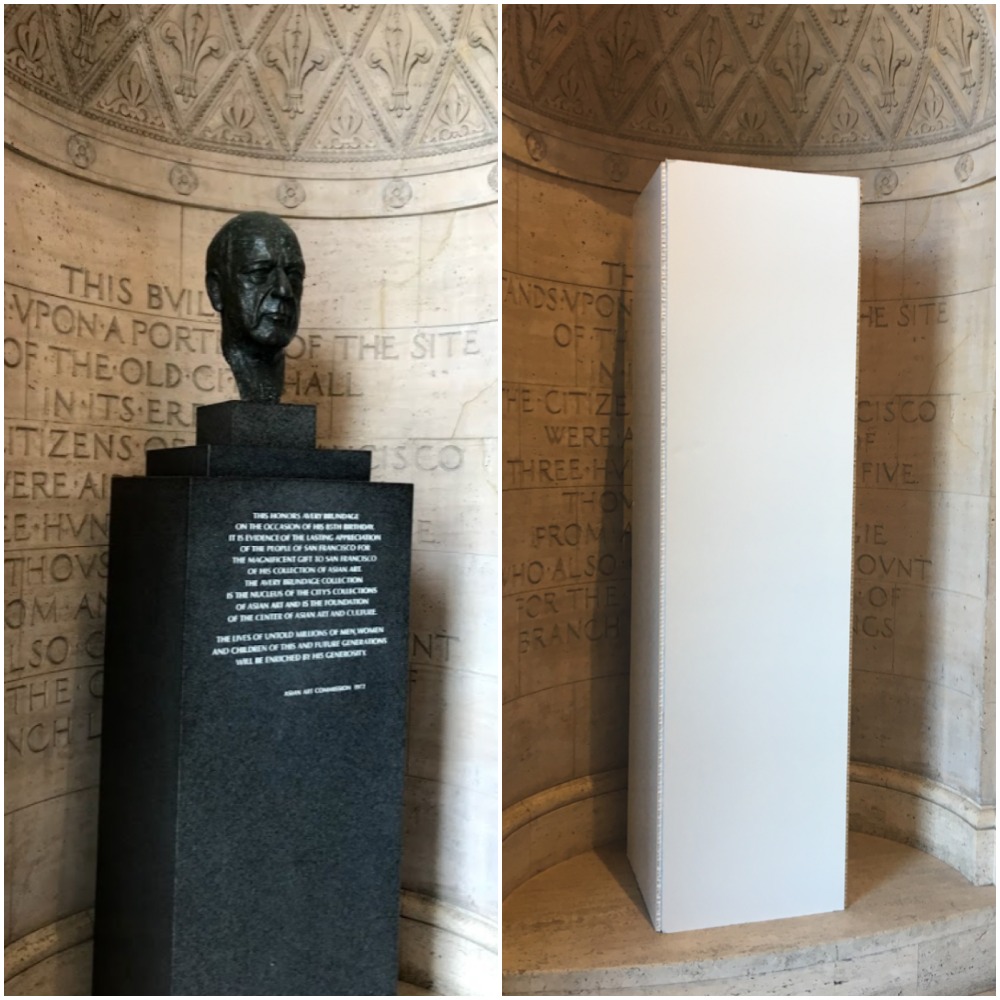
Facing increasing criticism surrounding Avery Brundage's well-documented antisemitic, racist, and sexist views, pervasive throughout his career, as well as questions around restitution, Dr. Jay Xu, director of the Asian Art Museum of San Francisco, advises the press that the museum plans to eventually move Avery Brundage's commemorative bronze bust, created by artist Jean Sprenger and on display in the museum's lobby, to “a discreet space” where the public can learn about museum's donor and “where the core of our collection came from.”
July 2020 The Asian Art Museum of San Francisco is formally notified that the U.S. attorney’s office is planning civil litigation to ensure the return of the plundered architectural lintel depicting Yama, the deity of the underworld illegally removed from Prasat Nong Hong and the plundered lintel depicting a deity or devata sitting over a Kala face that is disgorging garland from Prasat Khao Lon.
6 July 2020
The Asian Art Museum of San Francisco places a white box over Avery Brundage's commemorative bronze bust.
on/around 13 July 2020
The Asian Art Museum of San Francisco adds a sign by the covered bust of benefactor Avery Brundage, which reads:
August 2020 The Bangkok Post reports that according to the Thai Department of Fine Arts (DFA), the lintel depicting Yama, the deity of the underworld from Prasat Nong Hong and the lintel, depicting a deity or devata sitting over a Kala face that is disgorging garland from Prasat Khao Lon in the collection of the Asian Art Museum of San Francisco are predicted to be returned to Thailand in March 2021.
24 August 2020 The Thai Public Broadcasting Service (องค์การกระจายเสียงและแพร่ภาพสาธารณะแห่งประเทศไทย produces a documentary (in Thai) outlining the facts surrounding the stories of the contested lintels removed from Thailand.
22 September 2020
The Asian Art Museum of San Francisco releases a statement saying that the museum's board is noted to have begun the deaccession process for the lintel depicting Yama, the deity of the underworld from Prasat Nong Hong and the lintel, depicting a deity or devata sitting over a Kala face that is disgorging garland from Prasat Khao Lon. Note that this decision only seems to have moved forward four years after attention was drawn to their suspect status.
In its press release, the museum further stated: "The museum’s study found no evidence that these lintels were removed from their sites contrary to the laws of Thailand, but the museum was also unable to locate copies of the export documents that the laws of that time required. With this information in hand, the museum felt it was appropriate to begin the process of deaccessioning the artworks from the collection and to move forward with returning them to the Thai authorities."
8 October 2020 Ahead of the upcoming civil filing, lawyers from the Asian Art Museum of San Francisco sends a letter to the U.S. attorney’s office, indicating the museum's surprise over the government's plan for legal action and that the museum had previously stated that it“would prefer to return the lintels without litigation.”
In filing the complaint with the court, under Title 19, United States Code, Section 1595a(c)(1)(A) and Title 28, United States Code, Sections 1345 and 1355 it is believed that the lintels constitute merchandise that has been introduced into the United States contrary to law, as the property was stolen, smuggled, and/or clandestinely imported or introduced into the United States.
30 October 2020 Speaking with regards to the formal complaint in an Art Newspaper article, Robert Mintz, deputy director for art and programs at the San Francisco Asian Art Museum, contends that the process for repatriating both lintels was already underway prior to the civil complaint. Mintz tells the newspaper that “Deaccessioning requires two votes, separated by six months’ time,” indicating that this was the reason for the museum's apparently sluggish March 2021 date for potential restitution.
Mintz doesn't seem to recollect that the museum was first informally notified by the US authorities of the problems with these Thai artefacts in 2017, and after having been queried by the Royal Thai Consulate General in 2016. Time enough to have allowed the board to meet a minimum of six times to address the deaccession of these problematic pieces prior to the filing of the US Federal Complaint.
10 February 2021 The United States and the City and County of San Francisco enter into a settlement agreement signed by U.S. District Court Magistrate Donna M. Ryu, in which San Francisco consents to the forfeiture to the United States of the Lintel with Yama, the deity of the underworld, 1000-1080 (Lintel 1) and the Lintel, 975-1025. Northeastern Thailand, Khao Lon Temple, Sa Kaeo province (Lintel 2).
Upon the completion of the San Francisco Asian Art Museum’s deaccessioning process for the Thai lentils in March 2021, their repatriation to Thailand should move forward.
The Thai lintels, according to the agreement, will be returned to Thailand through the U.S. Department of Justice’s victim remission program. Upon their return, the lintels will be placed on exhibition for the religious and cultural appreciation of the people of Thailand.
25 May 2021
The Thai lintels depicting Yama, the deity of the underworld from Prasat Nong Hong and the lintel, depicting a deity or devata sitting over a Kala face that is disgorging garland from Prasat Khao Lon are handed over to Thai authorities in Los Angeles during a formal handover ceremony attend by Mungkorn Pratoomkaew, Consul-General of Thailand and carried out by Tatum King, Special Agent in Charge of Homeland Security Investigations in San Francisco.
The two Thai lintels are expected to fly back home via Korean Air and to arrive at Suvarnabhumi Airport in Bangkok, Thailand on Friday evening local time. Once back on Thai soil, they will be received by officials from the Fine Arts Department and then put on public display at the National Museum until July.


 Art Law Foundation,Fondation pour le droit de l’art
 No comments
 Art Law Foundation,Fondation pour le droit de l’art
 No comments