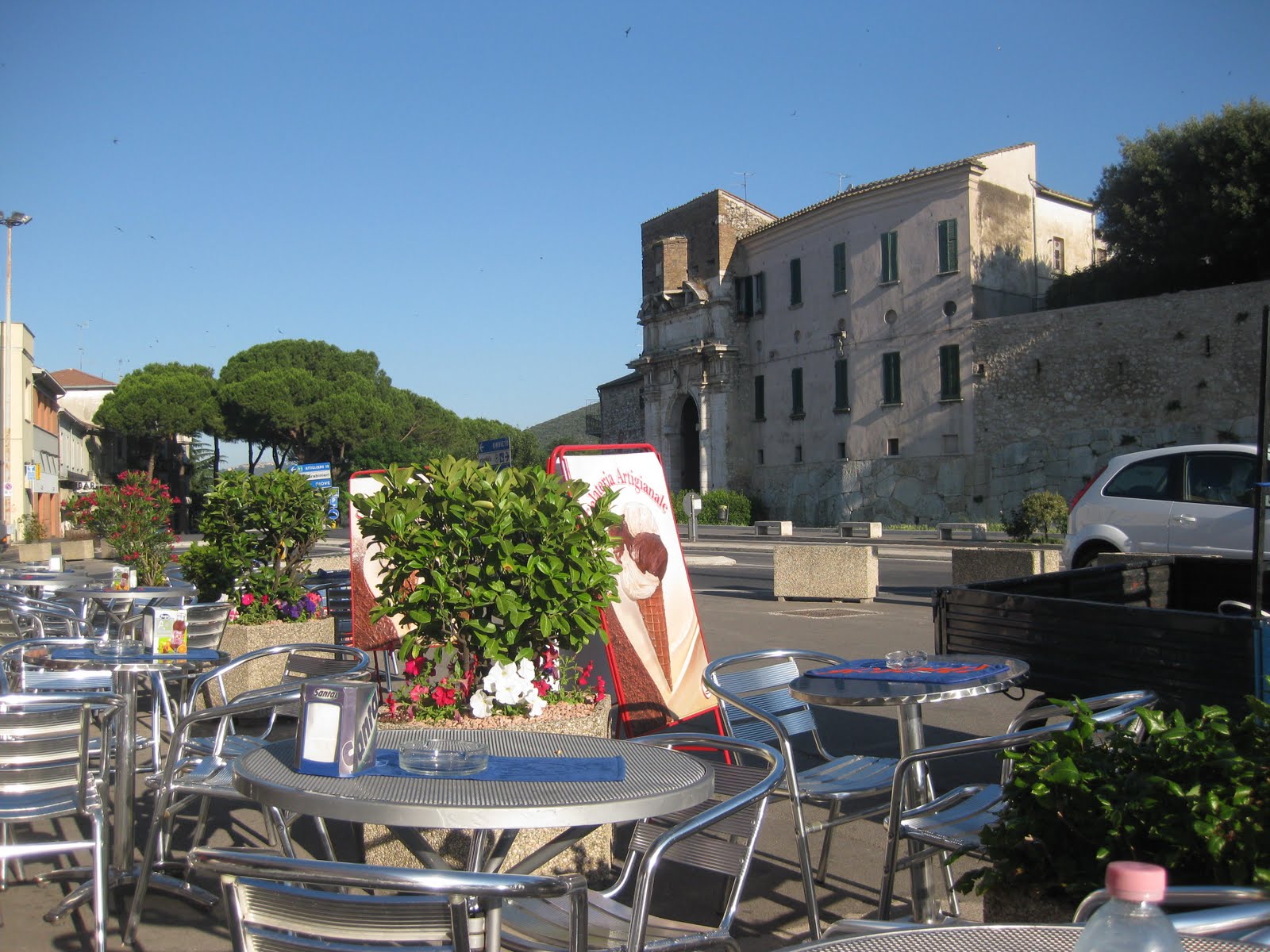
Amelia,Porta Romana,Via della Repubblica
No comments
Amelia, Umbria: A view from the Historic Center

Amelia,Porta Romana,Via della Repubblica
No comments

Amelia,pizza,Porcelli's,Valda
No comments


Amelia,La Misticanza,pizza
No comments


Amelia,Bar Leonardi,Luciano Rossi,Punto di Vino
No comments

Amelia,Bar Leonardi,Caffe Grande,Massimo's
No comments
adoration of the mystic lamb,all things considered,christmas art,Jan Van Eyck,most stolen painting,Noah Charney,Stealing the Mystic Lamb
No comments

art theft for scrap value,chillida,henry moore reclining nude,madrid art theft,madrid picasso theft,Noah Charney
No comments

On 29 November 2010, thieves stole a truck which was carrying what sources claimed was 28 artworks by the likes of Picasso, Chillida, Tapies, and Botero, worth at least 5 million euros. Three hooded men stole the parked truck from a warehouse in an industrial zone in Getafe, outside Madrid. The works were en route back to six galleries in Madrid and Barcelona, after having been on loan for display in Germany. The truck was not armored. It was recovered, empty, by police on 30 November 2010.
But ARCA can report exclusively thanks to knowledgeable sources in Madrid a series of different details and new facts related to the case.
Police in Madrid confirmed that there were in fact 35 works stolen, not 28. 34 of them have been recovered. The last work was not discovered along with the others, and no information as to its whereabouts has risen. Initial reports from Spain, after the air cleared on over-enthusiastic reports as to the value of the stolen art (originally touted by the media at 5 million euros), claimed that the 28 stolen works were valued at 2.7 million. It turns out that the media reports were accurate, despite though through a lucky estimate. The new tally of 35 stolen works are now valued by Spanish police at 5 million euros.
The police are keeping their investigation to themselves, choosing not to inform the media as they are still hunting for the thieves.
There was some concern that the sculptures stolen, among them a work in iron and bronze by Eduardo Chillida, might have been destined for the scrapyard. A string of theft in 2005 of objects, from artworks to garden ornaments, were disappearing from across England. The theme was that the objects were made of bronze or copper, the prices for which had quadrupled in the preceding months due to a shortage emerging from mines, particularly in China. Henry Moore’s Reclining Nude, a ten-ton abstract bronze sculpture, was stolen by local gypsies from the Henry Moore Estate in Hertfordshire, England in 2005, and has never been recovered—it is feared that it was chopped into pieces, melted, and sold for scrap bronze, perhaps for as little as 2500 pounds, when as an artwork it was insured at 10 million. Thieves would not be distraught by having “lost out” on 10 million—it would of course be all but impossible to shop, transport, and cash in on a ten-ton sculpture. Thieves would rather consider that they had “worked” (as in, stolen) for about a half an hour, and came away with 2500 pounds. This rash of thefts continued, and in locations as remote as Slovenia bronze objects and sculptures were stolen, only to be found sliced into segments, destined for the smelter. This technique, grotesque as it is, benefits the criminals in that it destroys any traceable evidence of the stolen object, while still allowing them to cash in, for however small a fraction of the total value. When gold sculptures by Bill Reid were stolen from the Museum of Anthropology in Vancouver in 2008, it was feared that the gold would be sold for scrap value—for this reason a reward was offered for the recovery of the sculptures, set at a higher value than the scrap metal, in an effort to delay the melting of the works. The ploy in that case worked out, as police captured a gang of jewelry thieves linked to international organized crime syndicates, and recovered the works.
Last month, 200 Spanish policemen raided a slum in southern Madrid, and arrested a slew of drug dealers and Romanian gypsies working for various criminal gangs. The target of the raid was several tons of copper, stolen from an AVE high-speed train.
The transport company responsible for the truck from which the art was stolen has never had an incident of this type in the last two decades, further suggesting a one-off inside contact aiding the thieves. Details of the recovery of the 34 stolen artworks have not been released, but the Madrid police said that they recovered the works when the Chillida sculpture was offered to a scrap metal merchant for 30 euros.
application,deadline
No comments
Art history,art world,Tom Flynn
No comments
Tom Flynn: The course aims to give students a thorough grounding in how the art market works and how its key institutions interact and relate to one another. The art market can often seem a somewhat mysterious and intimidating business environment with its own specific codes of communication and ways of conducting transactions and establishing price. The course sets out to dispel some of the myths and mysteries surrounding the rapidly globalizing market in an enjoyable way that will enrich and empower students in their future careers.ARCA blog: Does your course focus on particular subjects?
Tom Flynn: Yes, the course works its way through the main public and private institutions that make up the modern art market, offering a historical perspective on the market’s evolution as well as plenty of contemporary analysis. Through a series of intensive but lively and interactive teaching sessions, we explore the history of collecting, the evolution of museums, the emergence of the auction houses and the art trade in the eighteenth and nineteenth centuries, and the development of the contemporary art market. We also investigate the impact of technology on the art trade and art investment, how the art media works, and the importance of art fairs in the global market. Finally, we also touch on topical themes such as deaccessioning by museums, the repatriation of cultural objects, and the impact of the Artist’s Re-Sale Rights Levy.ARCA blog: How would you advise prospective students to prepare for your course?
Tom Flynn: A preliminary reading list is circulated in the weeks and months prior to the course and anything students can read from that list will be useful preparation for classroom discussion. I also urge students to try and visit at least one fine art auction sale before arriving in Italy and to stroll around the museums and art galleries in their home towns and cities, taking attentive note of how objects are exhibited and thinking critically about how business is conducted in those environments.ARCA blog: Tom, you’ve taught twice in Amelia with the ARCA program, what kind of a student do you think benefits from this program and what do you think they would get out of your class?
Tom Flynn: Any student with a genuine desire to learn will benefit from this course. I don’t expect students to arrive with specific knowledge of the art world as my course is designed to offer a grounding in the key issues. However, students who already have some experience of art and its markets will benefit from an opportunity to think in fresh ways about familiar ideas and to challenge their own preconceptions. In my first two years of teaching the course I’ve also noticed how students benefit from each other’s knowledge and experience, exchanging ideas in a relaxing, friendly and stimulating environment.
I hope that answers your questions. And you’ll notice I haven’t even mentioned the excellent local wine!
ArtGuard,conservation,Finald,icons,Noah Charney,Riika Köngäs
No comments

Riikka: I work as a head conservator in the Valamo Art Conservation Institute in Finland. We conserve paintings on wood and on canvas and are specialized on icon conservation. Our specialization is unique in Finland and in Scandinavia. We take commissions not only from the Orthodox church, but also other churches in Finland, from museums, insurance companies and works from private sources form perhaps half of our work load. Besides practical conservation, we do condition reporting to exhibitions and different art collections, give advice of preventing conservation and handling of art, and naturally give lectures about art conservation.
We are a small institute, but play a significant role in different European projects, from which the latest is a project called Icon Network. Within this project we set up an exhibition with theme “icons and war”, published a book supporting the theme and currently work partly with web pages to help people who are interested about icons.Noah Charney: What is the process, when you receive a commission of an icon to restore?
Riikka: Each icon is unique, and there is no straightforward way to restore an icon. Firstly, when talking about icon, we usually think about painting on flat wooden support. But there are icons painted on canvas, as well as on metal, I have even seen one painted on dried fish skull!Noah: You completed the ARCA postgraduate program in 2009. What did the program offer to you?
Normally our work starts with documentation. We have full-time research photographer working for us, so he photographs the icon, and if necessary, he can take ultraviolet and infrared photos, even x-rays. Then follows written documentation, which we carry on through whole process, writing down every step we do. So called “normal” process includes cleaning, stabilization of paint layer and restoration (painting) only if necessary. Each case has to be considered separately. For example, if an icon is from the museum, we hardly do any restoration at all. But if an icon goes to a church, or at private home, we usually do restoration. It would be rather difficult to concentrate on praying in front of this icon if half of the face was missing!
Riikka: It was terribly interesting, loaded with huge amount of information in short time, and it gave me a push to find out more about certain matters in illicit trade of art, and of icons. It assured me that the more we know about this dark side of art world and the more we educate ourselves, the more we can do to prevent these things happening. Finland is such a small country, but by no means a safe bird nest. The program gave me several ideas what to do next, and very importantly several good connections to turn to if I need advice.Noah: Tell me about your work since completing the ARCA program.
Riikka: Full speed rollercoaster! I took over the head conservators role after returning to work immediately after the course, and have been settling into that. Besides managing the institute, marketing, finding new projects, traveling around Finland from church to church, giving lectures etc etc, I do practical conservation as much as I can, since that is the part I enjoy tremendously. In June 2010 an icon was stolen from a cathedral in Helsinki, and one icon was damaged badly. I did conservation on this particular icon, and started discussions about the need to secure churches. This continues and hopefully with good results. We set up an exhibition in our monastery and did the security plan for it (using ArtGuard) and now I am planning next exhibitions. The plan is to have an exhibition with fakes and forgeries, co-operating with some museums and police. The process has been started already, and it looks splendid.Noah: What do you think are the greatest challenges facing the conservation world?
Riikka: Worldwide, there are so many challenges and demands to protect cultural heritage…Noah: There has been a recent debate about how much cleaning should be done on Jan van Eyck’s Ghent Altarpiece. Would you like to comment?
If I think only about my area of conservation, I almost see red when I meet today’s artists and see their work. I give many lectures trying to make artists understand the importance of good technique; it’s the matter of quality, not quantity. Just take a painting (or even icon) 100 years old, and it still looks more or less top quality. Whereas we are getting more and more badly prepared canvases or panels only 10-20 years old and already damaged. Education, education, that is the word!
Riikka: I am not very familiar with this case, but general rule I try to follow as much as I can is "less is more”, as I guess every conservator thinks. Making sure that piece of art will be there for next generations is the most important, not restoring it so that it looks like new. And this doesn’t mean treating the object only; it includes taking care of the surroundings as well. Cleaning is always a bit risky, especially when using detergents or solvents or new methods that haven’t been in use for long.