
Blog Subscription via Follow.it

February 24, 2011

ARTINFO reports Security Guard Stole Paintings from Corsican Museum for Ransom -- Only to Lose Them to Other Thieves



by Catherine Schofield Sezgin

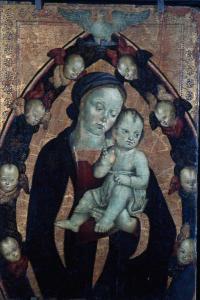
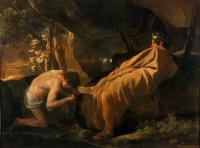
ARTINFO France reported today (Feb. 23) in an article, "Desperate Museum Guard Holds Renaissance Masterpieces For Ransom, Only to Have Them Stolen From His Car," that a security guard from Corsica's Fine Arts Museum in the Palais Fesch stole four paintings, submitted his ransom demand for housing through a local television station, and when he led police to his car, discovered that the window had been smashed and that the four paintings had been stolen from his car.

The security guard is a divorced father without a criminal record who was facing eviction from his apartment. ARTINFO reports:
Mocellini had served as a security guard some 20 years at Ajaccio's Fine Arts Museum, an institution known to have the second-largest collection of Italian paintings in France, surpassed only by the Louvre. When he finished his shift on Saturday morning, he absconded with one French painting and three Italian Renaissance works from the famed collection: Poussin's "King Midas at the source of the Pactole River," Bellini's "Virgin and Child," Mariotto di Nardo's "Pentecost," and an anonymous Umbrian artist's "Virgin and Child."
The Palais Fesch musée des beaux-arts, which reopened in June after a two-year 7 million euro renovation, houses one of France's most important art collections, second to the Louvre in Italian paintings. The four paintings, like most of the collection, were once in the Rome collection of Cardinal Joseph Fesch, one of the most important art collectors of his generation (1763-1839) and a Bonaparte supporter. During Fesch's lifetime, he owned 16,000 paintings, mostly Italian Renaissance paintings, and donated many works to his native city of Adjaccio upon his death.

Unfortunately, each of the stolen works was the museum's sole representation of that artist at the Adjaccio museum. Nicholas Poussin's "King Midas at the Source of the Pactole River" is a 17th century French oil on canvas measuring 58 x 82 centimeters; Giovanni Bellini's "Virgin and Child" is a 15th century tempura on wood measuring 65 x 46,5 centimeters; Mariotto di Nardo's "Pentecost" is a 15th century tempera on wood measuring 47 x 28 centimeters; the "Virgin and the Infant in the glory of the seraphins" by a 16th century Umbrian painter is a tempera on wood measuring 53 x 34 centimeters.

Photos: Clockwise: Poussin's "Midas"; Anonymous Umbrian Painter's "Virgin and the Infants in the glory of the seraphins"; Bellini's "Virgin and Child"; and Mariotto di Nardo's "Pentecost"; lower right is the Fresch Palais in Adjaccio, Corsica.

February 23, 2011

The Journal of Art Crime: Noah Charney on "The Art We Must Protect: Top Ten Must-See Artworks in Belgium"

In the fourth issue of The Journal of Art Crime, ARCA founder Noah Charney writes about "The Art We Must Protect: Top Ten Must-See Artworks in Belgium."

Mr. Charney proves history and context for the following artworks: Jean Fouquet's "Madonna and Child" at the Koninklijk Museum voor Schone Kunsten (Royal Museum of Fine Arts) in Antwerp; Hugo van der Goes' "Death of the Virgin" at the Groeninge Museum in Bruges; Jan van Eyck's "The Ghent Altarpiece" at the Sint Baafskathedraal (St. Bravo's Cathedral) in Ghent; Peter Paul Rubens' "The Raising of the Cross" at the Onze-Lieve-Vrouwekathedraal (Cathedral of Our Lady) in Antwerp; Hans Memling's "Shrine of St. Ursula" at the Memling Museum in Bruges; Hieronymous Bosch's "Christ Carrying the Cross" at the Ghent Museum of Art, MSK Ghent; the Palais Stoclet in Brussels designed by Josef Hoffman and Gustav Klimt; Rene Magritte's "Empire of Lights" and Jacques-Louis David's "Death of Marat" at the Royal Museum of Art in Brussels; and Paul Delvaux's "Nos Vieux Trams Buxellois" at the Bourse Metro Station in Brussels.

In his column on February 3, 2011, "The Secret History of Art" for ARTINFO, Noah Charney highlights Fouquet's "Madonna and Child".

To seek out this piece, and many others, consider a subscription to the Journal of Art Crime—the first peer-reviewed academic journal covering art and heritage crime. ARCA publishes two volumes annually in the Spring and Fall. Individual, Institutional, electronic and printed versions are all available, with subscriptions as low as 30 Euros. All proceeds go to ARCA's nonprofit research and education initiatives. Please see the publications page for more information.

February 22, 2011

Conservator Riikka Köngäs Tells the Tale of the Stolen Icon of the Mother of God of Kozeltshan and of its Recovery from the Ground

by Riikka Köngäs, Head conservator
Valamo Art Conservation Institute

On June 9, 2010, thieves broke into the Finnish Orthodox Church’s Uspenski Cathedral in Helsinki, the largest Russian Orthodox Church in Western Europe. The alarm went off at 2.16 a.m. By the time security arrived at the cathedral less than 15 minutes later, the thieves were gone, along with one of the spiritual treasures of the Finnish Orthodox Church, the icon of the Mother of God of Kozeltshan and pearls and other jewels worshippers had gratefully draped around the icon in gratitude for answers prayers.

Early in the 20th century, St. John of Kronstadt in St. Petersburg had given this icon of Panagia to a wealthy Russian family in Finland who told them to say a prayer in front of the icon for their daughter’s recovery from an illness. When the miracle of health occurred, the girl’s mother donated the icon to a church and the continued decoration of precious jewels signified additional miracles.

Thieves had also damaged another icon, breaking the protective glass around it, tearing away the decoration made of pearls, throwing them on the floor, and stealing its metal halo with precious stones. Apparently this icon was saved because of its size; it must have been too large for thieves to take with them.

The damaged icon of St. Barbara was brought to me for conservation treatment few days later. Luckily, the damages were not too serious, but the halo was missing.

Police were very doubtful that the icon of Mother of God of Kozeltshan could ever be found, assuming it had been taken away from the country immediately.

In the autumn of 2010, the Uspenski Cathedral had unpleasant visitors again. Due to fast action by the police and security, this time the thieves were caught before they could steal anything. Later, one of these men, a Romanian, was found guilty in the June theft and sentenced to prison for two and half years and required to pay compensation of 180,000 euro. Months later, he decided to confess what he had done with the icon. The police said he must have had a bad conscience, since his confession would not reduce his sentence.

On Monday, February 8, 2011, I received a phone call that nearly threw me off my chair. The police told me confidentially that they knew the location of an icon that had been stolen eight months earlier. They asked for advice on how to treat the icon, since it is likely buried in the ground. I could hardly believe what they told me, advised them on how to handle the icon, and received a promise that they would let me know what happened as soon as possible.

The next day, the police called me again, this time they were on the spot, they had dug in the snow and found the icon in the ground, and asked me what to do next. When I heard that the icon was there without any kind of protection, that picture side was towards the ground, my heart jumped to my throat. What is left from an icon after it has spent six or eight months buried in the ground? I flew immediately to Helsinki to see the icon and to take it to our conservation department.

My first sight of the icon made my hands shake, literally. A very strong smell of wet ground rose from the icon. It was covered with leaves, twigs, sand, and dirt. The icon had become a home for all sorts of insects and worms. What struck me was how the faces seemed to be so clean, almost glowing, in the middle of all that dirt, and how well the icon looked despite its fate.

Two weeks have passed now, and every morning, when I take the icon from the cold storage, where it spends most of its time at the moment, and open the box, I feel the same amazement. The odor of wet dirt still overwhelms me when I open the box. The initial cleaning has been completed, but the most important thing is to wait and have patience to allow the icon to dry. This process takes weeks, if not months, since the drying-process must be very slow so that the wood does not get any more damaged from fast drying. If the wooden ground gets damaged, the paper layer of the painting will get damaged as well. To prevent the icon from drying too fast, the icon is stored in a cold storage, letting it breathe for a couple of hours daily. During these hours I am able to document the icon, and get more knowledge about the damages, and make plans for conservation. Patience is needed at this point, lots of it.

Editor's Note: Readers can look at more photos on Riikka's blog at http://www.valamo.fi/fi/konservointi/konservointiblogi.html.

The Journal of Art Crime: Patricia Kennedy Grimsted on "Reconstructing the Record of Nazi Cultural Plunder"

Dr. Patricia Kennedy Grimsted most recent publication, Reconstructing the Record of Nazi Cultural Plunder: A Survey of the Dispersed Archives of the Einsatzstab Reichsleiter Rosenberg (ERR), will soon be launched on-line by the International Institute of Social History (IISG/IISH) in Amsterdam . Issued in association with the Netherlands Institute of War Documentation (NIOD), with generous support of the Conference on Jewish Material Claims Against Germany (Claims Conference) it describes the archival remains of the ERR in 29 repositories in 9 countries – from Washington and Brussels to Moscow and Kyiv.

Dr. Grimsted’s article “The Postwar Fate of Einsatzstab Reichsleiter Rosenberg Archival and Library Plunder, and the Dispersal of ERR Records,” appeared in the fourth issue of The Journal of Art Crime.

As Dr. Grimsted writes, “The Einsatzstab Reichsleiter Rosenberg (ERR), the ‘Special Task Force’ headed by Adolf Hitler's leading ideologue Alfred Rosenberg, was one of the main Nazi agencies engaged in looting cultural valuables in Nazi-occupied countries during the Second World War. The detail with which the ERR documented the art, archives, books, and other Judaica they plundered has proved essential for the recovery of cultural valuables after the war and their return to victims or heirs.”

Dr. Grimsted's new extensive international survey serves as a preliminary guide to documents generated by the ERR as well as records by postwar agencies seeking to return the ERR loot. Links are provided to many dispersed materials now available on the Internet or in microform. These include the recent efforts of the U.S. National Archives and Records Administration (NARA), the German Federal Archives (Bundesarchiv), and other repositories, with additional digital contributions expected soon, providing improved access to a major component of the record of wartime cultural plunder and retrieval.
A discussion with Dr. Grimsted about her article, "The Postwar Fate of einsatzstaf Reichsleiter Rosenberg Archival and Library Plunder, and the Dispersal of ERR Records", published in the same issue can be found on the ARCA blog on January 31.

Currently, Russian museums are withholding art previously scheduled for travel to the United States for exhibitions due to a conflict over books and archives from a Jewish library now held in Russia. The Schneerson Library of 12,000 books assembled by the Chabad-Lubavitch Hasidic movement over two centuries was nationalized after 1917 and is held today in the Russian State Library in Moscow. Their related collection of 50,000 religious documents taken to Poland prior to World War II was stolen by the Nazis, and then found by the Soviet Army and taken to Moscow, where it has been held in secret for decades in the Soviet Union.

To seek out this piece, and many others, consider a subscription to The Journal of Art Crime—the first peer-reviewed academic journal covering art and heritage crime. ARCA publishes two volumes annually in the Spring and Fall. Individual, institutional, electronic and printed versions are all available, with subscriptions as low as 30 Euros. All proceeds go to ARCA's nonprofit research and education initiatives. Please see the publications page for more information.