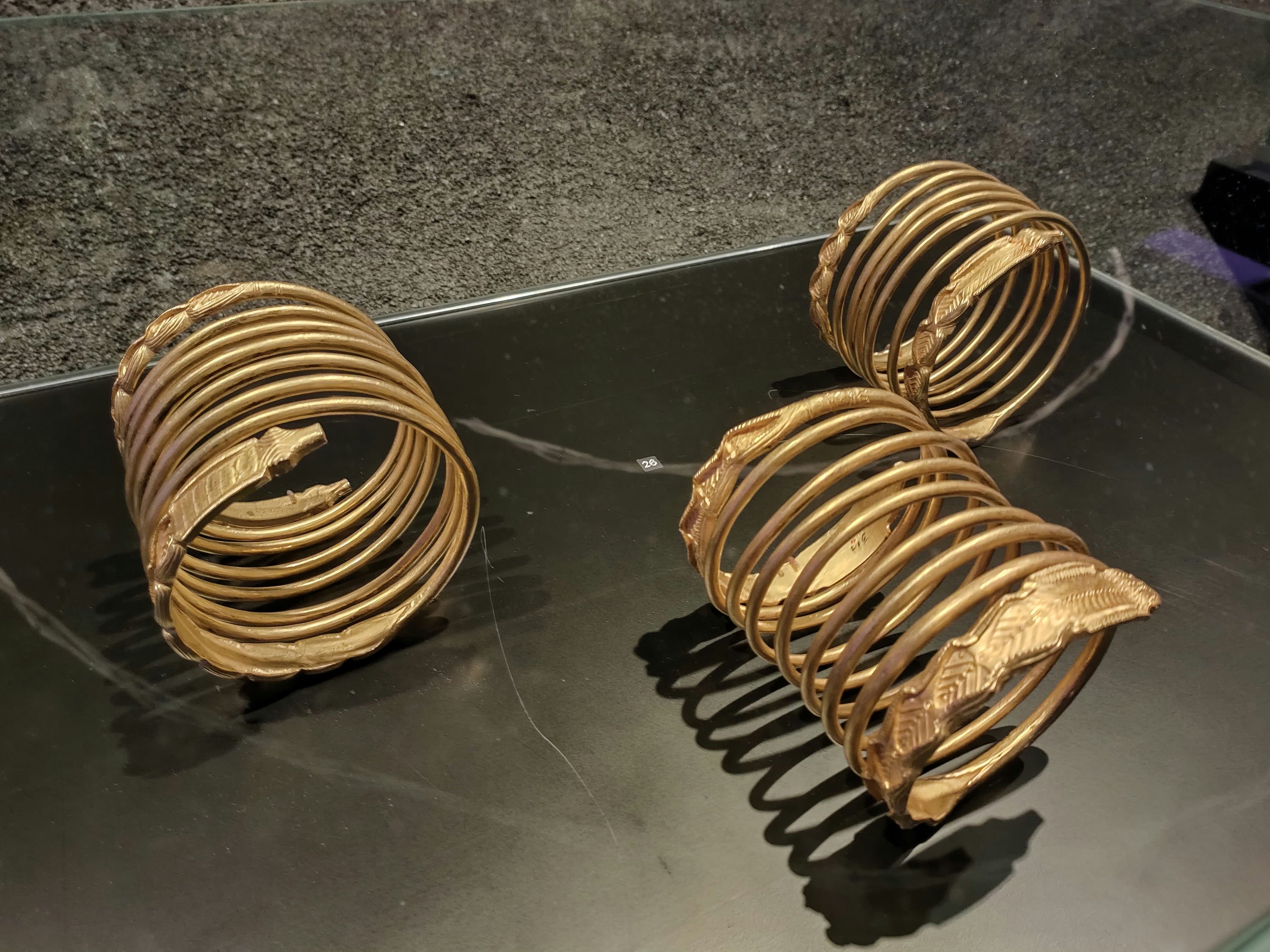
Thieves have struck the Museo Arqueológico Municipal de Villena, known as MUVI, in Alicante province, targeting the Treasure of Villena.
Initial reports indicate that the museum's prehistoric gold assemblage had been taken from the museum in an early morning raid on Thursday. Initial reports indicate that the museum's prehistoric gold assemblage had been taken from the museum following a diversion. At 05:16 local time, an alarm went off at the local sports centre on the other side of town, sending police there first. Investigators believe it could have been a diversion, given the chronology of events.
The museum's own alarm sounded at 5:20 a.m., and the Alicante Command received a call from the museum's security company reporting that the alarm had been triggered at 5:23 a.m., on the only day of the week when museum is closed to the public.
The thieves successfully left the museum by 5:24 a.m. before officers arrived.
At the time of writing, few operational details have been released.
It is not yet known the total number of objects removed, or whether the thieves targeted the collection after conducting prior surveillance. Spanish authorities have also not publicly confirmed whether every component of the treasure was taken.
What is known is that the thief or thieves gained entry by smashing an access window located in the museum's small square, and carried out the burglary in under four minutes, a timeframe that would have hampered any immediate intervention. What is also clear is the extraordinary scale of the potential loss. This was not simply the theft of a group of valuable gold objects. The Treasure of Villena is one of the most important surviving assemblages of prehistoric metalwork in Europe and the defining archaeological collection of the city whose name it bears.
Dated to the Late Bronze Age (approximately 1000 BCE), the Treasure of Villena was discovered in December 1963 by archaeologist José María Soler García and his team. The objects had been placed inside a ceramic vessel and concealed in the bed of a ravine near Villena. Whether the deposit represented the possessions of an elite individual, ceremonial wealth, metal reserved for a craft specialist, or objects hidden during a period of insecurity isn't clear.
The assemblage comprises 59 distinct objects, represented by a total of 66 individual components, weighing approximately 9.75 kilograms. Most are made of gold.
The historic hoard includes 11 bowls, 28 bracelets, gold and silver vessels, several fittings and fragments, an amber and gold button, an iron bracelet, and an elaborate fitting combining iron and gold.
The gold bowls constitute an unparalleled grouping within the Bronze Age archaeology of the Iberian Peninsula. Made from hammered sheet gold, several are ornamented with geometric patterns produced by working the metal from the reverse. The 28 bracelets are equally significant, both for their combined weight and for the variations in their construction and decoration.
The treasure’s importance, however, extends beyond the quantity of gold it contains. Its combination of gold, silver, amber, and iron provides evidence of technological knowledge, exchange networks, social hierarchy, ceremonial behaviour, and the movement of rare materials between groups at the end of the Bronze Age. Two of the iron components have attracted particular scholarly attention because scientific analysis indicates that they may have been made from meteoritic iron at a time before iron smelting became widespread in the Iberian Peninsula. Iron of this kind would itself have been an exotic and prestigious material, rather than the commonplace metal it later became.
The Museum describes the assemblage as one of the foremost examples of prehistoric goldwork in Europe. In terms of the quantity and character of its gold vessels, it is frequently compared with the celebrated finds from the royal graves at Mycenae (Greece). Its significance cannot therefore be expressed through bullion value or an insurance figure but rather by its place in historical records. If the objects are separated, damaged, or melted, the resulting loss will be archaeological, scientific, historical, and communal.
The Villena theft follows a troubling succession of robberies in which gold objects have been deliberately selected from European museum collections. There is presently no evidence that these incidents are connected or were committed by the same criminal organisation but the targeted similarities are worth exploring. Collectively, this series of recent museum break-ins demonstrate the heightened exposure of museum collections containing gold, jewellery, coins, and other objects that can be rapidly broken down to the base sum of their parts.
In January 2025, thieves used explosives to enter the Drents Museum in Assen, the Netherlands, stealing the fifth-century BCE Helmet of Coțofenești and three ancient Dacian gold bracelets loaned by Romania’s National History Museum. The helmet and two bracelets were subsequently recovered, but one bracelet remained missing as of the latest museum updates. The objects were archaeologically and nationally significant, yet their material presented the disturbing possibility that they could be melted if recovery efforts failed.
In September 2025, thieves broke into the Gallery of Geology and Mineralogy at France’s Muséum national d'histoire naturelle in Paris and stole native gold specimens reportedly valued by weight at approximately €600,000. Their scientific value was much greater. These were naturally occurring mineral specimens, each preserving evidence about its geographical origin and geological formation. Once melted, that information would be permanently destroyed.
The following month, the Louvre was robbed during opening hours as thieves entered the Galerie d’Apollon, smashed display cases, and took eight surviving pieces of French royal and imperial jewellery. A ninth object was dropped during their escape.
One month later, in November 2025, two men reportedly purchased admission tickets to the Musée romain de Lausanne Vidy in Lausanne, waited until other visitors had departed, overpowered and restrained a security guard, smashed a display case, and escaped with several dozen Roman era gold coins were stolen during an opening hour robbery. The coins possessed archaeological significance beyond their monetary or metallic worth, but their small size and fungible material again made them particularly vulnerable.
Spain had already suffered a major gold-related museum theft on 25 April 2026. Intruders broke into the Provincial Archaeological Museum of Badajoz and stole 144 of the 149 gold coins comprising the grouping known as the Villanueva de la Serena Treasure. Minted between 1772 and 1822 at mints across the former Spanish Empire, the coins included examples from the reigns of Charles III, Charles IV, and Ferdinand VII, and documented political authority, trade, currency circulation, and the historical connections between Spain and its overseas territories.
On 24 July 2026, two thieves posing as ordinary visitors stole the celebrated Vix gold torc from the Musée du Pays Châtillonnais in Châtillon-sur-Seine, France. Dating from the fifth century BCE, this torc came from the richly furnished burial of an elite Celtic woman discovered at Vix in 1953. Its craftsmanship and Mediterranean-influenced imagery offered important evidence of contact between communities in Iron Age central Europe and the Greek world. The thieves reportedly broke its display case during visiting hours and carried the object out through the museum’s entrance.
Gold as material and vulnerability
Gold has always attracted thieves, but the current threat is sharpened by the combination of high metal prices, the portability of many museum objects, and the difficulty of tracing gold once it has been melted. Unlike a painting or monumental sculpture, a recognisable gold object, later stolen, can be transformed into an anonymous material relatively quickly. Jewellery can be dismantled, gemstones can be removed, coins dispersed, and ancient vessels reduced to bullion.
This week's Europol assessment of changing museum-heist tactics identifies gold, jewellery, precious stones, and other easily marketable objects among the materials increasingly targeted by offenders. Europol also warns of more aggressive methods, including the use of sledgehammers, axes, explosives, physical violence, and threats against museum personnel.
All this, however, does not mean that every recent robbery forms part of a single organised campaign. Nor should the thefts automatically be attributed to sophisticated international art traffickers. Some perpetrators may be experienced property offenders attracted principally by the recoverable material value of the objects, rather than collectors or specialists seeking particular works of art.
That said, this distinction offers little comfort. A thief who understands an object’s cultural importance may attempt to sell or leverage it. A thief interested only in its constituent material may liquidate it.
If these earlier thefts have not already, the theft of the Treasure of Villena should prompt Museum Security Managers to immediately review of the protection afforded to collections containing precious metals, particularly in smaller and regional museums. Security planning cannot depend solely upon cameras, alarms, or the apparent strength of an individual display case as these rapid fire daytime thefts and nighttime burlaries prove. Institutions need object-specific risk assessments, tested alarm and police-response procedures, careful management of keys and access points, trained personnel, adequate overnight protection, as well as clear protocols for responding to suspicious behaviour and hostile reconnaissance.
Museums must also e xamine whether existing display arrangements reflect the changed threat environment. The answer cannot simply be to remove every important original from public view. Museums exist to preserve, interpret, and share cultural heritage, especially objects t hat explore our understanding of the past. Nevertheless, where the consequences of loss would be catastrophic, the continued display of an original must be supported by protection proportionate to its significance and vulnerability.
The Treasure of Villena survived for approximately three thousand years because someone concealed it in the landscape and because it remained undisturbed until its archaeological discovery in 1963. For more than six decades, it was preserved as a coherent group and made available for research and public understanding.
Gold can be weighed and priced. The historical evidence embodied in the Treasure of Villena cannot.


 Gold,Museo Arqueológico Municipal de Villena,Museum thefts,Spain
 No comments