Blog Subscription via Follow.it

Showing posts with label Libya. Show all posts

January 7, 2026

Boris Vervoordt’s TEFAF Appointment Sparks Debate on Leadership, Influence, and Problematic Art

Axel Vervoordt Co is a family-led business.
Boris (left) and Axel (right).Image Credit: TEFAF

In a surprising turn for the international art fair circuit, Dominique Savelkoul  stepped down as Managing Director of the European Fine Art Foundation, (TEFAF), at the end of December in what was described by the foundation this week as "differing views on the strategic direction."  This marks the second leadership change in just over one year at one of the world’s largest fair providers for fine art, antiques, and design, covering 7,000 years of art history.

TEFAF confirmed this week that, Boris Vervoordt, one of the sons of Belgian art and design dealer Axel Vervoordt, and a driving force behind his father's influential Axel Vervoordt Co, has been named chairman since 1 January 2026 and that the fair's executive committee members will each take turns leading the foundation for a period of six months. Vervoordt is the first non-Dutch chairman to steer Europe's prominent art foundation and on paper, brings visibility, experience, and an enviable network of ultra-high-net-worth clients to the foundation's annual New York and Maastricht fairs.  

Well known in the art world for cultivating an enviable black book of high-profile collectors and luxury tastemakers, Vervoordt arrives to TEFAF's management with deep familiarity of the fair’s culture and commercial ecosystem having been a participant from the fairs beginnings. Active in the international world of art, design, and antiques since the late 1960s, the family of Belgian art dealers have sold everything from Egyptian marble bowls, to contemporary Japanese paintings and Le Corbusier armchairs.

In it's current iteration, Axel Vervoordt Co, was founded in Belgium in 2011 (and in Hong Kong in 2014). Their  art gallery, arts and antiques trading organization, interior design and real estate development divisions are headquartered, since 2017, outside Antwerp, at an industrial complex known as Kanaal.  Part gallery, part exhibition space, Vervoordt's showcase institution is housed in a former malting distillery and malting complex built in 1857 on a shipping canal leading to the port of Antwerp, though many Vervoordt-held companies are registered elsewhere. 

Over several decades, Axel and Boris Vervoordts' clients have included Bill Gates, Calvin Klein, Mick Jagger, Givenchy, Calvin Klein, Ralph Lauren and Sting and his wife, Trudie Styler. But their brand extends beyond the art market into interior design, with widely publicised commissions for minimalist fusions of East and West, have been developed for petroleum heiress Betty Gertz in Texas, actor Robert De Niro’s TriBeCa penthouse in New York, and Kanye West and Kim Kardashian's home in the Hidden Hills neighbourhood of Calabasas in California to name a few. 

Vervoordt has also been connected to the interior redesign of a listed villa in Cap d’Ail on the French Riviera associated with shell companies tied to sanctioned 
Russian telecoms oligarch Sergei Nikolaevich Adonev, whose vast financial empire and holding companies have been identified as receiving investment and support from various figures linked to the Kremlin and Vladimir Putin.  These high-end affiliations underscore the breadth of the Vervoordt network, but also highlight the degree to which the family's businesses have profited in proximity to politically exposed or controversial figures.

Rostec boss Sergei Chemezov, Vladimir Putin and multi-millionaire Sergei Adonyev

A Pattern of Troubled Objects

While the Vervoordt name carries clout among the Who's Who in the art world, the family firm can also been linked, in several documented instances, to objects  identified as stolen, looted, or connected to problematic provenance histories, a few of which our outlined here.  Taken individually, these cases reflect the complexities of the art and antiquities market. Viewed together, they reveal a pattern that raises questions about whether Vervoordt's commercial considerations at times superseded rigorous vetting and the ethical stewardship expected in handling the world’s cultural patrimony.

In the 1980s Axel Vervoordt purchased the floor you see in this photo of his library at 's-Gravenwezel castle, the medieval fortress surrounded by 60-hectares of park land he calls home. After the parquet de Versailles floor was restored and published in the October 1986 issue of Architectural Digest, French authorities informed him that the flooring had been stolen from a French château.

Later, in March 1998, at a time when the art world's big players paid little attention to whether an artwork offered for sale could have been stolen during the Second World War, Axel Vervoordt brought the painting Sumptuous Still Life with Lobster, Oysters, Silvergilt Covered Beaker, Silver Mounted Kendi Wine Flask and Glassware by Pieter Gerritsz van Roestraten, (21 April 1630 – 10 July 1700), a Dutch Golden Age painter, apprenticed to Frans Hals to TEFAF's fair at the MECC Exhibition and Convention Center in Maastricht. 

Its provenance, stated:

"Doweswell, circa 1900; A. Schloss Collection, Paris; Private Collection, Belgium"

Remarkably, neither the Vervoordt gallery, nor their buyer raised any eyebrows. 

This despite the fact that the painting is recorded in publicly available wartime asset lists as having been taken during World War II from the renowned Schloss Collection, assembled by Adolphe Schloss—a German-Jewish collector whose family holdings, including more than 300 paintings were seized during the Nazi occupation. Documentation related to the Schloss seizure, including official French postwar recovery reports and international claims lists, identified the still life among the numerous works looted from the Schloss family collection. 

The French Ministry of Foreign Affairs even stated where the then holder of the Van Roestraten painting as: "Private collection, Belgium. Castle of 's-Gravenwezel,  the six-story castle home Axel Vervoordt shares with his wife May in Belgium. Deflecting from its non pristine past, Vervoordt sold the painting at the Maastricht fair along with the silver matching ewer which is depicted in the artist's work.  The painting sold for $800,000 to an unnamed European private collector.

Again, not shying away from World War II sensitivities, in 2011,  Le Monde, art critic and correspondent Philippe Dagen reflected on an exhibition curated by Axel Vervoordt at the Palazzo Fortuny in Venice. He noted that while the inaugural Artempo show had been widely admired, and its successor In-Finitum had leaned heavily into a lavish presentation of works associated with Vervoordt, the Belgian's third installment, TRA, included an absurd work by Cuban artist Tania Bruguera: a heavy iron sculpture emblazoned with the phrase: Arbeit macht frei, translated as "Work makes [one] free." 


Following the rise to power of the the National Socialist German Workers' Party in 1933, this phrase was posted above the entrances of several Nazi concentration camps, including Auschwitz.  According to Dagen, the piece appeared without contextual explanation, leaving visitors to encounter one of the Holocaust's most charged symbols of the twentieth century with no curatorial framing.  This absence of interpretation, he suggested, contributed significantly to the discomfort surrounding the exhibition’s presentation. 

Leaving aside the Second World War, the Vervoordt family has also handled antiquities which can be traced to problematic origins. By 2014 Dr. Morgan Belzic, a leading researcher in conflict antiquities originating from Libya had  identified Vervoordt's firm as having advertised a suspect Greek Hellenistic head (Belzic D.16) which was said to come from a "Private collection F.B., Barcelona, ca. 1970; Private collection, Europe, before 1970." 

Those familiar with Belzic's work on identifying stolen artefacts from Cyrenaica,  the region in North Africa located between Roman Egypt and Tripolitania; today it is part of Libya know that his identifications have lead to restitutions, some of which have been discussed on ARCA's blog.  Often, that same research, in favourable jurisdictions, has resulted in restitutions of cultural property to Libya. Note that the absence of a face, or aprosopy, remains without real parallel in any other location in the rest of the Mediterranean world. Likewise, this object's first appearance in circulation on the international art market coincides with the Second Libyan Civil War (2014–2020), which marked a large uptick in material appearing on the art market from illegal digging around Cyrene, near Shahhat, during the country's instability.

Also in 2014, Vervoordt's firm brought a first century BCE South Arabia (Yemen) alabaster Relief of a Male Figure with Elaborate Hairdo and Horns to TEFAF's Maastrich fair.  For that event, the gallerist listed the object's provenance as: "Ancient collection Belgium, acquired in 1940; Ancient collection M. Abdalla Babeker, Sudan, acquired between 1917 and 1930."

It should be noted that "M. Abdalla Babeker" has been identified as a false-collector name which has come up in provenance records linked to stolen artefacts from Sudan circulated and sold by Jaume Bagot, of J. Bagot Arqueología in Barcelona.  That problematic Catalan dealer, frequently discussed on ARCA's blog, is known for having handled stolen Egyptian shabtis of the Pharaoh Taharqa and Senkamanisken which were illegally exported out of North African country and sold onward in the European ancient art market with this same Babeker provenance.

In 2016 Kayne West visited Vervoordt’s stand at TEFAF in Maastricht ahead of the design firms work on the California mansion he shared with his then-wife Kim Kardashian.  According to U.S. Court documents filed in California, an 11 March 2016 invoice made out by Vervoordt's firm to Noel Roberts Trust, listed the sale of a well worn artefact referred to as "Fragment of Myron Samian Athena."   

This object was seized by US Customs and Border Protection at the Los Angeles/Long Beach Seaport on 15 June 2016 as part of a 40-item shipment weighing more than 5 tons collectively valued at over $745,000.  A form submitted by a customs broker lists the importer and consignee of the items as "Kim Kardashian dba (doing business as) Noel Roberts Trust," an entity linked to Kim Kardashian and Kanye West’s US real estate purchases.

That same Roman sculpture was photographed at Vervoordt's booth in TEFAF by the Italian Carabinieri on 21 March 2011
 as well as next to a second suspect object from Cyrenaica photographed at Vervoordt's  Kanaal exhibition space the following year. 

Nowadays, Vervoordt's family brings fewer pieces of ancient art to their TEFAF fair booth, opts more often than not for contemporary paintings, minimalist furniture and Wabi Sabi artworks, a hat tip to the Japanese philosophy that finds beauty in imperfection.

Even so, the few that have been displayed still come from questionable backgrounds, just far enough removed from their illicit circulation as to make them untouchable by Dutch law.  Take for example this 11th century CE sandstone Khmer Figure of a Male Deity on sale at Vervoordt's Maastrich stand in 2023 or the 13th - 14th century sandstone head of Buddha in Lopburi style the family brought in 2025.  


Both ultimately trace back to decades-old transactions involving a corrupt Chinese-Thai antiquities dealer named Peng Seng, also known as Arthorn Sirikantraporn.  Based in Bangkok, Seng was a well-known supplier of artefacts of murky origins, many transiting through France and the UK.  He was known to have worked closely with indicted dealer Douglas Latchford, (1931–2020), as well as Robert Rousset, (1901-1981), of Compagnie de la Chine et des Indes, the dealer in France both of these pieces were shipped to once purchased for the European market.


A letter, mentioned in the 2019 US Federal indictment against art dealer Douglas Latchford and later reported in an article published by the the Australian Broadcasting Company, describes perfectly, how Seng and Latchford agreed to work together to fabricate provenance so plundered material from southeast Asia could be whitewashed into the licit market in London, clearly circumventing source country  cultural property laws. 

That letter, written by a representative from the auction house Spink & Son, casts doubt on the legitimacy of hundreds of items sourced by Seng in the 60s and 70s and later sold  to private collectors, galleries, and museums around the world. 

It read, in part:

"I would consider my visit there most successful. The financial situation being what it is, I was anxious to spend as little money as possible in purchases and get as many pieces on consignment as possible. I am glad to say it worked out better than I expected."

"I bought a beautiful Baphuon female torso from Peng Seng for $ 13'000, a small, but exquisite Baphuon head from Chai Ma for $ 2'000 and four pieces from Douglas Latchford for $ 20'000. These Bangkok purchases, together with a vase from Mayuyama, $ 8'500, bring the grand total of my purchases on this trip to $ 43'500."

"The greater part of my time in Bangkok was spent in numberous [sic] meetings with our friend Douglas, I am getting the following two important pieces on consignment:(they are supposedly already on their way)."

"Pre Angkor Hari Hara, about 35", supposedly recently excavated in Cambodia near the South Vietnamese border, It is a great piece. The selling price will be $ 300'000 or over, still to be decided upon with Latchford."

"Large Koh Ker female torso; another very beautiful and important piece, selling price $ 100 000 or more, to be determined still."

"Douglas has the following 3 bronzes which at this time he is not ready to give me yet, but which I am sure will come in the very near future."

"I have explored extensively with Peng Seng and Latchford how to get legitimate papers for the large Koh Ker guardian and for all subsequent shipments. The following is the best procedure that I can think of at this time:  For the Koh Ker guardian Peng Seng will send us a letter written and signed somebody in Bangkok. He will say that he has seen this piece in Peng Seng's shop three years ago. Peng Seng would like us to give him the exact text we want in this letter. You and I will discuss this when I am in London."

"On all future shipments of important pieces only, both Peng Seng and Latchford, they will ship the pieces the way they have always done, but at more or less the same time will send a modern piece of about the same size and same subject, described on the airway bill in such a way that nobody will know to which this airway bill applies. From my discussions with Sherman Lee I can say that an airway bill which describes the shipment as a sculpture, rather than "personal belongings", would be satisfactory. It also occurred to me that: we are mostly talking about Khmer art from Cambodia, being shipped out of Thailand, which is not the country of origin, this should lessen our problem."

Peng also communicated in detail with Robert Haines, the David Jones Art Gallery director, explaining to him that he would still send the gallerist plundered Ban Chiang pottery, despite the ban put in place by the Prime Minister of Thailand prohibiting their export in 1972.

Although TEFAF’s vetting committees have, over the years, approved the display of long-looted pieces, links like these, to networks identified in criminal investigations into antiquities trafficking, raise serious questions about the consistency and rigour of the fair’s vetting standards. The fact that an object may now fall outside a statute of limitations does not resolve the ethical concerns surrounding its removal, circulation, or sale. For many observers, TEFAF’s willingness to showcase such works suggests that its vaunted vetting procedures risks becoming a matter of form rather than substance, an institutional gesture that satisfies procedural requirements, making objects "legal now", while sidestepping the deeper moral obligations inherent in stewarding cultural heritage.

Can TEFAF uphold its ethical commitments while being led by someone whose professional history intersects with so many provenance disputes?

The answer to this question matters.  Not only for collectors and curators, but for the broader conversation about accountability in what is circulating on the art market.  TEFAF’s next chapter will be judged not just by the quality of works it presents to its wealthier clientele, but by whether it can maintain integrity and transparency at a time when the global art market should be looking at prior ownership and circulation with more scrutiny. 

One thing is clear. TEFAF’s next Management chapter will be closely watched, not just for what exhibitions and sales it delivers under its new management and oversight, but to observe how its new leadership navigates ethical credibility alongside profit. 

November 27, 2023

Marking the return of 12 pieces to Libya recovered from Spanish gallerist Jaume Bagot of J. Bagot Arqueología

Image Credit: Archaeology IN - Libya

Following the order of the Central Court of Investigation number 6 of Madrid on 24 November 2023, it was announced last week that Spain had provisionally delivered a grouping of antiquities including four marble sculptures and eight mosaics, recovered during Operación Harmakis to the Libyan authorities at the country's  embassy in Spain.  

Hardly covered in the English speaking press, the pieces were formally transferred at a ceremony held at the Intercontinental Hotel in Madrid, the pieces were delivered to Mohamed Alfaloos, the general director of Museums and Archeology of Libya, and representatives of the ministries of Culture and Foreign Affairs.  Seized during investigations conducted by Spain's law enforcement authorities, each of the artefacts has been earmarked by the Court as having been looted in the North African country, coming from Balagrae (modern day al-Bayda), Apollonia (modern day Marsa-Susa), and the UNESCO World Heritage site of Cyrene (near modern day Shahhat).   They will remain at the Libyan embassy in Madrid, in the custody of the Libyan ambassador to Spain, Walid Abu Abdulla, as per the court's ruling, until the legal case surrounding them has concluded. 

The recovery of these artefacts dates back to late March 2018, when, after three years of investigations involving some fifty law enforcement officers, including the Spanish Policía Nacional, the UDEV Central de la Comisaría General de Policía Judicial and the UCIE de la Comisaría General de Información formal charges were brought against ancient art dealer Jaume Bagot and his partner Oriol Carreras Palomar.  During which, the pair were taken into custody under suspicion for their alleged participation in a crime of financing terrorism, belonging to a criminal organisation, concealment of contraband and use of forgery for their roles in facilitating the sale of illicit antiquities.

During the 2018 Harmakis action, five property searches were conducted, three in Barcelona and two in Argentona, with police inspecting a restoration studio, a deposit/warehouse where the artworks were stored, Bagot's residence and his Barcelona art gallery and the home of Oriol Carreras Palomar.  During the execution of these search warrants, artefacts from multiple countries and circulation documentation were retained by police as evidence in a criminal investigation. 

On March 28th of that same year, the Policía Nacional in Barcelona released a video which depicts part of the searches in which some of the objects sequestered during their investigation can be identified. In this opensource video, some of the mosaics handed over to the Libyan authorities can be seen beginning at 0.38 seconds into the video.  In addition, the marble head of Demeter is depicted from 0.58 until its boxing at 1.11 and the Roman togatus can be seen at 1.19. 

Answering to the charges in Spain, Jaume Bagot and Oriel Carreras appeared before Judicial Magistrate Diego de Egea of the Central Court of Instruction Number 6 of the National Court on March 26, 2018 where each were formally informed of the allegations and charges pending against them.  During the hearing the magistrate granted both men release pending trial, while imposing a financial surety (bond) of €12000 and a series of pretrial release conditions which include the forfeiture of their passports, a mandate to remain within the territory of Spain, and biweekly court appearances as conditions of their release while awaiting trial.

Standing by the all too familiar, I didn't know approach, which has, for so long, contributed to some of the challenges of prosecuting individuals for the illegal trafficking of cultural objects,  Bagot pleaded his innocence in handling blood antiquities in an March 30, 2018 interview with Crónica Global Media.  When asked the carefully-worded question --Do you claim not to have bought any objects from sellers in Iraq, Libya or Syria?  The Spanish dealer responds cleverly:

Never in life. What they intend in the Civil Guard report - to which I have not had access because it is confidential - is to make the judge see that I transported these objects or that I was in charge, through third parties, of moving them from a country. in a conflict zone to another country where there is legality to buy them legally in order to justify the operation.

The police say that I have expressly arranged to buy an object in Libya, take it to Dubai and sell it in Spain. But this is not the case, I don't know any people from Libya, nor do I have any contacts in Libya or anything.

What the Barcelona dealer failed to acknowledge in his interview was that he has bought artefacts coming from conflict and post conflict countries, via intermediary sellers, in multiple countries, who are known for brokering the sales of ancient objects from countries plagued with political and civil upheaval including, in this case, funerary sculptures of Cyrene in Libya.  This demonstartes, once again, that the routes laundered "blood antiquities" travel can be circuitous and that the international flow patterns conflict, and post conflict, antiquities travel often involve intermediary countries with willing middlemen.  This allows bad acting dealers in market country galleries to profess their purchases to these third-parties were made in good faith.  That is, until officers leading investigations gather evidence which proves definitively otherwise. 

Let's not forget that the 10th section of the Rome court in Italy sentenced Jaume Peix Bagot to 4.5 years of incarceration for his handling & laundering of the second-century headless Roman sculpture depicting the Muse Calliope which had been stolen from actor Roberto Benigni's villa in 2010.  That sculpture was identified in Spain with the dealer in April 2019 and was identified as part of a multinational investigation conducted by the Spanish authorities and Italy's Comando Carabinieri per la Tutela del Patrimonio Culturale who also recovered another sculpture in  the posession of another Spanish dealer that had been stolen from Villa Borghese.

ARCA would like to close this blog post with a reminder to its collecting readers that the market for illicit antiquities operates within the framework of basic economic principles, where the scarcity of authentic material and supply and demand dynamics play a pivotal role in incentivising the clandestine trade in ancient artefacts.  As the demand for antiquities by collectors, private investors, and museums increases, this buying power in turn stimulates profiteering individuals to acquire more and more material, sometimes sourcing artefacts through individuals who engage in, or turn a blind eye to, where, or who, a sellable object comes from.

Collectors of ancient art who acquire archaeological material without conducting thorough scrutiny of the sellers, especially when encountering seemingly too-good-to-be-true items like a Hellenistic Greek marble head from a war torn country, inadvertently fuel a perpetuating cycle of illegal activities. Unchecked acquisitions also contribute to the ongoing destruction of archaeological sites, posing a threat to the preservation of our historical record. 

A more conscientious approach involves diligent research into the provenance and legal status of what a collector or museum are purchasing, accompanied by a proactive "Know Your Seller" strategy. This not only shields the purchaser from potential legal complications but also plays a pivotal role in disrupting the demand side of the illicit supply chain for cultural goods, particularly antiquities from conflict-ridden regions. 

Responsible acquisition practices can and does empower collectors to contribute actively to the protection of global cultural heritage. By prioritising the preservation of our shared human history over profit, collectors wield significant influence in fostering an art market characterized by ethical values and a genuine commitment to cultural preservation.

By:  Lynda Albertson

April 4, 2022

The sometimes slow and sometimes fast return of historical artefacts pillaged from Libya


Cyrene, Northern Necropolis.
The Sculptured Tomb/Cassels from Pacho 1827

Parallel with the start of the First Libyan Civil War, the Security Directorate of Shahat, in the eastern coastal region of Libya, implemented a series of works in an attempt to address the looting and destruction of moveable and immovable heritage from the tangle of ruins known as the seventh century BCE  city of Cyrene.  Faced with rising civil unrest, the outbreak of wars, and unchecked and destructive urban encroachment, Ismail Dakhil, an official at the museums department of eastern Libya, estimated that as much as 30 percent of the ancient city may have been encroached upon due to urban expansion.

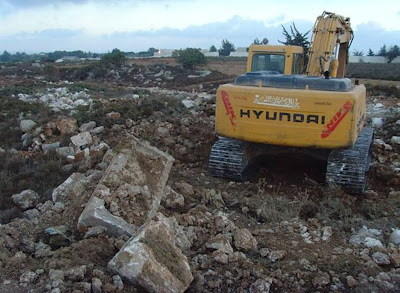
Despite Libyan archaeologists, officials, and academics doing all they can to protect and maintain their country’s heritage, often with only very limited resources, and sometimes at great personal risk, the extent of recent destruction of the rock-cut tombs and ancient structures at Cyrene is vividly illustrated in this July 2013 photograph.  The heartbreaking image clearly shows an operator's Hyundai Robex 250 LC-7 crawler excavator clearing land for development inside a stretch of the city's ancient necropolis. 


There, in abject disregard for the ancient burial vaults and sarcophagi below the treads of the construction vehicle, makeshift developers rashly transformed a swath of the archaeological site into a modern construction zone.  Before they could be stopped, these individuals crushed, destroyed, or dumped into waterways what Greek, Hellenistic, Roman and Byzantine Cyrenaica remains they came across, some of which dated as far back as 600 BCE.

Along with urban encroachment, insufficient security and a complicated political terrain has made Libya's rich archaeological heritage a vulnerable target for looting.  During the last two decades, according to the research of prominent forensic archaeologists, many of the territory's majestic Hellenistic sculptures have been plundered, only to turn up for sale on the ancient art market with little or fabricated provenance.  Many of the most beautiful of these pieces have turned up with, or have been sold through well known gallerists in London, Paris, Switzerland, Barcelona, and the United States. 

To illustrate the seriousness of the problem, the remainder of this article will be dedicated to four artefacts that have just gone home, identified in four separate US investigations of varying lengths and complexities.  Each of these artefacts made the long journey back home to Libya last week, and each were seized and relinquished as the price sometimes paid for trading in illicit material, and in one case, from wantonly collecting material with an absolute and total disregard for an object's legitimacy. 

Artefact #1

Cyrene Deity Head - Belzic Dt.54 *

The first, and oldest, is a fourth-to-third-century BCE Head of a Veiled Woman, (Cyrene Deity Head - Belzic Dt.54) which was recovered as part of an 11-year Federal investigation code named “Operation Lost Treasure,” led by HSI-ICE in New York, in conjunction with the U.S. Department of State and U.S. Customs and Border Protection. This 13 inch tall by 10 inches wide marble head was seized by US authorities while monitoring the shipments and way bills of a known problematic Sharjah-based antiquities dealer.  The artefact was being shipped to a sometimes collector, sometimes dealer operating in New York.  Unfortunately, this was not the only plundered artefact from Cyrene the UAE dealer knowingly handled, nor was America the only country where buyers for Libya's plundered material could easily be found.  

Freshly looted, this severed head of a divinity had been shipped out of Libya and made her way into the United States unwashed by her handlers.  As a specimen of the wonders of Cyrenaica's past, her expressive face still retains some of the underdrawing pigment used by her creator to outline and define her eyes.   

Officers involved in the U.S. investigation would go on to provide assistance to London investigators when this same dealer, continuing to ply his illegal trade in the lucrative London market, shipped yet another plundered funerary statue from Cyrene to the United Kingdom just three years after this New York seizure.  In the US case, Immigration and Customs Enforcement’s (ICE) Homeland Security Investigations (HSI) International Operations Division Chief Leo Lin formally handed over this sculpture to the safekeeping of the Libyan Embassy in Washington DC,  where it has remained until its journey home was finalised last week. 

Artefact #2

Cyrene Deity- Steinhardt-Albertson Dt.76*

The second artefact, the Veiled Head of a Female, as named in the Michael Steinhardt Agreement, was formally surrendered by the New York collector in early December 2021.  It is thought to be the head of a 2.5 meter tall 3rd - 2nd century BCE funerary monument representing a half-figure goddess.  One of just ten known to archaeologists from the Necropolis of Cyrene, before its plunder, this strikingly rare sculpture once adorned one of only six or seven monumental tombs located in the ancient city.   

The sculpture had been seized during the lengthy investigation into the highly questionable collecting practices of billionaire Michael Steinhardt, begun in New York in February 2017.  Manhattan District Attorney Alvin Bragg's team, lead by Chief of the Antiquities Trafficking Unit and Senior Trial Counsel Matthew Bogdanos, along with Supervising Investigative Analyst Apsara Iyer and Investigative Analysts Alyssa Thiel and Daniel Healey gathered evidence which demonstrated that the Veiled Head of a Female first surfaced on the international art market on 20 November 2000 when Michael Steinhardt purchased Dt.76 from Michael L. Ward, a dealer in New York with three business entities: 
  • Michael Ward & Co.
  • Michael Ward Inc.,
  • Ward & Company Works of Art LLC.
On his invoice, Ward noted the Veiled Head of a Female was “possibly from North Africa” and “a light brown earthy deposit uniformly covering the head imparts to its surfaces an attractive, warm patina.” This “earthy deposit” is thought by some experts to have been applied after the object was looted as it serves to lessen the noticeability of small chips and breakage on the surface of the artefact, a likely sign of rough handling by its looters.  

The ancient sculpture was sold to Steinhardt with no prior provenance for $1,200,000. 

Discussing the seized sculpture with Morgan Belzic, a PhD researcher at the Ecole Pratique des Hautes Études specialising in Cyrenaican Funerary Sculptures, under the direction of François Queyrel, he concurred with my preliminary observation that this head of a deity, with its telltale coloration and diadem, had to originate from Cyrene.  Belzic has made a name for himself, having noted a correlation between the increasing destruction of funerary monuments in Libya and the uptick in the appearance of ancient pieces from Cyrene on the market statistically out of range with those appearing in the market prior to the country's destabilisation.

As an expert on the sculptural remains of Libya's Greek cities, Belzic cooperates with national and international law enforcement authorities, including the Manhattan DA's office and the Libyan Department of Antiquities and has identified plundered and suspect objects originating from the Libyan cities of Shahat (Cyrene), Susa (Apollonia), Tocra (Taucheira), Tulmaytha (Ptolemais), and Benghazi (Euesperides/Berenike).  

Working closely with a multinational coalition of archaeological missions in Libya under the coordination of the French Archaeological Mission, lead by Vincent Michel, this group of allied researchers has provided critical evidence in law enforcement investigations identifying sculptures of high concern originating from Cyrenaica. 

The Manhattan District Attorney's office concluded its multi-year, multi-national criminal investigation into Steinhardt's ancient art collection in 2021.  In total, their work resulted in the seizure and forfeiture of 180 plundered antiquities valuing an estimated total of $70 million and imposing the first-of-its-kind lifetime ban on acquiring antiquities ever handed down to a collector. But this investigation is important for the history books not only for that reason but also because the case underscores and exemplifies the successes prosecutors can have when a) focusing almost exclusively on art and antiquities cases, b) working collaboratively with other law enforcement agencies and c) exercising the willingness to work with a group of forensic researchers who specialise in looted and stolen antiquities from specific regions or cultures. 

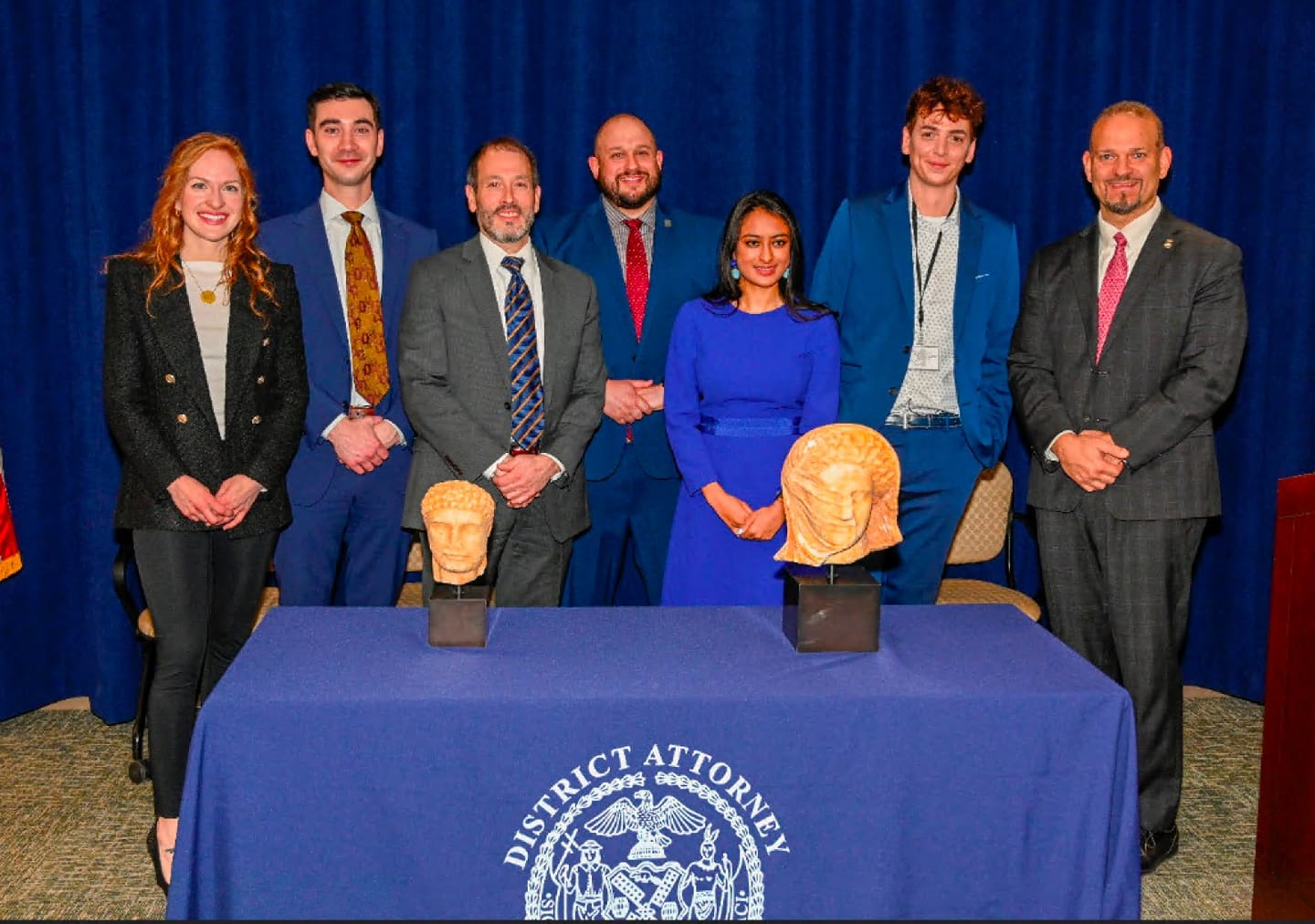
Handover Ceremony in Manhattan

Through the collaborative work of the DA's team, with the coordinated help of Special Agents Robert Mancene, Robert Fromkin, and John Labatt of Homeland Security Investigations, in this one case alone, the DA's office successfully identified 169 of the 180 seized antiquities as having been trafficked by a total of 12 different criminal smuggling networks.  The remaining eleven forfeited antiquities, including this one, first appeared on the international art market in the hands of dealers more concerned with the artefact's sales value than with closely examining the provenance of objects that come from countries plagued by civil unrest, war, and/or rampant looting. 


Artefact #3
Cyrene Deity Head - Belzic Dt.22*

While the exact dates of when the 3rd to 2nd century BCE, Belzic Dt.22, was looted from Cyrene is unknown, it is believed that this sculpture may have been stolen in the 1980s and then smuggled into Egypt by antiquities traffickers.  Investigators in New York have proven that it was eventually shipped onward to the United States, where it appeared on the US ancient art market in 1997.  According to investigators, the artefact demonstrated the “telltale signs of looting such as earth on the surface and new chips at the base and in the veil.”

By 1998, and now referred to as the Veiled Head of a Lady, and head had been valued at nearly half a million dollars and was placed on loan to the Metropolitan Museum of Art in New York by an anonymous donor, where it was catalogued simply as a Greek Hellenistic funerary head and mislabelled as being from the 4th century BCE. 

The veiled head remained on display at the Met for more than twenty years.  After being identified as having come from Cyrene, the sculpture was seized during an investigation conducted by Manhattan District Attorney Alvin Bragg's team, lead by Chief of the Antiquities Trafficking Unit and Senior Trial Counsel Matthew Bogdanos, along with Supervising Investigative Analyst Apsara Iyer and Investigative Analysts Alyssa Thiel and Daniel Healey in February 2022.  Note that the Met and DANY have declined to identify the lender at this time, given the sensitivity of ongoing investigations.

Prior to its formal transfer back home to Libya, the Veiled Head of a Female was handed over to the Libyan authorities on 30 March 2022 along with Artefact 4 during a repatriation ceremony attended by the Charge d’Affaires of the Embassy of Libya in DC Khaled Daief, and U.S. Homeland Security Investigations (“HSI”) Acting Deputy Special Agent-in-Charge Mike Alfonso.

Artefact #4

Cyrene Portrait Head - Belzic P.97*

After being smuggled from Libya to Geneva, Switzerland, Morgan Belzic first identified this 2nd century CE marble Cyrenaican Funerary portrait of a bearded man on the ancient art market in November 2018.  When documented, it was being offered for an estimated sales price of $19,000.  

Originally placed in a tomb rich with small niches, there are more than 250 Cyrene portraits of this category recorded by scholars studying the ancient remains of Libya.  The iconographic styling of this type of portrait head is so unique to Cyrenaican funerary imagery that this category of sculpture is referred to in scientific literature as a ‘Romano-Libyan’ portrait. 

The marble head of a man was next offered for sale two years later, in June of 2020, this time in Manhattan and with an asking price of $25,000 - $35,000.  But it is the third sale which turns out to be the charm, resulting in the fastest seizure to restitution of an artefact in history.  

Belzic P-97 was spotted for the third time on 28 March 2022, this time by art historian Camille Blancher, just shy of its next intended sale date through another USA antiquities dealer.  Through the responsive and collaborative efforts of Manhattan District Attorney Alvin Bragg's antiquities unit, working in close coordination with Special Agents Robert Mancene and Robert Fromkin of Homeland Security Investigations the bearded head of a man was seized on Tuesday, March 29th, back in the Manhattan DA's office where it was handed over to the Libyan authorities on Wednesday, March 30th, along with Artefact 3 during a repatriation ceremony attended by the Charge d’Affaires of the Embassy of Libya in DC Khaled Daief, and U.S. Homeland Security Investigations (“HSI”) Acting Deputy Special Agent-in-Charge Mike Alfonso.

Support for this case came from members of a coalition of archaeological missions working in Libya under the coordination of the French Archaeological Mission as well as from ARCA, all of whom are deeply committed in assisting Libyan institutions and authorities in enforcing the protection of cultural heritage in Libya and who voiced their collective concerns to the DANY regarding the artefact's potential sale. 

To put a nice bow on this story, all four marble funerary sculptures, along with a small grouping of terracotta urns and fragments, were flown via private jet, paid for by a philanthropist, to Mitiga International Airport in Libya.  Arriving to Tripoli on Thursday, April 1st, the repatriation of these antiquities is a “peace dividend” as described by Director-General of the United Nations Regional Institute for Crime and Justice Research (UNICRI) Antonia Marie de Meo, who led a delegation to Libya alongside James Shaw, Chief of that agency's Asset Recovery and Illicit Financial Flows programme.  Also on board was forensic archaeologist Morgan Belzic, who more than anyone, truly understood the efforts, coordination and cooperation, these four recoveries required. 

The handover ceremony took place at the Museum of Libya inside the former royal palace of Qasr al-Khild in Tripoli. Like other museums in Libya, it has remained closed to the public since the 2011 Libyan uprising.  Speeches at the event included statements made by Omar Kati, Deputy Minister for International Cooperation and Organizations Affairs, Libyan government antiquities chief Muhammad Faraj al-Falous, the envoy for Libya in the United States, representatives from the Libyan Ministry of the Interior and LARMO. Many of whom present for the celebration expressed gratitude for the efforts made by the US law enforcement and public prosecutors in bringing Libya's heritage home. 

U.S. Ambassador to Libya Richard Norland personally thanked the staff at the Manhattan DA's office and HSI- ICE.  

The spectacular ruins of the ancient Greek city of Cyrene have, for better or worse, survived Libya's 2011 revolution.  Looking at these beautiful artefacts and admiring the Met recovered piece in particular, I feel compelled to admire the learned skill that฀went into the creation of this veiled woman. For all our modern capabilities, I doubt we could turn such solid stone into the modesty of a semi transparent fold of material in quite the way that this unknown ancient Cyrene artisan did.  

Filled฀with admiration, but also a healthy does of cynicism, I understand that Libya's loses don't stop with the return of one woman behind one transparent veil to the place she was formed.  The rape of historic Cyrene for profit has and likely will continue, and there are other veiled faces of other victims still out there.  

Some of the forensic archaeologists involved in this fight were already back at work on Saturday, prepared to help law enforcement authorities in any way they can to bring Libya's sculptures back to a country that has already lost so much. 

By Lynda Albertson, ARCA CEO

-------

Addendum:

In July 2016 UNESCO placed all five of Libya's World Heritage sites on the UNESCO World Heritage in Danger list.  Equally concerned, and in response to a long history of threats, the United States and Libya signed its 17th cultural property agreement with Libya on 23 February 2018 to solidify the two countries' joint collaboration in combatting the looting and trafficking of cultural objects originating from the plagued North African country.  

Signed by Irwin Stephen Goldstein for the United States and by Lutfi Almughrabi, Libyan Under Secretary for Political Affairs, this agreement formalised a collaboration to protect Libya heritage for a period of five (5) years. And while this agreement was opposed by many in the antiquities trade, the restitutions discussed in this article demonstrate repeatedly that poverty, civil unrest and war create the perfect storm for the trafficking of illicit antiquities.

* Image Credit French Archaeological Mission to Libya

December 20, 2019

Homeland Security Investigations (HSI) seizes a female funerary statue previously on sale on the online website Live Auctioneers


Tuesday, December 17, 2019 agents with the United States Department of Homeland Security - HSI, Immigration and Customs Enforcement (ICE) seized a female funerary statue previously listed for sale last April for an estimated Estimation 500.000-800.000 USD on the online website Live Auctioneers.  The statue, advertised at: https://www.liveauctioneers.com/item/70314848_an-important-life-size-greek-marble-figure-of-a-female  was listed as Lot 0032.  In its description, the dealers had stated that the statue was "an impressive Greek marble three quarter life-size figure of a veiled woman, likely among a handful  [of] available Greek figures for sale."  

While the auction page for this antiquity has since been removed, the heavy 400 pound statue of a Greek funerary deity from the Hellenistic period, has been identified as having come from Cyrenaica, in present-day Libya, a source nation not mentioned in the description given by the sellers.  This area of the North African country has been the subject of accelerating pillage for more than a decade, sometimes in support of financing criminal groups.  Frequently this plunder destroys irreplaceable archaeological data. 

For years the Security Directorate of Shahhat, in Libya's eastern coastal region, has tried to foil the attempts of individuals threatening to tamper with, loot, or destroy antiquities from the ruins of the ancient Greek and Roman city, Cyrene.  But given rampant urban encroachment and the lack of uniform security within Libya's complicated political terrain following the overthrow of Muammar Gaddafi, Cyrenaica's rich archaeological heritage remains vastly underprotected, a fact often overlooked by the media amid its focus of ISIS looting and iconoclasm in Syria and Iraq. 

Veiled marble sculptures such as the one seized in New York City are not found in Greece.  They are only found in the ancient Greek cemeteries of the ancient cities of Cyrenaica, the area along the eastern coastal region of what is today modern Libya. These uniquely stylized funerary decorations are easily identifiable as their distinctive styling is not found in any other part of the Classical world.  The alone makes it off concern that the dealers elected to refer to the piece as solely "Greek". 

Following the statues identification, concern over the object's pending sale on the ancient art market was widely publicized by the Archaeology Information Network (ArchaeologyIN) through their Archaeology in Libya social media network.  Drawing the public's attention to the fact that plundered Libyan artifacts are regularly appearing on the licit market, the grass roots activist group included a link to the dealer's auction which identified the sellers as Aphrodite Gallery, an online branch of Aphrodite Ancient Art.  Both of these ancient art enterprises are owned and/or operated by Jamal and Jad Rifai.

The object's provenance on the online sales site was listed as:

"Ex. Swiss private collection, from the 1980's, with import document and Art Loss Register certificate."   But the export license? 


A 2008 cached version of the Aphrodite Ancient Art website (now taken down) stated: 


Previous notes on Facebook, also now removed, once indicated that the brick and mortar gallery of Aphrodite Ancient Art opened in Manhattan in May 2012 after operating virtually as far back as 2007.  This date coincides with data captured by the Wayback Machine which maintains archives of some of the company's web pages dating as far back as 2008.  In contrast, the LinkedIn profile of one of the company's principles states that he has been part of the ancient art market in New York operating as Aphrodite Ancient Art since 1999. 

The seizure of this funerary statue was taken into consideration based on initial research conducted by individuals working with the Federation of Archaeological Missions in Libya, including Vincent Michel and Morgan Belzic (French Mission), Oliva Menozzi (Italian missions), Susan Kane (US Missions), as well as other unnamed colleagues.  Formal requests for assistance from the Libyan authorities came from Dr. Ahmed H. Abdalkariem, Chairmen of the Department of Antiquities (DOA) in Libya, in coordination with the country's Ministry of Foreign Affairs and the Libyan embassy who worked jointly with the US Federal and local law enforcement authorities.  

According Morgan Belzic, at the Institut National d’Histoire de l’Art and Ecole Pratique des Hautes Etudes, illicit funerary sculptures from the Cyrenaica region of Libya have passed through the ancient art market with increasing frequency since the start of political unrest in the region. This uptick in sales volume for Greek artifacts plundered from Libya coincides with the suspension, or reduction, of many state services within the country, including those for heritage protection and management,  without which there has been an increase in criminal activity as well as sometimes aggressive pillaging of archaeological sites.  Belzic's conflict antiquities research has centered on the proceeds from the illicit trafficking of objects from the Cyrenaica region which benefit directly the criminal groups who organize the smuggling of looted antiquities out of Libya, selling on to intermediaries and art merchants in both the US and Europe. 

But could the dealer have known that the statue was illicit? 

Given its distinct style, it seems unlikely that the sellers of this important artifact would not have been able to identify that this statue came from the areas surrounding the ancient Greek cemeteries of the ancient cities of Cyrenaica.  Knowing that, the purported "Ex. Swiss private collection, from the 1980's" and the lack of export documentation of Libya fails to hold water. 

The cultural heritage of Libya is protected by both its national laws as well as by multilateral agreements and international instruments.  The 1951 Constitution grants the government control of the country’s antiquities, archaeological sites, and museums. Law Number 11 on Antiquities, Archaeological Sites, and Museums (1953) further obligates the state to protect cultural heritage in peace and wartime and prohibits damage to and illegal trade of cultural property, including exports. Law Number 2 of 1983 and Law Number 3 of 1994 have similar provisions. The latter names the Department of Antiquities (DOA) as the expert authority responsible for management, organization, care and protection of antiquities, museums, manuscripts, ancient cities, and historic localities and buildings.

The current governing document is the Constitutional Declaration, adopted by the National Transitional Council on August 3, 2011, which reinforces that Libya’s legal framework for cultural preservation has remained largely unchanged to date. International agreements to which Libya is a State Party also remain in effect such as the 1970 UNESCO Convention and the UN Convention against Transnational Organized Crime.

Nature and Extent of Art Market for Archaeological and Ethnological Material from Libya

On June 16, 2017, the U.S. Department of State published notification in the Federal Register of the receipt of a request from the Government of Libya to the Government of the United States of America requesting import restrictions on archaeological and ethnological material from Libya representing its prehistoric through Ottoman Era heritage.

In their request it was outlined that the United States is a major market, perhaps the single largest market, for sales of archaeological material from Libya. and that between approximately 2007 and 2014, nearly fifteen sculptures based on stylistic composition and other criteria identified as coming from Libya, and known to have come from Cyrene (some documented from the excavation storerooms; others undocumented) have been sold through the ancient art market in the United States or by US based companies operating virtually.

On December 5, 2017, U.S. Customs and Border Protection placed import restrictions on archaeological and ethnological material from Libya to assist in combating the illicit trafficking from the region.  

October 3, 2019

The Libya MOU in action. The United States recovers and restitutes an ancient sculpture stolen from the city of Shahat (Cyrene).


For years the Security Directorate of Shahhat in the eastern coastal region of Libya has tried to foil the attempts of individuals threatening to tamper with, loot, or destroy antiquities from the ruins of its ancient Greek and Roman city, Cyrene.  But given rampant urban encroachment and the lack of uniform security in a complicated political terrain created following the overthrow of Muammar Gaddafi in 2011, Cyrenaica's rich archaeological heritage remains vastly underprotected and often overlooked by the media amid its focus on looting and iconoclasm in Syria and Iraq. 

In answer to concerns that looters are exploiting the political chaos in the region, UNESCO placed all five of its Libyan World Heritage sites on the UNESCO World Heritage in Danger list in July 2016.  This list named the  2,600-year-old Greco-Roman archaeological city of Cyrene, which struggles with neglect, vandalism, looting and unregulated development; the ancient city of Leptis Magna; the ancient city of Sabratha; the Islamic desert trading city of Ghadamès; and the Tadrart Akakus, a mountain range in the desert of the Ghat District in western Libya that contains thousands of prehistoric rock-art sites, some dating as far back as 9,000 BCE.

Yet despite the lack of press coverage, a steady trickle of artefacts of dubious origin originating from Libyan historical sites do get identified by illicit trafficking researchers, law enforcement and customs officials.  Usually this occurs years after their original looting, once the antiquities are routed out of the region via transit countries and sometimes once they make their way into the commercial art market, turning up for sale in galleries and showrooms in London, Paris, Switzerland, Barcelona and the US.  

Some notable Libya-origin objects identified include:

Four funerary deities seized in France in 2012. 

A four foot marble statue, identified in 2013, as having been exported by Dubai-based antiques dealer Hassan Fazeli, dating from the 3-4 century BCE.  The statue was imported with provenance stating it was from the "personal collection of Mr Fazeli since 1977" and as having originated from Turkey when in fact it had actually been stolen from Cyrene before being smuggled into Britain.  This HMRC court case was not the first time that Hassan Fazeli's name had appeared connected to trafficked antiquities. 

Three Hellenistic Period funerary divinities probably coming from the same burial either from Cyrene or Apollonia seized in Geneva.  

A set of five marble sculptures from Cyrenaica seized by Egyptian port police in Damietta when inspecting  a container bound for Bangkok. 

Despite these identifications, protecting Libya's cultural heritage sites is difficult, in part because there is no single unifying political authority for the country as a whole in the aftermath of the Libyan Civil War.

For the moment the country is influenced by three influential political/governmental groups. The first is the Presidential Council (PC), which presides over the Government of National Accord (GNA) and is based in Tripoli.  The second, also based in Tripoli, was the former Government of National Salvation, which rested on the authority of the rival General National Congress (GNC), the resurrected parliament elected in 2012. Dissolved in April 2016, the GNC was replaced by the High Council of State, an advisory body advising the interim Government of National Accord (GNA).

The third governmental authority in Libya is based in Tobruk and al-Bayda.  The House of Representatives (HoR) in Tobruk is considered to be the legitimate legislative authority under the Libyan Political Agreement, while the government of Abdullah al-Thinni operates from al-Bayda. Both the Tobruk and al-Bayda authorities are united under the control of Field Marshal Khalifa Belqasim Haftar who leads the Libyan National Army (LNA) and the system of government in much of the east and some of the south and west parts of Libya following what is referred to as the Second Libyan Civil War (2014 to present)..

In response to a long history of threats to archaeological and historical sites in Libya, and to solidify U.S. and Libya’s joint collaboration to combat looting and trafficking of cultural objects originating from the north african country, the US signed its 17th cultural property agreement with Libya in 2018.  Signed by Irwin Stephen Goldstein for the United States and by Lutfi Almughrabi, Libyan Under Secretary for Political Affairs, the agreement formalizes a collaboration to protect Libya heritage for a period of five (5) years, unless the MOU is extended at a later date.  This agreement has been opposed by many in the antiquities trade but seen as necessary by those who see civil unrest and war as a precursor and or conduit to the trafficking of illicit antiquities.

Article 1.2 of the MOU states:

The Government of the United States of America shall offer for return to the Government of Libya any object or material on the Designated List forfeited to the Government of the United States of America.

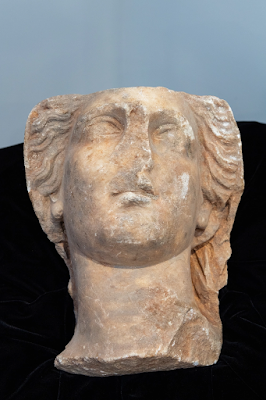
In the first tangible fruit of this accord, Jamal Ali al-Barq, head of the Department of International Cooperation, at Libya's Foreign Ministry has announced that during a ceremony today, at the Libyan embassy in Washington DC, the United States Department of Homeland Security, Immigration and Customs Enforcement (ICE) and the Department of Justice (DOJ) will hand over a marble head of a woman to the Libyan authorities.

Image Credit:  Libyan Embassy, Washington DC
The identification of this antiquity, up for auction in the United States, was partly made possible by French historian Morgan Belzic, an expert on the sculptural remains of Libya who cooperates with law enforcement authorities on identifying plundered objects from Shahat (Cyrene), Susa (Apollonia), Tocra (Taucheira), Tulmaytha (Ptolemais), and Benghazi (Euesperides/Berenike).  While working on his PhD, Belzic noted a correlation between the increasing destruction of funerary monuments in Libya and the appearance of ancient pieces on the market statistically out of range with those appearing prior to the country's unrest.

Image Credit:  HSI-ICE
This fragmented head of a veiled woman is the the first identification from Belzic's research into illicit trafficking to be returned from the United States.  In a conversation with Belzic, he in turn credited US art historian and archaeologist Susan Kane, of Oberlin College, Ohio, and the Department of Antiquities (DoA) of Libya for their own critical roles in making this recovery possible.

According to an HSI Cultural property report, the object had made its way into the United States via a Dubai-based antiquities dealer to a collector in Queens, NY following an investigation which began in 2008 identifying objects from various nations sold to major museums, galleries and art houses in New York City.  As a result of this investigation several key players in a transnational criminal organization engaging in the illicit trafficking of cultural antiquities were identified.

Anyone with information about the illicit distribution of cultural property within and the illegal trafficking of artwork within the United States are urged to call ICE at 1-866-DHS-2-ICE or to complete the online tip form.

March 30, 2018

Illegal chains which mirror legal ones and function in the penumbra of the legal ones


While much has been discussed with regards to terrorism financed via the sale of plundered antiquities, substantiating claims with clear and defined ‘evidence’ is not straightforward. From the outside these networks are labyrinthine, multi-tiered and opaque.  From the inside militants and non-militant criminals are known to conduct illicit transactions with cash and cash alternatives which are, by their very nature, structured to fly below the radar of law enforcement authorities. This makes assessing their impact difficult to estimate and the detection and prosecution of criminals complicated. 

Even when uncovered, traffickers involved in the laundering of illicit antiquities usually haven't kept substantive incriminating paper trails that investigators can peruse.  This makes it difficult to determine what their profit margins are on the antiquities they launder.  Nor are people facing charges of laundering antiquities through the art market likely to be forthcoming with incriminating evidence that identifies who else has benefited from the layered transactions that occur from the time the object is looted from an archaeological rich region until the antiquity reached the identified via a collector, dealer, gallery, or auction house.

All this to say that those involved in the illicit market don't advertise their relationships with known criminals and the same holds even more true when the profiteering parties have direct or indirect business dealings with transnational criminal networks or militant organizations.  Additionally the economic behavior of terrorist groups and transnational criminal networks during conflicts share many of the same characteristics, methods and tactics.  Both operate in secrecy and little is known about how groups such as these coexist and, or, interact within the same geographic space.  

But like any legal supply chain does, an illegal supply chain matches supply with demand. So while much of our evidence of where the proceeds of transnational artefact crime finish is condemned by the market as being overly anecdotal, what we see clearly is from what regions illicit contraband flows.  From there we can extrapolate that illicit antiquities originating in countries of conflict, from zones where terrorists or militants have a controlling stake territorially, are by extension, a viable revenue stream for terrorism.

Where the two chains, the legal and the illegal, meet.


This month after almost three years of investigations, involving some fifty law enforcement officers, Spanish authorities have brought formal charges against two individuals for their alleged participation in a crime of financing terrorism, belonging to a criminal organization, concealment of contraband and use of forgery for their roles in facilitating the sale of illicit antiquities.

On orders from the Audiencia Nacional, a special high court in Spain with jurisdiction throughout the Spanish territory, as well as over international crimes which come under the competence of Spanish courts, Barcelona antiquities dealer Jaume Bagot and his partner Oriol Carreras Palomar are being investigated for their purported roles in illiit trafficking.  Both have been taken into custody for their alleged role(s) in the sale of Greek and Roman antiquities plundered from Libya and Egypt, which prosecutors believe were then being sold through the licit European art market purporting to be antiquities from historic collections.

Screen Capture: 
Youtube https://www.youtube.com/watch?v=XObAk1kDVp4
Answering to the charges, the pair appeared before Judicial Magistrate Diego de Egea of the Central Court of Instruction Number 6 of the National Court on Monday, March 26, 2018 where they were formally informed of the allegations against them. During the hearing the magistrate granted their release pending trial, imposing a financial surety (bond) and a series of pretrial release conditions which included the forfeiture of their passports, a mandate to remain within the territory of Spain, and biweekly court appearances as conditions of their release while awaiting trial.

Jaume Bagot established his gallery, J. Bagot Arqueología Ancient Art Gallery in 2005 in the heart of Barcelona.  According to his profile on the BRAFA art fair website, where he is a vetted dealer of ancient art, Bagot's firm specializes in the sale of art from the Etruscan, Greek, Roman and Egyptian civilizations, from Mesopotamia, the Middle East, Gandhara and from various Pre-Columbian cultures. No mention of Libyan cultural objects are mentioned in his BRAFA profile, and yet, police authorities in Spain have seized sculpture which originated from three cities of Libya: Albaida, Apolonia and Cyrene, some of which are believed to have been looted while the territory was under the control of Islamist militant groups.

Bagot's gallery is listed as a member of the influential dealer association C.I.N.O.A. (Confédération Internationale des Négociants en Oeuvres d'Art), as well as the F.E.A. (Federación Española de Anticuarios) where they list him as Jaume Bagot Peix, and where he is also identified as the vice-président of the  Professional Group of Antiquarians of the (Barcelona) Royal Shipyard (Asociación de Anticuarios de las Reales Atarazanas) 

In addition to forming strategic affiliations within the art market's important dealer associations, Bagot's gallery's "about us" page assures potential collectors that he is an ethical dealer by stating:

"Our main objective is to offer original ancient works of art guaranteeing their authenticity and maximum quality while at the same time strictly complying with the laws of protection of national, foreign and UNESCO heritage." 

and

"We also carry out exhaustive research into the provenance and previous ownership of the pieces. To this end we make use of the  data base [sic] of stolen objects, Art Loss Register, as well as making use of publications, sworn  statements, dated photographs, bills, customs documents and insurance policies."

All of which stands in stark contradiction to the apparent charges he now faces with the Spanish authorities of facilitating the sale of illicit antiquities from regions of conflict where terrorist actors might have been involved.

Criminal actors and investments in the legitimate art economy: 
The making of a case = Good (unfortunately usally unpaid) research.

As is all too often the case, some of the best evidence collected highlighting trends in the field of illicit trafficking, is research conducted by unpaid academics, as there has been little funding up until now, made available at the national or multinational level in market countries to financially support the type of in-depth specialized research required by provenance experts studying the flow of illicit objects onto the licit market.  This holds true as well for this particular Spanish investigation, which got its start thanks to an academic researcher.

During his PhD research on les sculptures funéraires de Cyrénaïque (the funerary sculptures of Cyrenaica), French historian, turned conflict antiquities researcher, Morgan Belzic, of the École Pratique des Hautes Études had been working with the French Archaeological Mission and Libya heritage authorities documenting antiquity in the northeastern part of modern Libya focusing on the cities of Shahat (Cyrene), Susa (Apollonia), Tulmaytha (Ptolemais), Tocra (Taucheira), and Benghazi (Euesperides/Berenike).

Looking at evidence useful for understanding the culture and history of ancient Cyrenaica, which thrived between the 6th century BCE and the 4th century CE, Belzic uncovered a worrisome correlation between the looting and destruction that has occurred over the past twenty years at the Greek necropoleis of Libya and an uptick in the number of ancient objects, identifiable solely to that specific region, appearing on the international art market. In conjunction with this increased availability of ancient material surfacing on the art market, he also noted that tomb destruction in the region had risen exponentially, in part as a result of the longstanding instability in the region, but notably over the last ten years in conjunction with items appearing in the market.

Speaking with Morgan about his research last summer, during an informal ARCA meeting of academic antiquities researchers, he told me that while the material remains, the alabaster, glass, and terracotta, found in the tombs of Cyrenaica could likewise be found in other Hellenistic regions, making it difficult to pinpoint the country of origin for looted antiquities of these types, the deities and funerary portraits of Cyrenaica are an exception.

Belzic explained that these sculptures are quite specific in their iconography and style, making it possible for experts, familiar with the sculpture of Cyrenaica, to objectively identify pieces from the region.  Then when these types of sculpture come on the market,  with limited documentation that does not match with existing established collections, one can begin to question their legitimacy and whether or not they may have come from ransacked tombs before making their way into some of Europe's prestigious galleries.

With two rival governments, and countless local militias in Libya, Belzic understood that the probability of staunching the flow of illicit objects following out of Libya could only be tackled by disrupting the demand side of the supply chain.  With that in mind, he turned his research over to law enforcement authorities in Spain who began their lengthy investigation building upon the foundation of his academic research.

In an interview with Crónica Global Media “JBP,” as the Catalan antiquarian prefers to be called, denies any direct involvement with purchasing antiquities from parties in Iraq, Libya or Syria.  He goes on to add that all the items in his inventory have been purchased in good faith, without knowing that the objects in question had been stolen or looted.  His statements imply that any illegal antiquities that made their way into his gallery's inventory did so by honest, unknowing mistake, rather than willful ignorance or a lack of due diligence.

Bagot’s statements are telling as they touch upon the legal framework, technicalities and procedural obstacles that the dealer may try to use in his defence and when fighting any cross-border restitution claim presented by Libya and Egypt in relation to the seizure of his merchandise. It is this culture of willful impunity, the eye's closed "I didn't know" approach which has, for so long, contributed to the challenges of preventing the illegal trafficking of cultural objects through the means of prosecution. 

Unless we establish mandated due diligence accountability for dealers, those who deal in the grey area of the market will continue to rely on the legal conceptualizations of property and ownership in countries favourable to their mercurial transactions.  

Last week I spoke at an UNESCO-EU-funded conference in Paris entitled “Engaging the European Art Market in the fight against the illicit trafficking of cultural property” where I recommended more dedicated public prosecutors and law enforcement officers assigned to focus on art crimes, and building capacity (i.e. funding) in support of experts dedicated to analyzing trafficking from regions at risk.   Belzic, who sat beside me, listened thoughtfully to Erika Bochereau, General Secretary of C.I.N.O.A. (Confédération Internationale des Négociants en Oeuvres d'Art) as she said “It is in the interest of dealers to work only in the licit trade because their business depends on it.”  

I wonder what the confederation's stance will be now that one of their members has come under prosecutorial scrutiny.  

By:  Lynda Albertson