
Blog Subscription via Follow.it

February 28, 2011

Art Theft Anniversary: Three Picassos Stolen from Grandaughter in Paris
by Catherine Schofield Sezgin, Editor

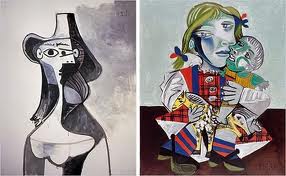
Four years ago on February 27, 2007, Pablo Picasso's granddaughter reported the early morning theft of two Picasso paintings worth 50 million euros from her Paris apartment. At about 4 a.m., two paintings had been removed from the Left Bank apartment of art historian Diana Widmaier-Picasso on rue du Grenelle in the 7th Arrondisement. "Maya and the Doll" (Maya a la poupee), is a 1938 portrait of her mother, Maya Widmaier, the daughter of Picasso and Marie-Therese Walter, the artist's companion from 1924-1944. "Portrait of Jacqueline" was painted by PIcasso in 1961 the year he married his second wife, Jacqueline Roque. The theft also included a lead pencil drawing and collage on paper, "Marie Therese at 21 years".

Widmaier and her mother were awoken by a noise, went downstairs, and having noticed nothing, returned to bed. They noticed the missing paintings later that morning. Thieves had neutralized the alarm and had either used the code or the keys to enter the second floor apartment. One painting had been sliced from its frame and another had been removed from the wall although newspaper reports differ as to what happened to each painting.

Pablo Picasso, who died at 91 years of age of a heart attack in 1973, is one of the world's most popular artists. His 1905 "Garcon a la pipe" sold for $104.2 million at Sotheby's in 2004. After Picasso's death, his heirs divided up his paintings.

The Organized Crime Unit of Paris police investigated the theft. In 1976, one of France's largest art thefts, involved the robbery of 118 paintings, drawings, and other Picasso works from a museum in Avignon. Picasso works were stolen from Zurich in 1994; from London in 1997; Rio de Janeiro; and the Pompidou Centre museum in Paris. In 1989, 12 Picasso paintings were taken from the Cannes home of Marino Picasso, another of the artist's granddaughters, and later recovered.

In August, within six months of the theft, Paris police had recovered the two paintings and arrested three people for the robbery which they had had under surveillance for more than a month when a suspect took the rolled-up paintings to a potential buyer.

Photos: "Portrait of Jacqueline" and "Maya and the Doll"
February 27, 2011

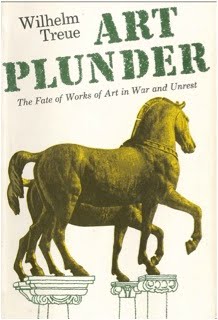
The Journal of Art Crime: Judge Arthur Tompkins Reviews "The Taste of Angels" and "Art Plunder: The Fate of Works of Art in War and Unrest"


In the fourth issue of The Journal of Art Crime, Judge Arthur Tompkins reviews "The Taste of Angels" (First American Edition; Little Brown and Company, Boston, 1948) by Francis Henry Taylor and "Art Plunder: The Fate of Works of Art in War and Unrest" (John Day, New York, 1961) by Wilhelm Treue and translated by Basil Creighton.

Although both of these books are out of print, they can be found from second-hand internet-based booksellers, and are valuable sources for any student of art crime, writes Judge Tompkins.

In "The Taste of Angels", a former director of New York's Metropolitan Museum of Art surveys the history of art collecting across a wide variety of settings, including the Pharaohs in Egypt, through the Hellenic and Roman Civilizations,the Italy of the Renaissance,the Medicis and the Papacy, and on to the fall of Napoleon.

Wilhelm Treue's small (250 pages) work is an illuminating precursor to the modern study of art crime. According to Judge Tompkins, "it is probably the earliest work of serious scholarship that sets out to encompass, in a coherent form, the long history of art crimes committed during times of war."

Judge Arthur Tompkins has been a District Court Judge in New Zealand for 11 years, having been appointed in 1997. He gained his Bachelor's degree in Law from Canterbury University, in Christchurch, New Zealand, in 1983, and subsequently graduated Masters in Law, with First Class Honors, from Cambridge University, England, in 1984. He has taught the Law of Evidence, and presented at numerous conferences and workshops on a variety of topics, including art crime, expert evidence, the intersect between law and science in courtroom, and forensic DNA, in New Zealand, China, England, Ireland, France, and Italy. He is an Honorary Member of Interpol's DNA Monitoring Expert Group, and an elected Fellow of the Cambridge Commonwealth Trust. He teaches "Art in War" at ARCA's Postgraduate Program in International Art Crime and Cultural Heritage Protection in Amelia each summer.

To seek out this piece, and many others, consider a subscription to the Journal of Art Crime—the first peer-reviewed academic journal covering art and heritage crime. ARCA publishes two volumes annually in the Spring and Fall. Individual, Institutional, electronic and printed versions are all available, with subscriptions as low as 30 Euros. All proceeds go to ARCA's nonprofit research and education initiatives. Please see the publications page for more information.

February 26, 2011

Saturday, February 26, 2011 - , No comments

Amelia, Umbria: "Ciao Ciao" to Giampiero Novelli

by Catherine Schofield Sezgin, Editor

One of the reasons I miss Amelia has nothing to do with pizza, gelato or art crime: Giampiero Novelli. Since my first walk through the open shops of the medieval center of Amelia, I would greet the man standing in front of the shoe store. He had a friendly smile and a quick cheerful "Ciao Ciao" which he accompanied with a wave. After seeing him sell tickets to the wine tasting festival, helping out at the dining room of Punto Divino (and sometimes in the kitchen), and organizing the medieval festivities in August, I understood that not much happens in Amelia without Giampiero, his wife Paola, and his brother-in-law Luciano Rossi (proprietor of Punto Divino) and Luciano's wife Manuela.

Giampiero's English is better than my Italian, but I asked his niece, Francesca Rossi, our correspondent in Amelia, to pass on a few questions to her uncle.
ARCA blog: Giampiero, how long have you lived in Amelia and are you happy living in this historic town?

Giampiero: I'm living in Amelia since 60 years ago...which means since I was born! And I'm really happy to live in here!

ARCA blog: You have a fantastic selection of shoes for men, women and children. What is it like to be a small businessman in Amelia right now?

Giampiero: Even if we're going through a difficult period, this is still a job full of satisfaction and also, after 30 years doing that, there is also an affection and a devotion to the shoe business that is stronger than everything.

ARCA blog: As I've told our readers, you don't just operate a shoe store. You are involved in just as many activities as the mayor of the town. Have you thought of going into politics or do all your activities keep you too busy?

Giampero: Absolutely not! I like to be involved in volunteering roles to make a better Amelia and to improve the hospitality here but I'm really not interested in being a politician. (After pausing to think, he continued) See, in this moment I am both Prior of my "contrada" and President of the traders' association in town and you know what? Actually it's sort of like being in politics because you have to deal with all the institutions and politicians in town and obviously this give you a certain influence in making decisions.

ARCA blog: Giampiero, many of our readers are learning about Amelia for the first time through our art crime blog. What would you advise someone about visiting Amelia for the first time?

Giampiero: Well...I would suggest a visit to our Museum and obviously Germanico; the Ancient Walls; the S. Magno Monastery with its unique organ; the Cathedral; the Roman Cisterne; the Theatre; and none the less, take your time for a gastronomic itinerary to taste our food and wine specialties!

Editor's note: A contrada is a district, or a ward, of a medieval Italian city. Historical Amelia is divided into five contrade.

The Journal of Art Crime: Noah Charney Reviews "A Real Van Gogh: How the Art World Struggles with Truth"

In the fourth issue of The Journal of Art Crime, Noah Charney reviews Henk Tromp's book, "A Real Van Gogh: How the Art World Struggles with Truth" (Amsterdam University Press 2010).
"The art world wants to be trick," Noah Charney writes. "That is certainly the conclusion one comes away with after reading A Real Van Gogh, Henk Tromp's thoroughly researched, highly readable, fascinating new book, which uses the history of van Gogh authenticity and forgery debates to discuss what happens in the art world when someone cries wolf. It's not a pretty picture for the expert who deigns to proclaim a work inauthentic."
To seek out this piece, and many others, consider a subscription to the Journal of Art Crime—the first peer-reviewed academic journal covering art and heritage crime. ARCA publishes two volumes annually in the Spring and Fall. Individual, Institutional, electronic and printed versions are all available, with subscriptions as low as 30 Euros. All proceeds go to ARCA's nonprofit research and education initiatives. Please see the publications page for more information.