Blog Subscription via Follow.it

Showing posts sorted by relevance for query serop simonian. Sort by date Show all posts

September 7, 2022

5+1+9+1= 16 plundered Egyptian artefacts restituted to their rightful owners in New York


Six of these pieces were seized while on display at the Metropolitan Museum of Art.  And like the restitutions returned to Italy yesterday, these pieces have likewise been linked to extensive criminal investigations into international antiquities-trafficking networks which have impacted multiple museum collections. Though in this case, the Egyptian artefats were handled by contemporary traffickers and looters, those whose networks have resulted in high level arrests in both France and Germany.  

Five of these antiquities, worth more than $3 million in total, were confiscated from the Metropolitan under a May 19 court order as having been looted from archaeological sites in Egypt, then eventually smuggled through Germany or the Netherlands before moving on to France.  These were sold by traffickers through the Paris-based Pierre Bergé & Associés to the Metropolitan Museum in New York.  

It should be noted that information gathered in this investigation has also resulted in the arrest of nine individuals in France including most strikingly, Jean-Luc Martinez, the former Chairman and CEO of the Musée du Louvre in Paris. 

The six artefacts from the Met's collection that were seized and are now going home are:

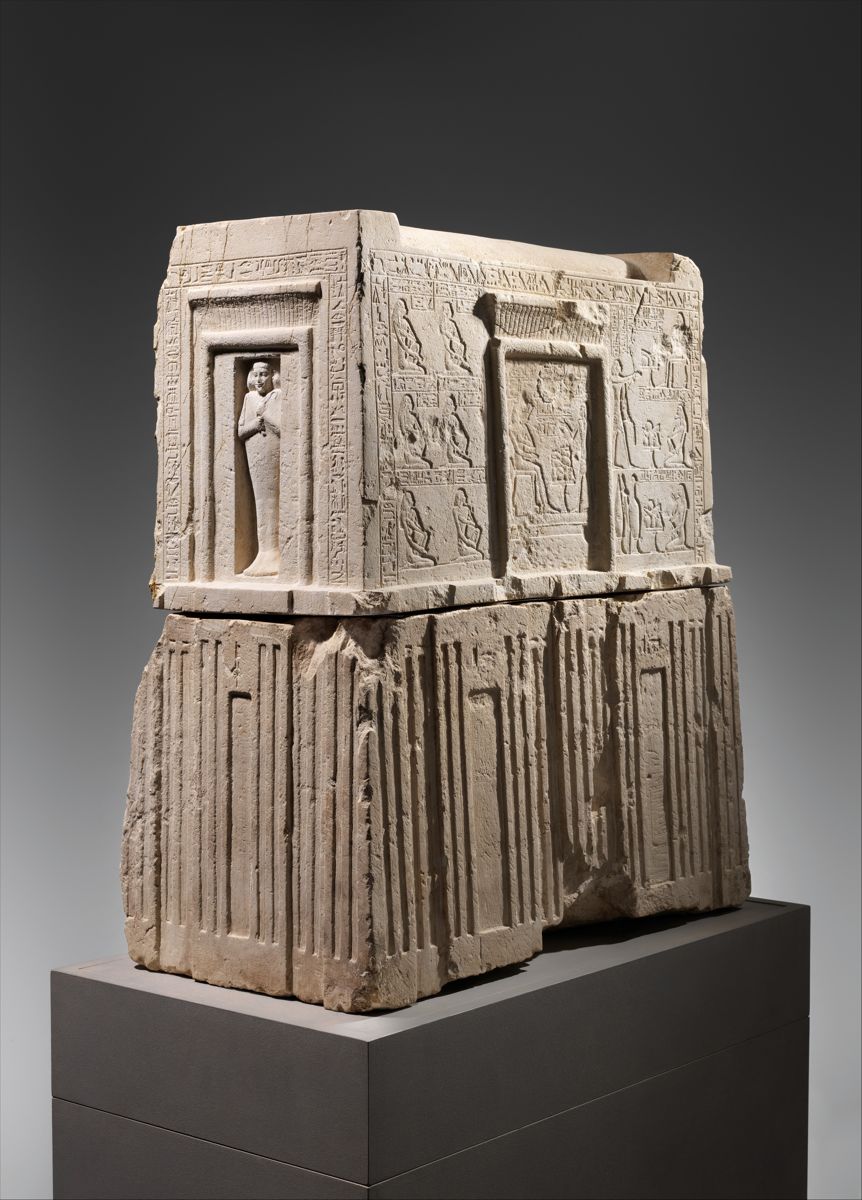
1 of 6 - A Monumental Stela of Kemes, ca. 1750–1720 BCE


Before the Met took down its accession page for this artefact, the provenance listed for this stela as listed in 2019 stated the following:

Purchased February 1969 by Uwe Schnell, Germany, from Heinz Herzer Gallery in Munich. Purchased in the 1970s by a private collector (probably Serop Simonian, Hamburg, Germany). Published fully in 1994, exhibited in Bonn University Art Museum 2006 through at least 2008 and published in the catalog. Acquired by the Museum at auction Pierre Bergé, 2014.

A check of open source records using the names Ewe Schnell, Heinz Herzer and Pierre Bergé & Associés combined only turns up one other antiquity, a Fayum panel painting of a woman in a blue mantle, which was also acquired by the Metropolitan Museum and one we will speak about later in this article.

Heinz Herzer, as many followers of ARCA's blog know, has his own interesting history in dealing with ancient objects with fabricated provenance.

Serop Simonian is an art dealer of Armenian origin at the fulcrum of the Met's gold-sheathed mummiform coffin of Nedjemankh restitution case as well as other pieces already seized and returned by the DANY or identified in other jurisdictions. His name comes up repeatedly in relation to suspect artefacts identified during police, and public prosecutor investigations, as well as academic forensic research.  Simonian has also been tied to numerous suspect acquisitions approved for purchase at the Louvre Abu Dhabi and is quite famous for having stirred up quite a bit of controversy in Italy regarding the sale of the disputed Artemidorus papyrus in 2004 for €2.75 million to the Compagnia San Paolo Art Foundation.  

But back to the Stela of Kemes.  On April 25, 2016, the Metropolitan's accession page for this Egyptian artefact stated the provenance quite differently.  Listing its collecting history as:

Believed to have been in the Todrous Collection, Luxor. Purchased February 1969 by Uwe Schnell, Germany, from Heinz Herzer Gallery in Munich. Purchased in the 1970s by the owner of the Tamerit Collection, Germany. Acquired by the Museum at auction Pierre Bergé, 2014.

This earlier collection history mentions a "Todrous Collection" of which there is nothing documented in open source records anywhere on the web for any other ancient objects.  A late antique textile fragment of a tunic with the inventory number T 34, from "the Tamerit collection" is on record at the at the Papyrussammlung der Österreichischen Nationalbibliothek at the Austrian National Library, though not much else.

Note that this Met record spells the collection's name Todrous, while the recently restituted golden coffin spelled the name Tawadrus, and trade journals have spelled the name Tawadros.  Later in this article you will also see the name spelled Tadross. All refer to the deceased Luxor dealer Habib Tawadros.

Christophe Kunicki's own website listed the provenance for this stela as:

Ancient european private collection, 1969.
With Tadross, Luxor, 1960’s

But stepping back even farther, outside of the Met Museum's and the seller's respective websites, the Monumental Stela of Kemes was published in the 2014 Volume 25 Number 5 issue of the journal Minerva: The International Review of Ancient Art & Archaeology.

This trade magazine listed the provenance for the stela as:

A rare Egyptian limestone chapel-stele of Kemes, superior of musicians (3), from the 13th Dynasty, circa 1770 BC (H. 73cm), in the form of a quadrangular naos resting upon a base carved with façades, was purchased from the Luxor dealer Tawadros during the 1960s. The cover-piece of the sale, it was estimated at €300,000-€400,000, but brought in a hammer price of just €200,00 from the Metropolitan Museum of Art. The expert for both sales was Christophe Kunicki.

Screen Shot: Volume 25 Number 5, Page 53
Minerva: The International Review of Ancient Art & Archaeology

It is important to recognise that the involvement of the French dealer Christophe Kunicki via Pierre Bergé & Associés does not appear in any of the Metropolitan Museum's provenance records for the 13th Dynasty Egyptian limestone chapel-stele of Kemes, despite what this trade journal says and despite the Met's curators in the Egypt department having direct and frequent contact with him as he brokered pieces to the museum directly.

Purchased on 21 May 2014, the Met's record also left out the "Luxor dealer Tawadros" connection on this object.  That name, if you will recall, is also the name associated on the  now restituted 1st century B.C.E mummiform coffin, inscribed in the name of Nedjemankh.
_________


Painted Fayum panel portraits of Egypt are among the few preserved examples of ancient Greek-style paintings on panel and canvas.  Prior to its seizure, this one was on view at The Met's Gallery 137.  The woman in the blue mantle was purchased in 2013 via Pierre Bergé auction house in Paris, with Christophe Kunicki, working as expert. 

When the Metropolitan's accession page was still live, the museum first listed its provenance as:

Purchased 1968 by Uwe Schnell from Heinz Herzer Gallery, Munich. Purchased 1972 by the owner of the Tamerit Collection. Purchased by the Museum from Pierre Bergé & Associés, Paris, 2013.

This was later changed to:

Purchased 1968 by Uwe Schnell from Heinz Herzer Gallery, Munich. Purchased 1972 by Serop Simonian, Hamburg Germany, who owned it until 2013. Published 1997 and 2003, exhibited in Frankfurt in 1999 and Vienna in 2003 and published in exhibition catalogs. Consigned to Pierre Bergé & Associés by a private collector; purchased by the Museum from Pierre Bergé at auction, Paris, 2013.

In trade catalogues for this artefact Kunicki listed only “a European collection“ as the Fayum portrait's sole provenance. 

3 of 6 - Stela Dedicated to the Goddess Hathor by the Temple Singer in the Interior of Amun


Prior to its seizure, this Third Intermediate Period (Kushite) to Late Period stela was on view at The Met's Gallery 137.  This Egyptian artefact was purchased in December 
2015 (accessioned in 2016) via Pierre Bergé auction house in Paris, with Christophe Kunicki, working as expert. 

Just before the Met took down this object's accession page, the museum listed the stela's provenance as:

In the Khashaba Collection, Assyut, by 1910. Permission granted to heirs to export through the Egyptian Museum Cairo for sale abroad by 1969. Exported abroad with license in 1972. Purchased by Adolf Smith (Schmidt), Germany, 1975, and descended in the family. Collection of Serop Simonian, Hamburg, Germany, 2015. Consigned to Pierre Berge & Associates by a private collector; auctioned at Pierre Bergé, Paris, December 2015, where it was purchased by the Museum. 

The 2015 Pierre Berge catalogue listed the provenance as:

Ancienne collection Sayed Pasha Khashaba, années 1910. Ancienne collection Smith, Allemagne, 1975.
Collection européenne.

Between 1910 and 1914, Sayed Bey Khashaba, AKA Sayed Pasha Khashaba, AKA Saiyid Khashaba Pasha, with other various subtle misspellings obtained from the Antiquities Service concessions to excavate at Assiut, Meir, Deir el-Gabrawi, Tihna and at Soknopaiou Nesos, in the Fayum.  I will leave whether or not this steal came from any of these places to the Egyptologists. 

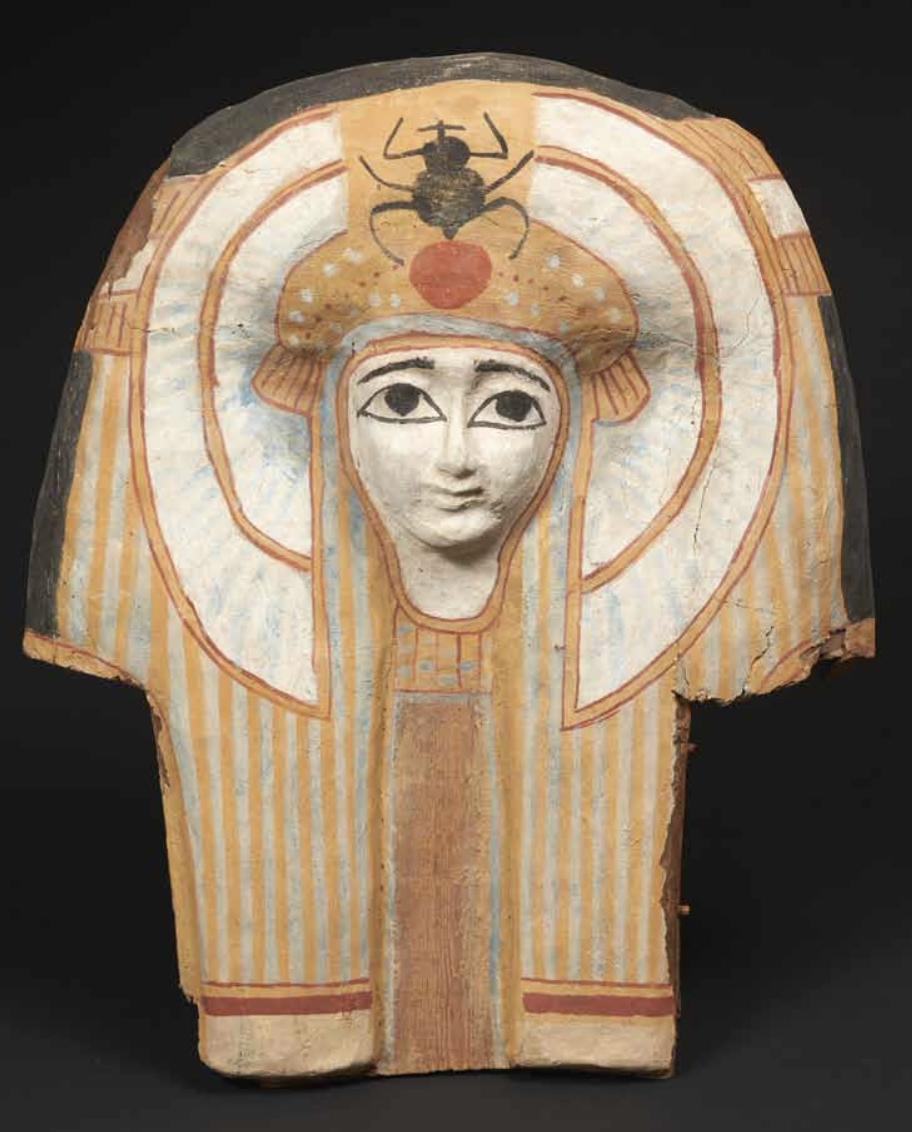
4 of 6 - A face from a painted wooden Egyptian coffin


Before being sundered in two, this Egyptian face once belonged to an anthropoid wood coffin decorated with plaster and then delicately painted in polychromy.  

This artefact was purchased by the Metropolitan during the same December 2015 sale as the previous stela, (accessioned in 2016) via Pierre Bergé auction house in Paris, with Christophe Kunicki, working as expert. 

Just before the Met took down this object's accession page, the museum listed the stela's provenance as:

Collection of Robert Boyd, originally from Scotland and living in Indonesia, from about 1890, possibly acquired through Eugene Dubois. Brought to the Netherlands by Boyd's descendants about 1950. Sold in 1968 by Galerie - 2000 annex Curiosa, Rotterdam, to Mr. Jan Veneman, Oegstgeest, the Netherlands. Subsequently sold again on the art market in The Netherlands. Placed by a Dutch dealer at auction, Pierre Bergé & Associés, Paris, December 16, 2015, where it was purchased by the Museum.

5 of 6 - Exodus Painting, five elements from a painted hanging depicting the Crossing of the Red Sea


The first appearance of the Exodus Painting in five fragments, depicting the Crossing of the Red Sea, occured in a 1998 publication, Alexandria: Die erste Königsstadt der hellenistischen Welt : Bilder aus der Nilmetropole von Alexander dem Grossen bis Kleopatra VII, written by Günter Grimm.   Grimm, who died 17 September 2010, is the same egyptologist who had a working relationship with Serop Simonian regarding the authentication of the suspect “Artemidorus” and other papyri while at the Archaeologisches Institut at the  Universität Trier.

Head of the University Institute in the mid-1980s, Grimm opened a small Late Period gallery in the Institute with objects from Serop Simonian’s stock.

On 26 November 2013 these five fragments came up for auction at Hôtel Drouot via Pierre Bergé & Associés with Christophe Kunicki listed as expert. At that Paris sale, Simonian's footprint was omitted and the only provenance given was: 

6 of 6 - An 8th century BCE Egyptian bronze statuette of a Kneeling Ruler or Priest


This sixth Egyptian artefact was seized at the Metropolitan Museum of Art earlier this year when linked to 81-year-old fugitive Georges Lotfi who split his time between New York,  Paris and Tripli, Lebanon. Lotfi was charged by the New York authorities in August 2022 with criminal possession of stolen property and remains at large.   

Before its seizure in February 2022, 2006, Lotfi sold the small bronze statue to the Metropolitan with a provenance history which read:

Ex Collection Joseph Shitrit, Israel, from the 1960s. Purchased from him by Biblical Antiquities, Jerusalem, Israel, 2005. Purchased by the Museum from Georges Lotfi, Tripoli and Paris, 2006.

In actuality the Egyptian antiquity had passed first through the hands of a source country looter in 2005, then on to a part-time looter/part-time dealer in Israel named Gil Chaya, a formerly licensed antiquities dealer from Jerusalem and the purported nephew of Shlomo Moussaieff. 


In 2011, as if to brag that pieces he handled had made it into a prestigious gallery at the Metropolitan Museum of Art, Chaya published a series of photos showing the bronze in his home, both before and after its restoration, posting a comment with the photo which read, "2 days after i clean it it was already in the amarna room at the MET."  This solidifies without a doubt that the provenance for this piece,as having come from the collection of Joseph Shitrit in the 1960s, is pure fabrication. 

Nine of the other Egyptian artefacts restituted in New York today are detailed in the Michael Steinhardt (Statement of Facts) document and are as follows:

1 of 9 - Vase from the Pan-Athenian Games


2 of 9 - Tel El-Yahudiyeh Beer Strainer


3 of 9 - Statue of a Winged Human;


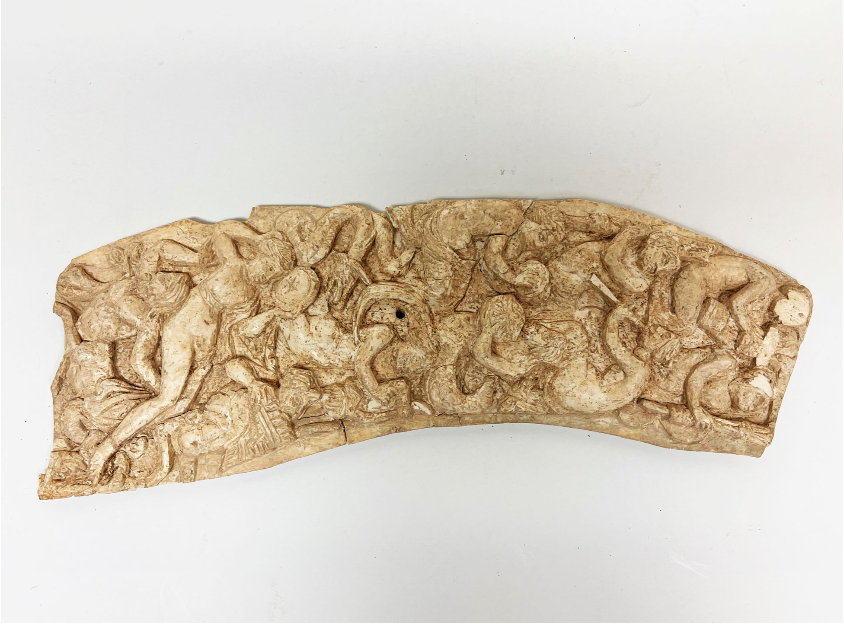
4 of 9 - A carved piece of ivory depicting 12 highly-engaged figures on musical instruments


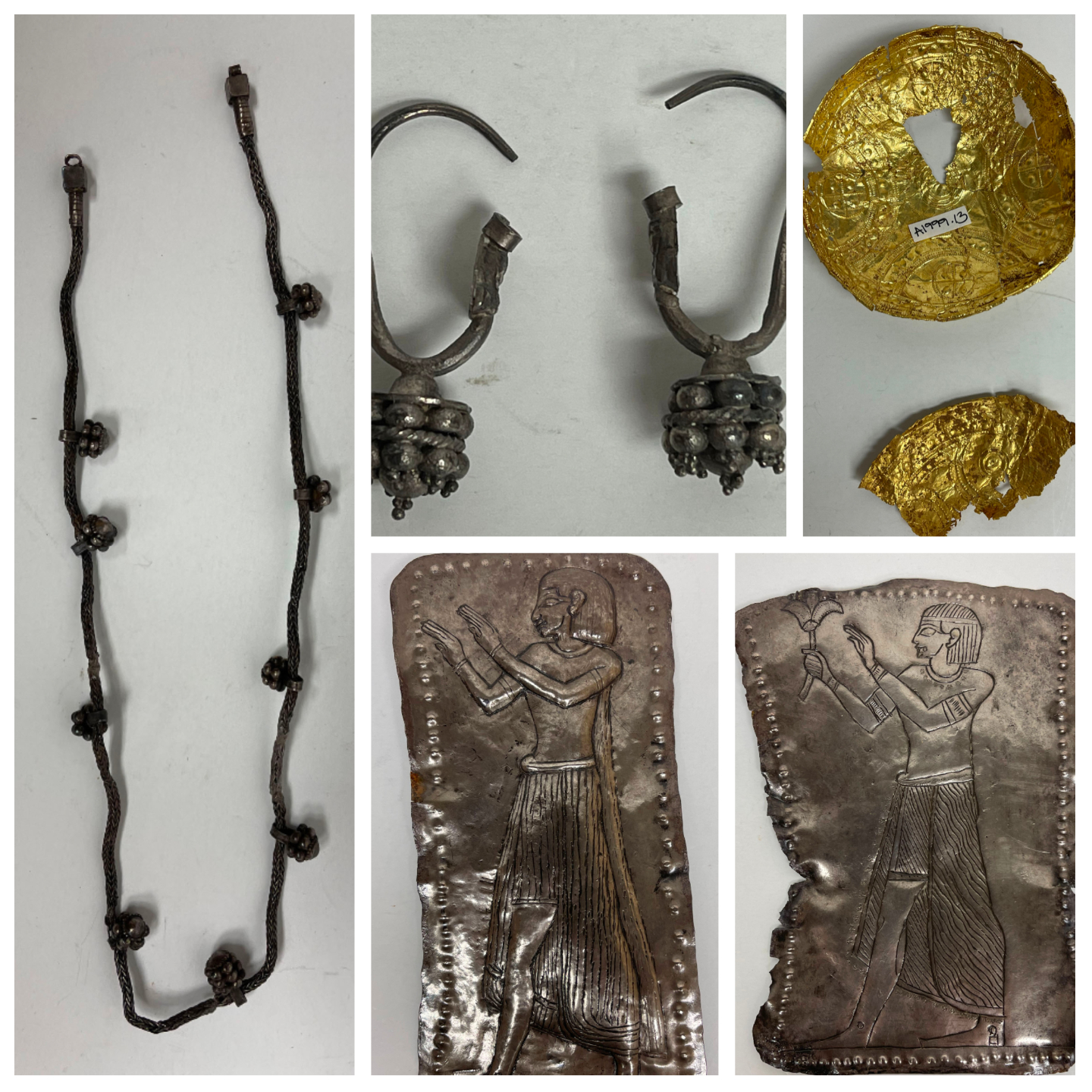
5,6,7,8,& 9 of 9 - A set of five gold and silver ornaments and plaques;


In 2017 the New York District Attorney initiated a criminal investigation into Michael Steinhardt’s acquisition, possession, and sale of antiquities.  That office's "Statement of Facts" document is the evidentiary basis for the conclusion that 180 antiquities possessed by Steinhardt constituted stolen property under New York law. 

The final object in today's restitution is a Ptolemaic gold coin.


This ancient coin was recovered as part of an ongoing investigation, which for now remains under the discretion of the prosecutor's office. 

In closing I would like to say that due diligence of looted antiquities, especially those that could be from conflict-based, or post-conflict source countries, must be meaningful and not simply and superficially plausible, in the furtherance of a purchase.  This holds true for lofty universal museums, as well as private buyers.  

Partially-documented histories in an object's collection background, do not necessarily always point to fresh loot or illegal export, but when an antiquity's background looks murky, as was obviously the case with several of these artefacts, museums and wealthy collectors need to step up their game, so they no longer perpetuate and incentivise plunder.  

Likewise, museums like the Metropolitan should not remove their accession pages, no matter how embarrassing they find them.  They should leave them up with notations that these pieces have gone home and who handled them. In doing so, they allow researchers and collectors to be more aware of the problem actors circulating material from past sales.  This also saves folks like me from having to store things away that only a few people can access. 

To conclude, ARCA would like to thank DA Bragg, Assistant District Attorney Matthew Bogdanos, Chief of the Antiquities Trafficking Unit; Assistant District Attorneys James Edwards-Lebair and Taylor Holland, Supervising Investigative Analyst Apsara Iyer, Investigative Analysts Giuditta Giardini, Alyssa Thiel, Daniel Healey, and Hilary Chassé; who alongside Special Agents John Paul Labbat and Robert Mancene of Homeland Security Investigations for the work put into these investigations.  

We would also like to thank Stephane Blumel, Major de Gendarmerie, of France’s Office central de lutte contre le trafic des biens culturels (OCBC) and Silvelie Karfeld and Nicole Pogantke of the Arts and Antiquities Crimes Unit of Germany’s Bundeskriminalamt (BKA) Kunst und Kulturgutkriminalität for their forensic investigative support in other jurisdictions.  Working collaboratively, we now know more about when, and where, and with whom, some of these recovered artefacts have circulated. 

By Lynda Albertson

March 27, 2025

From Pretrial Release to Disappearance: Where is Hamburg-based dealer Serop Simonian?

Having surrendered in Germany in connection with a multi-country investigation into illicit antiquities trafficking, Serop Simonian was extradited to France, where he was indicted on 15 September 2023 for fraud, organized gang money laundering, and criminal association, in a complex where he is accused of selling more than €50 million worth of illegally excavated antiquities.

Placed in pre-trial detention while his case made its way through the French courts, his French lawyer, Chloé Arnoux, requested that the courts consider pretrial release under supervision, citing Simonian’s advanced age (born in 1942) and his deteriorating health.  Approaching his 83rd birthday, and sensitive to the fact that his attorney had listed a range of health problems—including osteoarthritis, intestinal issues, migraines, and depression—a liberty and detention judge signed off on his release from La Santé Prison, located in the Montparnasse district of the 14th arrondissement in southern Paris.

According to an article first published by Emmanuel Fansten in the French newspaper Libération, the judge granted his pretrial release on 31 December 2024. The judge ordered Simonian to report once a month to the Hamburg police station and not to leave Germany, except in relation to his upcoming court case.

Given the gravity of the octogenarian’s alleged crimes—and the extensive evidence uncovered by Junalco, France’s National Jurisdiction for the Fight Against Organized Crime, linking Simonian to a criminal network that trafficked looted Egyptian artifacts to prestigious institutions such as the Metropolitan Museum of Art in New York and the Louvre Abu Dhabi—the General Prosecutor of the Paris Court of Appeal formally challenged his release from custody. Citing Simonian’s significant financial resources and extensive international connections, the prosecutor argued that he posed a serious flight risk and urged the court to reconsider its decision to ensure he remained within the jurisdiction of French authorities.

Two weeks after Simonian was granted pretrial liberty, the investigating chamber held a hearing, which ultimately reversed the earlier release decision and ordered that he report back to La Santé prison. Unfortunately, by this point, he had disappeared.

Simonian's case illustrates that age is no barrier to flight, particularly when financial means, international connections, and open borders make travel easier.

One well-known example of a senior citizen on the lam is Israeli-American businessman Jacob “Kobi” Alexander, the former CEO of Comverse Technology, who was charged in 2006 with securities fraud and other financial crimes. While out on bail, Alexander transferred millions of dollars overseas and fled to Namibia, a nation that has no extradition treaty with the U.S. He lived there for a decade before voluntarily returning to the U.S. in 2016 to face sentencing.

Another case is that of Leonard “Fat Leonard” Francis, the defense contractor at the center of one of the largest bribery scandals in U.S. military history. Francis, who was in his late 60s, was granted house arrest pending trial on the grounds that he was being treated for kidney cancer. However, while awaiting sentencing, he cut off his GPS ankle monitor in September 2022 and fled the country. Authorities later captured him in Venezuela, but his escape underscored how older fugitives can exploit compassionate release during ongoing judicial proceedings.

The flights from justice of these individuals, as well as Simonian's (whose whereabouts remain unknown), highlight how gray-haired, white-collar criminals with the financial resources to do so can evade justice just as easily as their younger counterparts.

Update:  28 March 2025 Journalists with The Art Newspaper have spoken with Simonian's lawyer, Chloé Arnoux,  who, breaking her initial silence stated that the problematic dealer was now at an assisted living facility near his family in Hamburg.   In another article Arnoux is quoted as saying "He was not notified in a language he understands that there was an appeal against his release."

No mention was made however explaining why she failed to explain this to her client given she would have been privy to the Court's decision as Simonian's counsel, or why, up until now he had not obeyed the French ruling to return to prison to await his trial. 

February 17, 2019

The Metropolitan Museum, Christophe Kunicki and a Luxor dealer names Tawadros: More questions than answers on recent Egyptian acquisitions

In researching details related to the acquisition and current restitution of the 1st century Egyptian B.C.E mummiform coffin, inscribed in the name of Nedjemankh, I came across two other objects which show Christophe Kunicki's relationship as an advisor of ancient art purchases to the Metropolitan Museum in New York.  

One of those objects is:

A Monumental Stela of Kemes , ca. 1750–1720 BCE


The provenance currently listed on the Metropolitan's website for the Monumental Stela of Kemes states:


A check of open source records using the names Ewe Schnell, Heinz Herzer and Pierre Bergé & Associés combined only turns up one other antiquity,  a panel painting of a woman in a blue mantle, which is also an acquisition within the Metropolitan Museum's collection. 


Serop Simonian is an art dealer of Armenian origin, born in Egypt and a resident in Germany.  He's interesting in that he has stirred up quite a bit of controversy regarding his involvement with the disputed Artemidorus papyrus, which he managed to sell in 2004 for €2.75 million to the Compagnia San Paolo Art Foundation notwithstanding that some experts have ascertained that it is a fake.  As the statute of limitations on that piece ran out, Simonian was never charged. 

On April 25, 2016 the Metropolitan's website for the Monumental Stela of Kemes stated the provenance as something quite different:


This earlier collection history mentions a "Todrous Collection" of which there is nothing documented in open source records anywhere on the web for any other ancient objects.  A late antique textile fragment of a tunic with the inventory number T 34, from "the Tamerit collection" is on record at the at the Papyrussammlung der Österreichischen Nationalbibliothek at the Austrian National Library though not much else.

Note this Metropolitan Museum record spells the name Todrous, while the recently restituted mummy spells the name Tawadrus, and trade journals spell the name Tawadros.  Later in this post you will also see the name spelled Tadross

Christophe Kunicki's own dealer website listed the provenance as:

Ancient european private collection, 1969.
With Tadross, Luxor, 1960’s

Stepping back even farther, outside of the museum's website, the Monumental Stela of Kemes was published in Volume 25 Number 5 of the journal Minerva: The International Review of Ancient Art & Archaeology.

This trade magazine listed the provenance as follows:

A rare Egyptian limestone chapel-stele of Kemes, superior of musicians (3), from the 13th Dynasty, circa 1770 BC (H. 73cm), in the form of a quadrangular naos resting upon a base carved with façades, was purchased from the Luxor dealer Tawadros during the 1960s. The cover-piece of the sale, it was estimated at €300,000-€400,000, but brought in a hammer price of just €200,00 from the Metropolitan Museum of Art. The expert for both sales was Christophe Kunicki.

Screen Shot: Volume 25 Number 5, Page 53
Minerva: The International Review of Ancient Art & Archaeology
Notice that the involvement of the French dealer Christophe Kunicki via Pierre Bergé & Associés in furthering this acquisition transaction does not appear in any of the Metropolitan Museum's provenance records for the 13th Dynasty Egyptian limestone chapel-stele of Kemes.  It only appears in the bimonthly trade rag for antiquities dealers.  Purchased on 21 May 2014 the Met's record also leaves out the "Luxor dealer Tawadros" connection on this object.  The name of that person is also the name associated on the  now restituted 1st century B.C.E mummiform coffin, inscribed in the name of Nedjemankh.

Note: Kunicki's website lists another egyptian object with the name "Habib Tawadros" giving us a another artefact linked to this mysterious Luxor dealer.

ARCA has notified the Egyptian authorities that this piece too may require closer examination. 

By Lynda Albertson

January 11, 2023

Not surprisingly, and despite all of his protestations earlier, Ali Aboutaam has been convicted.


In a hearing that took less than an hour at the Geneva police court, Ali Aboutaam, the owner of the Geneva gallery Phoenix Ancient Art SA has been sentenced by the Swiss authorities.  Following on a complex and multi-year criminal and procedural investigation by officers and analysts with Switzerland's customs and anti-fraud divisions, working with the Geneva Public Prosecutor's Office, the Swiss-based merchant has been found guilty of forgery of titles.  A misdemeanour under Swiss law on the transfer of cultural property, his admissions come with an 18-month suspended prison sentence, three years probation and requiring him to pay procedural costs totalling 450,000 francs or approximately €454,410.

The courts also confirmed the seizure of 42 artefacts, confiscated due to their illicit origin which will be devolved to the Federal Office of Culture.  Several dozen other antiquities will be returned to the countries of origin.

Aboutaam's conviction and sentencing comes in response to a conspiracy which proved that the art dealer, with the help of accomplices, produced false certificates of provenance in relation to ancient art objects in circulation. Aboutaam was also found guilty of having knowingly paid at least one accomplice, who sourced antiquities from illicit excavations in various countries of the Middle East.

A statement extracted from the Swiss indictment read: 
"Ali Aboutaam knew or must have assumed that they had been wrongfully acquired". 

This particular Swiss investigation dates back to 20 December 2016 when around 5:10 p.m., at around 17:10 hours, when arriving from France by car, a Swiss border patrol officer stopped a grey Land Rover vehicle, registration No. GE777994 registered to the company Phoenix Ancient Art SA, rue Verdaine 6 & 1204 Geneva at the Veyrier border checkpoint. The car had been driven by Ali Aboutaam's driver and was transporting then-Germany based antiquities dealer Roben Galel Dib as a passenger. 

The testimony of the two persons revealed that Dib was in possession of an antique oil lamp, which neither the driver, nor the purported owner of the lamp, were able to provide documentation for proving the object’s provenance to the officers’ satisfaction.  Dib told authorities he was coming to Switzerland to "meet a girl" and that he was carrying the lamp with him because he had just had an appointment on this subject in Paris to have it restored. The object was sequestered, and an inspection of the car revealed the presence of 3 receipts for the rental of two storage units at the company Flexbox Self Storage, route du Nant-d'Avril 40 in 1214 Vernier, in the name of a conservator in Chanoy. 

Both the driver and Roben Dib were released after questioning around 2:00 AM the following morning, while on or around that same time surveillance footage of the storage warehouse listed on the receipts found in the car captured Ali Aboutaam’s wife, Biljana Aboutaam, the family's chauffeur and a housekeeper participating “several movements of merchandise".  Predicated on the foregoing, Swiss Customs Administration developed a “strong suspicion” that the warehouse was being used to store illegally imported art and antiquities. 

As is publicly now known, Roben Dib is the business partner of Hamburg-based dealer of Egyptian art Serop Simonian.  Dib was arrested in Hamburg by German police on suspicion of art trafficking in August 2020 and released after only five weeks behind bars.  

Subject to a European Arrest Warrant, Dib was then rearrested in Paris, France on 22 March 2022 after traveling there to discuss charges related to dealing in illegally trafficked Egyptian antiquities with French authorities.  

Both Dib and Simonian have been tied to million dollar illicit antiquities which have made their way (illegally) into the Metropolitan Museum of Art, the Louvre Abu Dhabi, and museum and private collections throughout the world on the basis of false provenance documentation, a subject which has been covered with frequency on this blog.  

In January 2016, a 3rd millennium BCE, alabaster plaque was displayed at the European art fair BRAFA after first passing through Port Franc, the free port of Geneva to Inanna Art Services, a subsidiary of Phoenix Ancient Art.  This artefact, according to a qualified Syrian archaeologist, likely came from the ancient Mesopotamian city of Mari.  This artefact was confiscated following an inspection operation, carried out by the Belgian Federal Public Service Economy (French: SPF Économie, Dutch: FOD Economie) along with a marble table in the context of a suspicion of illicit trafficking in antiquities. 


The plaque was first identified in the Aboutaam's Phoenix Ancient Art 2012 - Crystal IV catalogue, which listed the 39.5 cm 3rd millennium BCE plaque with an image of ritual worship as having a provenance of: 

"Ex Elie Bustros Collection, Beirut, 1950s-1960s"

implying that the artefact may have come from the Beirut dealer Elias (Elie) Bustros, purportedly active from at least the 1930s through by some records the 1980s.   

It should be noted that in addition to its Ottoman Empire laws an antiquities, the Syrian Republic's Antiquities Law, Decree No. 222, was enacted in 1963.  That law vested ownership of all antiquities in the State and prohibited the sale or transfer of antiquities without governmental approval. 

This is not, however, the only incidence where "Ex-Elie Bustros Collection" has been used in connection with an artefact handled by Phoenix Ancient Art.


Provenance:
Elias Bustros, Beruit 1950’s-1983;
By descent, 1983-1986?;
(Gawain McKinley, England, on behalf of Selim Dere and Sleiman Aboutaam, 1986)

Selim Dere is the owner of a New York antiquities gallery, Fortuna Fine Arts where Manhattan authorities executed a seizure warrant in June 2018. Erdal Dere (the son of Aysel Dere and Selim Dere), was indicted in the US indicted in relation to a conspiracy to defraud buyers and brokers in the antiquities market with the use of false provenance documentation. 

The Belgian identifications resulted in a separate four-year investigation overseen by the Belgian federal prosecutor's office into the activities of the Aboutaam brothers, who opened a branch of Phoenix Ancient Art in the city of Brussel's Sablon in 2017.  This branch was subject to police raids in 2019 ordered by Judge Michael Claise. 

By June 2021, a Lebanese intermediary of Phoenix Ancient Art had already been condemned by the Geneva public prosecutor for having imported archaeological objects looted in the Middle East.  This individual was identified as having travelled to Geneva four or five times a year, for four years, to deliver ancient objects to Ali Aboutaam. Arrested in Romania, he was extradited at the request of the Geneva public prosecutor's office.

That same year, in November 2021, Ali Aboutaam was handed a 1.6 million francs fine via Swiss customs, including the costs of the proceedings. The tax authorities came after the dealer in this instance for having imported 37 million francs worth of antiquities into Switzerland between 2010 and 2017 without paying the applicable VAT. 

Which brings us back to the present, the Swiss indictment, accepted by Ali Aboutaam within the framework of a simplified procedure, acknowledges the following, verbatim:

"Ali Aboutaam, in his capacity as administrator of Phoenix Ancient Art SA, has asked art experts, or has asked employees of Phoenix Ancient Art SA to obtain from art experts: produce and/or sign false invoices; and/or produce or cause others to produce documents indicating source that are contrary to reality, sometimes contained directly in invoices; and/or provide untrue source indications for use by others."

In another section of the indictment, Aboutaam agrees that the falsification  of provenance documentation was done to launder the artworks, giving them: 

"a pedigree aimed at dispelling suspicion of illicit provenance and/or to facilitate their customs transfer with a view to their sale on the art market through Phoenix Ancient Art SA, Tanis Antiquities LTB and Inanna Art Services SA, i.e. companies of which Ali Aboutaam has Control."

The mention of Tanis is significant.  It helps conceptualise the range of years where this shell company has been linked to questionable transactions and laundered antiquities.  In 13 December 2003 Hicham Aboutaam, Ali's brother, was arrested in the United States and charged with smuggling the silver ceremonial drinking vessel known as a rhyton into the United States from Iran and falsely claiming that it came from Syria.  That 2003 government complaint identified the gallery’s affiliate office in New York as "the Bloomfield Collection" and informed that the invoice for the artefact, declaring Syria as country of origin was issued by Tanis Antiquities, Ltd.  

Tanis Antiquities, Ltd comes up again very recently in the ongoing important French investigation involving materials sold to the Louvre Abu Dhabi.  As reported by the French newspaper Liberation, French investigators discovered that Jean-François Charnier's sister, Marie-Christine Charnier, had received money from the Aboutaam family via an account opened in a Moroccan bank, paid from the offshore structure controlled by the merchants, again, Tanis Antiquities Ltd., based in Saint Vincent and the Grenadines.  

The legal representative for Tanis Antiquities Ltd is, a Canadian citizen, of Lebanese origin, resident of Geneva, Ali Aboutaam.

I will close this article by mentioning that this is not the first occasion where the Aboutaam family, or Ali personally, has had run ins with legal authorities for their involvement  in the circulation of suspect artefacts originating from varying jurisdictions regarding trafficked objects from the Middle East.  In April 2004 Ali Aboutaam was tried in absentia in an Egyptian court and pronounced guilty and sentenced in absentia to 15 years in prison in a long-running trafficking ring that had smuggled Egyptian artefacts through Switzerland to Western dealers and galleries.  That investigation resulted in the convictions of 25 defendants, including several high-ranking Egyptian police and government officials and nine foreigners. 

November 27, 2025

Red Flags Ignored? Seventeen Egyptian artefacts have been formally returned to Egypt from Australia

In a significant victory in the fight against illicit antiquities trafficking, seventeen Egyptian artefacts have been formally returned to the Government of the Arab Republic of Egypt in a handover held at the Australian Parliament House in Canberra on 26 November 2025, where officials marked the return as a milestone for cultural property protection.   Ambassador Nabil Habashi, Deputy Minister of Foreign Affairs, presided over the ceremony, receiving the voluntarily repatriated artefacts from an Australian citizen in the city of Melbourne, in coordination with the Australian side.   Additionally, Egypt and Australia signed the documents for the return of 17 rare Pharaonic artefacts to Egypt.

As Per MP Tony Burk, "most of the objects were purchased online and imported into Australia from the United States of America on separate occasions. A number were detected during a 2019 global operation to combat cultural property trafficking led by INTERPOL and the World Customs Organisation." 


Among the items handed over were:
     • a wooden statue of Isis which dates to the Ptolemaic period (332—30 BCE)
     • a sarcophagus panel depicting the goddess Nut (also Nunut, Nuit), mother of 
      Isis (664—30 BCE)
     • a mummy case (1570—332 BCE)
     • an amulet of Ptah (664−30 BCE) 
     • a matching amulet headrest (1,070−323 BCE) 
     • a range of pottery vessels and funerary jars spanning epochs from Naqada II 
      (c. 3500 – 3200 BCE) to the Ptolemaic era (332 – 30 BCE)
     • and a mummy cartonnage ensemble for a child

These objects had been illicitly acquired and imported into Australia from the United States and were eventually seized under Australia’s Protection of Movable Cultural Heritage Act 1986, which enables the repatriation of cultural property illegally exported from its country of origin.  

Left Image: Artemis Auction sale photo
Right Image:  Restituted cartonnage ensemble

The child's cartonnage ensemble, used for adorning a mummified body, is interesting as it was put up for auction online by Teresa and Bob Dodge at Artemis Fine Arts auction house in Louisville, Colorado where it reportedly sold for $10,000 USD on 13 February 2020.  


The provenance listed for the auction of this artefact was listed as:

Private J.H. collection, Beaverton, Oregon, USA; ex-Relics of the Nile, Lexington, Kentucky; ex-private S.O. Simonian collection, Switzerland, acquired in Egypt and transported to Switzerland in 1972, where they have been held in storage since 2010

J.H. is Jeff Hallen, a part-time collector-dealer in Beaverton, Oregon who, according to his Facebook profile was once affiliated with Yanto Alexander Fine Art.  He has also stated in a social media group that he was selling his collection through Artemis in Colorado.   Relics of the Nile, is a virtual dealer operated by Mike Sigler who in turn has purchased and circulated ancient artefacts which have passed through the hands of at least one suspect dealer operating in Dubai.

One should also note that this online sale took place in 2020, the year after Serop Simonian's name was scandalously linked as the alleged trafficker of the Gold Coffin of Nedjemankh, seized by the D.A.’s Office in Manhattan and HSI New York from the Metropolitan Museum of Art as well as other problematic pieces.  Given the high visibility of that scandal, it is reasonable to question what level of due diligence, if any, was conducted by Dodge when Artemis purchased, or accepted, the cartonnage on consignment, before subsequently auctioning the suspect artefacts onward to the  collector in Melbourne.

Why This Matters for the Global Fight Against Cultural Heritage Crime

The repatriation of these objects highlights a few critical truths for the broader field of cultural heritage protection:

It demonstrates that trafficked artefacts can surface and travel anywhere in the world, even in countries far removed from their origin, and that the illicit trade in cultural property often spans multiple continents, from excavation zones in post-conflict source countries, through transit countries, and on to primary and secondary market countries changing hands multiple times in sales and exports before arriving to private collectors, 

Laws like Australia’s Protection of Movable Cultural Heritage Act, combined with effective enforcement at borders and cooperation between national authorities, is what makes a real difference in recovering cultural property for source nations. And restitution is more than a symbolic act, it allows communities to reclaim part of their collective heritage.  For organisations like Association for Research into Crimes against Art (ARCA), this case serves as a concrete reminder that global vigilance, cross-border collaboration, and robust legal frameworks are essential if we are to put even a small dent in the tide of illicit heritage trafficking.

As we reflect on this satisfactory outcome, we should ask ourselves: how many more objects remain untraced, circulating anonymously through auction houses, private collections, or illicit networks? And if I found it this easy to trace the provenance of just one of these restituted objects, why is it that dealers and auction houses continye to walk around with one eye closed for the sake of a sale? 

By:  Lynda Albertson

July 3, 2019

Questions for Christie's with regards to its upcoming sale of the Quartzite head of the young pharaoh portrayed as the ancient god Amun

Unpacking some miscellaneous thoughts on the upcoming Christie's sale.

@ChristiesInc does the name Heinz Herzer sound any alarms?  

What valid paperwork does the auction house in their possession which would substantiates that the quartzite head of the young pharaoh portrayed as the ancient god Amun, left Egypt legally?

Has anyone provided the auction house with shipping, storage, customs, or insurance records of any kind documenting when and how the quartzite head left Egypt, or when and how it arrived in Munich or elsewhere during its travels?


Looking over your Resandro Head Fact Sheet the first thing that draws my eyes was not the head's innate beauty but rather it once being in the possession of a specific Munich dealer, Heinz Herzer.  As a firm champion of Italy's right to the return of  the statue known as The Victorious Youth, also known as The Getty Bronze or Atleta di Fano I am all to familiar with the fact that the very illegal, proven illicitly exported statue was acquired by Heinz Herzer in 1971.  Herzer even created a publicly traded fund called Artemis S.A., specializing in art works just to sell the bronze to either Thomas Hoving, the former Director of the New York Metropolitan Museum of Art.or John Paul Getty for his California Museum.  


But before the statue’s sale to the J. Paul Getty Museum, Herzer’s Munich firm removed the corrosion and incrustations covering the bronze statue, meaning Herzer had knowledge of the statue’s existence during the earliest periods of its clandestine movements. 

Image Credit:  Jiri Fril
Evidence presented by the Italian state at the Tribunal in Pesaro, Italy and later at the Appellate and Supreme Court demonstrate that Artemis was created ad hoc, with the specific purpose of managing the exportation and subsequent purchase of this valuable, but illicitly smuggled statue.  As most will remember, Italy's Appellate Court, followed by its Supreme Court, ultimately affirmed that this statue was clandestinely removed from Italian territory and has issued an order for restitution of their bronze. 


But back to the Quartzite head.  Christie's documentation state that Prince William of Thurn and Taxis owned the sculpture in the 1960s and sold it to Josef Messina, the owner of Galeria Kokorian & Co., Vienna, between 1973 and 1974.  


Best I can see Galerie Kokorian & Co KG, located at Spiegelgasse 19, 1010 Wien, Austria seems to be a discretely modest paintings gallery.  An unusual place to have an Egyptian statue of this significance to say the least. 


Let's also talk about the prince for a minute.  His full name was Wilhelm Alexander Lamoral Erich Maria Josef Ignatius Von Loyola Franciscus Von Assisi Benedictus Cyrillus Quirinus.  He lived from  1919-2004.  

As a general rule, as Live Science journalist Owen Jarus stated, the prince often went by the name "Willy".  Digging through records you can find some things listed in this diminutive name which includes some generalized information about his life including his debutante ball work but nothing at all on his collecting Egyptian antiquities.  Closest he ever appears to have gotten to Egypt was a brief stay in Morocco after the second World War.

There is even a strange mention of some former actress who swears that she was secretly married to him.  Her name is Ilona Medveczky.   Yet I find absolutely no mention of her having every had an art collection containing Egyptian artefacts. 

Even the prince's grave seems to me to be a modest one....so again, I would question if he was wealthy enough to have had an important, yet for all intents and purposes, unknown, ancient art collection.  

His niece, Daria Maria Gabriele Prinzessin von Thurn und Taxis was born on 6 March 1962. She is the daughter of Franz von Assisi Prinz von Thurn und Taxis (the prince's brother) and Mafalda Theresia Franziska Josepha Maria Prinzessin von Thurn und Taxis.  She told the Live Science journalist she didn't recall her uncle having such a piece in their collection. 

Interestingly though, I find nothing linking any official (legitimate) sons or daughters to the prince within official peerage documents.   I did find reference to a "Viktor", referred to in the Live Science article as Willie's son.  He is stated to live in Vienna and goes by the simplified name of Viktor Thurn Und Taxis and manages a Vienna film company called  VTT Film Service.   Who his mother was and why he is not listed on the noble roster is a mystery still to be untangled. 

Further digging I could see that there are three branches of the von Thurn und Taxis family: the German, Czech and the Austrian, each of which have little or no love lost for one another.  The German branch seems to be the very very wealthy one and extremely put out by the Czech branch of the tree going so far as to file at least one lawsuit against its relatives across the border. 


But let's not stray too far from the activities of Heinz Herzer and other dealers of interesting repute in the recent past that make me speculate about the legitimacy of this stone head.   Herzer's appears to have been associated with French dealer Christophe Kunicki, who was involved in the questionable acquisition of the looted Egyptian B.C.E mummiform coffin, inscribed in the name of Nedjemankh.  

Herzer's name is also connected with Serop Simonian, an art dealer of Armenian origin, born in Egypt and a resident in Germany.  Simonian's involvement in the Nedgemankh case makes for some interesting court document reading, as does the notoriety he gained with the controversy over the disputed fake/authentic Artemidorus papyrus, which sold for €2.75 million to the Compagnia San Paolo Art Foundation in Italy in 2004. 


Herzer and Serop's names both come up alongside the French dealer Christophe Kunicki via Pierre Bergé & Associés in the provenance of a 13th Dynasty Egyptian limestone chapel-stele of Kemes, which Kunicki sold to the Metropolitan Museum in 2014. This object's provenance also connects with the same Egyptian middleman, and was purportedly purchased Feb 1969 by Uwe Schnell from Heinz Herzer Gallery in Munich.


Which brings us back to Hertzer’s name in Christies Auction of a quartzite head of the young pharaoh, which portrays him as the ancient god Amun.  Lot 110, is set to be auctioned in London tomorrow in Sale 17042 on 4 July 2019.


Yet despite statements made by noble family members that they have no recollection of the object, the potential purchaser (as well as Egyptian authorities apparently) are supposed to accept the auction house’s word that due diligence has been properly and sufficiently conducted without being privy to any of the documentation Christie's used to made their determination that this stone head is fit for sale. 


Where is the paperwork provided to the auction house which fully and clearly confirms that this antiquity left Egypt legally and was once truly part of a collection of Prinz Wilhelm von Thurn und Taxis?
Image Credit of Egyptian Law
Courtesy of ICOM Red List for Egypt.
If this antiquity was removed legally from its country of origin, before the effective date of Egypt’s applicable patrimony law, the seller of the object should be able to provide something tangible to substantiate that export date.


In its statements to the Press, officials from Christie's have stated "It is hugely important to establish recent ownership and legal right to sell which we have clearly done. We would not offer for sale any object where there was concern over ownership or export."

In the interest of transparency, and good faith, and with Egypt’s Ministry of Antiquities making diplomatic demarches to INTERPOL, UNESCO, ICOM, the British Foreign and Commonwealth Office as well as asking Christie’s directly to provide any concrete information on the object's validity for sale on the London market, shouldn't tomorrow's pending auction be postponed until such time as the Egyptian authorities have been given the opportunity to satisfactorily review any and all related documentation that Christie's had at its disposal when making its claim that this object is licit and not illicit?   

By:  Lynda Albertson