
Blog Subscription via Follow.it

Showing posts with label Centuripe. Show all posts

October 9, 2026

The Wedding Photographs That Exposed an “Old Swiss Collection”

The photographs recorded a 1979 wedding in Sicily: guests celebrating, a cake being cut, tables covered with presents.  Elsewhere, on the same roll of film, were archaeological objects, including the richly painted ancient vessel which is the subject of this article.  Decades later, those neighbouring frames would help expose the false collecting history attached to an ancient vessel sold to the Allard Pierson Museum, ultimately helping secure the vessel’s voluntary return.

On 7 October 2026, the Amsterdam museum voluntarily returned its third-century BCE Centuripe pyxis to the Sicilian authorities after having acquired the artefact almost thirty years earlier in a ceremony attended by the assessore (regional minister) and the Director-General of the Assessorato dei beni culturali e dell'identità Siciliana, staff from the Comando Carabinieri Tutela Patrimonio Culturale as well as  staff from the Allard Pierson, the Dutch Information and Heritage Inspectorate and Dutch National Police.  The museum's decision to voluntarily relinquish the vessel followed an interesting research path that ultimately undermined the account supplied when the painted vessel was purchased, exposing the distance between an antiquity’s reassuring circulation history and condemning evidence of its illegal exportation.

The star shaped city of Centuripe

This pyxis takes its name from Centuripe, the Sicilian town whose ancient workshops produced this very rare and distinctive form of polychrome pottery.  Its elaborate painted decoration includes a bridal scene, Apollo, and winged figures associated with love.  These types of fragile vessels have often been interpreted through their wedding imagery, but archaeological comparisons suggest the vessels were used for funerary purposes.  The museum’s own research considers this example likely to have been placed in a chamber tomb as a burial gift.  Unfortunately, its precise excavation context has been lost.

In 1997, the Allard Pierson purchased the pyxis at The European Fine Art Fair (TEFAF) in Maastricht, from the Swiss antiquities dealer Herbert Cahn.  As the acquisition history records, it was one of three Centuripe objects bought by the museum with funds from a bequest, alongside a lekanis, and a small plaque depicting a woman.  

At the time of its acquisition, Cahn stated that the pyxis originated from a private Swiss collection dating back to before 1970.  Afterward's the museum's new antiquities were celebrated in an article written by H.A.G. Brijder, titled 'Polychrome Bridal Gifts from Centuripe', in its June 1998, no 71 issue of the Mededelingenblad (newsletter) of the Association of Friends of the Allard Pierson Museum. 

Unfortunately, what the museum had acquired in aesthetic and scholarly interest was not matched by refined provenance inquiry.  No export permit or supporting ownership records accompanied the object's sale substantiating its legitimate circulation and the museum's purchase seems to have been based solely on the seller's assurance that it had previously been in Swiss private ownership. 

Lucky for Italy, ordinary events recorded alongside a photo of this antiquity  provided a chronological reference against which the dealer’s provenance could be tested.

In 2016, the photographic archive of Antonello Catania, a local photographer in Centuripe, came into the hands of the historical society SiciliAntica which played an important role in identifying the illegal transfer of the 3rd century BCE Centuripe Pyxis.  In addition to other photographic assignments, Catania also seems to have been the great-nephew of a skilled forger and tombarolo of the time, Antonino Biondi.

Preparations for an exhibition brought attention to a series of images from the same roll of film which depicted antiquities among the photographer’s records of local life in Sicily.  Archaeologist Giacomo Biondi recognised the Amsterdam museum's pyxis in a series of images which show the artefact in a newly excavated state, and prior to its restoration and circulation with Herbert Cahn. 

The photos of the pyxis appear on the same roll of film as this wedding celebrated in Centuripe in 1979.  This ordinary event, intermingled with the photos of this artefact provide a chronological reference point against which the dealer’s provenance could be tested.

Together, they placed the ancient vessel as still being in Sicily as late as 1979, a fact which directly invalidates Cahn's account.  So while these photographs do not give us an exact excavation date or reconstruct how this antiquity was removed from Sicily and transferred to Switzerland, it does expose the underlying central defect in the provenance cover offered by the dealer facilitating its sale. With this discovery, the purported old Swiss collecting history could no longer be accepted.

By 2017, these findings had prompted a request from the public prosecutor in Enna seeking the pyxis’s restitution.  Yet demonstrating the problems with an object’s history and compelling its return proved to be separate matters.  Dutch authorities considered the applicable legal framework insufficient to enforce restitution in this case.  The Netherlands had implemented the 1970 UNESCO Convention in 2009, a date far after the museum’s purchase, and the relevant provisions were not retrospective.

The museum eventually chose voluntary restitution on ethical grounds.  Before the handover, it also made the impending departure part of its public interpretation.  In From Centuripe, with Love, University of Amsterdam Museum Studies students examined the pyxis’s history and asked how a museum might say goodbye to an object it had displayed for years.  This exhibition gave visitors an opportunity to understand why an acquisition once celebrated could become a dialogue for responsibility and return.

The 2026 handover is therefore the outcome of more than just an institutional change of heart.  It rests on the preservation of a local archive, careful identification, the reconstruction of a chronology that the acquisition itself had lacked and public will. 

For those investigating looted antiquities, the case demonstrates why the seemingly incidental details in old photographs deserve attention.  A recognisable guest, a dateable celebration, or the sequence of images on a surviving negative strip can help establish a chronology of when an object was somewhere its market history says it should not have been.  Such evidence can survive long after dealers, like Herbert Cahn, have died, when transactions become difficult to trace, or where unsupported assertions have hardened into museum catalogue entries.

The pyxis spent almost thirty years in Amsterdam. Its supposed Swiss history did not become more reliable with age.  It remained an assertion awaiting scrutiny, until researchers in Centuripe found the photographs that allowed them to test it.
August 10, 2023

So one particular (Sicilian) looting "mafia" was actually a Mafia.


Interrogated by Palermo prosecutor Maurizio De Lucia and deputy prosecutor Paolo Guido, shortly after his January 16th arrest by the Carabinieri del Ros, Cosa Nostra boss Matteo Messina Denaro, A.K.A. "Diabolik", had a lot to say about the source of his family's wealth during his 30 years on the run.   

Filed by the Court's yesterday, the kingpin's first formal judicial interrogation after his arrest took place on February 13, 2023.  In the official transcript of this exchange, which covers 69 pages, some heavily marked with redactions, we learn interesting details regarding some of the 62 year old mafioso's conversations and admissions, both given and made during his hour and forty minute interrogation with the Court's magistrates last winter. 

In some of his documented statements, Matteo Messina Denaro appears to have been extremely blunt about what he was willing to admit to and what he was not, regarding critical aspects of his criminal life and life on the run, stating:

"Listen, there will be things I don't answer, things I answer and I'll explain why I'm answering, and things I'll explain why I don't want to answer ” , while “ if I'm lying and it's obvious that I'm lying, let me pass, it means that I do not want to answer."

During his interrogation, the crime boss, denied to prosecutors that he had ever profited from drug trafficking or that he had any involvement in the more than 50 murders of which he has already been convicted.  This despite the fact that in 2012, while still a fugitive at large, Matteo Messina Denaro was one of five people sentenced to life imprisonment, in part, for his role in the kidnap, torture, and murder of 12-year-old Giuseppe Di Matteo. 

Di Matteo was the son of a mafia turncoat.  Held in captivity for 25 months before his murder,  according to Messina Denaro's reconstruction, he was just the instigator of the kidnapping of the child, and not responsible for his murder, though he admitted. "Listen, I'm not a saint..."

Denying that he was a Made Man, (a fully initiated member of the Mafia) Messina Denaro stated: "I feel like a man of honour but not as a mafioso. I know Cosa Nostra from the newspapers".   He also told the magistrates that he had evaded capture until January, in part by steering clear of technology because he saw its usage as a vulnerability, though this would become part of his undoing as his health worsened and he required the use of a mobile phone to stay in contact with the medical community. 

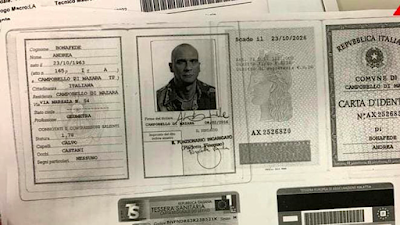
When discussing his life as a fugitive, using the name of Andrea Bonafede while hiding in plane sight in Campobello di Mazara, Massino Denaro told his judicial  interrogators that they had only captured him because he had been struck down with liver cancer and that this health related crisis required him to undergoing medical treatment at La Maddalena clinic.  Describing how he had been able to stay under the radar, he rationalised: 

"I followed an old Jewish saying, 'If you want to hide a tree, plant it in a forest."

But with worsening health, planting himself in the heart of the town while undergoing cancer therapies made the boss more visible. When asked about those who helped him remain hidden and with whom he had interacted while hiding in the Sicilian town, Denaro added "if you have to arrest all the people who had something to do with me in Campobello, I think you have to arrest two to three thousand people: that's what it's all about".

But while the Cosa Nostra boss denied his violent and drug-related crimes, during his interrogation he openly claimed that the Messino Denaro family supported itself through the buying and selling illicit artefacts, many of which were plundered from Selinunte, the rich and extensive ancient Greek city of Magna Graecia located in the territory of his home town of Castelvetrano, in southwest Sicily.

He told prosecutors that his father, Francesco Messina Denaro was an art dealer.  When asked if his father was a man of honor in the mafia sense he told the magistrates that he never asked him that question, then underscored "I hope that he had been, at least his life would have had meaning". 

Known as "Don Ciccio," Matteo Messina Denaro's father died as a fugitive, having been identified as the mafia boss who headed the Castelvetrano family from 1981 until 1998.  His father was a close ally to the Corleone faction loyalists led by Salvatore "Totò" Riina and Bernardo Provenzano.

Speaking further about his father's illicit ancient art involvement Messina Denaro was documented as admitting:

"My father didn't go digging in Selinunte though. At that time there were a thousand people and all of them, even the women, they dug at night. Those who didn't dig at night, dug during the day with the Superintendency of the State, but what else did they do (now maybe it can't be done anymore), that when with the axe they saw something coming out with their foot they covered it up and then at night they went back to it take it. 

In general, my father bought 100% of these things which were then sold in Switzerland and then arrived from Switzerland everywhere in Arabia in the United Arab Emirates, in America. We used to see things that passed through my father's in American museums, I don't know how they got there in museums but then it all started from Switzerland"

The crime boss also spoke knowledgeably about workshops of counterfeiters in Sicily, involved in the enhancement of Greek polychrome vases dug up by tomb-robbers who plundered the Hellenistic necropolis of Centuripe.  He explained to the Court's prosecutors that looters working in and around the province of Enna were known to add forged figural imagery to undecorated ancient vases, reburying them for several years in order to age their augmentation so that the terracotta vases brought higher prices when sold onward on the black market.  

Using a lekythos (a type of ancient Greek vessel used for storing oil) as his example, the Mafia boss stated that an ancient vase without a figure might be worth 2 to 3 million lire, while the object's value rose to 20-30 million or 40 million when the artefact depicted embellished imagery that passed as part of the original vase maker's artistry.   Messina Denaro also told the magistrates that in 1978 he found an ancient vase full of coins and spoke in a semi-informed way about how looters discovered and sold some of the ancient material in circulation via the Messino Denaro clan. 

He told the magistrates that silver coins could be found using metal detectors when coins were scattered on the ground but that finding vases required grave-robbers.  He also added that these graves also on occasion contained hoards of coins, often in excellent condition, having been buried with the tomb's occupants. 

He told the magistrates that his father had purchased seven such hoards, while an 8th was traded directly to dealers in Switzerland by the hoard's finder.  Messina Denaro admitted that in one such case, his father paid for one hoard of silver coins in instalments, as he didn't have the 800 million lire in his pocket that the finder was asking for the haul.  To obtain this grouping of coins, Francesco Messina Denaro wrote the seller a check for the entire amount, which was held as a guarantee by the finder and then torn up once the negotiated asking price had been paid in full. He stated that his father then broke up the hoard, selling it off piecemeal. 

While portions of Matteo Messina Denaro's interview imply that his life on the lam was financed by his father's illicit antiquities trade, rather than his own more serious and violent crimes, the unredacted portion of the interrogation does not appear to identify the Swiss-based receiver of the Cosa Nostra's looted ancient material which was laundered via Switzerland before ending up in museums.

Readers of ARCA's blog can make an educated guess who at least one of those traffickers might be, but we will have to wait to see what other reports come out in the days, weeks, and years to come.  One thing is for sure, the crime boss has ruled out repenting and in agreeing to answer questions, only admitted to what he could not deny. 

Suffering from cancer, Matteo Messina Denaro has remained under treatment in an Italian penitentiary since the day of his arrest where a room for chemotherapy has been set up for his required cancer treatment.  Several hours before a scheduled surgery, on August 8th he was transferred from prison to the San Salvatore hospital in L’Aquila, amidst tight security measures related to the 41bis regime where he was operated on for an obstruction “not closely related to cancer.”  According to the guarantor of prisoners in Abruzzo, Gianmarco Cifaldi the mafia boss is currently in intensive care as a standard precaution. 

Messina Denaro's defense council recently argued that his health conditions are not compatible with Italian law, Article 41-bis of the Prison Administration Act, also known as carcere duro ("hard prison regime"), arguing that he requires medical assistance 24 hours a day.  Cifaldi, however, reiterated that the right to health is already guaranteed through the use of qualified medical personnel, and that all state agencies are operating in compliance with the Italian Constitution.

Currently Article 41-bis of the Prison Administration Act is applied to people imprisoned for crimes such as mafia-type association under 416-bis (Associazione di tipo mafioso), drug trafficking, homicide, aggravated robbery and extortion, kidnapping, terrorism, and attempting to subvert the constitutional system. It is suspended only when a prisoner co-operates with the authorities, when a court annuls it, or when a prisoner dies.

By:  Lynda Albertson