Blog Subscription via Follow.it

Showing posts with label Pierre-Auguste Renoir. Show all posts

September 9, 2026

Stolen Once by War, Stolen Again by Thieves: The Troubled Provenance of Renoir’s Jeune Femme au puits


When two burglars broke into the Musée Renoir at Cagnes-sur-Mer before dawn on 8 September 2026, they removed four paintings from the same room in a matter of minutes.  Two were abandoned as the thieves fled.  Two were not.  One of the paintings still missing, Pierre-Auguste Renoir’s Jeune Femme au puits, carries with it a history that makes yesterday’s theft considerably more troubling than the loss of a valuable Impressionist painting alone.

Painted around 1886, this small oil on wood, measuring approximately 35 by 27 centimetres, depicts a young woman standing near a well seen in left-side profile as she raises her right arm to hold the rope to which a bucket resting on the well’s rim is attached.  Today it is registered as MNR 579.  The French Ministry of Culture describes it as an unfinished work depicting a woman beside a well and officially classifies it as an “œuvre probablement spoliée”, a work probably looted during the Nazi period, based on the present state of research.

The French government’s Rose-Valland database places the painting as at one point possibly in the collection of Ambroise Vollard and records the possibility that it subsequently belonged to a M. Voigt in Düsseldorf, citing François Daulte’s 1971 catalogue raisonné.  Later, research establishes that the painting was with Galerie Zak in Paris during, and immediately after, the German occupation of France.

That history needs to be understood against the systematic destruction of Jewish participation in the French art world after the Ordonnance d'Aryanisation was declared in October 1940.  Jewish collectors, dealers, and gallery owners were progressively deprived of their businesses, property, and legal rights.  Their collections were confiscated, subjected to forced sales, dispersed through the French and German art markets, or simply seized.  The art market did not sit apart from this process.  It was one of the mechanisms through which dispossession was converted into profit.

Galerie Zack
Among those caught in this machinery was a woman known as Hedwig (Jadwiga) Zak, a French-Polish Jewish art dealer and the founder of Galerie Zak at 16 rue de l’Abbaye in Paris.   Married to the Belarus painter Eugène Zakartist Zak, her gallery was an important centre for European art between the wars.  

The provenance chronology assembled for Jeune Femme au puits places the Renoir in Zak’s possession by 1941 and records its sale under duress on 3 March of that year to Paris dealer Raphaël Louis Félix Gérard for 80,000 francs, under stock number 1630.  Less than a month later, on 1 April 1941, Gérard is recorded as selling the painting onward to “de la Chapelle”, identified as the dealer Luce de la Chapelle of Galerie M. Bénézit, for 100,000 francs.

That sequence is particularly significant when viewed against what is known about Raphaël Gérard’s activities during the Occupation.  Research by the Institut national d’histoire de l’art describes Gérard as a Paris dealer who maintained close contacts with German dealers and representatives of the occupying authorities.  He also profited from substantial sales to German clients, and knowingly traded in works originating from looted Jewish collections during the occupation. 

The fate of Jadwiga Zak was considerably different. She and her son were arrested in 1943 and removed to Auschwitz where she was subsequently sent to the Birkenau camp. By1944, both had been murdered. 

At some point, before the Liberation of Paris in August 1944, Jeune Femme au puits entered another dark chapter.  The painting is documented at the Munich Central Collecting Point (MCCP) as "confiscated by SS man Brandl."  SS officer Hermann Brandl, was chief of the German procurement organisation commonly known as Büro Otto.  

Property Card for Jeune Femme au puits held today in the Bundesarchiv-Koblenz 
Brandl left France shortly before the Liberation with truckloads of property taken from war victims.  Historian and provenance researcher Marc Masurovsky, cofounder of the Holocaust Art Restitution Project, who has written extensively on the Galerie Zak, identified this problematic Renoir back in 2012, known in German documentation as Junge Frau am Brunnen, as being among the artworks carried away by Brandl.

In 1949, French recovery personnel located a cache of property associated with Brandl in Bavaria.  Jeune Femme au puits was found at the home of Martin Reichenwallner in Kölblöd, together with other material connected to the same source.  On 4 May 1949, the painting entered the Munich Central Collecting Point where it was given a registration number.  A month later, on 3 June, it was repatriated to France.

But repatriation does not automatically mean restitution.  This painting returned to France with its lawful owner unidentified. On 25 October 1950, it was selected by the Fifth Commission for the Selection of Works from the Artistic Recovery programme, and in 1951 the Office des Biens et Intérêts Privés assigned it to the Louvre’s Department of Paintings.  It was later deposited at the Musée des Beaux-Arts Jules-Chéret in Nice in 1983, transferred into the care of the Musée d’Orsay in 1986, and, in 1995, placed on deposit at the Musée Renoir at Les Collettes in Cagnes-sur-Mer.

This is where the significance of its MNR number becomes important.  MNR works are not ordinary property of the French national collections.  The designation Musées Nationaux Récupération was created for cultural objects recovered after the Second World War that could not be returned because their rightful owners had not yet been identified.  The French State holds them provisionally while provenance research (should) continue and where restitution remains possible. The Ministry of Culture reiterated this distinction yesterday when announcing that three of the four Renoirs targeted at Cagnes-sur-Mer were MNR works.

In other words, Jeune Femme au puits has spent more than seventy-five years in French public custody precisely because the history of its wartime displacement has never been completely resolved.

Then, at 5:48 on the morning of 8 September 2026, the painting disappeared again.

The four works had been hanging together in the Chambre Gangnat. The Musée Renoir normally displays only thirteen original Renoir paintings, making the removal of four works from a single room a substantial attack on a very small collection.  There is therefore an unsettling circularity to yesterday’s theft.

For Jeune Femme au puits, the crime committed at Cagnes-sur-Mer is not simply another museum burglary in what has become an increasingly troubling series of thefts from French cultural institutions. It is another interruption in an already unfinished history of loss.

And because MNR 579 was never truly France’s painting to lose, its recovery matters not only to the Musée Renoir or the Musée d’Orsay. It matters to the still unresolved question that has followed this small Renoir since 1949.   

To whom should it ultimately be returned?

By; Lynda Albertson


Sources Consulted: 


https://plundered-art.blogspot.com/2012/02/looted-renoir-painting-on-french.html

https://www.lostart.de/en/lost/object/femme-au-puits-woman-well/635814

https://pop.culture.gouv.fr/notice/rose-valland/MNR00579

https://www.culture.gouv.fr/presse/communiques-de-presse/vol-au-musee-renoir-de-cagnes-sur-mer-alpes-maritimes-catherine-pegard-ministre-de-la-culture-condamne-le-vol-commis-ce-mardi-8-septembre-et?utm_source=chatgpt.com


September 8, 2026

Another Museum, Another Theft: Two Renoirs Vanish from Cagnes-sur-Mer


As Europe's museums continue to be an enticing target for theft, France has suffered another serious museum raid, this time at the Musée Renoir, a house museum intimately connected with the life and work of Pierre-Auguste Renoir. 

In the early hours today, two intruders broke into the museum, housed at the Domaine des Collettes in Cagnes-sur-Mer, on the Côte d’Azur, and removed four paintings by the beloved Impressionist artist.  Two of the works were subsequently abandoned on the museum's ground when the accomplices made their escape and were recovered, leaving two important paintings stolen. 

As has been the case with several of the recent museum thefts in Italy and France, the attack unfolded with remarkable speed. The museum’s alarm was triggered at 5:48 a.m.  According to Cagnes-sur-Mer mayor Bryan Masson, municipal police responded and were at the property by 5:53, just five minutes later, but the burglars still managed to escape.

CCTV surveillance footage reportedly captured the two individuals inside the museum as they cut the locking bolts used to hang the four paintings in the same room where all four paintings were located before fleeing on foot through the museum's garden preserve.  

Le Portrait de Madame Stephen Pichon 

Le Portrait de Madame Stephen Pichon was abandoned on the museum grounds along the thieves' escape route, where two zipped bags, believed potentially to be connected with the thieves, were also recovered.  

The second abandoned painting, Coco lisant is said to be a portrait of Renoir's son reading.


The two paintings identified as stolen are: 


The titles of the stolen works are significant. The Musée Renoir contains only a relatively small group of original paintings by the artist, making any theft proportionally damaging to the collection.   According to the City of Cagnes-sur-Mer, the museum normally displays 13 original Renoir canvases alongside some 40 sculptures, period furniture, the artist’s studio, personal objects, photographs, and archives.  Three of those paintings, La Ferme des Collettes, Les Toits du vieux Nice, and La vallée de la Cagne et le Baou de Saint-Jeannet, belong to the City of Cagnes-sur-Mer. La Laveuse is on deposit from the Musée des Beaux-Arts de Lyon, while the four paintings targeted by the thieves were loans from the Musée d’Orsay.  

Early French reporting differs slightly on how the offenders gained entry. La Dépêche, citing Nice-Matin, reported that the thieves cut through a grille while others report fencing, and may have acted during a change in the guards’ patrol pattern.  Actu17, reported that a bay window was broken and served as the apparent entry and exit point while other news sites claim the thieves entered through a door.

What appears consistent across the reporting is that the offenders were recorded by the museum's surveillance cameras and were able to remove the works before police reached the property.  Le Parisien reported that footage showed the men cutting paintings from the wall.  For now the Grasse public prosecutor has opened the initial  investigation which is being followed by the judicial police.

The municipality has placed the estimated value of the works involved at approximately €9 million, although investigators were still assessing the financial loss this morning. That figure should therefore be treated as preliminary, particularly since two of the four paintings has already been recovered.


The setting of the theft adds considerably to its cultural significance. The museum is not simply a museum containing Renoir paintings.  It was the artist’s former home and working environment.  Renoir settled there in 1908, drawn to the Mediterranean climate, landscape, and light, and spent the final twelve years of his life in this house in Cagnes-sur-Mer.  

It was there that he continued painting despite the physical limitations imposed by illness and began working seriously in sculpture, collaborating with Richard Guino.  The house, studio, gardens, furniture, and surrounding olive grove together preserve the context in which Renoir produced a substantial portion of his late work.

The French Ministry of Culture, which classifies the site as both a Musée de France and a Maison des Illustres, has been protected as a Monument historique since 2001. The ministry describes Renoir’s Cagnes period as the final phase of his career, characterised by intense colour and his growing exploration of sculpture.  Among the artists and cultural figures who visited the artist there were Henri Matisse, Aristide Maillol, Amedeo Modigliani, Auguste Rodin, and Claude Monet.

There is also an unfortunate irony in the timing. The museum is normally closed to the public on Tuesdays, according to the municipality’s published opening schedule. The burglary therefore occurred on a scheduled closure day, although there is presently no evidence establishing whether that fact played any role in the offenders’ planning.

For France, the Cagnes-sur-Mer theft arrives at an especially sensitive moment. Less than two months ago, on 27 July, the Ministry of Culture announced a national action plan intended to strengthen security at museums and other institutions holding cultural property.  That plan followed the theft of the Vix gold torc from the Musée du Pays Châtillonnais on 24 July 2026 and, before that, pieces of jewellery from the Lalique museum in Wingen-sur-Moder as well as the spectacular October 2025 burglary at the Louvre.  The ministry explicitly acknowledged that these incidents had exposed continuing vulnerabilities within French heritage institutions.

The government’s security programme includes 33 measures encompassing the identification of particularly vulnerable institutions, prioritised security funding, improved inventories and object marking, strengthened staff training, greater cooperation with police and gendarmerie services, additional security audits, and revised procedures for responding to thefts and updating heritage databases.  The Ministry of Culture also stressed that museum security cannot depend on technology alone.  Its guidance states that effective protection requires an appropriate combination of technical measures, trained personnel, knowledge of the collections, access control, detection systems, surveillance, and continuing staff awareness.

That point is particularly relevant at Cagnes-sur-Mer.  Here, the alarm appears to have worked.  Video surveillance appears to have worked.  Police response, at five minutes according to the municipality, was responsive and rapid.  Despite all this, four important paintings were nevertheless removed from the building, with two of them being stolen. 

Updated: 8 September 2026 at 13:10 

March 31, 2026

The Long Game: Why Organised Crime Holds, Not Sells, What It Steals

When the news of the €11 million museum theft at the Fondazione Magnani Rocca in Traversetolo broke last Sunday, the incident was already six days old.  Shortly after 2:00 am, on Monday, March 23, 2026, at least four masked accomplices entered the museum grounds having tampered with barrier rods which were part of a metal gate located along the periphery of the museum's manicured 12-hectare English-style garden to the North and East of the car park.  From there it was a straight walk up the museum's pebbled path to reach the rear of Villa Magnani, also known as Villa dei Capolavori or "Villa of Masterpieces" where they broke in through an entrance door.

Modern museums design security around deterrence, delay, and response, layered measures which include access control, alarms, CCTV, and rapid police coordination.  All of which are intended to shorten the time between intrusion and intervention.  These thieves seemed to know this and set to work quickly.

Once inside, they quickly climbed the villa's sumptuous staircase, turned left down the hall and made their way into the small gallery on the left, the Sala Cézanne, which housed one oil and five watercolours, completed by the artist.  Selecting one, the thieves removed it from its hook on the wall.

Paul Cézanne's Tasse et plat de cerises c. 1890 
is one of the painter's rare works in Italy
Medium: Watercolour paint, and pencil on paper 
38cm x 49 cm

On that same floor, their second target was the Sala Impressionisti, which contains works by French masters who are quite rare in permanent Italian museum collections.  

There, the thieves selected two small, high-value paintings:


and Henri Matisse's Odalisque sur la terrasse 1922


Pierre-Auguste Renoir's Les Poissons, 1917
Medium:  Oil on Canvas
40 x 51.5 cm
Worth an estimated at €9 million.

Some news reports say that the thieves left behind a second painting by Renoir, the artist's Paysage de Cagnes as the team made their getaway in a 3-minute dash.  Others document that painting was left in place within arm’s reach of the two other work taken from the Impressionist gallery, along with a canvas from the Pourville Cliffs series by Claude Monet and post-war paintings by Hans Hartung, Jean Fautrier, Wols and Nicolas de Staël.

Perhaps the other artworks were too big?  Too many to carry, or time was running out.  One thing is certain, the strike team walked through one gallery to get to the other, making their choice of artworks seem intentional: an operational calculus versus indiscriminate removal.  Pre-selected, portable, and high-value targets, each apparently chosen over other works in the collection. 

One possible motive behind high-value art thefts is their utility within organised crime as instruments of negotiation rather than objects of aesthetic or commercial interest.  Works of art can function as portable leverage, stolen not for their sale's value, they are too recognisable, but for strategic use at some later date as a bargaining tool with judicial authorities. 

In this context, highly recognisable paintings stolen from a museum become a form of currency within the criminal justice system, where cooperation, restitution, or intelligence can be perceived as potentially useful bartering tools, relinquished in exchange for reduced sentences or more favourable detention conditions. The cases of cocaine traffickers Flor Bressers and Raffaele Imperiale illustrate how artworks may be retained by organised crime actors for years before resurfacing (or not resurfacing) as part of broader negotiations, underscoring their strategic value which goes beyond their multi-million dollar price tags.

In Imperiale’s case, his possession of two paintings, View of the Sea at Scheveningen, 1882 and Congregation Leaving the Reformed Church in Nuenen 1884 - 1885,  became a bargaining asset during the fugitive's cooperation with Italian authorities.  When speaking in relation to the stolen paintings, Imperiale indicated that he had purchased (without explaining from whom) "some goods", not simply the two Van Goghs, paying five instalments of one million euros each for a total of €10 million for both paintings.   

Similarly, Belgian drug dealer Bressers, is believed to have used the chat handle Bongoking to discuss the recently filched 17th-century painting, bragging about negotiating a lower purchase price.  

In selected texts released to the public Bongoking writes:

“I recently bought a Frans Hals, 2 laughing boys,” “Paid dearly, brother… Asked for 750, settled for 550.”

 Authorities believe this figure represents €550,000,

Both cases illustrate how the theft, concealment, and circulation of the high-profile stolen painting can be of interest to and circulate within criminal networks before resurfacing in judicial contexts. 

These examples suggest that, for organised crime actors, the true value of stolen art may lie not in its liquidity, but in its capacity to be converted into legal advantage.  In this sense, the thefts of paintings can serve a dual function: both as a criminal enterprise and as a long-term hedge when justice comes knocking. 

By:  Lynda Albertson

February 1, 2023

Ukraine very own, "Arsène Lupin" is sentenced to five years in French prison


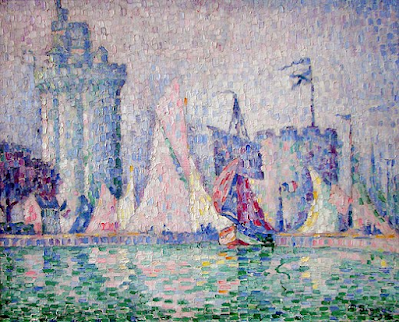
In 2018 a painting Le Port de La Rochelle by French Neo-Impressionist painter Paul Signac was stolen from the Musée de Beaux-Arts in the city of Nancy, in north-east France.  The theft, which took place in broad daylight, involved at least three accomplices, one of whom removed the painting from the wall and then sliced the canvas away from its frame using a box-cutter.  The culprits then rolled the painting up, and walked out of the museum, deftly hiding the stolen painting under a raincoat one of the thieves were wearing.

At the time of the theft, the artwork was estimated to be worth more than one and a half million euros.

Flash forward to April 2019 when Kyiv police raided the home of a suspect allegedly linked to the murder of a jeweller named Serhii Kiselyov, shot dead in his car on March 5, 2019 in Kyiv in a daytime assassination-style killing.

As they searched the residence in the Ukrainian capital, this suspect informed them that there was a valuable painting hidden in a cupboard in the home, advising them to handle it carefully.  The painting turned out to be the stolen 1915 oil painting by Paul Signac.

Interrogated by officers, this suspect implicated Vadym Huzhva, a Ukrainian  collector and sometime art thief from Kharkiv, who at the time was already serving a prison sentence in Austria for art theft.  In that case, Huzhva was one of three well-dressed men in jackets and coats who, working in tandem, waltzed into the Dorotheum auction house in Vienna and stole Golfe, mer, falaises vertes by Pierre-Auguste Renoir in November 2018.  This stolen painting was worth some €120,000 and €160,000 at the time of its consignment. 

At the conclusion of his Austrian prison sentence, Huzhva was extradited to stand trial in France in June 2020, where he was held in pre-trial detention until his court case began on January 30th.  But not just for the stolen Signac artwork, but also the theft of several art works, including a second Renoir, Portrait d'une Jeune Fille Blonde.  This painting was taken on September 30, 2017 from the wall of a gallery in the Parisian auction l'Hôtel des Ventes de Saint-Germain-en-Laye (Yvelines) operated by SGL Enchères/F. Laurent de Rummel where the artwork had been on display just prior to its auction.  

CCTV Image captures three thieves in the Dorotheum theft

Meanwhile, Le Port de La Rochelle was restituted by the Ukrainian authorities to the Musée de Beaux-Arts in September 2021. 

By the time Vadym Huzhva finally appeared for trial in France before the Specialized Interregional Court (Jirs) this week, an investigation entrusted to the SRPJ of Nancy and France's Office central de lutte contre le trafic de biens culturels (OCBC) had documented that this Ukrainian "Arsène Lupin" was responsible for a total of at least five thefts in France.  In addition to the Signac, and the second Renoir, Huzhva was also implicated in the thefts of a rare book with 12 gouaches by Russian artists stolen from the Hôtel Drouot auction house, the theft of another painting "Composition with Self-Portrait" by Giorgio De Chirico stolen on November 16, 2017 from the Fabrégat Museum in Béziers, and two stolen artworks by Eugène Boudin and Eugène Gallien-Laloux, taken from the Chateau de Versailles auction house in Versailles in 2018. 

A quick search of Ukrainian news outlets shows that Guzhva has also been implicated other art thefts in his home country, one of which involved a painting  stolen from the Odessa Art Museum on 21 June 2005, which was discovered by police rolled up and sealed in a bag, and stuffed under the seat of his Opel-Astra car in 2006.  And just like in this case, while appearing before the court, the defendant railed angrily against his prosecutors and his charges, claiming he was falsely accused and citing far-fetched conspiracies.  

Yet, despite being held in pretrial custody in Ukraine for several years, the Odessa Museum theft charges failed to stick, despite suspicions that Guzhva that he might be responsible for as many as two dozen museum thefts.

Back in France, prosecutors pointed to the fact that Guzhva's flights into the country coincided with the periods of each of the theft incidences occurred, as did his hotel reservations near each of the intended targets.  CCTV footage also revealed the same, or quite similar, modus operandi, and illustrated that the targets were often quite similar.  Artworks found on his phone, as well as the contact details for accomplices which matched descriptions in CCTV footage, also provided further evidence in the prosecution's favour. 

So, after just two days before the court, Vadym Huzhva was sentenced by the French judge to 5 years in prison.  The court also sentenced two of his known accomplices, tried in absentia, to three years each.  A fourth suspect, a woman, has not been publicly identified.