Blog Subscription via Follow.it

Showing posts sorted by date for query robin symes. Sort by relevance Show all posts

October 20, 2025

The Aboutaam Brothers, Phoenix Ancient Art, and the Hidden Routes of Italy’s Lost Antiquities

Phoenix Ancient Art - BRAFA 2019 

With a precautionary seizure order, filed by the Rome Public Prosecutor's Office, led by Prosecutor Stefano Opilio, nearly three hundred ancient Italian artefacts may finally be coming home after years of investigative work marking the judgement as one of Italy's most important cultural recoveries in recent history.  

This recovery finds its roots in a multi-year operation linking the Italian Carabinieri’s Cultural Heritage Protection Command with prosecutors in Rome and the United States, as well as Belgian investigative and judicial authorities.

Acting on a European seizure order issued in July 2025 officials have frozen nearly three hundred artefacts confirmed or strongly suspected to be of Italian origin.  These were identified as being tied to storage facilities in Belgium associated with the owners of the art gallery Phoenix Ancient Art, Hicham and Ali Aboutaam.  

Some of the artefacts identified in this operation coincide with business record documentation police obtained during a lengthy group pf investigations into the illicit dealings of  ancient art dealers Robert Hecht, Giacomo Medici, Gianfranco Becchina and Robin Symes, as well as a large dossier of material recovered from the prolific tomb raider Giuseppe Evangelisti.

While this blog has dedicated ample articles on the problematic art dealers mentioned above, we have never covered Evangelisti in the past.  His involvement in the illicit trade was first identified during Operation Geryon just before Christmas in 2003, when officers overheard a conversation during wire taps which referred to someone nicknamed “Peppino il taglialegna”—Peppino the woodcutter, a name derived from the individual's “day job”, providing firewood to two villages.  At night however, Evangelisti moonlighted as a tombarolo,  scavenging the hillsides for Attic and bucchero ceramics, bronze statues and various terracotta finds primarily used in funerary contexts. 

Luckily for investigators, when they raided Peppino's home near Lake Balsena they found not just the fruit of his recent clandestine labours but a batch of books on a shelf (nine books of agendas and seven albums) which documented the extent of his looting from 1997 to 2002.   A virtual goldmine for investigators, the albums contained photographs of every object he had ever looted, even going so far as to record the depth underground of the objects he illegally excavated.  In her review of these journals and albums, former Villa Giulia employee Daniela Rizzo stated that in her twenty-six years of experience, Evangelisti was the only person, aside from Giacomino (Medici), who recorded such detailed records of his activities. 

But back to the Belgium Recoveries

The recoveries announced today are due in part to the New York investigation into the purchasing activity of problematic hedge fund billionaire Michael Steinhardt who not only surrendered $70 million in plundered antiquities, but was the first collector in the United States to be handed a lifetime ban from antiquities collecting. That District Attorney's Office investigation, conducted by the Antiquities Trafficking Unit in Manhattan, uncovered a series of clandestine networks responsible for supplying looted Mediterranean objects to museums, collectors, and gallerists in the United States. 

Following up on that US investigation, a joint Italian-Belgian investigative team was formed expanding Italy's inquiry into northern Europe’s illicit art-dealing hubs and exploring the Aboutaam's footprint in Belgium.  This European investigation allowed for the cross-referencing of some 283 artefacts identified in Belgium, documented in Italian police databases and dealer archival photos.  That number in turn  demonstrates that despite numerous seizures in the US and Europe, the transnational ancient art market, despite decades of scandals, continues to recycle problematic artefacts extracted from clandestine digs.

According to Italy prosecutors Giovanni Conzo and Stefano Opilio, 132 of the seized works can be definitively linked to Italian sites, while the remaining artefacts almost certainly share the same illicit origin. The order, upheld by the Court of Appeal, described the pieces as the product of “illegal provenance” and repeated violations of cultural-property law.

Through it all Phoenix Ancient Art, long considered one of the most prominent galleries dealing in classical antiquities, once again finds itself at the center of controversy.  While the Aboutaam brothers have not been charged in connection with the Italian-Belgian operation, their business history is inseparable from the problematic story of the antiquities trade. 

In January 2023 at the Geneva police court, Ali Aboutaam was sentenced by the Swiss authorities following a complex and multi-year criminal and procedural investigation by officers and analysts with Switzerland's customs and anti-fraud divisions, working with the Geneva Public Prosecutor's Office.  The Swiss-based merchant had earlier been found guilty of forgery of titles.  In that case the courts also confirmed the seizure of 42 artefacts, confiscated due to their illicit origin. 

For Italian authorities, the current case is less about one gallery than about dismantling a system that has long allowed cultural property to vanish from archaeological landscapes and reappear behind glass cases thousands of kilometres away. The artefacts now bound for Rome belong, by law, to the Italian state’s “unavailable assets,” meaning they can neither be privately owned nor sold and their repatriation signals both a practical and symbolic victory for Italy’s Carabinieri TPC, which has spent decades tracking stolen heritage across the world’s galleries, auction houses and art fairs.

The anticipated return of these objects does more than close a legal chapter, it again  underscores how the same names, archives, and networks continue to bear fruit in terms of recoveries, even twenty years after the Medici conviction and the scandals that rocked museums in the 1990s and early 2000s. The discovery in Brussels suggests that, despite improved international cooperation, large caches of looted antiquities remain hidden in private storage and corporate collections.

October 8, 2025

Caveat Emptor: What the Dancing Maenad Can Tell Us About the Market for Looted Art

Christie's 2019 Auction
In November 2019, ARCA published a blog post raising questions about a 5th-century BCE polychrome antefix depicting a dancing maenad, which had been consigned to a Christie’s auction and that I believed the piece warranted closer scrutiny. For those unfamiliar, an antefix is a decorative architectural element once placed along the eaves of ancient roofs to conceal the joints between tiles.

What drew my attention was the striking resemblance between the object at right and three other Etruscan antefixes, also portraying maenads, that had previously been repatriated to Italy after being identified as having been illegal excavated and removed from Italy.


The provenance of the previous, 2019-consigned, antefix up for auction at Christie's read:
Provenance:

In terms of its circulation history, that sparse entry left roughly 2,500 years unaccounted for as nothing prior to 1994 was specified.  Knowing a bit about the consignor's background, I knew, that before her death, Ingrid McAlpine had been married to the ancient art dealer Bruce McAlpine, and that prior to their divorce, both were listed as proprietors of McAlpine Ancient Art Limited in the United Kingdom.

The McAlpines’ names have surfaced in connection with other trafficked antiquities that passed through the legitimate art market. Among these is an Attic black-figured hydria which reached the McAlpines through Palladion Antike Kunst, a gallery operated by disgraced dealer Gianfranco Becchina. Their names also appear alongside the red flag names of Robin Symes and Barbara and Lawrence Fleischman, in relation to the donation of a looted Apulian bell-krater, both objects of which were later restituted to Italy. 

In addition, former Judge Paolo Giorgio Ferri, the Italian judge who worked heavily on these looting cases, showed me a letter, seized by the Italian authorities during their investigations which was written by the staff of Bruce and Ingrid's McAlpine Ancient Art Gallery.  This letter, dated 8 July 1986, tied the couple to at least one transaction with Giacomo Medici and Christian Boursaud and referred obliquely to companies that the later convicted Rome dealer operated through third parties, fronts, or pseudonyms. 

Despite my suspicions I still didn't know where that Etruscan dancing maenad came from.  

Villa Giulia, 1937 Excavation
A few weeks into that investigation, and following a notification from the Carabinieri Command for the Protection of Cultural Heritage, curators Leonardo Bochicchio and Daniele F. Maras of Italy’s Ministry of Culture identified the likely find spot of the disputed object: Campetti Nord. They were able to pinpoint the location precisely, as the National Etruscan Museum of Villa Giulia already held another headless antefix of a dancing maenad, featuring the same polychrome details and stylistic traits.  The museum’s specimen had been uncovered during authorised excavations by the Italian Superintendency at the Etruscan sanctuary of Campetti Nord in the autumn of 1937 — a site previously worked over by tombaroli.

The sanctuary lies within the ancient urban area of Veio, also known as Veii, one of the major cities of Etruria and a formidable rival to early Rome. Its ruins rest quietly near the medieval village of Isola Farnese, about fifteen kilometers northwest of Italy's capital, amid the rolling hills and woodlands of what is now the Veio Regional Park.  For archaeologists, the city is a treasure of discovery, offering rare insight into the architecture, rituals, and daily life of the Etruscans on the frontier between the  Etruscan and Latin worlds.

After much finagling, the story of the first looted antefix was brought to light in an art crime documentary Lot 448, directed by Bella Monticelli which highlighted the objects lack of legitimate paperwork or export license and which exposed how difficult it is to identify and document an object with only a few days notice before an appraching sale.  Fortunately, with some help from Bulgari SpA, (who purchased the artefact at auction and donated it, through the Ministry of Cultural Heritage and Activities and Tourism, to the Italian State) the 2019 auctioned dancing maenad joined her sister at the National Etruscan Museum of Villa Giulia, reunited with other ancient artworks from the same archaeological context from which both figures originated.

Fast forward to a 2nd Christie's Antquities auction, scheduled for later this month and it seems we have a third headless lady dancer from Veio. 


The provenance for this third Etruscan antefix, equally headless, but less intact reads:  Elsa Bloch-Diener (1922-2012), Bern, 1975 (Antike Kunst, no. 113).

If you look carefully, by her feet you can make out the hoof of the Silenos this lady would have been dancing with.  

This detail is remarkably similar to the antefix in the form of a Maenad and Silenos Dancing which once graced the cover of the exhibition catalog A Passion for Antiquities: Ancient Art from the Collection of Barbara and Lawrence Fleishman.  

After careful restoration that antefix was first seen on the market with Robert Hecht who sold it to the Hunt collection.  Next it was circulated via Sotheby's with that collection was liquidated and bought by Robin Symes, who immediately resold it to the Fleischmanns.  In1994 the couple exhibited the piece , along with their entire collection, at the J. Paul Getty Museum, before it was formally acquired by   the museum in 1996 (96.AD.33).  The piece was restituted to Italy after it was matched by Daniela Rizzo and Maurizio Pellegrino to a polaroid in the Giacomo Medici archive.  Like the one up for sale at Christie's now, both artefacts were broken along the lower half and when whole, depicted a Silenos dancing behind the Maenad.


Now let's look at the provenance the auction house has cited.

Elsa Bloch-Diener (1922–2012) was a Swiss art dealer who operated a gallery at Kramgasse 60 in the old town of Bern.  She is known to have collaborated with Ines Jucker (née Scherrer, 1922-2013), the scholar and sometimes ancient art dealer responsible for the exhibition catalogue Italy of the Etruscans, cited in the Christie’s lot description as an exhibition where this piece was on view to the public. 

Jucker not only authenticated works for Bloch-Diener but also curated the 1991 Etruscan exhibition at the Israel Museum in Jerusalem referenced in the Christie's sale.  Also contributing to that exhibition's catalogue were entries by Giovannangelo Camporeale, Fiorella Cottier-Angeli, George Ortiz, and Christoph Reusser, names that have, at times, prompted debate and concern within the field.

In May 2002, when Swiss and Italian authorities raided Gianfranco Becchina's Antike Kunst Palladion, as well as three of Becchina’s storage facilities in Basel, authorities seized documents which identified transactions between the Sicilian and Ines Jucker which documented that she purchased artefacts from this dealer and sold them onwards.

Along the same theme Jucker studied an Attic Red-Figured calyx krater signed by Syriskos (painter); donated by Lawrence Fleischman and his wife to the J. Paul Getty Museum which had been acquired from Robin Symes in 1988.  Pictured on Medici Polaroid it was restituted to Italy.   Likewise a Black-Figure Cup Fragment with the Capture of Silenus in the Tondo which Jucker sold to Dietrich von Bothmer was also returned to Italy.

In the Israel exhibition Jucker curated, which featured the antefix up for auction and identified it as coming from the ancient site of Veio, some four hundred Etruscan objects were presented, none of large format, some with an inscriptions.  Among them were small bronzes, ceramics, jewellery, terracottas (architectural, votive, and cinerary urns), and sculptural fragments in nenfro.  In total they represented all periods and regions of Etruscan art. 

The main nucleus of the Israel displayed ensemble came from the collection of the late Ivor and Flora Svarc, many of whose holdings would be donated to the Israel Museum.  Svarc's objects were complemented by pieces already in Israeli collections, along with loans from the collector-dealer Jonathan Rosen and other private collectors, mainly in Switzerland.  

As cited by Drs David Gill and Christopher Chippindale in Material Consequences of Contemporary Classical Collecting the vast majority of the artefacts exhibited during this exhibition were previously unpublished.  This made this public display of the items their first concretising stop towards having an art marketable pedigree. 

The fact that we know this object comes from the context of Veio, can also be found in the same catalogue as the restituted Getty atefix, A Passion for Antiquities: Ancient Art from the Collection of Barbara and Lawrence Fleishman.


Page 197 refers specifically to the artefact currently up for auction:

A number of fragmentary examples of antefixes of this type, as well as of molds for producing them, have come to light at Civita Castellana (Falerii) (see Andrén; Sprenger/Bartoloni), finds which clearly prove their local manufacture. But the votive deposit of Campetti at Veii has yielded the head of a silenos of identical type and made of Veian clay (see Vagnetti 1971), which led P. J. Riis to suggest that this type of antefix was invented at Veii. The lower half of an antefix of this type with a provenance from Veii is in a private collection in Switzerland (see Jucker), and similar fragments have recently been excavated in Rome (see Cristo fani). 

With that in mind, it is necessary to return to the same question previously directed at Christie’s: 

On what evidentiary basis, supported by what verifiable documentation, did the auction house authorise the consignment of this artefact?  In the absence of any demonstrable chain of custody or export records, the decision to green-light its sale raises serious concerns regarding the robustness of the auction house’s internal due diligence procedures.


In this case, the question is not rhetorical but fundamental. Is Christie’s in possession of any concrete paperwork supporting the legitimacy of this Dancing Maenad’s appearance on the market, or was the absence of evidence simply overlooked given its publication in an exhibition, in the hope that the object’s passage through the auction process would escape closer scrutiny.


By:  Lynda Albertson

May 25, 2025

A Slap on the Amphora: After 17 years of court filings, only mild sentences in Greece’s landmark antiquities trafficking case

The private peninsula on the the Island of Schinoussa,
currently owned by the Papadimitriou family.

A long time ago, on an island not so far away, in April 2006, Greek authorities involved in “Operation Aeolos”, executed a search warrant at the Papadimitriou - Michaelides family properties located on the small Greek island of Schinoussa in the Eastern Cyclades, as well as a second residence owned by Despina Papadimitriou in the affluent Athens suburb of Paleo Psychiko.  By the time this police action took place, the 206 acres on the privately-owned cape overlooking the Aegean Sea, purchased in the 1970s by Christos Michaelides, Despina Papadimitriou, and their mother Irini Papadimitriou, had already been transferred to six offshore limited liability companies based in Panama.  Those company shares were subsequently transferred to Dimitri, Angeliki and Alexandros Papadimitriou.

Early view of the Michaelides Papadimitriou mansion,
on the privately owned cape of Schinoussa.

The searches carried out at these two locations lasted a week, during which a total of 152 ancient artworks were inventoried by investigating authorities, pieces which the Papadimitriou's appointed lawyer claimed belonged to an offshore Panama-based company named Land Investments Funds S.A.   Later, evaluations by two committees of experts, held in order to determine which objects were authentic and subject to seizure under existing Greek Law 3028/2002 on the Protection of Antiquities and Cultural Heritage in General, determined that 65 of the seized items were protected under Greece's cultural property law and that 53 of these were confirmed as having been illegally acquired.  The committee also looked into what objects might merely have been fakes or reproductions.

Some of the notable objects identified on the Papadimitriou properties included two large Egyptian sphinxes made of pink granite, nine rare Coptic weavings from the fourth-to-sixth centuries C.E., multiple marble busts, Corinthian capitals, and Byzantine architectural elements.  There was even a fake statue that was once displayed at the John Paul Getty Museum.  One of the more unusual finds was the remains of an entire 17th century building which had been dismantled, perhaps with the intent to be reconstructed elsewhere at some later point.

In addition to the artefacts, police conducting the search recovered 17 leather-bound albums containing photographic documentation, evidence now referred to as the “Schinoussa Archive”.  These Inside these binders, business records depict a total of  995 artefacts viewable across 2,191 photos, with the bulk of the images, shot by professional photographers.  

The records are derived from the most important antiquities which are known to have been directly circulated by, or proffered for sale to, antiquities dealers Robin Symes and Christo Michaelides, who sold ancient art to prominent collectors and museums through Robin Symes Limited, based in London.

While the professional photographs contained in this archive are not, in and of themselves, probative evidence that each photographed antiquity came into the possession of Symes and Michaelides, or that each ancient object was circulated on the art market subsequent to illicit excavation or illegal removal from their country of origin, but the vast number of antiquities depicted in these files raise disturbing questions about where the objects came from as well as the pair's established business connections with known antiquities trafficking networks. 

The artefacts seized in 2006 as evidence in accordance with Greek Law 3028/2002 on the Protection of Antiquities and Cultural Heritage in General, along with these business records, kicked-off one, if not the, singularly most important and protracted illicit trafficking investigations to be undertaken in Greece.

Christo Michaelides descended from a prominent Greek shipping dynasty, run by his father, Alexander Votsi Michaelides.  His sister is Despina Papadimitriou, was one of the four original defendants charged with cultural property crimes by the Greek prosecutor Eleni Raikou seven months after the Schinoussa and Psychiko seizures in 2006.  Other individuals originally named in that first criminal case included Despina's three adult children, Dimitri, Alexis, and Angeliki, though the court's rulings would eventually apply solely to Despina and Dimitri.

Now, nearly two decades after these objects' seizures, an Athens court has delivered what one hopes will be a final ruling against Despina and Dimitris Papadimitriou, concluding the extended courtroom drama which has dragged on for 17 years. 

Mother and son were sentenced on 22 May 2025 to three years and six months in prison, with a suspension of three years, specifically for misappropriation of monuments of particularly great value.  In addition to these brief prison sentences, a modest fine of 10,000 euros was imposed which hardly reflects the extensive public resources and years of prosecutorial effort expended by the country's prosecutors and judges in pursuing justice.

Originally accused on 22 November 2006 of illegally possessing and receiving illicit antiquities, the Papadimitrious, were first convicted at the end of July 2018 by the E (5th) 3 member Appeal Penal Court of Athens who stated:

"The Court by majority found guilty Despina and Dimitri Papadimitriou for the act of embezzlement of monuments and convicted each one of them to suspended imprisonment of 4 years. It also ratified the seizure and ordered the confiscation of the seized items."

According to Greek Law No. 3028/02, “On the Protection of Antiquities and Cultural Heritage in General” (article 56), destruction, damage or alteration of a monument, as well as theft or embezzlement of monuments, (articles 53 and 54 respectively) are punishable acts in Greece.  

According to that indictment, the defendants unlawfully appropriated: 

"ancient monuments, cultural goods dating back to prehistoric, ancient, Byzantine and post-Byzantine times until 1830." (Greek «ιδιοποιήθηκαν παράνομα αρχαία μνημεία, πολιτιστικά αγαθά που ανάγονται στους προϊστορικούς, αρχαίους, βυζαντινούς και μεταβυζαντινούς χρόνους έως και το 1830»)

And as stated in the hearing that referred them to the audience of the Triennial Court of Appeal of Athens: 

"There is an aim of income generation and a constant propensity to commit the crime, which is directed against the State, the embezzlement of monuments as an element of their personality."(Greek «Προκύπτει σκοπός για πορισμό εισοδήματος και σταθερή ροπή προς τη διάπραξη του εγκλήματος, που στρέφεται κατά του Δημοσίου, της υπεξαίρεσης μνημείων ως στοιχείο της προσωπικότητάς τους».)

In 2022, despite the breadth of the incriminating evidence collected by investigators, a Five-Member Athens Court of Appeal overrode the lower court decision and moved to acquit the Papadimitrious of monument embezzlement, citing insufficient proof of the crime.  That ruling was then reversed by Greece’s Fifth Criminal Chamber of the Supreme Court who criticised the Appellate Court's decision citing that it exceeded its authority, since, among other things, it selectively assessed the evidence that emerged during the hearing and had issued its acquittal of the defendants without sufficient reasoning. 

That decision sent the case back for retrial in 2025, paving the way for this year's proceedings before a new panel of judges, distinct from those who had previously acquitted the pair. 

Last week, in issuing its convictions, the court rejected the Papadimitrious' defence, citing the scope of the collection and significant gaps in provenance.  Undeterred and well-resourced, the family plans to continue litigating. 

According to their lawyer, the Papadimitrious will appeal the conviction to the Greek Supreme Court, an option readily available to those for whom time is no constraint and money no object.  Until then, their distinguished guests will continue to rub elbows with the elite, arriving in various ways to the Cycladic island, some by helicopter, others on ultra-luxury yachts, visiting the emblematic island home of the shipping family who only received a slap on the wrist.

By:  Lynda Albertson

February 4, 2025

At a Glacial Pace: Why does the return of stolen art take years?

The Oracle at Delphi, 1881, by Camillo Miola

The long and winding road
That leads to your door
Will never disappear
I've seen that road before
It always leads me here
Lead me to you door
By The Beatles

Sometimes the road from diplomatic agreement to restitution or seizure to restitution is a long and windy road like the lyrics of a Beatles song.  And in the announcement and publication of victories, which flash across the news, the general public sees only the superficial details, carefully curated to neutralise all the hard fought passages that allowed "Object A" to be returned to "Country B".   

Such is the case with The Oracle at Delphi (1881) by Camillo Miola, a neoclassical painting depicting the ancient Greek sanctuary of Delphi, where the Pythia, a high priestess of Apollo, delivered prophecies. The artwork portrays a dramatic scene within the grand temple, with the Pythia seated on a tripod, enveloped in mystical vapors, as she channels divine messages. A group of supplicants, including warriors and noble figures, eagerly awaits her pronouncements, their expressions reflecting awe, anticipation, and reverence. 

On August 11, 2022, ahead of their agreed upon negotiations, The J. Paul Getty museum made a widespread public announcement that it would be returning a number of objects in their collection to Italy including:

Orpheus and the Sirens (inv. 76.AD.11) acquired in 1976 from Bank Leu in Zurich,

Colossal Head of a Divinity (inv. 72.AL.96) acquired in 1996 from scandalous UK art dealer Robin Symes,

an Etruscan bronze thymiaterion (inv. 96.AC.253) acquired in 1996 from the Fleischman collection, It was sold to the Fleischmans in 1987 by Italian art dealer Edoardo Almagià.  A while back New York Assistant District Attorney Matthew Bogdanos, who heads the Manhattan Office's Antiquities Trafficking Unit was quoted in an interview with the Princeton Alumni Weekly, saying: 

“If Almagià is the first name on your provenance, it is stolen.” 

a Mold for Casting Pendants, (75.AA.35) about 2nd century CE, donated by collector Lawrence A. Fleischman and his wife;

and lastly, a rather fanciful oil painting entitled The Oracle at Delphi, 1881 by Camillo Miola (72.PA.32), a neoclassical painting depicting the ancient Greek sanctuary of Delphi, where the Pythia, a high priestess of Apollo, delivered prophecies.  

This artwork portrays a dramatic scene within the grand temple, with the Pythia seated on a tripod, enveloped in mystical vapours, as she channels divine messages. A group of supplicants, including warriors and noble figures, eagerly awaits her pronouncements, their expressions reflecting awe, anticipation, and reverence. Miola’s use of rich colours, classical architecture, and meticulous detail captures the spiritual intensity and grandeur of the sacred ritual, emphasising the oracle’s central role in guiding ancient Greek society.

In their announcement they stated that the impetus for the return of the Sculptural Group of a Seated Poet (Orpheus) and two Sirens is evidence presented to them of their looting.  Their announcement fails to make mention of the fact that the artefacts had been seized earlier pursuant to a court order and no other details were presented for the remaining pieces going home but as we know by the names of the dealers that circulated them, they propensity for being problematic was high. 

But what about the Miola painting nothing was stated as to why this artwork was coming home?

While Orpheus and his two friends came home in 2022, its taken two years and five months after the Getty's initial and somewhat lacking announcement, for Camillo Miola's painting to arrive back in Naples, along with the oil painting Portrait of Vittorio Emanuele III, 1902 by Achille Talarico.  

The paintings having just arrived and been presented at Palazzo Matteotti in Naples, by Gaetano Manfredi the Mayor of Naples and Gen. Div. Francesco Gargaro, the Commander of the Carabinieri Command for the Protection of Cultural Heritage.  

But when and how long ago did this particular painting's story begin? And why is at that so many of these restitution announcements, which concretise agreements between museum parties and source country authorities such as the Carabinieri, or Italy or the USA's prosecutorial bodies, omit historical facts when it is exactly these historical facts which served as the evidence needed to persuade museums, or courts of justice that these artworks need to come home. 

We know that Miola's painting depicting Pythia was stolen from the San Lorenzo Institute of Aversa between 1943 and 1946.  But not much has been written in public records which elaborates upon its exit from Italy.  We know only that the painting left Italy at some point after the close of World War II arriving to America.  It was then consigned to Parke-Bernet in New York as coming from "a Private Collection", and sold on 24 February 1972 to Ira Spanierman, who operated the eponymous Spanierman Gallery (1961-2014).   He in turn sold it to the J. Paul Getty that same year.

According to the museum's accession record the provenance for this painting is:

By 1880 — Pinacoteca Provinciale (Naples, Italy)
until 1972 — Private Collection [sold, Parke-Bernet, New York, February 24, 1972, lot 273, to Ira Spanierman.]
since 1972 — Ira Spanierman (New York), sold to the J. Paul Getty Museum, 1972. 

Open source records show us that following a meeting of Italy's Committee for the Recovery and Restitution of Cultural Heritage, chaired by Minister Alberto Bonisoli Italy's Ministry of Cultural Heritage formally asked the J. Getty Museum on 9 May 2019 to consider the country's claim for the Victorious Youth bronze (no progress there yet) and to also evaluate the provenance of four objects in the museum's collections that were also stolen or exported without permission from Italy. 

Those four objects were:  

Camillo Miola "The Oracle of Delphi" stolen from the San Lorenzo Institute in Aversa between 1943 and 1946; 

two marble lions from the Roman era that were in the Palazzo Spaventa in Preturo (Aquila) and 

a Mosaic with Medusa stolen from the National Roman Museum. 

This request was signed by the secretary general Panebianco and emphasised Italy's ministry's full willingness to keep alive the consolidated relations with the Getty,  blah blah blah, and considers cultural diplomacy a priority, blah blah blah, and stated that the writers would like to identify a suitable date for a meeting between the two parties to further discuss the Italian request for the restitution of The Victorious Youth, or the Athlete of Fano, the bronze statue that was fished out in 1964 in the waters of Fano in the Marche region and was subsequently illegally exported from Italy as determined by Italy's courts.

From the museum's side, the Getty replied that it would start their verification with the technical staff and that a response will be sent "as soon as possible"which, given the presentation of Miola's painting back in Italy has happened five and a half years later, and two years after the museum acknowledged that they were in agreement to relinquish the artwork, one has to marvel at the almost glacial pace of restitutions. 

And while ARCA is more than pleased that these artworks have actually come home through mutually beneficial agreements between museums and ministries and law enforcement officers and art researchers doing diligent work, we do wish there was a little more information than just somber, happy, formal, tight-lipped presentations stating these works are once again home. 

Transparency in restitution agreements between museums and source countries is crucial for ensuring accountability and ethical stewardship of cultural heritage. Not to mention it also builds public trust.  

Too often, repatriation deals are negotiated behind closed doors, with mutually agreed upon formal announcements which are carefully worded and often vague, leaving out key details about the provenance research, legal considerations, and the conditions of return.  All facts which could help us learn why one object makes it home and another doesn't. Or why certain objects are returned home quickly, while others take years after a restitution is announced, delaying justice for affected communities. 

This lack of openness can fuel skepticism, and invites speculation and negative interpretation, where the length of delays from announcement to homecoming can be misinterpreted foot dragging on the museum's part.    

By committing to clear, public disclosure of restitution decisions—detailing the origins of looted works, the justification for their return, the collaborative efforts between museum staff and source nations, and the complex mechanisms that often delay repatriation—museums can demonstrate a genuine commitment to ethical responsibility and cooperation. Transparency in these processes not only fosters trust but also ensures that institutions are seen as proactive stewards of cultural heritage rather than merely responding to external pressure.

Greater transparency would not only strengthen international cooperation—providing provenance researchers with valuable roadmaps from successful restitution cases—but also help rebuild public trust in museums as institutions committed to rightful ownership and historical justice. Rather than treating returns as mere footnotes with minimal explanation, museums should fully articulate the reasons behind their decisions, reinforcing their role as ethical stewards of cultural heritage.

September 6, 2022

Museum restitutions are more than just the sum of their numbers

Image Credit - HSI - ICE

On 21 February 2006 the Metropolitan Museum of Art and the Italian government signed an agreement under which the Met agreed to return 21artefacts looted from archaeological sites within Italy's borders. With that accord, the New York museum yielded its prized sixth-century BC "hot pot," a Greek vase known as the Euphronios krater.  

As part of that historic accord, the museum also relinquished a red-figured Attic amphora by the Berlin Painter; a red-figured Apulian Dinos attributed to the so-called Darius Painter; a psykter with horsemen; a Laconian kylix, and 16 rare Hellenistic silver pieces experts determined were illegally excavated from Morgantina in Sicilia.  It also included a carefully-worded clause which stated:

I) The Museum in rejecting any accusation that it had knowledge of the alleged illegal provenance in Italian territory of the assets claimed by Italy, has resolved to transfer the Requested Items in the context of this Agreement. This decision does not constitute any acknowledgement on the part of the Museum of any type of civil, administrative or criminal liability for the original acquisition or holding of the Requested Items. The Ministry and the Commission for Cultural Assets of the Region of Sicily, in consequence of this Agreement, waives any legal action on the grounds of said categories of liability in relation to the Requested Items.

Admitting no wrongdoing, where there surely was some, this unprecedented and then-considered watershed resolution, put an end to a decades-old cultural property dispute, with both sides choosing the soft power weapon of collaboration and diplomacy, complete with agreed upon press releases that enabled Italy to get its stolen property back without the need for costly and sometimes fruitless litigation.  

The signing of this 2006 agreement was thought to usher in a new spirit of cooperation between universal museums and source nations that those working in the field of cultural restitution hoped would permanently alter the balance of power in the international cultural property debate.  At the time of its signing at the Italian cultural ministry, the Met's then-director, Philippe de Montebello, said the agreement "corrects the improprieties and errors committed in the past."

Heritage advocates applauded the agreement, hopeful that museums around the globe would begin to more proactively explore their own problematic accessions and apply stricter museum acquisition policies to prevent looted material from entering into museum collections.  Coupled with collaborative loan agreements, museums and source country accords like this one, combined with strongly worded ethics advisories, like the one set forth that same year by the International Council of Museums in their ICOM Code of Ethics for Museums should have served to eliminate the bulk of problematic museum purchases and donations without the need for piece by piece requests for restitution and protracted and costly litigation. 

But has it? 

The aforementioned ICOM document clearly states: 

4.5 Display of Unprovenanced Material

Museums should avoid displaying or otherwise using material of questionable origin or lacking provenance. They should be aware that such displays or usage can be seen to condone and contribute to the illicit trade in cultural property.

8.5 The Illicit Market

Members of the museum profession should not support the illicit traffic or market in natural or cultural property, directly or indirectly.

Yet, here we are, 16 years after that signing of the Met-Italy accord, with the same universal museum [still] hanging on to and displaying material of questionable origin, long after their questionable handlers have been proven suspect. Likewise, 16 years later, and with the persistence of the Antiquities Trafficking Unit at New York District Attorney's Office in Manhattan, we see another 21 objects being seized last month from the largest art museum in the Western Hemisphere.   

In total, some 27 artefacts have been confiscated in the last year from the Metropolitan Museum of Art,  In 2022 alone, five search warrants have resulted in seizures of pieces from within the museum's collection,  demonstrating that the Met, and other universal museums like it, (i.e., the Musée du Louvre and the Louvre Abu Dhabi) have yet to satisfactorily master the concepts of “provenance” research and “due diligence”. 

Founded in 1870, the MMA's mission statement states that it "collects, studies, conserves, and presents significant works of art across time and cultures in order to connect all people to creativity, knowledge, ideas, and one another."  Yet, despite holding many problematic artefacts purchased, not only the distant past, but also in the recent, the Met still struggles with the practical steps it should be taking regarding object provenance and exercising due diligence, both before and after accessioning purchases and donated material into their collection.

As everyone [should] know by now, the concept of provenance refers to the history of a cultural object, from its creation to its final destination.  Due diligence, on the other hand, refers to a behavioural obligation of vigilance on the part of the purchaser, or any person involved in the transfer of ownership of a cultural object, (i.e., museum curators, directors, legal advisors etc.,).  This need for due diligence stretches beyond the search for the historical provenance of the object, but needs to also strive to establish whether or not an object has been stolen or illegally exported.  

So while we applaud the Metropolitan Museum of Art for having been fully supportive of the Manhattan district attorney’s office investigations, as has been mentioned in relation to the August 2022 seizure, we would be remiss to not  question why, in the last 16 years, and despite the fact that the “Met’s policies and procedures in this regard have been under constant review over the past 20 years,” the museum has still not addressed these problematic pieces head on.  

This museum is home to more than two million objects. Despite the responsibility and gravitas required for building and caring for such a large collection of the world's cultural and artistic heritage, the Met has yet to establish a single dedicated position, with the requisite and necessary expertise, to proactively address the problematic pieces it has acquired in the past, and to serve as a set of much needed set of breaks, when evaluating future acquisitions, so that the next generation of identified traffickers, don't also profit from the museum's coffers as they did with the $3.95 million dollar golden coffin inscribed for Nedjemankh and five other Egyptian antiques worth over $3 million confiscated from the museum under a May 19 court order.  

For the most part, provenance has been carried out haphazardly, and by only one or two people, working in specific departments, primarily in curatorial research rolls that only covering specific historical time frames or one or two material cultures. The lack of that comprehensive expertise brings us to apologetic press statements and a plethora of seizures like ones we have seen over the last year.  

But moving on to what was seized at the Metropolitan Museum of Art on 13 July 2022. The $11 million worth of objects include: 

a. A bronze plate dated ca. 550 BCE ,measuring 11.25 inches tall, and valued at $300,000.  

This artefact was donated by Norbert Schimmel, a trustee at the Metropolitan Museum of Art, who, during his tenure, was member of the Met's acquisitions committee.  By 1982 he was known to be purchasing antiquities from Robin Symes via Xoilan Trading Inc., Geneva.  This firm shared a Geneva warehouse address (No. 7 Avenue Krieg in Geneva) with two of Giacomo Medici’s companies, Gallerie Hydra and Edition Services.

Symes is noted as being one of the leading international merchants of clandestinely excavated archeology.  His name appears in connection with four different objects in this Met seizure. 

__________

b. A marble head of Athena, dated ca. 200 BCE, measuring 19 inches tall and valued at $3,000,000.  

This Marble Head of Athena was with Robin Symes until 1991, then passing to Brian Aitken of Acanthus Gallery in 1992.  It was then sold to collectors Morris J. and Camila Abensur Pinto, who in turn, loaned the artefact to the Met in 1995.  It was then purchased by the Metropolitan in 1996.  

Symes's name appears in connection with four different objects in this Met seizure, while Aitken's name comes up frequently as having bought from red flag dealers.  His name appears in connection with two different objects in this Met seizure. 

__________

c. A fragmentary terracotta neck-amphora, dated ca. 540 BCE, measuring 14.75 inches tall and valued at $350,000. 

This fragmented neck-amphora was purchased by the Met from Robert Hecht (Atlantis Antiquities) in 1991.  Four years later, Hecht's name would appear in seized evidence outlining his key position at the top of two trafficking cordata on a pyramid org chart which spelled out seventeen individuals involved in one interconnected illicit trafficking network.  

Archaeological artefacts sold by Hecht have been traced to the collections of the Met, the British Museum, the Musee du Louvre, and numerous other U.S. and European institutions, many of which have been determined to have come from clandestine excavations.

Polaroids photographs of this artefact, shot after the advent of Polaroids in 1972, are among the seized materials found within the Giacomo Medici archive.  These photos  depict the neck-amphora balanced precariously on a rose-colored upholstered chair. 

As mentioned above, Hecht's name appears in connection with three different objects in this Met seizure. 

__________

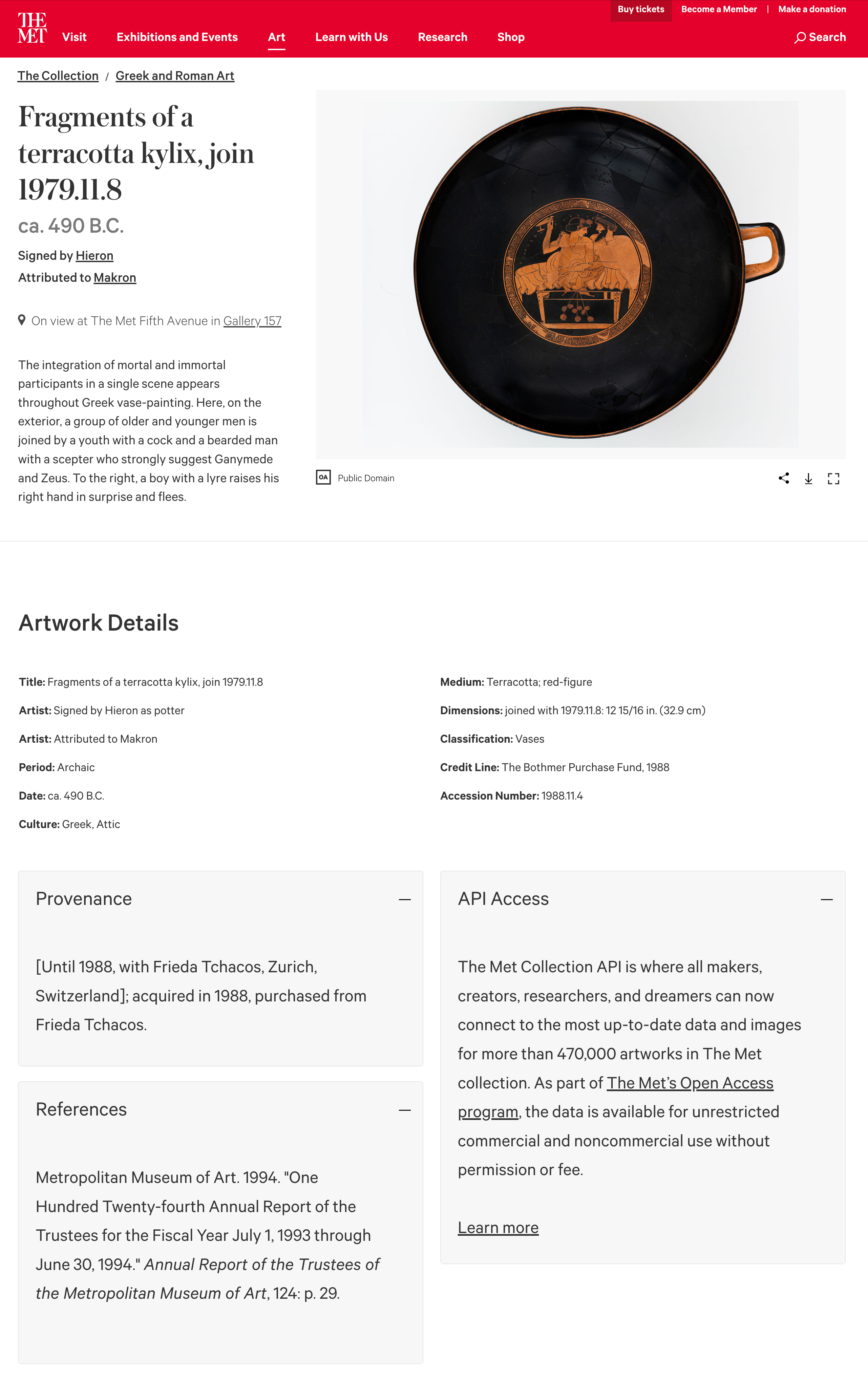
d. A terracotta red-figure kylix, dated ca. 490 BCE, measuring 13 inches in diameter, and valued at $1,200,000.

This fragmented kylix was purchased from Frederique Marie Nussberger-Tchacos in 1988 and consolidated with other terracotta fragments purchased earlier from Robert Hecht in 1979. 

In 2002 Tchacos was the subject of an Italian arrest warrant in connection with antiquities laundering.  And again, as mentioned above, Hecht's name appears in connection with three different objects in this Met seizure. 

__________

e. A marble head of a horned youth wearing a diadem, dated 300-100 BCE measuring 14 inches tall, and valued at $1,500,000.

This marble head of a horned youth wearing a diadem passed through the ancient art collection of Nobel Prize winner Kojiro Ishiguro, another client of Robin Symes.  It was then purchased by Robert A. and Renee E. Belfer when sold by the Ishiguro family via Ariadne Galleries.  Afterwards it was gifted by the Belfers to the Met in 2012. 

__________

f. A gilded silver phiale, dated ca. 600-500 BCE, measuring 8 inches in diameter, and valued at $300,000. 

This long-contested gilded silver phiale was purchased via Robert E. Hecht in 1994.  As mentioned previously Hecht's name appears in connection with three different objects in this Met seizure. 

__________

g. A glass situla (bucket) with silver handles, dated ca. 350-300 BCE, measuring 10.5 inches tall, and valued at $400,000.

This unique glass situla was purchased by the Met through Merrin Gallery in 2000. Photos and proof of sale of this artefact are documented in the archive of suspect dealer Gianfranco Becchina.  Correspondence within in the Becchina Archive cache of business records shows communication between the Sicilian dealer and Ed Merrin and/or his gallery dating back to the 1980s.  In the book, The Medici Conspiracy, by Peter Watson and Cecelia Todeschini, the writers cite one letter written by Merrin Gallery to Becchina, where Becchina was asked not to write his name on the back of photos of antiquities he sent for consideration.

Gianfranco Becchina's name or company name appears in connection with twelve different objects in this Met seizure. Merrin Gallery appears in connection with multiple objects within this seizure. 

_________

h. A terracotta lekythos, dated ca. 560-550 BCE, measuring 5.3 inches tall and valued at $20,000.

This terracotta lekythos was purchased from Galerie Antike Kunst Palladion in 1985 the same year Becchina sold a suspect krater by the Ixion painter to the Musée du Louvre. 

As mentioned above, Gianfranco Becchina's name or company name appears in connection with twelve different objects in this Met seizure.

__________

i. A terracotta mastos, dated ca. 520 BCE, measuring 5.5 inches in diameter and valued at $40,000.

Before he even moved to Switzerland, Gianfranco Becchina was already selling to the J. Paul Getty Museum in 1975.  According to the Met's records, which we believe contain a date error, this terracotta nipple-shaped cup was purchased from Antike Kunst Palladion in 1975.  However, records show that Becchina emigrated from Castelvetrano in Sicily to Basel, Switzerland after having undergone a bankruptcy procedure in 1976 and formed the Swiss business that same year.

As mentioned previously, Gianfranco Becchina's name or company name appears in connection with twelve different objects in this Met seizure.

__________

j. A fragment of a black-figure terracotta plate, dated ca. 550 BCE, measuring 3 by 2.5 inches and valued at $4,000.

This fragment, attributed to Lydos, was purchased by the Metropolitan from Galerie Antike Kunst Palladion in 1985. 

As mentioned above, Gianfranco Becchina's name or company name appears in connection with twelve different objects in this Met seizure.

__________

k. A fragment of a black-figure terracotta amphora, dated ca. 530 BCE, measuring 2 by 2.6 inches and valued at $1,500.

This fragment, attributed to the Amasis Painter, was purchased from Galerie Antike Kunst Palladion in 1985.

As mentioned previously, Gianfranco Becchina's name or company name appears in connection with twelve different objects in this Met seizure.

__________

1. A pair of Apulian gold cylinders, dated ca. 600-400 BCE, measuring 2.25 inches in diameter and valued at $10,000. 

This pair of gold Apulian cylinders was gifted to the Metropolitan Museum of Art in 1981 by Mr. and Mrs. Gianfranco Becchina.

As mentioned above, Gianfranco Becchina's name or company name appears in connection with twelve different objects in this Met seizure.

__________

m. A bronze helmet of Corinthian type, dated 600-550 BCE, measuring 8.5 by 7.75 and valued at $225,000.

This helmet is one of five Met-donated helmets identified as being part of the Bill Blass collection between 1992 and 2002.  It joined the Met in 2003.  Within the Gianfranco Becchina archive is a page of five Polaroid photographs,which depict multiple bronze helmets, including those from the Bill Blass collection which are part of this seizure. 

Also, among the Becchina archive documentary material are two business documents believed to be related to these transactions. 

The first is a 1989 multi-page export document for a grouping of objects being exported to Merrin Gallery indicating the sale of three helmets, one of which is described as "one South Italian Greek Bronze Helmet of the so-called Corinthian type, with bronze pins remaining for the attachment of the lining. "

The second is a fax correspondence from Becchina to Samuel Merrin discussing some sort of transfer regarding a single helmet and Acanthus Gallery.

As mentioned previously, Gianfranco Becchina's name or company name appears in connection with twelve different objects in this Met seizure.  Merrin Gallery appears in connection with multiple objects within this seizure. 

__________

n. A bronze helmet of South Italian-Corinthian type, dated mid-4th-mid-3rd century BCE, measuring 7.75 inches tall and valued at $125,000.

Like the previous one, this helmet is one of five Met-donated helmets identified as being part of the Bill Blass collection between 1992 and 2002.  It joined the Met in 2003.  Within the Gianfranco Becchina archive is a page of five Polaroid photographs, which depict multiple bronze helmets, including those from the Bill Blass collection which are part of this seizure. 

Also, among the Becchina archive documentary material are two business documents believed to be related to these transactions. 

The first is a 1989 multi-page export document for a grouping of objects being exported to Merrin Gallery indicating the sale of three helmets, Two of which are described as "two South Italian Greek Bronze Helmets, both decorated with incised animals, one with restings [sic] of a plume holder on top."

The second is a fax correspondence from Becchina to Samuel Merrin discussing some sort of transfer regarding a single helmet and Acanthus Gallery.

As mentioned previously, Gianfranco Becchina's name or company name appears in connection with twelve different objects in this Met seizure.  Merrin Gallery appears in connection with multiple objects within this seizure. 


__________
o. A bronze helmet of Apulian-Corinthian type dated 350-250 BCE, measuring 12 inches tall and valued at $175,000

Like the previous one, this is one of five Met-donated helmets identified as being part of the Bill Blass collection between 1992 and 2002.  It joined the Met in 2003.  Within the Gianfranco Becchina archive is a page of five Polaroid photographs, which depict multiple bronze helmets, including those from the Bill Blass collection which are part of this seizure. 

Also, among the Becchina archive documentary material are three paper business documents. 

The first is a 1989 multi-page export document for a grouping of objects being exported to Merrin Gallery indicating the sale of three helmets,  two of which are described as "two South Italian Greek Bronze Helmets, both decorated with incised animals, one with restings [sic] of a plume holder on top."

The second is a fax correspondence from Becchina to Samuel Merrin discussing some sort of transfer regarding a single helmet and Acanthus Gallery.

The third is a photocopy of this object with a red line through the image and v/ Me written below. While not conclusive, V/Me most likely refers to venduto (sold) Merrin.  

As mentioned previously, Gianfranco Becchina's name or company name appears in connection with twelve different objects in this Met seizure.  Merrin Gallery appears in connection with multiple objects within this seizure. 

__________

p. A white-ground terracotta kylix attributed to the Villa Giulia Painter, dated ca. 470 BCE. measuring 6.5 inches in diameter and valued at $1,500,000.

This rare Terracotta kylix is the second highest value item of all 21 artefacts seized.  It joined the Met in 1979. Unfortunately it too was purchased via the Galerie Antike Kunst Palladion.

As mentioned above, Gianfranco Becchina's name or company name appears in connection with twelve different objects in this Met seizure.

__________

q. A marble head of a bearded man, dated 200-300 CE, measuring 12.2 inches tall and valued at $350,000.

This marble head of a bearded man joined the Met in 1993, purchased from Acanthus Gallery operated by Brian Tammas Aitken.  Gianfranco Becchina archive documents an October 1988 sales receipt to Aitken for "3 Roman Marble heads" for 85,000 Fr.  

As mentioned above, Aitken's name comes up frequently as having bought from red flag dealers and appears on two different objects in this Met seizure. Gianfranco Becchina's name or company name appears in connection with twelve different objects in this Met seizure.

__________

r. A terracotta statuette of a draped goddess, dated 450-300 BCE,  measuring 14.75 inches tall and valued at $400,000.

This terracotta statuette of a draped goddess was donated to the Met by Robin Symes in 2000, in memory of his deceased partner Christos Michaelides.  His name appears in connection with four different objects in this Met seizure. 

__________

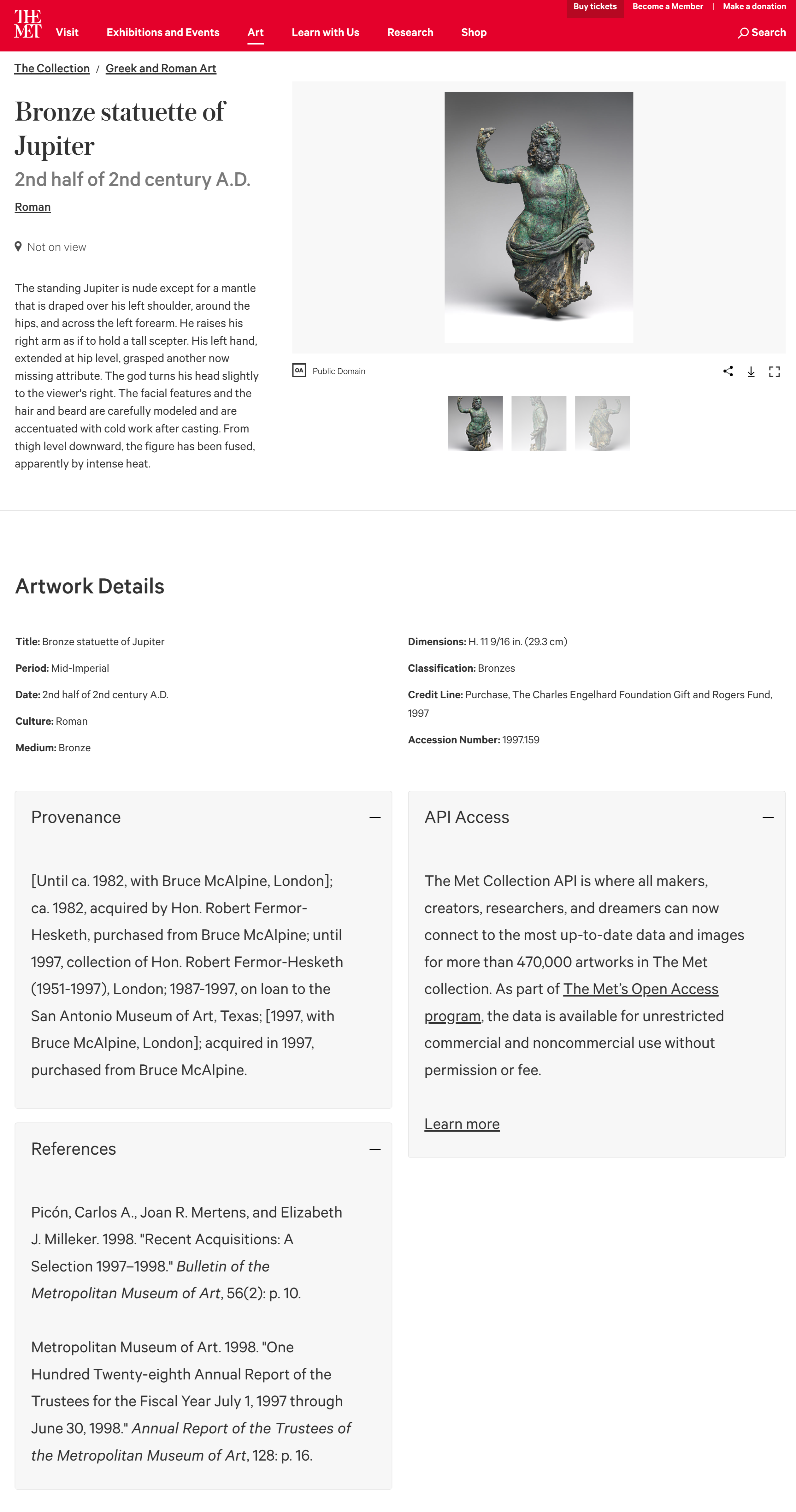
s. A bronze statuette of Jupiter, dated 250-300 CE, measuring 11.5 inches tall and valued at $350,000.

This bronze statuette of Jupiter was acquired by the Met via Bruce McAlpine in 1997. A UK-based dealer, McAlpin had dealings with Robin Symes, Giacomo Medici, and Gianfranco Becchina.

__________

t. Marble statuettes of Castor and Pollux (on loan), dated 400-500 CE, measuring 24 inches tall and valued at $800,000.

The Dioskouroi had been on anonymous loan to the Metropolitan Museum since 2008 as L.2008.18.1, .2. While the Museum's loan accession record has been removed, a Met catalogue informs us that the statues were "probably from the Mithraeum in Sidon, excavated in the 19th century". 

With a bit more digging Dr. David Gill was able to get further details from the Met itself.  They indicated the pair had come from an "ex private collection, Lebanon; Asfar & Sarkis, Lebanon, 1950s; George Ortiz Collection, Geneva, Switzerland; collection of an American private foundation, Memphis, acquired in the early 1980s".

At some point along their journey, the pair passed through the Merrin Gallery where they were published by Cornelius C. Vermeule, in Re:Collections (Merrin Gallery, 1995).

While a seemingly professional photo of these objects exists in the confiscated Robin Symes Archive, that photo depicts the object prior to restoration.  In that photo,  Castor's leg, and the leg of his horse behind him, are missing.  By the time they arrive to the Met on loan, the two limbs have been reattached. 

As mentioned above, Merrin Gallery appears in connection with multiple objects within this seizure. 

__________

and lastly,

u. A fragment of a terracotta amphora attributed to the Amasis Painter, dated ca. 550 BCE, measuring 3.25 by 4.5 inches and valued at $2,000. 

This terracotta amphora fragment is attributed to the Amasis Painter. It is one of many examples of fragments bought via Gianfranco Becchina's gallery, Galerie Antike Kunst.  It was acquired+gifted by Dietrich von Bothmer to the Met in 1985.

Gianfranco Becchina's name or company name appears in connection with twelve different objects in this Met seizure.


__________

But these seized pieces are more than the sum of these numbers.  They tell us a lot about this one museum's particular lethargy in dealing with or voluntarily relinquishing problematic pieces before being handed a court order.

One thing is certain though, museums reputations certainly do not benefit when dragged into adversarial, long-winded, and sometimes costly claims for restitution.  Nor do they benefit from having their name up in lights when objects are seized on the basis of investigations the museum would have been wise to have done themselves. 

Waiting until either of the above happens also runs counter to, and impedes, the essential purposes of museums, which should be about presenting their collections in innovative ways, and fostering understanding between communities and cultures. The Met would have been better off providing open and equitable discourse about their collection's problems before their hand was forced, as waiting until after says a lot about their true collecting values. 

When museums hedge their bets, hoping that the public's memory is short, or crossing their fingers that source countries are too disorganised, too undermanned or to poor to spend hours looking for problematic works they will pay the price later.  Far better to avoid the painfully slow, one seizure after another reality, and the negative spotlight and mistrust that comes with it, by doing what all museums should be doing, i.e., conscientiously conducting the necessary provenance research and due diligence on their past and potential acquisitions.

Image Credit - HSI - ICE

To close this article, we would like to announce that today, New York DA Bragg returned 58 stolen antiquities valued at over $18 million, to the people of Italy, including a goodly number of the 21 pieces mentioned above.

Image Credit - HSI - ICE

In closing, ARCA would like to thank DA Bragg, Assistant District Attorney Matthew Bogdanos, Chief of the Antiquities Trafficking Unit; Assistant District Attorneys Yuval Simchi-Levi, Taylor Holland, and Bradley Barbour, Supervising Investigative Analyst Apsara Iyer, Investigative Analysts Giuditta Giardini, Alyssa Thiel, Daniel Healey, and Hilary Chassé; who alongside Special Agents John Paul Labbat and Robert Mancene of Homeland Security Investigations as well as Warrant Officer Angelo Ragusa of the Comando Carabinieri Tutela Patrimonio Culturale, Dr. Daniella Rizzo, Dr. Stefano Alessandrini, and Dr. Christos Tsirogiannis gave crucial contributions to the knowledge we have about when, and where, and with whom, these recovered artefacts circulated. 

ARCA would also like to personally thank Assistant District Attorney Bogdanos for the trust he puts in the contribution of forensic analysts inside ARCA and working with other organisation. He and his team's approach and openness has proven time and time again, that such collaboration is worthwhile and fruitful. 

By:  Lynda Albertson