Blog Subscription via Follow.it

March 27, 2014

Dr. Christos Tsirogiannis matches two objects up for auction in London with objects identified in the Medici and Becchina archives

Medici oinochoe (Medici)
by Catherine Sezgin, ARCA Editor-in-Chief

University of Cambridge researcher Dr. Christos Tsirogiannis has reviewed the catalogues for three upcoming London auctions and identified two objects to photos in the archives of two art dealers, Giacomo Medici and Gianfranco Becchina, confiscated by Italian and Greek police who have used them to identify objects looted and smuggled from at least 1972 until 2006.

The three auctions of antiquities will be held at Bonhams on April 1; at Christie's on April 2; and again at Bonhams on April 3 

The first object is Lot 173 in Christie's Sale 1548 described as a Greek Core-Formed Glass Oinochoe from the Eastern Mediterranean, circa 2nd-1st century B.C., with an estimated bid at £4,000 - 6,000 (US $6,604 - $9,906). Christie's "Provenance" -- or what Dr. Tsirogiannis described in his email as the collecting history -- is described as:
"Anonymous sale; Sotheby's, London, 11 July 1988, lot 198".
"However, I identified the object from a Polaroid image from the Medici archive," Dr. Tsirogiannis wrote. "We know that Medici consigned hundreds of antiquities to Sotheby's (Watson & Todeschini, The Medici Conspiracy, 2007)."

The second object is Lot 22 in Bonhams April 3 sale (#21926) described as a Canosan polychrome painted lidded pottery pyxis, circa 3rd century B.C., with an estimated bid at £3,000 - 5,000 (US $5,000 - $8,300).  Bonhams' "Provenance" -- or collecting history -- of the oinochoe is:
"American private collection, New York, acquired from Ariadne Galleries, New York City in the late 1980s."
"However, I identified the pyxis in two Polaroid images from the Becchina archive (both attached, in the first the object is depicted broken and unclean, in the second the pyxis appears conserved and ready for sale)," Dr. Tsirogiannis wrote. "I have also found documents which prove that the depicted broken pyxis IS THE SAME as the one put on sale by Bonhams. Also, the same documents prove that Becchina sold the object to Ariadne Galleries, who were involved in other cases of "unprovenanced" antiquities (e.g., see Gill 2013 http://lootingmatters.blogspot.co.uk/2013/01/icklingham-bronzes-looking-back.html), Tsirogiannis 2013:10 http://art-crime.blogspot.co.uk/2013/07/the-journal-of-art-crime-spring-2013.html)."

"Why do Christie's and Bonhams still fail to supply the full and correct collecting history of the objects, especially when they advertise their due diligence before the auctions?" Dr. Tsirogiannis wrote. "Why are these objects depicted in the Medici and the Becchina archives?"

Becchina pyxis in pieces
Becchina pyxis conserved

March 26, 2014

Nominees for ARCA's 2014 Award for Art Protection & Recovery Announced

Here are the nominees for ARCA's 2014 Award for Art Protection & Recovery, which is usually given to a police officer, investigator, lawyer, security director or policy-maker. This year ARCA has combined two of the previous year’s awards categories as more often than not, individuals were double nominated in two award categories.

Past winners have included: Vernon Rapley and Francesco Rutelli (2009), Charlie Hill and Dick Drent (2010), Lord Colin Renfrew and Paolo Giorgio Ferri (2011), Karl von Habsburg, Dr. Joris Kila Ernst Schöller (2012), Sharon Cohen Levin and Christos Tsirogiannis (2013).

The Nominees for the 2014 Award for Art Protection & Recovery Award are:

Monica Dugot, Senior Vice President and International Director of Restitution, Christie’s Auction House. Nominator's Synopsis: "In her more than 17 years of practice in the restitution field, Ms. Dugot has been instrumental in resolving major claims and in developing international policies in this area. Under her guidance, Christie’s was one of the first auction houses to publish on its website a detailed explanation of its practices with regard to claims to artworks consigned for auction. In so doing, Ms. Dugot has led the way in prescribing for claimants and possessors alike the manner by which claims could be resolved without the need for litigation, especially in emotionally fraught cases involving Nazi-looted art. She would be a worthy addition to ARCA’s illustrious list of past recipients of this award."
Monica Dugot is responsible for coordinating Christie's restitution issues globally. She and her team of researchers vet nearly every lot Christie’s offers at auction, which means somewhere in the region of 200 sales a year, from Old Masters and Books to Impressionist and Modern Art focusing on provenance between 1933 and 1945; to identify possibly spoliated but unrestituted objects; and to help in resolving restitution claims for works consigned for sale. 
Prior to joining Christie's, Ms. Dugot served for almost eight years as Deputy Director of the New York State Banking Department's Holocaust Claims Processing Office, where she coordinated the Art Claims branch of the HCPO's work and assisted owners and heirs in seeking to recover art collections that were lost or looted during the Nazi era. She has represented New York State on art restitution matters at many venues including the 1998 Washington Forum on Holocaust-Era Assets and the International Conference on Holocaust Era Looted Cultural Assets in Vilnius, Lithuania. Ms. Dugot is on the Advisory Board of Claremont McKenna College’s Center for Human Rights Leadership, and the Society of American Friends of the Jewish Community Vienna. She is currently a member of the Art law Commission of the Union Internationale des Avocats (UIA). She also served as a member of the NYC Bar Association's Art Law Committee.
Martin Finkelnberg – Special Investigating Officer, Art and Antique Crime Unit of the Netherlands. Nominator's Synopsis: "Martin was the only art detective in the Dutch police force, and was assigned, pretty much on his own, to set up the force’s first arts unit. He runs it now with several part-time officers who are art historians, and yet he has great success in coordinating art-related cases from throughout the Netherlands and abroad."
Martin Finkelnberg is the Head of the Art and Antiques Crime Unit of the National Criminal Intelligence Division which is part of the recently reorganized National Police Force of the Netherlands. He joined the police force in 1976 as a junior intelligence officer and for roughly 30 years was mainly involved in firearms investigations and counter terrorism. 
In 2006 he was asked to build a national database on stolen works of art. At the same time he also had to restart the Art and Antiques Crime Unit that had been discontinued in 2002. Today this unit is composed of four individuals. Over the course of the years Finkelnberg also felt necessity to establish contact points within each police region. In 2013 this led to the appointment of not only ten dedicated police officers -- one in every region -- but also to a dedicated national public prosecutor. These are however not experts and they are being trained on a regular basis by Finkelnberg and others on legislation, awareness of the importance of preserving cultural heritage, and on criminal trends and activities. The unit, in principal, is not an investigating body itself but an intelligence hub for the regional police forces who are responsible for carrying out criminal investigations. 
However, because of the complexity of Dutch legislation regarding illegal trade in cultural property, Martin Finkelnberg occasionally goes out on the road himself. During several of these occasions and in close cooperation with the Cultural Heritage Inspection, he recovered more than 70 items from Iraq, some of them dating back to 5,000 B.C.. He and his unit also proved to be instrumental in solving many major museum break-ins such as the Hofje van Mevrouw van Aerden Museum in 2011 in which case the police recovered a 15 Million euro painting by Frans Hals; and the Museum Gouda where in 2012 the burglars used an explosive device to blow up the front door of the museum (In this case the unit was also able to establish links between these suspects and another museum break-in in 2009 and to them identifying several other museums as possible targets).
(Jointly) Dr. Daniela Rizzo and Mr Maurizio Pellegrini, Soprintendenza Beni Archeologici Etruria Meridionale. Nominator’s Synopsis: "Pellegrini and Rizzo are well known for their groundbreaking forensic work from for the Italian government. During that period, they were responsible for identifying dozens of looted and smuggled masterpieces for the Italian judicial authorities from the confiscated archives of illicit antiquities dealers Giacomo Medici, Gianfranco Becchina, and Robin Symes, etc. Based on Pellegrini and Rizzo's meticulous research, the Italian state managed to repatriate numerous stolen treasures of antiquity and to have solid evidence for the prosecution of several members of the international illicit antiquities network. Their more recent work, while less well known to the general public, involves ongoing negotiation with museums around the globe encouraging them to return looted objects found in their collections."
Dott.ssa Daniela Rizzo and Maurizio Pellegrini are employees of Italy’s Ministry of Cultural Heritage and Activities and Tourism (MiBACT) who work directly for the Soprintendenza for Southern Etruria's Archeological Heritage which covers the archaeological territories of Cerveteri, Tarquinia, Vulci, Veio, Lucas Feroniae, Civitavecchia, Sutri , Tuscania, Pyrgi, Volsinii and San Lorenzo Nuovo. Dr. Rizzo oversees the department of Goods Control and Circulation with the assistance of Massimo Pellegrini. Their offices are located at the National Etruscan Museum of Villa Giulia. One of the main commitments of their department and the Soprintendenza overall is the fighting of criminal activities and illegal traffic of archaeological objects from the southern territories. 
In 1985 the Soprintendenza set up a special service, "The Office of confiscation and illicit excavations" (ufficio sequestri e scavi clandestini), which constantly monitors the phenomenon of illegal excavations and the finds of illegal trafficking. To achieve this goal, their office began working closely with Italy’s National Judicial Authority and the security forces (Carabinieri TPC and Guardia di Finanza), which work together in this sector. This collaboration aims to recover Italian archaeological materials that have been taken away illegally from the national territory and often have ended up in important foreign collections. Since 1995, their work has achieved very positive results and has resulted in the identification of numerous archaeological objects taken illegally and found in a number of American and European museums or in private collections abroad. Based on the inspection of and matching between confiscated photographs and documents, their investigations have facilitated negotiations between American and European museums which have often concluded in important cultural agreements rather than lengthy judicial prosecutions. Thanks to these agreements, archaeological finds are regularly being returned to Italy from places like New York and Boston. 
Through their in-depth work, the famous Euphronios crater, now on display in the new rooms of Villa Giulia, has been recognized as property of the Italian state and was returned to Rome in 2008 from the Metropolitan Museum in New York. Similar agreements have been concluded with the Princeton University Art Museum, the Cleveland Museum of Art and the J.P. Getty Museum of Malibu. In cases where traffickers have been identified their work with the "Procura della Repubblica" (Italian prosecutor's office) and the Court of Rome has made it possible, in some circumstances, to try specific cases associated with illegal trafficking of antiquities within Italy. Cases of note include the exemplary punishment imposed by the Court of Rome on an Italian trafficker, who operated in Switzerland and the 2005, criminal proceedings that were initiated against Marion True, the former curator who purchased trafficked archaeological objects for The Paul Getty Museum, and cases involving Robert Hecht. As a result of their work and the recovery of objects, a room in the Villa Giulia has housed a temporary traveling exhibition to increase the public’s awareness to the impact of trafficking, the significance of the problem and what is being done to combat it. The carefully curated exhibition included numerous objects which have been repatriated from Southern Etruria as well as examples of documents used in their ongoing investigations and prosecutions by the Italian authorities.
Roma Antonio Valdés– Public Prosecutor, Carrera Fiscal, Fiscalía de Santiago de Compostela, Spain Nominator’s Synopsis – "A public Prosecutor for the Government of Spain, he is an expert in legal international cooperation and crimes against cultural heritage. He was the public prosecutor in charge of the successful recovery of the Codex Calixtinus, a 12th-century illuminated manuscript from the cathedral of Santiago de Compostela. The Codex was stolen in July 2011, and successfully recovered in 2012 in the garage of a former employee of the Cathedral."
Roma Valdés holds a Licentiate in Law from the University of Alcalá, a PhD in Archaeology from the University de Santiago de Compostela, and a diploma in advanced studies in criminal law from the Universidad Nacional de Educación a Distancia, Spain. He has been a prosecutor since 1994 and specializing in crimes against cultural Heritage since 2004. He also serves as a professor in procedural Law at the University of A Coruña and serves as a representative to Spain in some international conventions. He is the author of 5 Law books, 48 Law papers, 7 History books, and 43 History papers. Some of these documents can be accessed at: https://coruna.academia.edu/AntonioRomaValdes.
Below are a listing of significant art crime cases he has been a part of: 
- 2011-2014 Theft and recovery of the Codex Calxtinus. Investigation and prosecution of the theft of one of the main medieval books of Europe. 
- 2008-2014 Affaire Patterson II. The collection above was exported without authorization from Spain to Germany. The case implies another precedent, in this case of use of the most recent Framework Decisions of mutual recognition of judicial resolutions principle in Europe. Other cases were open to prosecute cases of illicit trade of cultural heritage. Now, there is a non guilty decision pending appeal. 
- 2007-2009 Affaire Patterson I. The case, followed mainly by Latin American media, implies the judicial international cooperation between the Republic of Peru and the Kingdom of Spain to send more than two thousand of Pre-Columbian objects, some of the with a great historic importance. After the Republic of Peru, other Latin American states claimed successfully another pieces. The case is the main precedent in legal cooperation among judicial authorities in the field of the restitution of cultural heritage. 
- 2009 Corrubedo. During March 2009, several British divers were condemned to damage a XIX c. boat sunk in the Galician coast. Another similar case is open now. 
- 2000-2004 Os Castriños. The owner destroyed an archaeological site to build a camping site. Besides the fine, the Spanish jurisdiction for the first time prohibited developing activities not directed to the diffusion of the archaeological culture. Since then to now, more cases were open to prosecute owners of buildings and sites that destroy them to sell new buildings.

March 25, 2014

The Toronto Star: ARCA graduate Mark Collins quoted in article on "Crimes of the art"

Last summer, ARCA awarded Mark Collins, a senior officer at the Ontario Provincial Police, the Minerva Law Enforcement Scholarship to attended the Postgraduate Certificate Program in Art Crime and Cultural Heritage Protection. Murray Whyte, writing for the Toronto Star in "Crimes of the art" (March 24, 2014), reports:
Last month, thieves stole work from a collective of Toronto artists. OPP officer Mark Collins is doing what he can to get it back and build some respect for a criminal realm worth $6 billion a year.
Collins, officially assigned as an investigator to the Alcohol and Gaming Commission, was in attendance at a fundraiser for Creatures:Collective, the site of a robbery on Feb. 13 of four pieces of art:
The crowd of mostly young, artfully dishevelled downtown sorts sipped bulk-quality wine and perused the offerings on the walls: small works, for the most part, were offered for auction by a dozen or so artists to help raise a little money to cover the victims’ losses and pay for what’s become, in hindsight, a glaring oversight. “A security system,” smiled Darren Leu ruefully, listing alongside it repairs to the back door and relief for the victims. Leu, the director of Creatures, chatted warmly and embraced a good many of the dozens of people who streamed in over the first hour of the event. He held a clipboard, tracking bids and handling of the auction. The gallery had a camera pointed at its front door, mounted on the wall across the street, he said. That morning, they found the camera oddly askew, directed at a storefront two doors down. “The first week of February was extremely windy,” he said. “But still, the way they came in made it seem like they knew the space.”
[...]
The Creatures: Collective case is being handled out of the Toronto Police Service’s 14 Division, with an unofficial assist from Collins based on his particular expertise. “A lot of police here just write art theft up like a stolen laptop or iPad. It’s not differentiated,” he says. “It isn’t following fingerprints; it’s getting images of the works out there and making them too hot for the thief to handle. But if you start telling police forces they don’t know what they’re doing with this stuff, you end up with a lot of hurt feelings.” Collins has always had a connection to art. “But I couldn’t draw a straight line with a ruler,” he said. “I might be able to do a Damien Hirst: I could pickle a shark, but it probably wouldn’t turn out as well.” Before getting involved in law enforcement, as a teen he worked as a night cleaner at the Art Gallery of Ontario. In 1992, he started policing traffic, writing tickets and plotting his next move. He became an investigator in 2000, but the idea of working with art lingered in the back of his mind. Then, a couple of years ago, he read Canadian author Josh Knelman’s book Hot Art and the light went off. “I talked to everyone in that book,” he said. “It made me frustrated: art theft is recognized as a serious crime, but it’s like the drug trade. No one knows how much it actually represents.” There are guesses. The most noted one is roughly $6 billion per year. Nonetheless, Collins is willing to start small. One of Chen’s stolen works was part of a triptych, priced at $400. “It’s kind of fun, putting it on Interpol or Scotland Yard, or the FBI and the international Art Loss (Register),” Collins said. Chen lost another work, a four-by-six-foot canvas he’d made with Kevin Columbus, destined for another show. “I guess it’s the ultimate compliment,” he said. Within hours of the theft, the pair set to work to replace the stolen painting. They finished it in a week. “It was just hateful,” he said. “We couldn’t let them take anymore.”

March 24, 2014

Antique Coin Dealers Joël and Michael Creusy Robbed of their Entire Collection in France

By Lynda Albertson, ARCA CEO

As reported in Coins Weekly, the family of Joël and Michael Creusy have been selling ancient coins for forty years. Saturday, March 15, 2014, on the way home from the Bi-Annual Numismatic Exhibition in Paris, the family’s entire ancient coin collection, worth an estimated one million euros, was stolen.  Details of the theft itself have not been made available at the moment to the general media.

https://www.facebook.com/numismeo 
One of the more risky collection professions in France, the family has stated in an open letter that can be read here that insurance companies no longer provide coverage while coins are in transit.  Michael Creusy further stated that unless the coins are recovered, the family’s Lyon-based coin business, ABC Numismatique, located at 14 rue Vaubecour in Lyon, France will face bankruptcy.

A 16 page list of the 456 stolen coins with detailed images can be viewed on the ABC Numismatique website. In addition, the British Numismatic Trade Association for coins metals and banknotes also keeps a publicly posted list of recent coin and metals related thefts.  This list detailing the numerous thefts can be accessed from the BNTA website here and give a better idea of how significant the problem is for ancient coin collectors and dealers.

March 20, 2014

Essay: Why Steal a Rembrandt if They are so Difficult to Sell?

By Lynda Albertson, ARCA's CEO

French Police from the Criminal Brigade of the Judicial Police Nice and the central office of Cultural Property (OCBC) happily announced the recovery of the painting "Child with a Soap Bubble" attributed to Rembrandt yesterday.  While everyone knows that Rembrandt van Rijn was the master of the dramatic contrast of light and dark known as Chiaroscuro and unquestionably one of the world’s most beloved artists, no one quite knows why actual Rembrandt's paintings or those thought to be by Rembrandt, are repeatedly the target of thieves.

Scholars debate what was beneath his impetus to create illuminated figures that emerge from darkness.  Law enforcement officers instead question why more than 80 of Rembrandt’s paintings have been stolen over the last 100 years.  Here's a list of a six of the more disturbing cases.
Christ in the Storm on the Lake of Galilee

Christ in the Storm on the Lake of Galilee was painted in 1633.  The painting is the master’s singular known seascape and was snatched from Isabella Stewart Gardner Museum of Boston, Massachusetts, United States on March 18, 1990. During this exceptionally costly heist a total of three Rembrandt's were taken. 

A 1634 Rembrandt self portrait etching, Portrait of an Artist as a Young Man, was also stolen from the Isabella Stewart Gardner Museum years earlier in 1970.  The painting had been snatched from the museum by a group of not-so-smart teenagers who created a diversion in the gallery by smashing a light bulb to make a loud noise. When the guard's attention was diverted, one of the culprits left with the small image. Unsellable, it was quickly recovered. 

Portrait of Jacob III de Gheyn

Portrait of Jacob III de Gheyn – A painting given the horrible moniker the “Takeaway Rembrandt” because it has been stolen four times since 1966.   Each time, the painting was abandoned anonymously making an indisputable statement that stolen paintings by the master are too hard to fence.  The last time this portrait was stolen thieves broke in through a seldom-used door leading into the Dulwich Picture Gallery in south London.  The portrait was recovered on October 8, 1986, after being found abandoned on a luggage rack in a Münster, Germany train station.

Stolen two times in ten years, police last recovered Portrait of the Father on March 18, 2013 in the Serbian town of Sremeska Mitrovica, 40 kilometers south of the city of Novi Sad.  The portrait, attributed to Rembrandt and valued at almost $4 million had been stolen by two armed robbers who tied up a guard at the Novi Sad City Museum, making off with the Rembrandt and three other paintings.
Portrait of the Father

The second painting in a span of months to be recovered in Serbia, it seemed to prove that gangsters in the former Yugoslavia have no better luck fencing hot Rembrandts than their North American counterparts. Four accomplices were arrested as a result of the police blitz.

In December 2000 a small self-portrait, one of only five artworks carried out by Rembrandt on copper, was stolen during an spectacular armed robbery from the Nationalmuseum in Stockholm.  During the heist, assailants ordered museum patrons to the floor and two car bombs were detonated on roads leading to the museum thereby allowing the thieves to make off with the Rembrandt and an additional two Renoir paintings.  All three paintings were recovered, the Rembrandt during a multinational law enforcement sting operation in Copenhagen in 2005. 
Portrait of a Girl Wearing a Gold-Trimmed Cloak

In an equally violent episode, two men strolled into the Boston Museum of Fine Arts around noon on April 14, 1975 and stole Rembrandt's portrait of Elizabeth Van Rijn titled Portrait of a Girl Wearing a Gold-Trimmed Cloak snatching it from a wall of on the second-floor.  When a guard intervened they pistol-whipped him and escaped out a rear door fleeing via a get-away car.  To add emphasis to their not to be messed with persona, the assailants fired three shots to discourage pursuit. Nine months later, notorious Boston-area art thief, Myles J. Connor Jr., used the return of this painting as a successful bargaining chip in a plea deal for another art heist and bail jumping in Maine leaving one to ponder if these thefts, when used to make a quick million, serve as a means to avoid longer prison sentences if caught for other offenses. 


**Image credits for this article include the Isabella Stewart Gardner Museum, Wikipedia, Novi Sad City Museum, and Getty Images.

March 19, 2014

French police recover painting by Rembrandt (or in the style of Rembrandt) stolen in 1999 from the municipal museum in Draguignan

"Child with a Soap Bubble" by Rembrandt?
Journalist Vincent Noce reports in the French newspaper, Liberation, that a Rembrandt painting stolen in 1999 has been recovered in Nice ("Un Rembrandt volé en 1999 e été retrouvé à nice, 19 March 2014) although the thieves may have discovered the work was not by the 'genius from Amsterdam'.

Noce reported that Tuesday afternoon French police from the unit assigned to fighting trafficking in cultural goods (OCBC) arrested two men (ages 44 and 51 years old) for trying to sell a painting stolen 15 years ago from the municipal museum in Draguignan in southeastern France. The oil painting, measuring 60 cm by 50, is attributed to Rembrandt and known as "Child with a Soap Bubble". According to Noce's article, the recovered painting has an estimated value of 4 million euros (U.S. $5.56 million) -- if it is indeed by the Dutch master and not by an artist inspired by Rembrandt. According to the article, the museum's inventory shows that the painting was taken from the Château de Valbelle [now in ruins] in Tourves during the revolution in 1794. 

Sophie Legras, writing for L'Agence France-Presse (AFP) and published in Le Figaro, reports that judicial police in Nice helped the OCBC in recovering the painting from two men known as petty criminals. Legras cites the newspaper Var Martin that the oil painting entered the municipal museum in Draguignan in 1974 as part of the original collection.

The robbery occurred on July 14th (Bastille Day). According to Legras, the 1999 theft was staged during a military parade when thieves broke into the municipal library adjacent to the museum and stole the painting and frame before police could respond to the alarm. Legras reports that "Child with Soap Bubble" was the victim of a previous robbery in February 1975.

This theft is listed in the book, Stealing Rembrandts: The Untold Stories of Notorious Art Heists by Anthony M. Amore and Tom Mashberg (Palgrave MacMillan, 2011).

Lynda Albertson contributed to this post.

March 18, 2014

Art Recovery International Announces Opening of London Office; ARCA Lecturer Dorit Straus Joins Team

Dorit Straus
Christopher Marinello, Chairman and Founder of Art Recovery International, issued a press release today announcing the opening of its new offices at Exhibition House, Kensington, London and the recruitment of several key staff, including Dorit Straus, a lecturer at ARCA's Postgraduate Certificate Program in Art Crime and Cultural Heritage Protection:
Joining the team are the following: 
Mark Maurice, Executive Director Mark specialises in corporate and personal wealth preservation and acts for some of the most prestigious dealers and collectors worldwide. He has a First Class Honours Masters in Land Economy from University of Cambridge and has focused his practice on international corporate structuring, private equity and wealth protection with particular emphasis on the fine arts sector. Mark has dealt with a number of high profile restitution and cultural patrimony cases involving complex cross border disputes. 
Dorit Straus, Insurance Industry Advisor Dorit has over thirty years experience in the fine art insurance industry and served as Vice President and Worldwide Specialty Fine Art Manager at Chubb & Son. Trained as a Middle Eastern archaeologist at Hebrew University, Jerusalem, Dorit began her career at some of America’s top art institutions, including the Museum of Contemporary Crafts, Peabody Museum of Ethnology and Jewish Museum, Dorit has an extensive knowledge of collection management, art shipment, exhibition loans and valuation. For the last five years Dorit has been a visiting lecturer at the Association for Research into Crimes against Art and regularly speaks about issues affecting the art market and associated insurance industry. 
Ariane Moser, Associate Director Client Relations Ariane studied Art History, Sinology and East Asian Art History at the University of Zurich and holds an MA in Art Business from Sotheby’s Institute of Art. Ariane was the Manager of European Clients at the Art Loss Register in London where she was responsible for developing and maintaining relationships with major European auction houses, insurance companies, art dealers and law enforcement agencies. Later, at ArtBanc International, Ariane served as a Research Specialist where she engaged in comprehensive provenance research projects as well as assisting the Expert Committee in preparing art valuations, market analyses and intelligence services. 
Alice Farren-Bradley, Associate Director Recoveries Alice read Ancient History and Archaeology at Durham University before completing her Graduate Diploma in Law and Legal Practice Course through the University of Law. She worked for four years at the Art Loss Register in London as Recoveries Case Manager and teaches undergraduate and postgraduate modules in Art Law and Professional Practice and Ethics in the Art Market, at Kingston University. In 2013 Alice was named successor to Ton Cremers as Moderator of the international Museum Security Network, which monitors and circulates information on cultural heritage crime to museums, security personnel, art market professionals and law enforcement agencies.
You may read the complete press release here.

March 10, 2014

Monday, March 10, 2014 - 2 comments

'Bibliomania': Gustave Flaubert; Don Vincente, Catalan monk and Barcelona bookseller; Murder and Planas' Argument with a Legend

by A.M.C. Knutsson

In early 1837 a young promising writer published a novella called ‘Bibliomania’ in the French literary magazine Le Colibri. [1]  The young writer’s name was Gustave Flaubert and his novella was inspired by a news article that the 16-year-old had read only a few months earlier.

In October 1836 an article had appeared in La Gazette des Tribunaux accounting for the wondrous tale of Don Vincente a Catalan monk who after the dissolution of his monastery, Poblet, had become a bookseller in Barcelona. Whilst it was unknown whether Don Vincente could read, he was never seen reading a book, his passion for books was indisputable. It was described that he was very unwilling to part with all but the cheapest of his stock and once a valuable book entered his collection it would most likely never emerge again. Evil gossip circulated about the book dealer and people hinted at a dubious origin for his impressive stock. People suggested that the poor monk might have helped himself to the monastery library contents at the dissolution of Poblet.

At a book auction in the middle of 1836 a very rare book came up for sale.  The book was Furs e Orinacions, printed in 1482 in Valencia by Lamberto Palmar – the first Spanish printer, and it immediately caused a stir. No other copy of this edition was known and any book collector worthy of the name would have made ample sacrifices to be able to add this treasure to their collection. Don Vincente was no different, he is said to have bid furiously at the auction but was in the end beaten by Agustin Patxot, a fellow book dealer.

However, not even a week after the sale the residents of Barcelona woke up to find Patxot’s shop devoured by flames. When the fire had finally been tamed the body of the bookseller was recovered under the debris of burnt books. It was concluded that he had fallen asleep whilst smoking. During this time several other bodies were also found around Barcelona, they bore no trace of robbing as gold and jewels had been left on the bodies. The nine people that were found had no seeming connection apart from their love of learning and their passion for books.

An investigation was commenced and by chance a police officer noticed Furs e Orinacions, on one of Don Vincente’s shelves. Remembering the title from all the buzz around the auction, he confronted Don Vincente. The former monk claimed that the book had been sold to him but other dealers insisted that this claim was most unlikely. Further investigations of Don Vincente’s stock revealed books that had belonged to several of the dead men and Vincente was arrested. After first denying his guilt, the article tells us that he finally admitted to the murders on the understanding that his library would remain intact.

Under questioning the prosecutor asked why Vincente had left Patxot’s money behind when he had taken the Furs e Orinacons. Vincente is said to have answered, “Take money? Me? Am I a thief?" Commenting on why he committed these monstrosities, he answered calmly “Men are mortal. Sooner or later, God calls them back to him. But good books need to be conserved.” Don Vincente was condemned to death.[2]
  
Gustave Flaubert’s account of Don Vincente’s destiny would not reappear at the printing presses again until 1910 in Oeuvres de Jeunesse Inédites, Vol. 1. However, many other writers would also lace their pens with ink to cover this marvelous story.  To these count:
·     Le Voleur, no. 60 (Paris, 31 Oct 1836)
·     The Literary Gazette; and Journal of Belles Lettres, Arts, Sciences &c., for the year                1837, (1837)
·     Serapeum (Leipzig), no. 22 (20 Nov 1843)
·     Jules Janin, Le Livre (Paris, 1870), pp. 120-27.
·     P. Blanchemain, Miscellanees Bibliographiques, II (1879)
·     Lang, Andrew, The Library, (1881)
·     Halkett, Lord, ‘Don Vincente, the Assassin Bookseller’, in The Book-Lover, Vol IV,              Oct 1903.
·     Jackson, Holbrook, The Story of Don Vincente, (1939)
·     Sander, Max, Bibliomania, Journal of Criminal Law and Criminology (1931-1951),                Vol. 34, No 3, (1943)
·     Roland, Charles G., ‘Bibliomania’, JAMA, Vol 212, (1970)
·  Basbanes, Nicholas A., A Gentle Madness- Bibliophiles, Bibliomanes, and the Eternal Passion for Books, (1995)
·     Hoover Bartlett, Allison, The man who loved books too much, (2009)
The story reached far and H.C. Watson even wrote about the case in his Statistics of Phrenology (1836).

However, already in 1928 a book had appeared in Spain written by bibliophile and author Ramon Miquel I Planas (1874-1950). The name of the book was El Llibreter assassí de Barcelona, and in it Planas sought to rectify the story of Don Vincente, arguing that the anonymous article in La Gazette des Tribunaux, which had informed the world about the existence of Don Vincente, had been fictional. Indeed, Planas argued that the article had been written by French author and librarian Charles Nodier, (1780-1844), most known for his influence on the French Romantics. Planas argued that Don Vincente’s crime does not appear in any local newspapers of the time, that there was no monk by the name of Fra Vincentes at Poblet at the time of its closure, and that the local ‘colour’ does not ring true. [3] Despite the fact that little research has been conducted into the case of Don Vincente since Planas, most scholars hold his version for true despite a disagreement about the identity of the original author. If Nodier was indeed the original author, it is interesting to note that it was rumoured that Nodier had killed a man for outbidding him at auction during one of his trips to Spain. [4]

Only 14 years short of the centenary of Plana’s book it is high time to introduce his theories also into the English accounts of book thieves and to add a scrap of skepticism into the accounts of this famous library-assassin. 

[1] Richmond Ellis, Robert, ‘The legend of Fra Vicents in European and Catalan Culture’, in Symposium: A Quarterly Journal in Modern Literatures, Vol. 56, Issue 3, (2002), p. 129-131
[2] Anonymous, Gazette des Tribunaux, (23 Oct 1836)
[3] Private correspondence with Barry Taylor at the British Library, 17-18 September 2013  & Richmond Ellis, Robert, ‘The legend of Fra Vicents in European and Catalan Culture’, in Symposium: A Quarterly Journal in Modern Literatures,  Vol 56, Issue 3, (2002)

[4] Loving, Matthew, ‘Charles Nodier: The Romantic Librarian’, Libraries & Culture, Vol. 38, No. 2 (Spring, 2003)

March 2, 2014

Gurlitt Art Collection: ARCA Lecturer Dick Ellis interviewed by "Voice of Russia" about the general issues of art restitution

Richard Ellis, retired Scotland Yard detective
Voice of Russia features an exclusive interview with ARCA Lecturer Richard Ellis in "Holocaust victims' heirs to reclaim Nazi-looted artwork if Gurlitt bill passed" (February 28, 2013):
An act allowing the heirs of Holocaust victims get more powerful leverage to claim their property, i.e. the works of art looted by the Nazis, is being debated by Bavarian legislature.The bill is named after Cornelius Gurliit - a Munich pensioner and owner of a spectacular collection of modernist paintings, drawings and watercolors. The Art Management Group and former Head of the Art and Antiques Union of Scotland Yard Richard Ellis and Gurlitt’s representative Stephan Holzinger explained to the Voice of Russia the legal aspects of the intricate "treasure hunt".
Mr. Ellis, who is not involved in the Gurlitt case according to the article, 'exclusively told the Voice of Russia that even if Germany will change its laws considering the looted art, the Gurlitt collection will remain out of legal prosecution.'

You can read the interview here.

March 1, 2014

Faculty and Course Schedule for the 2014 Postgraduate Certificate Program in Art Crime and Cultural Heritage Protection

This is the Faculty and Course Schedule for the 2014 Postgraduate Certificate Program in Art Crime and Cultural Heritage Protection in Amelia, Italy. The general application period has been extended through March 30, 2014.

Course I – June 2-4 and June 9-11 “Art Policing, Protection and Investigation”
Richard Ellis, Detective and founder of Scotland Yard’s Art and Antiquities Squad (retired), Art Management Group Director 

Course II - June 4-6 and June 11-13 “The International Art Market and Associated Risk”
Dr. Tom Flynn, London Art Lecturer, Docent and Art Historian

Course III - June 16-20 “Transnational Organized Crime and Art”
Dr. Edgar Tijhuis, Lawyer and Assistant Professor of Criminology at the VU University in Amsterdam

Course IV - June 23-27 “Art Forgers and Thieves”
Dr. Noah Charney, Founding Director of ARCA - Adjunct Professor of Art History, American University of Rome

Courses V - June 30-July 2 and July 7-July 9 “Art Crime in War”
Judge Arthur Tompkins, District Court Judge in New Zealand

Courses VI – July 2-4 and July 9-11 “Art and Heritage Law”
To be Announced

Courses VII - July 12 -16 “Risk Assessment and Museum Security”
Dick Drent, Corporate Security Manager, Van Gogh Museum, Amsterdam

Course VIII - July 23-25 “Insurance Claims and the Art Trade”
Dorit Straus, Vice President and Worldwide Specialty Fine Art Manager for Chubb & Son, a division of Federal Insurance Company (retired)

Course IX - July 28-30 and August 4-6 “Unravelling the Hidden Market of Illicit Antiquities: Lessons from Greece and Italy” 
Dr. Christos Tsirogiannis, Forensic Archaeologist, Illicit antiquities researcher, University of Cambridge

Course X - July 30-August 1 and August 6-8 “Antiquities and Identity”
Dr. Valerie Higgins, Associate Professor and Chair of Archaeology and Classics at the American University of Rome

February 27, 2014

Thursday, February 27, 2014 - , No comments

"Mona Lisa Is Missing" DVD offers a special discount price to ARCA blog readers

Joe Medeiros, producer of the documentary on the 1911 theft of the Mona Lisa from the Louvre, has a special offer for ARCA blog readers:
It's the greatest little-known art theft of all time. With the most unlikely thief. And no one knows why he really did it. Until now. 100 years after the theft of the Mona Lisa, the award-winning documentary "Mona Lisa Is Missing" reveals the real reason Vincenzo Peruggia stole the Mona Lisa from the Louvre -- a reason Peruggia's only daughter didn't even know. And now ARCA members can own the DVD -- featuring 90 minutes of Bonus Features -- at a special discount price. Click on this link: http://bit.ly/MtZWpb and enter (or copy and paste) this special code at checkout: 3UJGLXNQYTJ8.
Here's a blog post on the documentary -- I've seen it twice and will still purchase this for the additional footage offered on the DVD.

February 26, 2014

OpEd: Italy’s Corte Suprema di Cassazione and the Getty Bronze: What will be the fate of the Fano Athlete?

By Lynda Albertson, CEO, ARCA

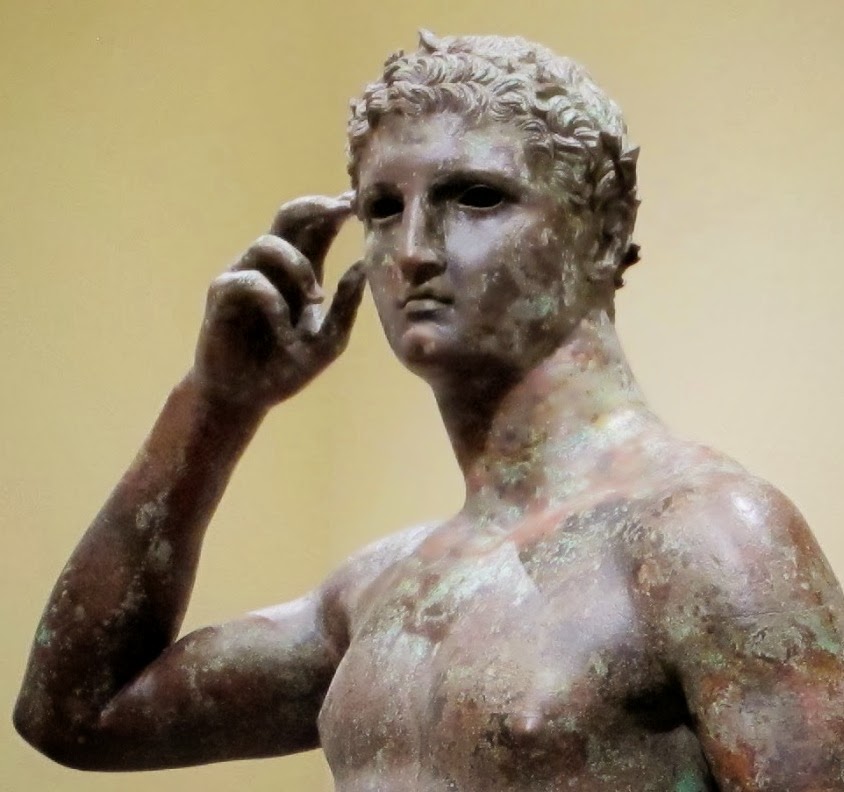
A story decades in the making, Italy’s Corte Suprema di Cassazione (Supreme Court of Cassation) was scheduled to hand down its final ruling today at the Palace of Justice in Rome on the fate of the l’Atleta di Fano, commonly known by as The Getty Bronze, the “Victorious Youth" or il Lisippo.  The bronze work of art, a representation of an athletic youth standing with all of his weight on his right leg, is depicted crowning himself with an olive wreath. It was purchased by the J. Paul Getty Museum under less than transparent circumstances in 1977 for $3.95 million.

After years of discussions Italy's highest court has elected not to issue its ruling today upholding a lower court's judgment that the "Victorious Youth" was illicitly exported from Italy and as such, is subject to seizure.  Instead the Prima sezione penale della Cassazione (First Penal Section of the Supreme Court of Italy) has elected to transfer the case to the Terzo sezione penale della Suprema Corte (Third Criminal Chamber of the Supreme Court) where a new hearing will be scheduled to establish whether or not the order of confiscation issued by the Court of Pesaro on May 3, 2012 should be affirmed.

The Getty Museum has been fighting a lower court's ruling by claiming that the statue was found in international waters in 1964 and was purchased by the Getty Museum in 1977 -- years after Italian courts concluded that there was no evidence that the statue belonged to Italy.  Throughout this elongated court process, the J. Paul Getty Museum has maintained that the statue's accidental discovery by Italian fishermen, who then brought the bronze to Fano and hid it from authorities, did not grant the statue the status of an Italian object.
Examining the merits of the case within the Prima sezione penale della Cassazione (First Penal Section of the Supreme Court of Italy) were the following magistrates:

Dott. Renato Cortese, Panel President
Dott. Angela Tardio, Consiglieri (Counselor)
Dott. Lucia La Posta, Consiglieri
Dott. Filippo Casa, Consiglieri
Dott. Francesco Bonito, Relatore (Speaker)

The Getty museum was represented in the case by Milan attorney Emanuele Rimini and attorney Alfredo Gaito from Rome. The Italian Ministry of Culture was represented by state cultural heritage attorney Maurizio Fiorilli.

But why fight over such a beautiful work of art?

This life-size Greek bronze statue is believed to have been created between the 4th and 2nd century BCE, possibly by the artist Lysippo, the court sculptor of Alexander the Great. While Lysippo was a prolific sculpture, few of his bronzes remain in existence making this particular statue and its high financial value something worth fighting for.  Italy has fought for the statue's return based on principle and for many years has utilized the judicial system within its means to make a point that its antiquities should not be trafficked.  The J. Paul Getty Museum is concerned that it will lose a substantial investment and a critical and cherished piece in their collection.  These opposing desires have placed the "Victorious Youth" at the epicenter of an international legal dispute that has lasted through the careers of two of Italy's finest cultural property attorneys, Giorgio Paolo Ferri and Maurizio Fiorilli.

The story of the statue begins with its discovery in 1964 off the northern Adriatic coast of Italy where it was fished from the sea by the Italian crew of the fishing trawler, Ferrucio Ferri who plied their trade out of Italy. Hauled aboard in the fisherman's nets and later hoisted from the boat onto Italian soil when the ship docked in Fano, the statue has changed hands and countries multiple times.  Its journey has been filled with fishermen, traffickers, shady middlemen and even a priest, making its journey from port harbor to one of the United State’s most prestigious museums a story worthy of more than just one article.

Rather than declare the statue’s discovery to customs officials, as required under Italian law, the fisherman and his brothers hid the bronze almost immediately.  To protect their asset, they buried the bronze in a cabbage field and began scouting for potential buyers.  The work of art was eventually sold to Giacomo Barbetti, a wealthy antiquarian, who was the first to identify the bronze as perhaps being the work of the Greek master, Lysippo.

In May 1965, the bronze moved from Fano to Gubbio, where, with the help of Father Giovanni Nagni, it was hidden for a brief period in a church sacristy. As the encrusted statue, covered in marine organisms and barnacles from its 2000 years in seawater began to smell, it drew unwanted attention forcing the resourceful conspirators to relocate the bronze from the church room for vestments to the priest’s bathtub.  There it was submerged in a saltwater bath to minimize its odor and slow its decay.  Investigators and lawyers tracing the statues journey say that Barbetti quickly sold the bronze to an unidentified buyer from Milan. 

Afterwards, the "Victorious Youth" passed through a number of other hands, crisscrossing its way through several countries after it was smuggled out of Italy.  In 1972 it passed through antique dealer Herzer Heinz in Munich who was tasked with removing the detritus that was encrusting the statue. It was in Heinz's studio in Germany that the bronze was examined, but not purchased, by Thomas Hoving from the New York Metropolitan Museum. 

In 1974 the Luxembourg-based company Artemis S.A, purchased the statue for $700,000.  Founded in 1970, evidence presented by the Italian state at the Tribunal in Pesaro in February 2010 suggests that the firm was created ad hoc to craft false provenance for antiquities trafficking.

During this period Herzer contacted Bernard Ashmole, at the British Museum who in turn approached J. Paul Getty about a possible purchase.   The American industrialist, turned art collector was skeptical enough of the statue’s sketchy provenance and Italian police interest in the piece that he declined to purchase the masterpiece.  Despite their founder's misgivings, the J. Paul Getty Museum bought the statue one year after Getty’s death.  The purchase in turn resulted in an INTERPOL notification to the Italian authorities that the Victorious Youth had found a museum buyer.
Palazzo di Giustizia, Roma

To understand how the case moved through the Italian judicial system it is first necessary to understand a bit more about the country’s legal system.  It is the responsibility of the Corte Suprema di Cassazione to ensure the correct application of law in the inferior and appeal courts and to resolve disputes as to which lower court (penal, civil, administrative, military) has jurisdiction.  Additionally, the higher court is also entrusted with the charge of defining the jurisdiction i.e., of indicating, in case of controversy, the court, either ordinary or special, Italian or foreign, which has the power to rule on a case.

Unlike upper level courts in the United States or the United Kingdom, the Italian Supreme Court cannot refuse to review cases and defendants have unlimited appeal rights to the Supreme Court of Cassation.  Given the backlog of criminal and civil cases pending and the lengthy process involved in delivering a ruling once an absolute decision has been handed down, cases like this one can linger in judicial limbo for many years.

Interior, Palazzo di Giustizia, Roma
To put things in perspective and to give readers an idea of how this complicates judicial resolutions, it's helpful to look at other countries for comparison.  The United Kingdom's Supreme Court hears approximately 75 cases per year while the United States Supreme Court generally rules on 100 to 120 case decisions annually.  In a country serving a local population that is one-fifth the size of the United States, the Italian Supreme Court of Cassation decides on close to 50,000 cases (both criminal and civil) annually.  The final administrative court, the Consiglio di Stato decides over 10,000 cases per year; while the Constitutional Court makes final decisions on around 400 cases per year.

Like other supreme courts around the world, the Court of Cassation is not tasked with re-examining the entire body of evidence in a given case.  Additionally it does not have to make rulings solely on cases that have passed through the Corte d'Assise d'Apello, Italy's Appellate Court. Cases which meet certain criteria can go directly from the tribunal level court system to the supreme court as the Court's role is specifically to rule on erores in iudicando and errores in procedendo (errors in procedure or application of the law). 

Some criminal cases reach Italy's Court of Cassation first passing through the Corte d'Assise d'Apello as was the case recently with the high profile murder case of Amanda Knox.  Both the defendant and the prosecution in this type of appeal case retain the right of appeal and both the Corte d'Assise d'Appello and the Supreme Court are required to publish written explanations of their rulings and decisions. But these are the upper courts.

Before arriving at the Supreme Court or Appeal Court cases are heard by regional tribunals.  Tribunals consist of one single judge or a panel of three judges depending on the type of case being heard.  It is these tribunali which are the Italian court's first instance of general jurisdiction in both civil and criminal matters. 

The Getty Villa, California
But getting back to the case of the Getty Bronze that in some ways is as complex and hard to follow judicially as a Wimbledon tennis match.

In 2007 the Italian Ministry of Cultural Heritage and the J. Paul Getty Trust agreed to set the question of the Victorius Youth aside pending the ongoing legal process before the Tribunal in Pesara concerning the object's illegal exportation from Italy.  The accord of the parties on this point was crucial as earlier negotiations in 2006 had been contentious and unfruitful due to disagreements between Italy and the Getty over the statue's ownership status.

In 2007, in proceedings before the Tribunal of Pesaro, charges related to the illicit exportation of the Victorious Youth were dismissed upon the request of the public prosecutor on the grounds that the statute of limitations on prosecution had expired against all of the defendants in the case leaving the Italian state with no one to prosecute.  At the time of the requested dismissal the prosecutor demanded the confiscation of the bronze given it had been exported out of Italy in contravention of existing Italian law.

Almost three years later, on the tenth of February 2010, Luisa Mussoni, the preliminary investigation judge at the Tribunal of Pesaro, ruled that the Victorious Youth was exported illicitly.  As a result of this court decision, the tribunal issued an order for the statue's immediate seizure and restitution to Italy.  This order followed an earlier and separate order June 12, 2009 ruling on the question of the jurisdiction.

As a result of these two decisions, the Getty Museum subsequently challenged the orders' validity before the Italian Court of Cassation on February 18, 2011. At that

hearing the case was remanded to back to the Tribunal of Pesaro for further examination of the merits of the case.


On May 3, 2012 Maurizio Di Palma, the Pre-Trial judge at the Tribunal of Pesaro, once again upheld the earlier 2010 order of forfeiture and confirmed that the statue was illegally exported from Italy.  His ruling placed the case's resolution back with Italy's Supreme Court for what was supposed to be today's final ruling.

If the Italian state affirms its final ruling with respect to this case at the Third Criminal Chamber of the Supreme Court it will be interesting to see how the repatriation order will be enforced and if the J Paul Getty Museum will to the right thing and relinquish the statue voluntarily.

When asked his opinion on today's postponement, Stefano Alessandrini, Perito Scientifico to the Italian state on this and other cultural heritage looting cases indicated that he would not celebrate (or give up) until he saw the statue arrive at Rome's Aeroporto Internazionale Leonardo da Vinci di Fiumicino.

Italy's cultural property attorney Maurizio Fiorilli retires April 12, 2014 meaning the torch will have to be passed to a third state prosecutor. 

For now, Italy continues to wait.

February 25, 2014

John Follain in The Sunday Times Reports J. Paul Getty May Send The Athlete of Fano to Italy

Official from Marche visited in 2011 to
press for possession of Athlete of Fano
In Britain's The Sunday Times, John Follain reports in "2,400-year-old 'hostage' ready to fly home to Italy" (February 23, 2014) that the statue known as The Athlete of Fano may be leaving the J. Paul Getty Villa in Malibu:
CALIFORNIA’S J Paul Getty Museum is expected to be ordered this week to return to Italy an ancient Greek bronze statue of an athlete that has been one of its most prized exhibits for more than three decades. In a case that has become a symbol of Italy’s new-found determination to reclaim its lost masterpieces, the Supreme Court in Rome is due on Tuesday to rule on the long battle for the “Getty bronze” — also known as Victorious Youth — considered one of the greatest treasures of the ancient world. The statue, which depicts an athlete crowned with an olive wreath, dates back to the 4th century BC and is believed to be the work of Lysippos, personal sculptor to Alexander the Great.

In May 2012, an Italian judge ruled that the statue should be returned to Italy. Officials from the Region of Marche visited California in March 2011 to press their argument for the statue's return.

February 24, 2014

Monday, February 24, 2014 - , No comments

Wolfgang Beltracchi, Art Forger: CBS Profiles German Fraudster, An "Evil Genius" and "Con Man"?

Here's a link to the CBS "60 Minutes" segment on art forger Wolfgang Beltracchi. The German fraudster tells interviewer Bob Simon that he knew what he was doing was wrong, he did not feel guilty for defrauding collectors, and used faked 'archival photographs' to support fake collecting history.

Here's a review ("60 Minutes" Recap) by Tammie Edenshaw of CMR (Current Movie Reviews):
Bob Simon brings the next story about Wolfgang Beltracchi, a con artist whose paintings are remarkable works of forgery. They are the ideas of a man whose visions are what he feels the master painters would have done or may have lost. His career has encompassed more than forty years and earned him millions. During the interview, Beltrachhi shows how he forges Max Ernst by painting on a wooden bridge outside his home. What is spectacular about this man is not the fact he “copies” famous works of art, but that he “channels” the artist and creates new works, which are his own, but passed off as those of a famous artist. He is probably one of the most exhibited painters in the world but was busted in 2010 but white paint which had titanium white. His downfall has turned the art world on his head as auction houses are being sued for endorsing the forgeries. Experts are now unsettled to the point of no longer rendering opinions of authentication. Beltracchi is now painting under his own name as he faces millions in lawsuits.
Dawn Levesque on Liberty Voice writes in "Wolfgang Beltracchi and the Biggest Art Scandal" that:
It is said that Wolfgang Beltracchi painted artworks by Raoul Duffy, Max Ernst, Georges Braque and Fernand Leger, along with other 20th century Surrealists and Expressionists. Beltracchi did not copy the paintings but passed off his own paintings in what he believed the real artist might have painted. These paintings became “newly discovered masterpieces” by 20th century artists. He expertly forged the artist’s painting style so flawlessly that no one was the wiser. In hindsight, according to modern art expert, Ralph Jentsch, it was due to the formidable desire to believe. Jentsch affirms, that in the world of art, connoisseurship and origins can go astray in the “frenzy of excitement over a new find.” Beltracchi also created artwork that once existed but had been missing for years. He conned even the finest art connoisseurs by working with paint and canvases from the appropriate period. In addition, he went so far as to produce realistic, time-worn dealer labels. Then, came the story to accompany the forged artwork. His wife, Helene claimed that her deceased grandfather, Werner Jägers had hidden his fine art collection away prior to World War II in a country home near Cologne. Subsequently, the collection was bequeathed to her, and according to Beltracchi, that is how he came into possession of the undiscovered artworks by renowned artists. To add integrity to the story, the Beltracchis presented a credible old black and white photo of Helene personating her grandmother, posed in front of canvases from the alleged “Jägers collection.”
[...]
In August 2010, Berlin’s art fraud branch conducted their biggest operation, and police teams seized paintings, the Beltracchis and their accomplices. However, with the lack of evidence at their trial, the judge terminated the proceedings, and the Beltracchis jail terms were reduced. A top forensic art analyst, Jamie Martin, is one expert that acknowledges that Wolfgang Beltracchi’s fakes are very credible, and some of the best counterfeits he has seen in his profession. He believes that if forensic analysts had inspected the paintings more thoroughly that maybe Beltracchi would have been exposed much earlier. However, that does not raise the spirits of those who have been prosecuted, including auction houses, galleries and experts, for selling Beltracchi fakes. At Beltracchi’s trial, the prosecuting attorney stated that he had produced 36 counterfeit artworks, bought for $46 million. Spanning four decades, it has been estimated that Beltracchi, Helene and their accomplices made $22 million on their art fraud. Even though authorities have charged Beltracchi with 36 works, he claims that there may be over 300 counterfeit paintings still in circulation. In truth, what is considered the “biggest art scandal of all time is not finished. German police have only uncovered 60 fraudulent paintings of Wolfgang Beltracchi since the trial, with an undetermined quantity amount still in circulation.

February 23, 2014

Sam Cullman and Jen Grausman seeking support on Kickstarter to complete "Art and Craft", a documentary on art forger Mark Landis

Here's a link to the Kickstarter campaign to raise $48,250 to bring "Art and Craft", a documentary by Sam Cullman and Jen Grausman on the fraud art forger Mark Landis, to audiences:
THE STORY: Mark Landis has been called one of the most prolific art forgers in US history. His impressive body of work spans thirty years, covering a wide range of painting styles and periods that includes 15th Century Icons, the Hudson River School, and even Picasso. And while his copies could fetch impressive sums on the open market, Landis has never been in it for the money. Posing as a philanthropic donor, a grieving executor of a family member’s will, and most recently as a Jesuit priest, Landis has given away hundreds of works over the years to a staggering list of institutions across the United States. But, when Matthew Leininger, a registrar in Cincinnati, discovers his thirty-year ruse and organizes an exhibition of the work, Landis must confront his legacy and a chorus of museum professionals clamoring for him to stop.


February 22, 2014

The Gurlitt Art Collection: Cornelius Gurlitt has retained legal counsel who have established a website on the case involving the seizure and claims over the "Nazi treasure"

In early November, the weekly German magazine Focus reported that Bavarian authorities had custody of value art collection owned by Cornelius Gurlitt whose father Hildebrand had been an art dealer to the Nazis. More than two months later, Mr. Gurlitt obtained legal counsel, Tido Park and Derek Setz, who have published a website presenting information about the Gurlitt Collection.

The website's chronology section details how a check of Cornelius Gurlitt on a train by German custom officials in September 2010 led to a search warrant a year later and the seizure in February 2012 of Gurlitt's art collection of 1,406 items from his residence in Munich. After Focus published the news of this "Nazi treasure", various government agencies initiated the process of publicizing the works amidst claims of theft. In December, a Munich court appointed a custodian, Chirstoph Edel, for Gurlitt. In January, Gurlitt's legal counsel filed 'a criminal complaint with the chief public prosecutor's office in Munich for breach of official secrecy. The main reason for the complaint was the publication of photographs of Gurlitt's apartment being searched and of other confidential details from the investigation files.' In February, more than 60 artworks were seized from Gurlitt's residence in Salzburg 'and were then insured and transported to a safe place at Mr. Gurlitt's request and at the suggestion and instigation of Christoph Edel – the court-appointed preliminary custodian – together with attorney Dr. Hannes Hartung and the professional assistance of art experts and conservators.' On Valentine's Day:
Professor Tido Park and Derek Setz, the attorneys defending Cornelius Gurlitt in his criminal lawsuit, filed an appeal with the Augsburg local court on February 14 this year against the search warrant and seizure order issued by the Augsburg local court on September 23, 2011 regarding the Schwabing part of the Gurlitt collection.
Another section on the Gurlitt Collection website, written by Munich lawyer Dr. Hannes Hartung, discusses the "Structure of the Collection of Dr. Hildebrant Gurlitt" from Gurlitt's role 'as one of the most important dealers in the German Reich' who 'acquired'
works for the Führermuseum planned by Hitler in Linz, Austria. In the same year, Gurlitt purchased a very large quantity of works that had formerly been Reich property from the German Reich and that as “degenerate” art had been confiscated from German museums. After the totalitarian “integration” process (Gleichschaltung), the German Reich saw no difference, both practically and legally, between national, regional, and local governments as we have today in our federal structure. 
The works originally came from the property of the German Reich and were legally acquired by Dr. Hildebrand Gurlitt by way of purchase or trade. The collection of Cornelius Gurlitt confiscated in Schwabing now includes about 380 of these artwork.
Hildebrand Gurlitt’s avid acquisition activities, among other things motivated by the desire to save art labeled as degenerate from its destruction, is documented in the so-called Fischer List (see http://www.vam.ac.uk/content/articles/e/entartete-kunst/). This list shows that Dr. Hildebrand Gurlitt legally acquired many important works from former German Reich property. In many instances the works would have been destroyed if Dr. Gurlitt had not acquired them at bargain prices. The art that had been defamed as “degenerate” can therefore be considered the art historical focus of the Gurlitt collection. 
Private property of the Gurlitt family 
A large part of the artworks confiscated by the public prosecutors also includes works from the private collection of the Gurlitt family. Cornelius Gurlitt’s family is a major dynasty of German art historians. Some 330 works were already part of the family’s private collection before 1933 and are meant to be returned to their rightful owner, Cornelius Gurlitt, in the near future. 
“Looted art 
When the Nazis persecuted what they considered “degenerate” art, their target was the art itself and not its owners. Only in the case of looted art were the cultural assets bought up for far less than they were worth (compulsory sale), dispossessed, or confiscated. Only very few works in the collection of Cornelius Gurlitt are suspected of being looted art. 
Another 590 works are the solely property of Cornelius Gurlitt. Currently (as of February 14, 2014) only four claimants assert that the Gurlitt collection contains works that may have once been appropriated from Jewish owners in the context of Nazi persecution. Stated differently, the 1,280 seized works that are the property of Cornelius Gurlitt have attracted only four claimants who demand the return of so-called looted art from Cornelius Gurlitt. Specifically, the claimants are the Rosenberg, Friedmann, Glaser, and Littmann heirs.