Blog Subscription via Follow.it

February 4, 2011

The Journal of Art Crime: Columnist David Gill on 'Context Matters'

by Catherine Schofield Sezgin

In his column “Context Matters,” archaeologist David Gill writes of “Greece and the U. S.: Reviewing Cultural Property Agreements” of Greece’s 2010 formal request to the United States to impose “import restrictions on archaeological and ethnological material from Greece dating to the Neolithic Period through the mid-eighteenth century”.

Gill’s column also covers international looting news from the period from March 2010 through August 2010 in Egypt, Greece, Italy, Japan, Turkey, the United Kingdom, and the United States.

David Gill is Reader in Mediterranean Archaeology at Swansea University, Wales, UK. He is a former Rome Scholar at the British School at Rome and was a member of the Department of Antiquities at the Fitzwilliam Museum, University of Cambridge. He has published widely on archaeological ethics with Christopher Chippindale. His Sifting the Soil of Greece: The Early Years of the British School at Athens (1886-1919) is due to be published in March by the Institute of Classical Studies in London. He is a member of the editorial board for the Journal of Art Crime.

ARCA blog: Dr. Gill, some of our readers are not schooled in cultural property law, how would you explain to them the lay meaning of Greece's request to the U. S. to impose "import restrictions in archaeological and ethnological material from Greece"?
Dr. Gill: The US has been a signatory to the UNESCO Convention on the Means of Prohibiting and Preventing the Illicit Import, Export and Transfer of Ownership of Cultural Property (1970) since 1983. However this seems to have made little significant impact on the acquisition policies of public museums and private collectors (as the impact of the “Medici Conspiracy” has shown all too clearly). In the last few years the J. Paul Getty Museum returned a gold funerary wreath that appears to have been removed from an archaeological context in Macedonia, and the New York collector Shelby White handed back a bronze calyx-krater that also appears to come from northern Greece. There are reports in the Greek press that there is a claim on a number of Greek antiquities in a major U. S. university museum. The case of the Aidonia Treasure that appeared on the North American market drew attention to concerns about recent illicit activity on archaeological sites in Greece. The Greek authorities feel that a formal Memorandum of Understanding (MOU) would have an impact on the movement of recently-surfaced cultural objects.
ARCA blog: Why do you think that the agreement stops "through the mid-eighteenth century"? What was the political compromise here?
Dr. Gill: The requested agreement covers material from prehistoric times (Neolithic) right through to the period of the Turkokratia. The MOU statement made it clear that Greek authorities wished to protect post-Byzantine art and materials.
ARCA blog: Would you expect to see any practical changes in how museums or private individuals collect items from Greece? And what kind of items would be included in this agreement?
Dr. Gill: The “Medici Conspiracy” has delivered a wake-up call to major museums and private collectors in North America (and beyond). Museum curators, dealers and collectors can no longer turn a blind eye to the issue. The Association of Art Museum Directors (AAMD) has re-formulated its policy towards the acquisition of archaeological material, and established an online object registry. There needs to be a more rigorous due diligence process by those selling antiquities as well as those making purchases. Collecting histories (I prefer this to the misleading term “provenance” that is so carelessly used in art history circles—but that is another story) need to be carefully documented. The proposed MOU with Greece covers a range of works from Neolithic figurines to ecclesiastical icons.
To seek out this piece, and many others, consider a subscription to the Journal of Art Crime—the first peer-reviewed academic journal covering art and heritage crime. ARCA publishes two volumes annually in the Spring and Fall. Individual, Institutional, electronic and printed versions are all available, with subscriptions as low as 30 Euros. All proceeds go to ARCA's nonprofit research and education initiatives. Please see the publications page for more information.

Photo: Dr. Gill at Rhamnous in eastern Attica, Greece

February 3, 2011

Financial Times Reporter Interviews Benevolent Forger

Financial Times' columnist John Grapper
by Catherine Schofield Sezgin

In case you missed this interview by the Financial Times' chief business commentator, we're giving you the link here to "The forger's story" (January 21, 2011). John Gapper writes about Mark Landis who dressed up as a priest to donate paintings to art institutions.
"For nearly three decades, Landis has visited ­museums across the US in various guises and tried to donate paintings he has forged. As well as Father Scott, he has posed as “Steven Gardiner” among other aliases. He never asks for money, although museums have often hosted meals for him and made small gifts. His only stipulation is that he is donating in his parents’ names – often his actual father, ­Lieutenant Commander Arthur Landis Jr, a former US Navy officer.

Landis has been prolific and amazingly persistent. A few weeks before he came to Lafayette, “Father Scott” arrived at the Nelson-Atkins Museum of Art in Kansas City, Missouri, with a ­forgery of Head of a Sioux by Alfred Jacob Miller that he said he was giving in memory of his mother, “Helen Mitchell Scott”. Landis has so far offered copies of that work to five other museums. Yet in all this time, although curators speculate about his motives, no one has found out why he is doing it."
There's a paragraph mentioning the The New York Times that I read as a competitive -- and well-earned -- jab:
"The New York Times reported recently that Landis “seems to have disappeared altogether”, but it did not take long to locate him. After I had visited the Lauren Rogers museum, I drove the few blocks over to the apartment where his mother had lived, in a gated community for the elderly called Sugar Hill Resort."
John Gapper reports on why the forger sat down with him and talked about his family and his motivations. Fascinating story -- Mr. Gapper made me feel as if I too was meeting with the forger in an intimate talk. On his blog, Mr. Gapper continues with information he obtained after the interview with forger Mark Landis about where he purchased some of his materials. No, I won't be a spoiler, you have to go to Mr. Gapper's blog here, it's his story.

Photo: John Gapper.

Profile: ARCA Lecturer Edgar Tijhuis on Transnational Crime, Organized Crime and Illicit Art and Antiquities

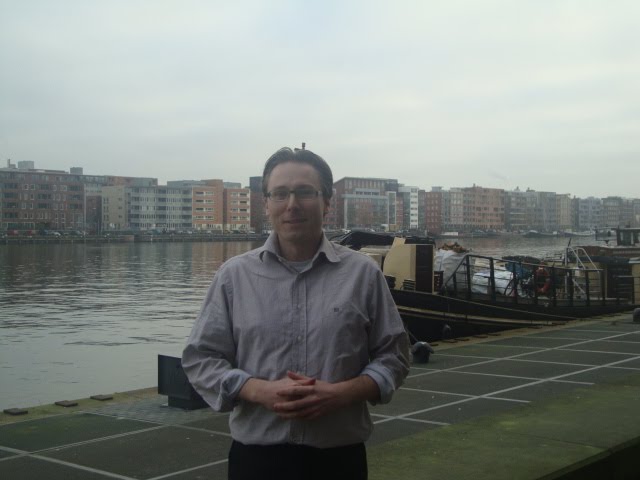
Edgar Tijhuis
by Catherine Schofield Sezgin

Edgar Tijhuis, lawyer and assistant-professor of Criminology at the VU University in Amsterdam, in The Netherlands, will return to Amelia for the third year to teach “Criminology, Art, and Transnational Organized Crime” for ARCA’s Postgraduate Program in International Art Crime and Cultural Property Protection Studies.

Tijhuis, the author of Transnational Crime and the Interface between Legal and Illegal Actors – The Case of the Illicit Art and Antiquities Trade (Nijmegen, Wolf Legal Publishers, 2006), published a chapter in Art & Crime: Exploring the Dark Side of the Art World (Praeger, 2009), “Who Is Stealing All Those Paintings?” He is also associated with the Netherlands Institute for the Study of Crime and Law Enforcement in Amsterdam.

ARCA blog: Professor Tijhuis, your essay in Art & Crime makes the point, as Noah Charney wrote in a long footnote, “that most experts are going on hearsay from police about Organized Crime and art crime, with relatively little empirical data and evidence beyond the word of police, undercover agents, and criminals.” Since publishing this article in 2009, do you think that anything had changed? Have you seen any data that would support the level of activity of Organized Crime in the illicit and antiquities trade?
Professor Tijhuis: It is difficult to answer this question briefly. To be sure, I did not mean to say that “organized crime” is not involved in crimes related to art. The point is that general claims of this involvement do not seem to be based on firm empirical data. In fact, “art crime” consists of all kinds of rather different types of (criminal) activity, in uncountable places around the world. With some specific types of art crime, one can clearly see an “organized” character, with others there does not seem to be any organization at all and with many we simply do not know or we see all kind of different ways of organizing these crimes. To make it even more complex, an ongoing debate among criminologists focuses on the whole concept of “organized crime”. Do we actually focus on actors (organizations) or activities?
At this moment different studies try to shed light on these topics. Among others, Noah Charney and myself are involved in these studies and I hope they will enhance our knowledge.
ARCA blog: As a practical point, do you think that Organized Crime uses stolen art and antiquities in part of the trade on illegal drug and arms activities? Are you aware of any data that ties stolen art or antiquities to any other illegal activities supported by Organized Crime networks?
Professor Tijhuis: Again, we are dealing with a rather broad category of crimes that take place all around the world. I am not aware of data that systematically connects art crimes with other illegal activities. However, one can find examples of connections with other crimes in specific places around the world.
ARCA blog: What is the difference between transnational crime and Organized Crime and how does this influence the way you teach your course for ARCA?
Professor Tijhuis: First of all, transnational crime clearly involves cross-border types of crime. At the same time, it does not necessarily involve all kind of criminal organizations but may involve individuals or constantly changing networks of people involved in specific crimes. The different terms are related to the different perspectives on crime that were mentioned earlier. When one takes actors as the starting point of studies, one will use the terms “organized crime” or “transnational organized crime”. Transnational crime, on the contrary, is sometimes used when one takes (illicit) activities as starting point.
ARCA blog: What is your current area of focus as related to art crime?
Professor Tijhuis: Currently I'm looking at several specific topics. One of them is “profiling”. We look at ways to profile art crimes, either geographically or psychological. Furthermore, together with Noah Charney, I am working on an article on Organized Crime and Art Crime, which should help to clarify things for readers and students alike, and which will combine our two approaches. We very much enjoy working together, and this is the first of what we hope will be several collaborative future projects.
ARCA blog: Will you be doing anything differently in your class this year?
Professor Tijhuis: Each year I try to add new elements and change the material. This year will probably have somewhat less purely criminological theory and more theory on organized crime and white- collar crime. Furthermore, recent literature and cases always provide wonderful new material.

Journal of Art Crime: Columnist Ton Cremers on 'Security & Safety Reflections'

In his column "Security & Safety Reflections", security consultant Ton Cremers, founder of the Museum Security Network, writes about “Tracking and Tracing of Stolen Art Objects” in the fourth issue of The Journal of Art Crime (Fall 2010). Cremers questions the “not always very trustworthy” marketing of a UK-based company, RFID (radio frequency identification); addresses the complexity of tracking and tracing objects inside and outside museum buildings; and describes the difference between active and passive tags.

Ton Cremers was awarded the 2003 Robert B. Burke Award for excellence in cultural property protection.

To seek out this piece, and many others, consider a subscription to the Journal of Art Crime—the first peer-reviewed academic journal covering art and heritage crime. ARCA publishes two volumes annually in the Spring and Fall. Individual, Institutional, electronic and printed versions are all available, with subscriptions as low as 30 Euros. All proceeds go to ARCA's nonprofit research and education initiatives. Please see the publications page for more information.

Dr. David Gill at Looting Matters Relays Messages from the Field in Egypt

David Gill is reporting on his blog Looting Matters that a former colleague of his is reporting damage to archaeological sites. You can read it here. Professor Gill notes that this report from the field is in contrast to the statements issued earlier by the government's new Minister of Culture, Dr. Zahi Hawass.

David Gill is a member of the Department of History and Classics at Swansea University, Wales. He was a Rome Scholar at the British School at Rome and a Sir James Knott Fellow at the University of Newcastle upon Tyne. He was subsequently part of the Department of Antiquities at the Fitzwilliam Museum, University of Cambridge.

National Geographic also reports Egyptian antiquities damaged. They include photos and identify objects. The interests of the majority of Egyptians intent on protecting their culture and history are threatened by the "few" looking to make money.


February 2, 2011

Wednesday, February 02, 2011 - ,,, No comments

Zahi Hawass provides update on status of Egypt's Museums and Archaeological Sites


Here's an update from Dr. Zahi Hawass on the current condition of Egyptian museums and archaeological sites. Dr. Hawass, secretary general of Egypt's Supreme Council of Antiquities was interviewed by Michele Norris of NPR yesterday and you can see that here. Dr. Hawass was recently appointed Minister of Antiquities, a new department in charge of the maintenance and protection of all Egyptian monuments and museums.

Noah Charney interviews Mark Durney, creator of the ARCAblog and "Art Theft Central" in his new ARTINFO column "The Secret History of Art"

In his new ARTINFO column, "The Secret History of Art," Noah Charney interviews Mark Durney who discusses how he began studying art crime and his development of the ARCA blog. You can read it here.

Durney studied History at Trinity College in Hartford, CT and earned a masters degree in cultural heritage studies at University College London's Institute of Archaeology.

Here's an excerpt from Charney's interview:
Describe some of your past work experience?

While a student at Trinity College, I pursued internships in finance, including in the financial services strategic business unit of Capgemini Consulting. Although not related to the culture heritage field, these experiences greatly enhanced my research and analytical skills as well as my business acumen. Since graduation in 2008, I have volunteered and consulted with ARCA on a number of projects, such as the development of ARCA's blog and podcasts, and the advancement of its postgraduate program International Art Crime and Cultural Heritage Protection Studies. Additionally, in 2009 I worked as a gallery officer at Boston's Isabella Stewart Gardner Museum, which was the victim of an art heist in March 1990. During my studies at UCL, I completed a work placement in the UK's Museums, Libraries, and Archives Council's Cultural Property Unit. In my spare time, I maintain Art Theft Central, which discusses art theft news and provides insights into the historical trends in the field, and I moderate the Museum Security Network, which redistributes news related to the protection, preservation, and conservation of cultural heritage. 

How did you develop an interest in art crime and cultural heritage?
At Trinity College, I wrote my senior thesis on debunking the Thomas Crown Affair art heist scenario by utilizing a number of case studies from the 20th century. This was not hard to do in light of the fact that not every art thief is as sophisticated or affluent as Thomas Crown! Similarly, my master's thesis "An Examination of Art Theft, Analysis of Relevant Statistics, and Insights into the Protection of Cultural Heritage" qualifies and interprets art theft statistics provided by the London-based Art Loss Register (ALR) and the International Criminal Police Organization (INTERPOL) in order to quantify the problem of art theft and to assess the effectiveness of the most recent strategies that have been implemented to combat the illicit art trade. 

How did you learn about ARCA and first become involved? 

I received "The Art Thief" for Christmas 2008, and after reading it began seeking opportunities that enabled me to contribute to the greater security of our collective cultural heritage. Eventually, I discovered ARCA and Noah Charney offered me voluntary (and eventually paid) opportunities.