Sunday's Musée du Louvre heist has captivated global attention as an example of a spectacular daylight raid on one of the world’s most visited and symbolically important cultural institutions. Yet, while the audacity and precision of the theft are shocking, the event is not unique, nor is it just a "France" problem.
Museums across the world, from Berlin to Hyderabad, from Dresden to Cardiff, have been targeted for their treasures. Whether it is the glint of gold, the rarity of ancient gems, or the prestige of royal jewels, institutions that safeguard the world’s cultural inheritance have face the dual challenge of welcoming the public while defending against those who would steal from it. The Louvre Museum incident is therefore part of a much larger pattern, one that reveals the enduring allure and vulnerability of gold and jewels, history, and craftsmanship in a modern world that can strategically monetise cultural patrimony.
Here is a list of some recent noteworthy museum heists, some with recoveries, others not:
1. British Museum (London, UK) – curator-linked insider theft (~2009-2018 publicly revealed)
In August 2023 the British Museum revealed that an internal investigation had uncovered the alleged theft of over 1,800 objects, mostly small ancient gems, rings, earrings, coins and other jewellery-type artefacts, from its storerooms believed to have been taken between 2009 and 2018.The suspected perpetrator is a former veteran curator, Peter Higgs, who held a senior post in the Greece & Rome department. The museum claims Higgs used his privileged access and knowledge of the collection’s gaps to remove items, alter or delete records, then sell them — often via eBay and PayPal under false identities — over a period spanning at least several years.
On 26 March 2024, a London High Court ordered Higgs to list all allegedly stolen items, return what he still holds, and disclose the proceeds of sales. The case is particularly notable because it underscores how insider threats — curators or staff with access to collections — can pose severe risks to heritage institutions, not just late-night break-ins or external smash-and-grabs.
2. Bode Museum, Berlin – 27 March 2017
In the pre-dawn darkness of 27 March 2017, three masked men scaled the exterior of Berlin’s Bode Museum and accessed a second-floor window via a derelict support extension linking to the nearby train tracks. Inside, they located and removed the massive 100-kilogram “Big Maple Leaf” gold coin — a specially minted Canadian coin on loan to the museum and valued at several million euros purely for its gold content. The thieves then wheeled the coin out aided by insider knowledge of the museum’s security schedule. The heist shocked the museum world because of its audacity, the sheer weight of the object stolen, and the implication that even highly visible landmarks remain vulnerable to well-planned operations.
The coin was never recovered and most believe it was melted down soon after the theft.
3. Musée du Hiéron, Paray-le-Monial – 29 June 2017
On 29 June 2017, two elaborately crafted gold crowns by the 19th-century goldsmith Paul Brunet — the couronne de Notre-Dame de Romay and the couronne de l’Enfant Jésus — were reported stolen during an early morning burglary from the Musée du Hiéron in eastern France. Although few details are released to the public, the theft was significant because the museum is dedicated to sacred art and the objects were unique liturgical gold-smith works with both artistic and religious value. A later press article noted that the Hiéron had been flagged for security concerns after this incident. The case is emblematic of how relatively modest regional institutions can be targeted for objects of substantial heritage value and how some thefts draw only short-lived media attention.
4. Doges Palace, Venice - 3 January 2018
Jewellery worth an estimated €2m (£1.7m) was stolen from a display case at the museum palace of the Doge of Venice during a brazen, broad daylight, robbery which occurred shortly after ten in the morning on the last day of the exhibition "Treasures of the Mughals and Maharaja" brought together 270+ pieces of Indian jewellery, covering four centuries of India's heritage, owned by Sheikh Hamad bin Abdullah Al-Thani, CEO of Qatar Investment & Projects Development Holding Company (QIPCO), the Qatari mega-holding company. According to the incident's reconstruction using cameras surveillance footage, two thieves, one serving as lookout and a second culprit who actively broke into a display case located in the Sala dello Scrutinio, quickly made off with 10 carat, grade D diamond and ruby pendant brooch and a pair of pear-shaped 30.2-carat diamond earrings in a platinum setting. As soon as the display case was breached, sounding an alarm, the pair deftly escaped through the crowded museum gallery, blending in among the patrons and were out of the museum before security could seal the museum's perimeter to apprehend them.
Both items belonged to His Highness Sheikh Hamad bin Abdullah Al-Thani, a member of the Qatari royal family, who is the first cousin of the current emir, Sheikh Tamim bin Hamad Al-Thani.
5. Musée Dobrée, Nantes – 13-14 April 2018
After narrowly escaping being melted down after the French Revolution, the 16th century gold case containing the heart of Anne of Brittany, the only woman to have twice been crowned queen of France was stolen along with other items from the Musée Dobrée in a nighttime burglary between 13-14 April 2018 in Nantes.
6. Strängnäs Cathedral - 31 July 2018
Two thieves entered the Strängnäs Cathedral one hour west of Stockholm during opening hours and quickly made their way down to the lower sacristy at the far left of the cathedral, the room where royal jewels were kept. One there, they smashed a jagged hole into the bottom left of the glass case where the objects were displayed, stealing two crowns and an orb used at the funerals of King Karl IX and Queen Kristina.
Exiting the museum at a brisk pace, the pair escaped on bicycles before boarding a boat on Lake Mälaren which contains hundreds of islands and is surrounded by several large towns and the capital, Stockholm. Two accomplices, Johan Nicklas Bäckström and Martin Cannermo were convicted in the Attunda District Court in large part due to the amount of DNA evidence left behind. The jewels were recovered the following year in February.
7. Nizam Museum, Hyderabad – 2 September 2018
In the evening of Sunday, 2 September 2018, thieves entered the historic Purani Haveli palace in Hyderabad and broke into the Nizam Museum through a ventilation shaft. Among the stolen items were a multi-tier gold tiffin box studded with diamonds and rubies, a gold cup and saucer set, and a spoon — all belonging to the seventh Nizam of Hyderabad. In this theft the perpetrators were arrested in the following weeks and the objects were recovered. This heist underlined the vulnerability of heritage sites in parts of India, where lesser-known treasures may attract opportunistic thieves, and like with the Louvre museum, the site faces security challenges include mixing public access with historical building layouts.
8. Blenheim Palace, Oxfordshire (UK) – 14 September 2019
In the predawn hours of 14 September 2019, at the stately country house museum of Blenheim Palace (the birthplace of Winston Churchill), a gang of five men executed a brazen smash-and-grab theft. Their target was America, a fully functional lavatory sculpture cast in 18-carat gold created bythe artist Maurizio Cattelan. The piece weighed approximately 98 kg (216 lb) and was insured for about £4.8 million. The intruders drove two stolen vehicles through locked wooden gates, entered the palace grounds just before 5 am, smashed a window and a heavy door, detached the art piece from its plumbing connections (which caused flooding and structural damage to the historic building) and left the site within roughly five minutes.
Despite subsequent arrests and a trial, with men jailed for their roles in the theft, the gold artwork has never been recovered and is widely believed to have been cut up or melted down for its bullion value. This case stands out not only for the extraordinary value of the object, but for the dramatic nature of the heist: a major heritage site, a pre-planned reconnaissance (one suspect reportedly visited the palace twice ahead of the theft), and an artwork that itself criticises excess and privilege.
Police are seeking six suspects who ransacked the17th-century French Chateau Vaux-le-Vicomte near Paris, and tied up the palaces owners before making off with a haul worth €2m (£1.8m), authorities have said.
9. Chateau Vaux-le-Vicom (Maincy) – Mid September 2019
In the hours before dawn, six masked thieves crept into the private quarters of the lavish 17th-century chateau Vaux-le-Vicomte and tied up 90-year-old Patrice de Vogüé and his 78-year-old wife, Cristina, with neckties, according to local police.
The couple, who opens the palatial home to the public, were uninjured, however the thieves made off with an estimated €2 million in cash, emeralds and other jewels from the Baroque chateau's safe, which they emptied.
10. Green Vault (Grünes Gewölbe), Dresden – 25 November 2019
In one of the most audacious museum heists in recent history, early on 25 November 2019 a gang used axes to smash glass display cases in the Green Vault (Grünes Gewölbe in German) within Dresden Castle in Saxony a nd stole three jewellery sets made for Saxon royalty in the 18th century, estimated to be worth €113 million (or more). The theft was preceded by a power cut and use of an incendiary diversion, demonstrating a sophisticated, coordinated strike. A trial in 2023 saw five men convicted. This case exposes how even well-guarded state museums with legacy architecture and internationally renowned treasures can still fall victim to organised crime networks, in this case members of one of the Arabische Großfamilie clans.
11. Museum of Applied Arts, Belgrade (Muzej Primenjene Umetnosti) – 2019
In 2019, the Museum of Applied Arts in Belgrade disclosed that several dozen items, including jewellery, medals, coins, weapons, many relating to the historic Obrenović dynasty, were stolen. Although precise dates and object lists remain incomplete publicly, the incident illustrates how institutional under-resourcing and internal vulnerabilities can enable thefts of culturally significant material, especially where tracking and transparency may be weaker than in major Western European museums.
12. Museo Civico a Palazzo Guicciardini ( Montopoli) - 28 October 2020
Thieves gained entry to this historic palazzo from the building's rear garden, forcing open the only unbarred window located between the first and second floors and bypassing the alarmed entrance and bookshop. Once inside, they stole 17th silver, and silver and brass liturgical objects as well as metal antiquities, scooping up as mucg as they could and throwing the pieces haphazardly into garbage bags.
13. Arundel Castle (West Sussex) - 21 May 2021
At approximately 10:30 pm, thieves targeted the medieval castle in Arundel. Despite responding within minutes of the alarm going off, Sussex police arrived to find a burnt-out car, thought to be connected to the heist, and a display cabinet in the dining room stripped of £1 million worth of historic gold and silver artefacts, including a 16th Century set of gold and enamel rosary beads made up of a crucifix and a string of five decades made up of small beads, with five larger beads. This rosary was carried by Mary Queen of Scots to her execution at Fotheringhay Castle in 1587 and was bequeathed by her to Anne, Countess of Arundel, wife of St. Philip Howard. In addition to these, several coronation cups given by Mary to the Earl Marshal of the day, and other gold and silver objects were taken.
14. Kelten‑ & Römermuseum Manching – 21-22 November 2022
On 22 November 2022, in a heist believed, like the one at the Louvre to have taken under ten minutes, four burglars used heavy crowbars to force their way into the Kelten- & Römermuseum in Manching (near Ingolstadt, Germany) and made off with 483 gold coins excavated in 1999, on display at the museum. The rapidity and precision of the raid emphasise how even smaller regional archaeological museums with high-value ancient objects face serious risk from targeted operations.
The four culprits in the case were accused of a total of 20 break-ins or attempted robberies in Germany and neighbouring Austria and most of the gold has not been recovered.
15. Musée Hébert (La Tronche) – 22 January 2023
Thieves targeted the Hébert Museum, a former bourgeois residence dating from the early 19th century and honoring the French painter Ernest Hébert near Grenoble. The burglars gained access to the museum by climbing the balustrade, then breaking open a window pain which allowed them to open the balcony door.
Once inside, the thieves targeted specifically the jewellery thought (incorrectly) to have once belonged to a relative of Napoleon III currently the property of the Uckermann Foundation, housed within the Fondation de France. Around 4:30 a.m., the museum's intrusion alarm sounded, but the culprits were in and out of the museum in under 4 minutes and had already fled by the time the police arrived. The loss was estimated at €110,000.
16. Clifton Park Museum (Rotherham) – 13-14 April 2023
A grouping of historically-significant necklaces and bangles, part of an Indian artefacts exhibit, are among the jewellery items stolen from this Rotherham museum in Clifton Park.
South Yorkshire Police say that thieves forced entry into the site. This is the third incident of theft at this museum.
17. Kelham Island Museum (Sheffield) – May 2023
A range of valuable metalwork items and sculptures dating back to the 1700s, some on loan from Sheffield Assay Office, and others featured in displays created by the Ken Hawley Collection Trust, were stolen from Kelham Island Museum during a burglary.
18. Royal Lancers & Nottinghamshire Yeomanry Museum (Newark) – 29 October 2023
Tens of thousands of pounds worth of antique silver artefacts were stolen in an early morning raid between 02:40 and 03:30 GMT at this military museum in Nottinghamshire at Thoresby Park.
19. Musée Saint‑Remi – December 2023
Highlighting a case of insider threat,
at the end of 2023 (inventory in December), the Musée Saint-Remi in Reims discovered that 130 coins: Roman, medieval and modern, which were missing from its storage. The losses triggered a formal investigation and, in early 2025, by cross-border cooperation Russia-France, seized matching coins from Moscow. Although perhaps lower in headline value than giant jewellery sets, the case is important for illustrating how gradual internal losses of heritage items may go undetected until routine checks reveal the gap, especially in institutions with littler public visibility.
20. Vittoriale degli Italiani (Gardone Riviera) – 5/6 March 2024
Forty-nine jewellery pieces, created by twentieth century sculptor, painter, and Italian partisan, Umberto Mastroianni and loaned by his heir Paola Molinengo Sosta disappeared during a burglary between 5/6 March 2024 at the house-museum, Vittoriale degli Italiani in Gardone Riviera, which was once home to Italian poet and novelist Gabriele D'Annunzio. A 50th object was dropped when the thief or thieves departed.
21. Ely Museum – 7 May 2024
In the early hours of 7 May 2024, thieves broke into Ely Museum (Cambridgeshire, UK) and stole a Bronze-Age gold torc and matching gold bracelet dating back ~3,000 years. This theft highlights that even smaller local museums housing valuable examples of pre-historic metalwork are vulnerable to great losses as their artefacts are highly portable, extremely rare, and often less visible in high-security circles, making them tempting targets for specialist thieves.
22. Musée Cognacq‑Jay, Paris – 20 November 2024
On 20 November 2024, daytime thieves burst into the Musée Cognacq-Jay in Paris,
stealing precious snuff-boxes and other luxury items from 18th-century collections. This daylight robbery in a central Paris museum, like the Louvre's underscores that the risk is not limited to dramatic late-night smash-and-grabs. This meticulously planned raid, like the Louvre, lasted only minutes, during which the thieves targeted small but immensely valuable £5 million collection, due to their portability and worth. It demonstrates that even open-hours thefts in busy urban settings are possible when the thieves planning and execute their crimes with precision.
Thankfully, we have some recent recoveries in this incident.
23. Musée du Hiéron (again) – 21 November 2024
Just one day after the Musée Cognacq-Jay thefts, on 21 November 2024, the Musée du Hiéron in France suffered its own bold daylight robbery of sacred art and jewellery. The fact that the same institution was hit so soon after a theft in Paris underlines what happens when vulnerabilities are exposed: criminals may act quickly to exploit perceived weakness.
Once the glass was breached, the culprits quickly snatched as many of the small gold and ivory statuettes and jewel encrusted elements as they could and in just two minutes the deed was done and the thieves' escape was made.
24. Museo Diocesano di Nocera – 14 January 2025
In a nighttime burglary, three thieves broke into the the Diocesan Museum of San Prisco, located within the Episcopal Curia of Nocera Inferiore and stole a series of votive objects and precious objects including Jewellery, bracelets, rings and votive offerings from three display cases which were part of the Treasure of San Prisco, estimated to be worth tens of thousands of euros
25. Drents Museum, Assen – 25 January 2025
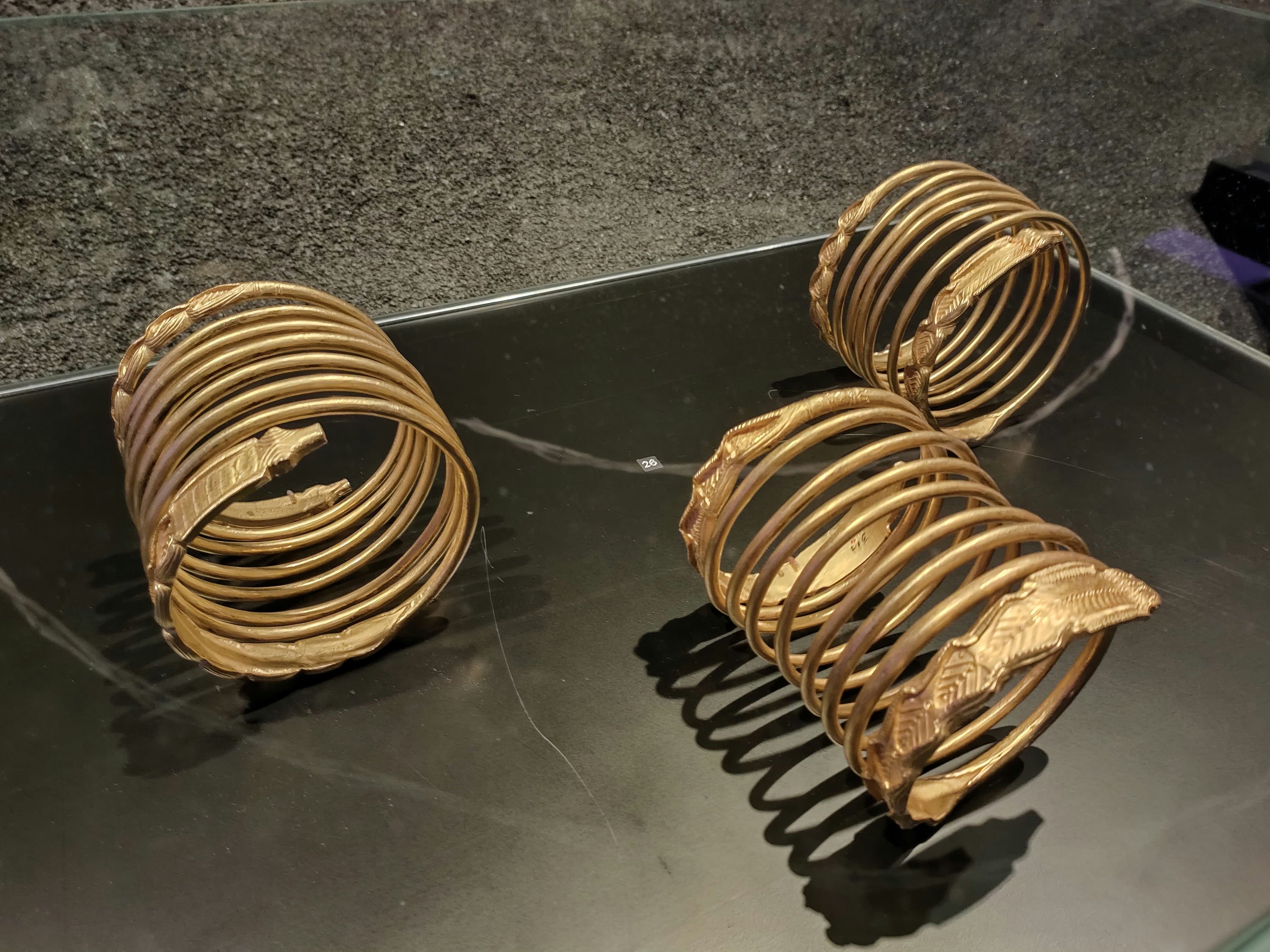
On 25 January 2025, early morning, thieves used an explosive device at the underground garden entrance of the Drents Museum in Assen (Netherlands) to gain entry. The blast broke windows and enabled the hoist of ancient gold bracelets and a gold crown on loan from Romania’s national museum. Later official statements described this as a major cross-border heritage crime.
This incident showcases how extreme force and organised crime tactics may be used, as well as how valuable insured items on loan may be targets.
26. Historisches Museum Basel – Late May 2025
A historic finger ring was stolen from the Haus zum Kirschgarten, one of the three exhibition halls of the Basel Historical Museum. The ring bears the initials "B M" and is made from a piece of jewelry that Tsar Alexander I (1777–1825) presented to his hostess at the Segerhof in Basel as a gift in January 1814. The theft was discovered at the end of May 2025 but was only made public in June 2025.
27. Egyptian Museum - September 2025
A 3,000-year-old gold bracelet once belonging to Pharaoh Amenemope was stolen from a secure safe inside the Egyptian Museum in Cairo by a restoration specialist entrusted with its care. Rather than being preserved or sold intact, the artefact was melted down for its metal content, reducing an irreplaceable piece of Egypt’s ancient history to bullion worth only a small amount on the open market. The act represents not only a profound betrayal of professional trust but also a stark illustration of how the price of gold can incentivise destruction of world heritage, even for comparatively trivial financial gain.
28. Royal Albert Memorial Museum and Art Gallery, Exeter – 10 September 2025
Seventeen antique pocket watches and a a flintlock blunderbuss firearm were taken during an overnight theft at the Royal Albert Memorial Museum and Art Gallery after two people forced their way into the museum.
29. Muséum national d’Histoire naturelle (Paris) – 15-16 September 2025
On 16 September 2025, a lone thief broke into the geology/mineralogy gallery of the Muséum national d’Histoire naturelle (Jardin des Plantes, Paris) and stole an Australian gold nugget weighing five kilos as well as smaller ones, from California and Bolivia, valued at ~€600,000. The targeted nature of the theft (raw gold specimens) indicates a recurring modus operandi: thefts in museums focused on easily transportable and smelt-able assets even within large heritage institutions.
30. Sain Ffagan National Museum of History, Cardiff (Wales) – 6 October 2025
At 12:30 AM on 6 October 2025, two suspects smashed their way into the main building of Sain Ffaganin Cardiff and pulled off one of the fastest museum heists on record, just four minutes from entry to exit.
They targeted Bronze-Age gold jewellery (including ingots and a lunula) dating back to 2300–800 BCE from the “Wales is…” gallery. This theft demonstrates that even regional, national-heritage museums can also be targeted.
31. Musée du Désert, Mialet – 7 October 2025
During the early morning hours, 7 October, a burglary occurred at the Musée du Désert, a museum dedicated to the history of Protestantism in France, particularly in the Cévennes in Mialet, France. During the incident an individual entered the museum and, as seen on the CCTV footage, quickly made his way to a display case containing the collection of gold Huguenot crosses where the burglar seized around a hundred pieces, dating from the 18th to the 20th century.
32 Musée du président Jacques Chirac, Sarran – 12, 13-14 October 2025
On Sunday October 12, four burglars “wearing balaclavas and armed with a shotgun and knives” broke in and stole cash €300 and a watch from theMusée du président Jacques Chirac with the suspects being arrested shortly thereafter. Then, during the night of 13-14 October the museum was struck a second time, with thieves managing to make off with items totalling over one million euros. The stolen items include collector watches and jewellery given to President Jacques Chirac during his two terms in office (1995-2007).
33 Denis Diderot House of Lights Museum, Langres – 20 October 2025
Just days after the dramatic burglary at the Louvre Museum in Paris, French authorities reported an overnight burglary at the Musée de la Maison des Lumières Denis Diderot in Langres (Haute-Marne) where a “treasure” of gold and silver coins was stolen. According to local police the entry was detected around 11 a.m. on the morning after windows were found broken and a sliding door forced, but by then the thieves had already made off with the items, which reportedly came from a cache of some 2,000 coins worth roughly €90,000 when first discovered in 2011.
All this to say, that while the Louvre theft stands out for its scale in audacity, its symbolism, and the prominence of the institution involved, it underscores a truth well known to those working within the museum security community: no collection, however secure, is entirely beyond reach.
From local galleries to national archives, cultural institutions exist in a constant state of balance between access and protection. Each theft , whether a handful of gold coins or a crown once worn by royalty, represents not only a material loss but a fracture in the shared narrative of human history. The resilience of curators, conservators, and security professionals who work to preserve and who are left to rebuild after such attacks don't deserve arm-chair posturing by others who haven't walked a mile in their moccasins. They alone understand what it takes to ensure that the world’s heritage remains not just displayed, but defended. They deserve governmental and public support, not just the wringing of hands or the I could have done it better criticism and posturing when losses such as these occur.
The instances should be studied for their lessons learned, knowing that the reality is that there will always be a trade off between access/visibility and security.
By: Lynda Albertson


 dacian,Drents Museum,Gold,museum theft,romanian,Romanian Police,The Netherlands
 No comments