Blog Subscription via Follow.it

April 16, 2025

Sudan’s Cultural Heart Under Threat: The Fate of the Sudan National Museum Amid Civil Conflict


In the heart of Khartoum, nestled near the confluence of the Blue and White Nile, stands the Sudan National Museum—once a vital repository to centuries of knowledge regarding country's ancient and storied past.  Home to the world’s most comprehensive collection of Nubian archaeology, the museum has long served as both a guardian of Sudan’s rich cultural heritage and a symbol of national identity. 

When violence first broke out in April 2023 between the Sudanese Armed Forces (SAF) and the paramilitary Rapid Support Forces (RSF), Khartoum became an epicenter of combat. Within days, RSF units occupied large swaths of the city, including key government buildings, residential neighbourhoods, and the area surrounding the Sudan National Museum. 

The museum itself fell within contested territory, with ongoing shelling and street battles posing severe risk and making its interior impossible to secure.  Throughout the months that followed, reports of looting and damage to Khartoum’s infrastructure and the museum were reported, with its museum staff and heritage experts displaced under the strain of war, making it nearly impossible to assess the damage while the the city remained under siege. 

It wasn’t until early 2025—after a sustained counteroffensive by the SAF and international diplomatic pressure—that much of central Khartoum, including the museum district, was recaptured. By then, however, the damage to Sudan's important cultural landmarks had already been done.

A Repository of Nubian Glory

The Sudan National Museum was established in 1971 and housed over 50,000 years of human history. Its galleries showcased everything from prehistoric stone tools and ancient Christian frescoes to monumental statues and pharaonic temples rescued from the waters of Lake Nasser during the UNESCO Nubia Campaign of the 1960s. The museum's collection includes artifacts from the Kingdom of Kush, the Kerma civilisation, and the Christian kingdoms of Nubia, shedding light on cultures often overshadowed by their northern neighbours in Egypt.

What made the museum especially significant was not just the artefacts it held, but the unique narrative it wove—a story of African ingenuity, political power, and religious transformation that challenged long-standing historical biases and centered Sudan within the broader tapestry of global heritage which transcended its modern day, and often contested borders.

Cultural Institutions in the Crossfire

Since the outbreak of conflict, the museum—like many institutions in the country—suffered from a lack of security, interrupted funding, and the physical dangers posed by armed clashes waged in and around it.  By early 2024, satellite images and reports from heritage professionals warned of structural damage to the museum's building and the increasing vulnerability of its collections to looting and environmental degradation.  

As the war raged on, nearly all archaeological research was suspended in the country and most conservation projects ceased. 

In September 2004, two hundred Sudanese researchers called on South Sudan President Salva Kiir Mayardit to help recover valuable artefacts believed to have been looted from the National Museum in Khartoum, and thought by some to have been routed through South Sudan as a transit country for resale on the black market. 

Buhen temple at the grounds of Sudan National Museum in Khartoum before conflict

Outside of Khartoum, heritage sites like the pyramids of MeroĆ«, the ruins of Dongola, and the ancient city of Naga face their own perils, ranging from looting to neglect, as tourism halted and protective oversight became more and more precarious.  In many cases, local communities that once partnered with archaeologists to steward these sites, were forced to focus on survival amid conflict and displacement.

Current Situation

The first awful photos ARCA has seen of the devastated Sudan National Museum show one small glimmer of hope that at least the Buhen Dynasty temple, on the grounds of the museum, appears to be mostly intact.  Built by Hatshepsut, daughter of Thutmose I (1473-1458 BCE), the temple is dedicated to Horus and once stood at the fortress of Buhan.  It was moved to Khartoum, when its find spot was covered by the resulting Lake Nasser, created by the Aswan Dam project in 1964.

The damage inside the museum and in its labs is more painful and the destruction and looting of pieces in the collection are still under assessment.  The Director of Museums at the National Corporation for Antiquities and Chair of the Sudanese Antiquities Repatriation Committee, Ikhlas Abdel Latif has stated that all the artefacts from the Gold Room, one of the rarest museum collections from the Kushite Empire, were systematically stolen, and many of the museum's other artefacts were also destroyed.


Outside, unexploded projectiles can be found embedded in the stone and will need to be removed carefully by explosive experts. 

In the Aftermath

The current situation in Sudan is critical, and serves as a painful reminder of the fragility of cultural heritage during times of conflict, as well as the fact that the human impact of devastation and war often supersedes and takes priority over heritage impact.  

That said, the loss of collections within the Sudan National Museum and its other heritage institutions and archaeological sites should not be under-recognised. The museum did more than simply display artefacts—it anchored identity, inspired pride, and offered future generations a connection to their roots. 

Losses such as those being recorded now, are and will continue to be a national tragedy, as well as a global one, long after the conflict subsides.

King Atlanersa (also Atlanarsa), Kushite ruler of the Napatan kingdom of Nubia
(Reign c. 653–643 BCE) 

In the meantime, digital preservation efforts, diaspora scholarship, and international partnerships are called upon to help safeguard what could not be protected from afar. The world must not turn away. The ruins of Nubia tell a story that spans millennia and whether or not that story continues depends not just on the past—but on how we choose to protect it today.

Registration Now Open for ARCA’s 2025 Amelia Conference on Art Crime and Cultural Heritage Protection

The Amelia Conference: 
ARCA’s Annual Interdisciplinary Art Crime Conference     
Conference Dates: June 21-23, 2024

Location:
Collegio Boccarini (adjacent to the Museo Civico Archeologico e Pinacoteca Edilberto Rosa) 
Piazza Vera
Amelia, Italy

The Association for Research into Crimes against Art (ARCA) is pleased to announce that registration is now open for its 13th Annual Interdisciplinary Art Crime Conference, taking place from June 21–22, 2025 in the historic town of Amelia, Italy. As the seat of ARCA’s renowned Postgraduate Certificate Programmes in Art Crime and Cultural Heritage Protection, Amelia offers the ideal setting for the Association's annual thought-provoking event.

This year’s conference will kick off with a welcome cocktail on the evening of Friday, June 20, providing an opportunity for early networking among speakers and attendees. The main program will span two full days of panels and presentations on Saturday and Sunday, June 21–22, hosted at the Collegio Boccarini, adjacent to the Museo Civico Archeologico e Pinacoteca Edilberto Rosa in the heart of Amelia’s centro storico.

The Amelia Conference continues ARCA’s longstanding commitment to fostering critical dialogue and cross-disciplinary collaboration on pressing issues related to art crime, cultural heritage protection, and the illicit trafficking of cultural property. This annual gathering brings together experts from international organisations, universities, law enforcement, academia, cultural institutions, and the art market to explore practical solutions and forward-thinking strategies to better safeguard our shared cultural heritage.

Call for Presenters - Extended Deadline:

Due to a few cancellations, we are still accepting abstract submissions for the 2025 conference. The extended deadline for proposals is April 15, 2025.

Conference sessions are designed to reflect the growing complexity of art and heritage crime and the expanding range of disciplines engaging with these challenges. This year’s panels will feature 75- to 90-minute sessions, each comprising 15–20 minute presentations by invited speakers, with ample time for Q&A and moderated discussion. Presenters are encouraged to focus on key themes or case studies relevant to current challenges in art crime, with the aim of encouraging thoughtful—not combative—dialogue among peers. Some sessions may also include panel-style debate or showcase diverse perspectives on a given topic.

Whether you are an academic, a museum professional, a law enforcement officer, or a member of the private sector working to protect cultural property, we invite you to attend and share your insights and contribute to this important conversation.

Registration:

To register for the 2025 Amelia Conference, please visit our Eventbrite registration page. Early registration is encouraged, as lodging in and around Amelia is limited and this event regularly reaches capacity.

We look forward to welcoming both returning attendees and first-time participants to Amelia this June. Join us in one of Italy’s most charming towns for an unforgettable weekend of presentations, connections, and in invigorating a shared commitment to protecting the world’s cultural legacy.

For more information about the conference, to submit an abstract, or accommodation suggestions, please contact us at:

italy.conference (at) artcrimeresearch.org


April 9, 2025

Celebrating the International Day of Provenance Research

Each year, on the second Wednesday of April, museums, cultural institutions, provenance researchers, and art lovers around the world come together to mark the International Day of Provenance Research—a day dedicated to tracing the complex and often controversial collection histories of cultural objects.

Established by the German Lost Art Foundation in 2019, the day aims to shine a spotlight on the crucial but often behind-the-scenes work of provenance researchers. Their mission? To investigate the ownership history of artworks and artefacts, ensuring that institutions are stewards of culture—not of looted or illicitly traded cultural property.

Provenance research is about more than just filling in the blanks of a museum label. It involves meticulous detective work: poring through archives, old photographs, dealer records, shipping documents, and personal correspondence to reconstruct an object’s journey through time. In some cases, that journey reveals ties to war-time looting, colonial exploitation, illicit excavations, or forced sales under duress.

The International Day of Provenance Research highlights not only the successes of this field—such as the repatriation of artworks to the heirs of Holocaust victims or the return of sacred objects to Indigenous communities—but also the ethical questions that institutions must confront who house suspect material in  their collections. Highlighting this day encourages transparency, collaboration, and public dialogue around the issues of cultural heritage and ownership.

From seminars and exhibitions to digital campaigns and published reports, organizations worldwide use this day to share discoveries, raise awareness, and promote best practices in provenance research. It serves as a reminder that the objects we admire in galleries and museums carry stories—sometimes uncomfortable ones—that deserve to be told with honesty and integrity.

As calls for restitution and ethical collecting grow louder, the work of provenance researchers has never been more vital. On this International Day of Provenance Research, ARCA honours their dedication and reaffirms our commitment to historical justice, cultural respect, and the truth behind every art work and artefact.

Every work of art tells a story.  It is time to listen. 

April 1, 2025

The Life and Death of Antiquities Trafficker Leonardo Patterson: A Dealer in Stolen History

1992 photo of Leonardo Patterson with Pope John Paul II 

This morning Arthur Brand posted that Leonardo Augustus Patterson, euphemistically known as a dealer and collector of ancient art, but long accused of trafficking looted pre-Columbian artefacts, has died.  His passing, on 11 February in Bautzen, Germany, at the age of 82, marks the end of a decades-long saga of intrigue, deception, and international investigations conducted by the F.B.I., and the National police in Mexico, Spain, Peru, Guatamala and Germany, all of which centred around his circulation and sale of illicit ancient artefacts as well as forgeries.

Born in Costa Rica to Jamaican parents in 1942, Patterson rose to prominence in the booming, Janus-faced antiquities market of the 1960s and 1970s.  Over the years, he developed a reputation as both a knowledgable connoisseur as well as a trafficker, and occasional dealer in forgeries, who amassed an inventory of ancient artefacts worth millions and maintained homes in New York, Mexico city, and Munch.  Many of the pieces he handled are believed to have been plundered from sites in Costa Rica, El Salvador, Mexico, Guatemala, and Peru, all countries rich in archaeological histories.  

During the 1960s and 1970s, Mesoamerican archaeological sites were subjected to rampant looting, driven in part by an increasingly insatiable global demand for Pre-Columbian material.  In Mexico, Guatemala, Honduras, and Belize, ancient Maya, Olmec, and Aztec sites were raided by looters, often referred to as huaqueros who left behind a path of damage or devastation in their wake. 

These individuals, working in well-funded and well-connected trafficking networks, unearthed jade masks, ceramic figurines, jewellery, carved stelae, and codices, stripping important archaeological sites of invaluable movable cultural heritage.  With the rise of private collectors and museum acquisitions in Europe and the United States during this period, many of these black market artefacts ended up in prestigious collections as well as in institutions, purchased through dealers such as Patterson, or those who bought directly from him.

Governments in Mesoamerica responded to their losses with stricter cultural patrimony laws.  Yet ,despite increased legislation, enforcement remained inconsistent.  This in turn allowed the looting to persist, and further resulted in damaging the historical record of what we know and can document about the sites and customs of these ancient civilisations.

Patterson’s dealings in cultural property, on and over the edge of legality, placed him at the centre of legal controversies.  

In his first overt brush with the law, on 21 May 1984, the FBI charged Patterson federally with wire fraud for trying to sell a fake Mayan fresco to an art dealer in Boston.  In that instance he pleaded no contest, contending that he was set up by FBI officers, who he claimed held had a vendetta against him.  Despite the felony conviction, he was sentenced lightly, to probation. 

A year later, and while still on probation for his earlier conviction, Patterson was arrested upon arrival at the Dallas-Fort Worth airport for illegally importing a 650 and 850 CE, pre-Columbian ceramic figure and 36 sea turtle eggs, a violation of the Endangered Species Convention.  In that case, the flamboyant merchant claimed that the pre-Columbian artwork was a newly made souvenir, but openly admitted he planned to consume the eggs as part of his health regimen, even describing how he would eat them.  In his own defense, he stating that he thought he only had to declare the endangered turtle eggs when he arrived at his final destination.  

Leonardo Patterson in his apartment in Munich.

By the 1990s, Patterson had moved away from his repeated US headaches to Europe, relocating to Munich, where he began holding large exhibitions and making sales in France, Germany, and Spain.  There, he befriended and sold ancient art works to a large circle of wealthy collectors and by 1995, was named Costa Rica's cultural attache to the U.N.  Interviewed by the newspaper, Der Spiegel, journalists recorded that at the highest point in his selling career, the extravagant dealer had been chauffeured around the city in a blue Rolls Royce and sponsored his own polo team, which included four players and 12 horses.

In 1995, this also became complicated in Europe, when Patterson's activities were linked publicly in the New York Times to Val Edwards, a successful, if not controversial smuggler.  Edwards told journalists that over the course of a decade he had covertly brought 1000 museum-quality artefacts into the United States which had been plundered from various sites in Guatemala and Mexico.   

With pre-Columbian artworks fetching record prices and while the United States Customs Service officials concentrated on the drug trade, Edwards claimed that he got away with smuggling by posing as a businessman, entering the United States with restaurant equipment and a ready-made alibi that the objects he possessed were cheap tourist reproductions, to be used to decorate a Mexican restaurant he planned to open.  In his ten years of smuggling, Edwards was never arrested, and his bags were only searched once, for drugs. 

Not long after he this link to Edwards was made public, Patterson's honorary role with the UN was revoked.

One of the most important pieces tied to Patterson's illicit activities is this three-foot-wide Mochica headdress of a tentacled zoomorphic sea god.  In was looted from a Moche funerary site in the Jequetepeque valley in northern Peru during a wave of clandestine excavations following the discovery of the famous lord of SipĆ”n tomb.  The artefact had been stolen by a man named Ernil Bernal, who led a band of huaqueros who tunnelled into one of the pyramids located at Huaca Rajada.  Bernal in turn sold the piece to a Peruvian collector named Raul Apesteguia, who later sold the extremely rare artefact to Patterson. 

On 26 January 1996 ApesteguĆ­a was robbed, and found beaten to death in his home. Authorities in Peru believe that the collector died at the hands of an antiquities trafficking mob with whom he had been associated.  Though never charged, Patterson's name surfaced as a person of interest in connection to this murder investigation, as objects associated with ApesteguĆ­a, including this magnificent gold piece, were identified in circulation with Patterson.

While it is not possible to list all of Patterson's antics in one blog post, here are a few.

In 1997 Patterson staged an exhibition at the Museo do Pobo Galego in Santiago de Compostela in northwestern Spain, sponsored by the Galicia regional government.  During this event, several experts voiced concerns that some of the artefacts might be forgeries, including an Olmec throne described as made of fired clay, something the Olmecs weren't known for. Patterson filed a $63 million defamation lawsuit against the dissenting experts, only to later withdrew his charges.

Peruvian archaeologist Walter Alva, who reviewed a copy of Patterson's museum exhibition catalog, identified more than 250 ancient Peruvian pieces, mostly from tombs raided in the late 1980s, one of which was the gold Peruvian Mochica headdress mentioned earlier. 

In 2004, after receiving a tip, customs officials in Germany targeted an air freight delivery at Frankfort Airport containing archeological artefacts from Mexico and simply waited until Patterson's daughter showed up.  That same year, and based on the contents of Patterson's 1997 exhibit catalogue for the Santiago de Compostela exhibition, and identifications from archaeological experts, Peru issued an arrest warrant for the dealer.

In 2006, and acting on information from Michel van Rijn and Arthur Brand, London's Metropolitan Police successfully recovered the Mochica headdress of a tentacled zoomorphic sea god when Van Rijn posed as a buyer during a visit to the London office of Leonardo Patterson's lawyer. That piece was returned to Peru later that summer. 

Later that same year, on 30 October 2006, Peruvian commander George Gamarra Romero received a confidential email inbox in which Spanish colleagues had notified him that Spanish authorities had a tip that more than a thousand of pieces tied to Patterson were being stored in a moving warehouse in Galicia.  Executing a search warrant in early 2007, police documented rare Mayan and Aztec pieces, Incan gold, and a variety of other pre-Columbian relics were suspected to have been illegally obtained.  As part of this police investigation, and based on a request from Peru, Spain seized 45 Peruvian cultural objects, many of which were determined to have been looted from SipĆ”n and La Mina.

But before Spanish police could investigate the remaining pieces further, Patterson had the rest of the items moved to Munich in March 2007.  Sparking further questions, Patterson disputed the sequester in Spain and claimed that all of the artefacts were part of a loan from German millionaire Anton Roeckl.

As the international cases progressed, German authorities seized more than 1,000 Aztec, Maya, Olmec and Inca antiquities from Patterson in April 2008.  The pieces were packed into more than a hundred crates held in a Munich warehouse.

In September 2011 Patterson was arrested at the Mexico City international airport while traveling to his native Costa Rica based on an Interpol red notice issued by Guatemala and a location order issued in Mexico by the Specialized Unit for Investigation of Crimes against the Environment and Provided for in Special Laws of the PGR, for the alleged crime of theft of archaeological goods and pieces.   In December 2012, a criminal court in Santiago de Compostela put the dealer on trial for violating export regulations relating to cultural artefacts when he moved his collection to Munich.  Unfortunately, Patterson wasn't present at the trial, as a German doctor had issued him a certificate of poor health saying that he was unable to travel. 

Leonard Patterson during the trial in Spain.

On 28th March 2013, at yet another airport, Patterson is again arrested, this time at the Adolfo SuĆ”rez Madrid–Barajas Airport in Madrid on the bases of Interpol notices from Guatemala and Peru. While awaiting a decision on extradition to Latin America, he was housed at the Madrid V Penitentiary Center, Soto del Real.

Wanted since 2008, Guatemala's Office of the Public Prosecutor for Crimes against Cultural Heritage requested Patterson's extradition for the crimes of illicit export of cultural property and the illegal possession of 269 looted objects purportedly part of the larger "Patterson Collection" a batch of 1,800 archaeological objects from countries such as Mexico, Guatemala and Peru, which he's exhibited in Santiago de Compostela.  But as the requests progressed, Patterson was released from custody for health reasons 10 months after his arrest in January 2014. Although he had been ordered to remain in Spain, he immediately left for Munich.


Back in Germany,  he racked up another charge, for selling a 10 percent share of an allegedly fake Olmec head (the Olmec were an ancient civilization in Mexico) to a businessman from nearby Starnberg for €85,000.  In that case the Court in Munich found him guilty of "deceptively selling a piece of recent manufacture as an archaeological artefact of Mexican origin to a German citizen" and "possessing looted artefacts."  


Given his advancing age, as is too often the case with elderly lifetime traffickers, Patterson was sentenced in Germany to probation, plus home confinement for three years, ordered to return two wooden Olmec head carvings to Mexico and fined approximately $40,000.  Arthur Brand, a witness in that trial, testified that Patterson had told him that the returned pieces had been taken by a tomb raider from an archaeological dig in El ManatĆ­, Mexico, a sacred site of the Olmec people. 


In his 2016 interview with Der Speigel, Patterson openly elaborated on his business model, and admitted to working with Mexican intermediaries who travelled to Munich on a regular basis. "They worked together with the illegal excavators," he stated. "Their focus was on fresh goods, primarily because of the prices. They had to know where digging was currently going on. They always got it at the place where it was found. They knew the people in the villages."


Patterson’s death leaves many questions unanswered about the final fate of the thousands of artefacts he once controlled.  While some have been returned to their countries of origin, many others remain in legal limbo, or in the hands of private collectors, some of whom are unaware of—or indifferent to—their questionable provenance.

A Paris warehouse of Patterson's merchandise. 

Noting his death today, some say, why not let the dead rest? I myself disagree, as this man certainly didn't.

By Lynda Albertson

March 29, 2025

Justice for Cambodia: Manhattan D.A. Repatriates Looted Artifacts

This week the Manhattan District Attorney’s Office announced the restitution of two two looted Cambodian sculptures, recovered as part of its ongoing investigation into global antiquities trafficking networks, including that of Subhash Kapoor, who is currently awaiting extradition from India to face charges in New York. 

A former Manhattan ancient art dealer who operated the gallery Art of the Past, Kapoor is at the center of one of the largest antiquities trafficking networks in history, orchestrating the looting and illegal sale of thousands of cultural artefacts from India, Cambodia, and other Southeast Asian countries. 

Operating under the guise of a legitimate antiquities dealer, Kapoor used his once-prestigious New York gallery to launder stolen artefacts many of which found their way into major museums and private collections worldwide. In India, he worked with temple looters and smugglers to steal sacred Hindu and Buddhist sculptures, many of which were violently removed from their original sites. Similarly, in Cambodia, Kapoor’s network targeted Khmer-era temples, plundering centuries-old statues and carvings that were then smuggled out of the country using falsified provenance documents.

Arrested in Germany on 30 October 2011 while on business to Cologne,  he was  extradited to India, where he remains in custody for his role in illicit activities tied to that source country, with U.S. authorities seek his extradition to face additional charges in New York. To date, investigations into his network have led to the recovery and repatriation of hundreds of looted artefacts, and has exposed the weaknesses in the ancient art market which were easily exploited.  

Cultural Significance of the Returned Artefacts

The first artefact, a Baphuon Period, (11th Century CE) Sandstone Torso, carved standing in samabhanga and wearing a high-waisted sampot, was excavated from the site of the ancient temple Prasat Bavel in northwestern Cambodia and was displayed at the Wat Po Veal Museum in 1965.  The statue is one of at least 68 statues dating from the 6th century to the post-Angkorian period that were stolen from Battambang Provincial Museum or the Wat Po Veal Museum in Battambang City during Cambodia's unrest and was stolen after being placed in protective storage by national authorities.

The Khmer artifact collection at the Wat Po Veal Museum was greatly damaged (with some artefacts looted) in the 1970s, as this early 1980s photo demonstrates. - Image Credit:CDCAM

The torso began circulating on the ancient art market in 1981 at Spink & Son, Ltd., a defunct London auction house that has frequently been linked to looted antiquities.  There it was acquired by a Chicago collector on 20 January 1982.   Once in the US, it remained in private hands for decades until it was placed up for sale by Freeman’s | Hindman auction in New York on 20 September 2024 as Lot 153, at which point the DANY-ATU swiftly intervened and seized the artefact.

The second artefact, a 12th-century Angkor-style Khmer Head of a Ruler, bears a fragmentary naga, a traditional symbol of royalty and divinity with a conical mukuta rising above a diadem carved in filigree design while a fragment of one heavy earring hangs from his right ear.  The sculpture, decapitated at the neck, is symbolic of so many sculptures, violently reduced to transportable moveable commodities by looters. The object was smuggled into the United States and funnelled through a network of dealers, including Kapoor and appraisers before coming to the attention of DANY's investigative team. 

The second artefact, a 12th-century Angkor-style Khmer Head of a Ruler, bears a fragmentary naga, a traditional symbol of royalty and divinity with a conical mukuta rising above a diadem carved in filigree design while a fragment of one heavy earring hangs from his right ear.  The sculpture, decapitated at the neck, is symbolic of so many sculptures, violently reduced to transportable moveable commodities by looters. The object was smuggled into the United States and funnelled through a network of dealers, including Kapoor and appraisers before coming to the attention of DANY's investigative team. 

Efforts to Repatriate Looted Heritage

The return of these sculptures highlights the close collaboration between U.S. authorities and the Cambodian government in reclaiming looted heritage. Ambassador Koy Kuong of Cambodia praised the effort, stating, “As we mark the 75th anniversary of Cambodia–U.S. diplomatic relations, this meaningful act reflects the strength of our enduring ties and our shared commitment to cultural preservation and justice.”

Assistant District Attorney Matthew Bogdanos, along with ADAs Jacqueline Studley and James Edwards-Lebair, led the investigations, supported by a team of investigative analysts and international experts. The efforts were further bolstered by the contributions of Cambodian officials and scholars from the University of Poitiers’ Celtrac Team.

The work of the ATU serves as a crucial reminder of the enduring impact of cultural theft and the importance of holding those responsible accountable. With Kapoor’s extradition still pending, the battle against illicit antiquities trafficking continues, but each successful repatriation marks another step toward justice and the restoration of global heritage.

For over a decade, the District Attorney’s Antiquities Trafficking Unit (ATU) has worked alongside international partners to investigate Kapoor and his co-conspirators for their alleged role in the illegal looting, exportation, and sale of artifacts from South and Southeast Asia. This extensive probe has resulted in the convictions of five individuals, with extradition proceedings pending for five more. In total, more than 30 artifacts have been repatriated to Cambodia in recent years, underscoring the ATU’s commitment to dismantling smuggling rings and restoring cultural property to its rightful home.

Investigative support for these returns was provided by Huot Samnang, Director of the Department of Antiquities, Ministry of Culture and Fine Arts, Cambodia; CelTrac (Cellule de recherche des trafics des biens culturels) at the UniversitĆ© de Poitiers; and MĆ©lanie Theillet.

March 28, 2025

Orange County Califrnia man sentenced to prison for violin thefts and bank Robbery

Mark Meng, 58, has been sentenced to 46 months in federal prison for orchestrating a years-long scheme to steal high-value violins and for robbing a bank in Irvine.

Meng received his sentence from United States District Judge David O. Carter, who also scheduled a restitution hearing for June 24 to determine financial compensation for the victims. Meng had pleaded guilty in September 2024 to one count of wire fraud and one count of bank robbery. He has been in federal custody since May 2024.

Fraudulent Violin Scheme

From August 2020 to April 2023, Meng posed as a collector of fine musical instruments in a scheme to defraud violin shops across the country. He requested to borrow violins on a trial basis, negotiating potential purchase prices but ultimately kept the instruments and failed to pay.

Meng issued checks to the violin shops, knowing they would bounce due to insufficient funds. When shop representatives attempted to recover their instruments or payments, he issued additional bad checks or falsely claimed to have returned the violins, alleging they had been lost in the mail. Eventually, he cut off communication with the sellers altogether.

According to court documents, Meng systematically stole multiple valuable violins, including:

  • A Lorenzo Ventapane violin (1823), valued at $175,000;
  • A Guilio Degani violin – valued at $175,000;
  • A Guilio Degani violin (1903), valued at $55,000;
  • A Caressa & Francais violin (1913), valued at $40,000;
  • A Gand & Bernardel violin (1870), valued at $60,000;
  • A French, Charles J.B. Colin Mezin violin, valued at $6,500;
  • A German, E.H. Roth Guarneri violin, valued at $6,500;
  • A Francais Lott violin bow, valued at $7,500.

In one notable instance, which occurred in February 2023 when Meng borrowed a Guilio Degani violin worth $175,000 from a victim under a trial-period contract, which required him to return or purchase the instrument by February 10, 2023. Instead, Meng attempted to sell the violin to another buyer, who was unaware of its stolen status.


Irvine Bank Robbery

Meng’s criminal activities escalated in desperation in April 2024 when he robbed the  U.S. Bank on Barranca Parkway in Irvine. Wearing a hat, sunglasses, a bandana over his face, and blue latex gloves, he approached a teller and handed over a note demanding $18,000 with the message, Stay Cool. No harm. Thx. 

When the teller informed him she did not have access to the requested amount, Meng responded, “Give me whatever you have.” Fearing for her safety, the teller handed him $446 from her till before the suspect fled the scene in a white Toyota Sienna with a temporary license paper plate or a covered plate.

Investigation and Sentencing

Following his crime spree, a latent print left on the robbery note was later traced back to Meng and the getaway vehicle used in the Bank theft was found at his home. On the day of his arrest in the spring of 2024, Meng suffered a heart attack and was remanded into federal custody last May. 

In September 2024 hepleaded guilty in to: one count of wire fraud and one count of bank robbery.

Following his conviction, Meng now faces the possibility of a court-ordered restitution payment to his victims, to be determined in the upcoming June hearing. His case underscores the vulnerability of art and musical instrument dealers to fraud and highlights law enforcement’s commitment to protecting cultural and financial assets.


His crimes were investigated by the FBI’s Art Crime Team, with assistance from the Irvine and Glendale Police Departments. Assistant U.S. Attorneys Laura A. Alexander and Mark A. Williams of the Environmental Crimes and Consumer Protection Section prosecuted the case.


March 27, 2025

From Pretrial Release to Disappearance: Where is Hamburg-based dealer Serop Simonian?

Having surrendered in Germany in connection with a multi-country investigation into illicit antiquities trafficking, Serop Simonian was extradited to France, where he was indicted on 15 September 2023 for fraud, organized gang money laundering, and criminal association, in a complex where he is accused of selling more than €50 million worth of illegally excavated antiquities.

Placed in pre-trial detention while his case made its way through the French courts, his French lawyer, ChloĆ© Arnoux, requested that the courts consider pretrial release under supervision, citing Simonian’s advanced age (born in 1942) and his deteriorating health.  Approaching his 83rd birthday, and sensitive to the fact that his attorney had listed a range of health problems—including osteoarthritis, intestinal issues, migraines, and depression—a liberty and detention judge signed off on his release from La SantĆ© Prison, located in the Montparnasse district of the 14th arrondissement in southern Paris.

According to an article first published by Emmanuel Fansten in the French newspaper LibĆ©ration, the judge granted his pretrial release on 31 December 2024. The judge ordered Simonian to report once a month to the Hamburg police station and not to leave Germany, except in relation to his upcoming court case.

Given the gravity of the octogenarian’s alleged crimes—and the extensive evidence uncovered by Junalco, France’s National Jurisdiction for the Fight Against Organized Crime, linking Simonian to a criminal network that trafficked looted Egyptian artifacts to prestigious institutions such as the Metropolitan Museum of Art in New York and the Louvre Abu Dhabi—the General Prosecutor of the Paris Court of Appeal formally challenged his release from custody. Citing Simonian’s significant financial resources and extensive international connections, the prosecutor argued that he posed a serious flight risk and urged the court to reconsider its decision to ensure he remained within the jurisdiction of French authorities.

Two weeks after Simonian was granted pretrial liberty, the investigating chamber held a hearing, which ultimately reversed the earlier release decision and ordered that he report back to La SantƩ prison. Unfortunately, by this point, he had disappeared.

Simonian's case illustrates that age is no barrier to flight, particularly when financial means, international connections, and open borders make travel easier.

One well-known example of a senior citizen on the lam is Israeli-American businessman Jacob “Kobi” Alexander, the former CEO of Comverse Technology, who was charged in 2006 with securities fraud and other financial crimes. While out on bail, Alexander transferred millions of dollars overseas and fled to Namibia, a nation that has no extradition treaty with the U.S. He lived there for a decade before voluntarily returning to the U.S. in 2016 to face sentencing.

Another case is that of Leonard “Fat Leonard” Francis, the defense contractor at the center of one of the largest bribery scandals in U.S. military history. Francis, who was in his late 60s, was granted house arrest pending trial on the grounds that he was being treated for kidney cancer. However, while awaiting sentencing, he cut off his GPS ankle monitor in September 2022 and fled the country. Authorities later captured him in Venezuela, but his escape underscored how older fugitives can exploit compassionate release during ongoing judicial proceedings.

The flights from justice of these individuals, as well as Simonian's (whose whereabouts remain unknown), highlight how gray-haired, white-collar criminals with the financial resources to do so can evade justice just as easily as their younger counterparts.

Update:  28 March 2025 Journalists with The Art Newspaper have spoken with Simonian's lawyer, ChloĆ© Arnoux,  who, breaking her initial silence stated that the problematic dealer was now at an assisted living facility near his family in Hamburg.   In another article Arnoux is quoted as saying "He was not notified in a language he understands that there was an appeal against his release."

No mention was made however explaining why she failed to explain this to her client given she would have been privy to the Court's decision as Simonian's counsel, or why, up until now he had not obeyed the French ruling to return to prison to await his trial. 

Ancient coins stolen from the MusƩe Saint-Remi found in Moscow's antique trade

Employees of Russia's Ministry of Internal Affairs and the FSB reported on Russia Media and the messaging system Telegram that law enforcement officers in Moscow had recovered 79 stolen gold coins, after police received a tip-off to the circulation of a grouping of ancient coins similar to those that were reported as missing from a French museum collection in late 2023.  After comparing photos and detailed descriptions of the stolen items, Russian police raided an antiques shop in Moscow, as well as several collectors' homes and recovered the stolen property. 


The coins in question appear to match with images released by the MusĆ©e Saint-Remi, in Reims, a city in northeastern France's Grand Est region, like this Aureus coin of Empress Faustina, which are reported to be collectively worth more than 55 million rubles (approximately 607,200 euros).  The information about their recovery was subsequently relayed to the French authorities via INTERPOL NCB channels to the Office central de lutte contre le trafic de biens culturels (OCBC - Central Office for the Fight against Illicit Traffic in Cultural) where images of the seized pieces appear to match with published object descriptions within the INTERPOL's ID-Art database

An investigation into the theft of ancient coins from the French archeology and art museum, housed in the former Abbey of Saint-Remi, was begun in December 2023 following a routine inventory where staff discovered that a total of 130 Roman, medieval, and modern coins, were missing from the museum's storage area. 

As a result of a subsequent police investigation into the missing coins in France, eight individuals have been indicted, including a (former) museum guard, previously on temporary duty with the museum.  

The members of this group have been formally charged in 2024 with theft of cultural property, illegal export, and concealment of archaeological discoveries as part of an organised gang.  They remain are under judicial supervision according to the Reims public prosecutor, while their case makes its way through the judicial system. 

March 22, 2025

Bellerophon’s Return: Spain recovers a stolen antiquity after years on the ancient art market

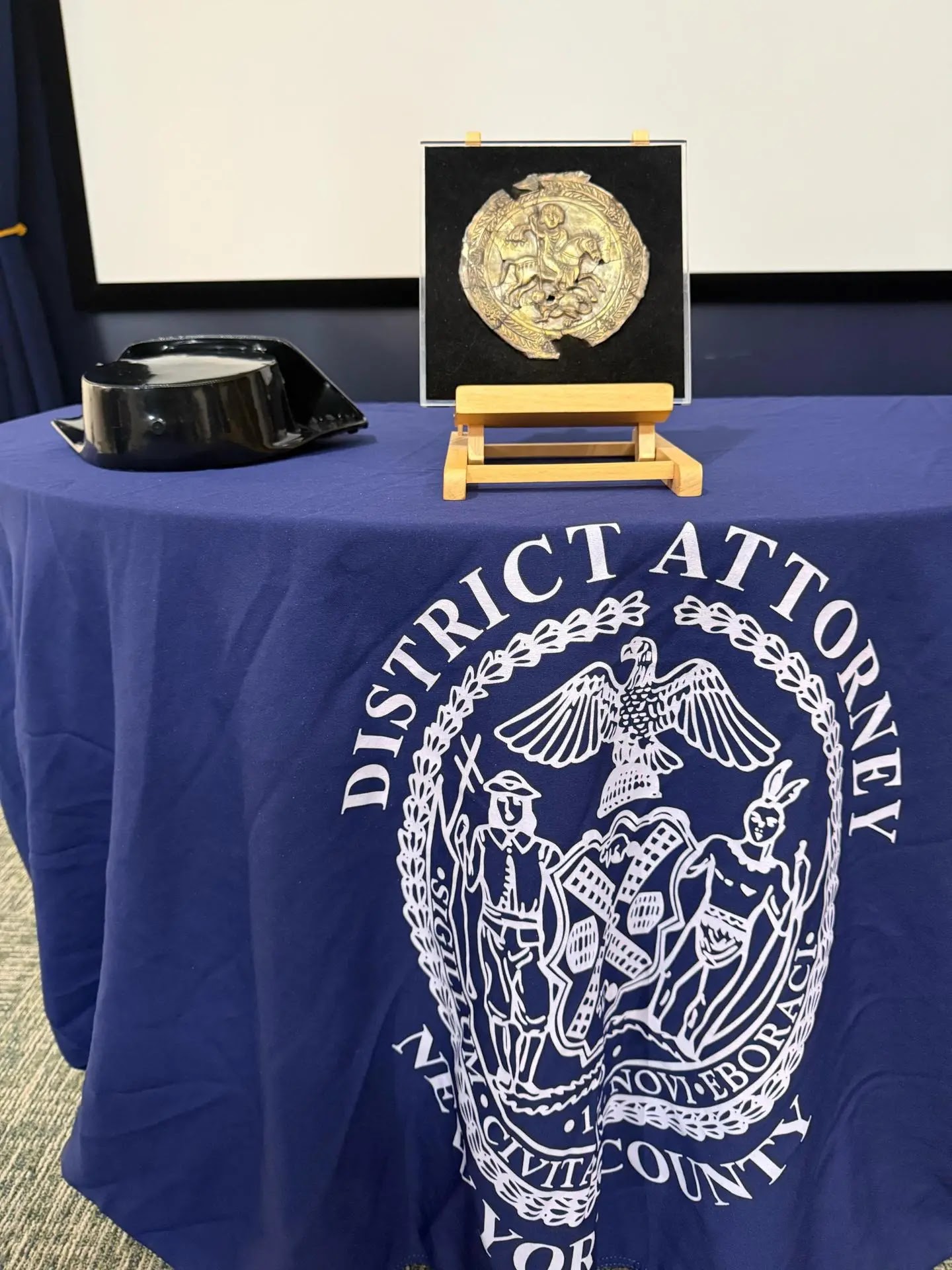
A Visigothic silver medallion, dating between the 5th and 7th century CE and depicting the Corinthian hero of Greek mythology Bellerophon on horseback, slaying a Chimera, has been formally returned to Spain, following an international investigation involving Spanish and U.S. authorities.

The artefact, measuring 13.7 centimeters in diameter, was discovered by a local metal detectorist in the municipality of Peraleda de la Mata, in CĆ”ceres, Spain in 2007.  The individual who unearthed the piece initially reported the find to the regional government of Extremadura and even took a photograph of it still freshly covered in dirt.  However, soon after, the individual withdrew the medallion from the market, refused to cooperate with authorities, and its whereabouts became unknown.

What followed was a series of events that eventually resulted in the Spanish Civil Guard’s Central Operational Unit (UCO), U.S. Homeland Security Investigations (HSI) and the New York District Attorney's Office to formally lead to the object's recovery. 

Sometime after its disappearance, according to the New York District Attorney's Office, the medallion surfaced in the possession of the Barcelona-based antiquities dealer FĆ©lix Cervera Bea of GalerĆ­a F. Cervera.   After that, it was smuggled out of Spain and purchased by Geneva's based Phoenix Ancient Art, where it was circulated publicly to international buyers. 

By 2010, the object was published, in a cleaned and restored state, in a Phoenix Ancient Art catalogue which listed the object with the following provenance: 

Ex Spanish Private Collection, collected ca. 1960, 

While vague provenance omitting a Barcelona dealer is not unusual in the art world, the date given for the purported Spanish collection ownership is completely incongruent to the one recorded with the authorities in the Spanish municipality.  Who, or what, if anything, was provided to Hicham and Ali Aboutaam to seemingly justify this false collection pedigree has not been publicly disclosed. 

By at least 2021,  the medallion had also been published to the Phoenix Ancient Art's website, where the dealers in question advertised an asking price of $210,000.   

The provenance on the webpage again did not match the discovery date of this piece in Spain, and instead stated:

Art market, prior to 1960;
Ex-Spanish private collection, collected ca. 1960

By 2022, the medallion had been featured in an academic article written by CesĆ”reo PĆ©rez GonzĆ”lez and Eusebio Dohijo.  This article was published in the academic journal Oppidum, and reconfirmed that the unique Visigothic medallion was in the possession of the New York-Swiss ancient art dealers, and again noting that the artefact came from a private collection.  

The publication of this article came to the attention of the Dirección General de Bibliotecas, Archivos y Patrimonio Cultural of Extremadura who in turn alerted the Spanish Civil Guard’s UCO, a specialised division within the Guardia Civil responsible for the investigation and prosecution of the most serious forms of crime and organised crime.  The GC then reached out to US law enforcement.

When questioned as part of this case, Phoenix Ancient Art provided an invoice linking the silver medallion to the Catalan dealer, however, Spanish officials noted that no export permit had ever been requested or obtained for the object then being offered for purchase through the New York gallery.  Under Spanish law, artefacts removed from the country without a valid permit automatically become the property of the Spanish State. 

As a result of the following international investigation, involving the Spanish government, the Federal Bureau of Investigation (FBI), U.S. Homeland Security Investigations (HSI), the New York District Attorney's Office - Manhattan's Antiquities Trafficking Unit, and the Guardia Civil UCO Historical Heritage section, the owners of Phoenix Ancient Art agreed to voluntarily relinquish the artefact, indicating in doing so that they had purchased it as part of an "old collection of Spanish art."

On March 21, 2025, after 18 years, U.S. authorities officially handed over the long lost medallion to their Spanish counterparts, in a ceremony in New York.  On hand were Captain Juan JosĆ© Ɓguila, head of the Historical Heritage section of the UCO, Colonel Matthew Bogdanos, head of the Antiquities Trafficking Unit of the New York District Attorney’s Office, and Marta de Blas, Consul General of Spain in New York.

The successful repatriation of the Visigothic medallion marks another milestone in the ongoing efforts by Spanish and international authorities to combat the illicit trade of cultural artefacts and to return stolen heritage to its rightful place.  The case also serves as an example of just how long it takes for smuggled artefacts to be identified and that information relayed onward to the right authorities who can work towards restitution.  It also shows how an object's true origins can be obscured by vague provenance statements which give no hints to unweary buyers that the piece they are considering purchasing, may have left its country of origin in contravention of the national law. 

When looted artefacts like this one do resurface—whether in a gallery, auction house, or academic publication—identifying them requires the expertise of scholars, investigators, and cultural heritage officials.  Their recovery is therefore rarely straightforward, and often demands a coordinated effort between law enforcement agencies, government authorities, and vigilant researchers across multiple countries who are often the first to spot an illicitly exported piece in circulation. 

This case also underscores the immense challenge it takes to monitoring countless sales catalogues, websites, and scholarly publications in the search for artefacts that have been illegally removed, especially when their collection history has been falsified along the way. 

NB:  This article has been updated on 25 March 2025 with facts released in the official New York District Attorney's Office - Manhattan press release on this restitution. 

March 11, 2025

Forensic Archaeologist Dr. Samer Abdel Ghafour is teaching with ARCA again this summer


Can you give us an introduction about yourself?

I’m honoured to be part of this interview and to share my journey in cultural heritage protection and the fight against the illicit trafficking of antiquities.  My background combines extensive experience in cultural heritage preservation with a strong focus on safeguarding archaeological sites and cultural assets in conflict zones.  Early in my career, I worked at the National Archaeological Museum of Aleppo and later at the Syrian Directorate-General for Antiquities and Museums (DGAM), where I engaged in efforts to protect heritage under various circumstances.

Over the years, I’ve collaborated with international organisations, including UNESCO, Europol, and the British Museum, as well as with law enforcement agencies on projects with the Italian Carabinieri TPC, and the Dutch National Police.  I also founded ArchaeologyIN, a social media network aimed at promoting cultural heritage awareness across ten countries.  This work remains close to my heart, particularly as we confront ongoing challenges to cultural heritage in the Middle East and North Africa region.

From Aleppo to Europe is quite a journey, can you tell us about that?

My journey into the world of cultural heritage protection began at the National Archaeological Museum of Aleppo.  I was fortunate to work at one of the region’s oldest and most prestigious institutions, which fuelled my passion for preserving Syria’s rich heritage.  My early days were filled with fieldwork, cataloguing artefacts, and collaborating with teams dedicated to archaeological research and preservation.  Later, I joined the Syrian Directorate-General for Antiquities and Museums in Damascus, where my knowledge and experience in project management and international cooperation increased.

With the outbreak of conflicts in the Middle East and North Africa region and in response to the emergence of new challenges, I launched ArchaeologyIN, a platform designed to raise public awareness about the importance of cultural heritage.  Over time, my work extended beyond Syria to encompass the broader MENA region.  My research and collaborations have focused on mitigating the risks to cultural assets in conflict zones, working with global institutions such as UNESCO and ARCA.  Each step of this journey has deepened my understanding of the complex network behind the illicit antiquities trade and strengthened my resolve to protect what remains.

How did you get involved with ARCA?

My connection with ARCA started through a shared passion for combatting art crime and protecting cultural heritage.  I first learned about ARCA’s work through its extensive publications and network of experts.  When I attended their postgraduate program as a Minerva scholar ten years ago, it became clear that this was more than an academic experience—it was a community of professionals committed to making a difference.  The program’s unique approach to blending practical case studies with cutting-edge research inspired me to stay involved.  I was later invited to join as a lecturer, an opportunity I gladly accepted.  Teaching at ARCA allows me to engage with dedicated professionals and students who share a passion for protecting cultural heritage and disrupting the networks that traffic antiquities.

Can you tell us about the purpose of the your course?

This summer, I’ll be teaching Unravelling the Hidden Market of Illicit Antiquities, a course that offers participants a deep dive into the international trafficking of antiquities. We’ll explore case studies from the past 50 to 60 years, focusing on how the trade has evolved.

The course is designed to be both informative and interactive. We’ll begin with a historical overview of the illicit trade, then move on to key players in the market, from prominent dealers to auction houses, museums, and galleries. We’ll uncover the intricate network behind this shadowy trade by examining the roles of source, transit, and market countries.  Our sessions will include practical discussions on the legal and ethical challenges of repatriation and the level of proof required to secure a successful claim.

Participants can expect a mix of lectures and interactive discussions, giving them the tools to better understand and confront this global issue.

Tell us life when you are in Amelia

Amelia is a hidden gem in the heart of Umbria, Italy.  Nestled atop a hill, this charming medieval town offers a serene escape from the hustle and bustle of modern life.  Narrow cobblestone streets wind through centuries-old buildings, leading to stunning views of the surrounding countryside.  Life in Amelia is peaceful yet vibrant, with a rich cultural history, making it the perfect setting for ARCA’s program.

For participants, Amelia becomes more than just a backdrop—it’s a place to immerse yourself in Italian culture, connect with fellow professionals, and reflect on the importance of preserving our shared heritage.

Can you tell us what makes ARCA's programmes special?

One of the most unique aspects of ARCA’s program is its emphasis on blending theoretical knowledge with real-world application.  Participants gain not only a deep understanding of the international art and antiquities crime landscape but also access to an extraordinary network of professionals.  This program creates an environment where scholars, law enforcement professionals, and cultural heritage experts from around the world come together to share insights and collaborate on solutions to some of the most pressing challenges in the field.

A highlight of the summer is The Amelia Conference – 2025, ARCA’s Annual Interdisciplinary Art Crime Conference, which will take place from June 20 to 22, 2025.  This conference is a rare opportunity for program participants to meet and engage with a wide range of experts in art crime and cultural heritage protection.  The conference offers participants the chance to learn from leading voices in the field, expand their professional networks, and gain practical insights that complement their studies.

By the time participants complete the program, they’re not only better equipped to address the complexities of art crime—they’re also part of a vibrant, global community dedicated to protecting cultural heritage.

If you could follow another professor's course, which one would it be? 

If I had the chance to take a course at ARCA, it would likely be “Discarded, Discovered, Collected: The Ethics of Antiquities Preservation and Publication” by Roberta Mazza.  This course offers invaluable insights into why are antiquities exchanged on the market and what drives price formation? It also covers grouond on what is special about antiquities with texts inscribed on them, and the sometimes vulnerable relationships between academics and actors in the art market who deal in this type of textual remains.

Do you have any advice for applicants and participants?

My advice for new participants is simple: embrace every opportunity this program offers.  Be curious, ask questions, and engage with the community.  The beauty of this program lies in its diversity—everyone brings a unique perspective to the table.

Also, take the time to explore Amelia and immerse yourself in its history and culture.  These experiences will enrich your understanding of cultural heritage in ways that go beyond the classroom.  Most importantly, remember that what you’re learning here has real-world implications. You’re joining a global effort to protect our shared history—an effort that is more important now than ever.

By Edgar Tijhuis