Blog Subscription via Follow.it

Showing posts with label Cambodian art. Show all posts

February 23, 2026

From Skanda Trust to Singapore: Tracing One Spunky Hanuman to Douglas Latchford

If you read our recent article about the Dong Son bell identified at a museum in Assen and the troubling questions surrounding its provenance, you will recognise a pattern that extends far beyond that single suspect artefact.  That case, resting on little more than a hypothetical pre-1970 export date, forms part of a larger story that has been unfolding for years.  It is a story that continues to cast a long shadow over the global market in Southeast Asian antiquities, museum institutions, and private collections worldwide.  Time and again, it is a story in which the fingerprints of Douglas Latchford can be found on objects that passed through his hands, sometimes decades before his alleged crimes were brought to light.

Recently, I was working to identify the Cambodian, Thai and Vietnamese artefacts purchased by Leon Black which were mentioned in some of the three million documents released by the U.S. Justice Department on 30 January 2026 as part of the Jeffrey Epstein data dump.  During my wanderings my searches brought me back to Latchford's and Emma Bunker's artistic publications. 

Cultivating the image of a passionate scholar-collector prior to his indictment, the Bangkok-based dealer worked closely with Bunker to publish a series of lavishly illustrated books on Southeast Asian and Khmer art that featured many of the objects he circulated through the antiquities market.  Far from being neutral scholarly exercises, these publications functioned as instruments of laundering. 

Sculptures and bronzes with little or no documented provenance were presented alongside established museum holdings and described as significant works from private collections.  They were framed within authoritative art historical narratives that obscured both their true ownership history and the circumstances of their removal from Cambodia.  By embedding freshly surfaced objects in academic-style volumes, Latchford and Bunker effectively manufactured a sort of cosmetic legitimacy, transforming recently trafficked antiquities into catalogue-worthy published masterpieces, thereby smoothing their path into major collections.

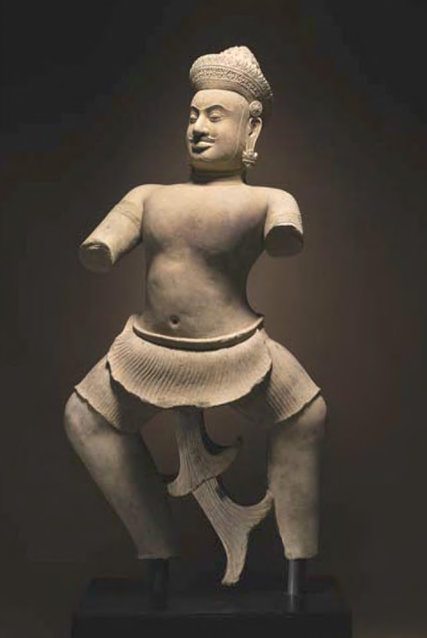
Thumbing through the pages of their 2011 book Khmer Bronzes: New Interpretations of the Past my eyes paused briefly on a piece I recognised.  It was a bronze statue of Hanuman, the monkey general of the Indic epic poem Ramayana, who helped Rama rescue Sita from the demon Ravana.  

In the book Latchford and Bunker went on to describe the unusual piece as coming from Angkor Borei, adding:  

This fierce little Hanuman once surmounted a battle standard to which he was attached by a short tang under the foot. Hanuman waves his arms vigorously as he balances on one foot, a pose very similar to that of a gilded-bronze male figure from Vietnam in the Musee Guimet that has also been identified as a standard emblem. Hanuman is often represented in later Khmer art.

In their 544-page tome, and including this bronze, there is an outstanding number of pieces, which appear courtesy of "Skanda Trust."  Formed just three months before the book’s publication, Skanda Trust is now understood to have been one of Latchford’s offshore vehicles, registered in Jersey in the Channel Islands, and estimated by experts to have held art-related assets valued at approximately $10 million.  An email from Latchford dated 23 April 2007 to a New York dealer left little to no doubt about the dealer's level of direct involvement and knowledge in transnational criminal activity against Cambodian artefacts. In it Latchford offered his colleague (and sometimes cohort in crime) a looted standing Buddha from the same pre-Khmer site of Angkor Borei.  That artefact was depicted in a photo that showed signs of recent excavation.

So where did this Hanuman wander off to?

In a 2017 Facebook post, the Asian Civilisations Museum shared a photograph of an eighth-century bronze monkey figure identified as probably depicting Hanuman and coming from Angkor Borei.  The figure was described as unusual because it was unclothed.  I had saved a screenshot of that image for use in my course on open-source intelligence research in object tracing. It served as an excellent example of how museums use social media and how such posts can reveal information about objects in their collections, even when full catalogues are not accessible online or researchers cannot physically visit a specific institution in another country.

That is why the image clicked in my memory when reviewing Latchford’s publication.  They were one and the same.  The museum appears to have acquired the bronze in 2014 and assigned it Accession number: 2014-00439.

The presence of this Hanuman in a Latchford publication, attributed to Skanda Trust and later accessioned into an important museum collection, is not a trivial detail.  It places the object squarely within a museum collection that has already led to previous restitutions to India

In recent years, the museum has begun to confront the uncomfortable reality that publication history and aesthetic importance cannot substitute for clear, documented provenance.  If they are serious about transparency and ethical stewardship, then works linked to Latchford’s orbit warrant their careful review. 

The question is no longer whether these objects are beautiful or significant. It is whether they left Cambodia lawfully.  One hopes that this bronze will receive that scrutiny it needs, and that if the evidence points where other cases have led, that his path home will be quick. 

By:   Lynda Albertson


January 31, 2021

Sometimes restitution is a little like putting lipstick on a pig

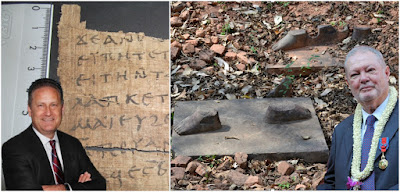
Left: Steve Green and the Controversial Coptic Galatians fragment
first offered on eBay in 2012 by Yakup Ekşioğlu.
Right: Douglas Latchford and the two plinths with the broken feet of ancient sandstone statues looted from the Prasat Chen temple complex in Koh Ker

Last week we have seen two eye-popping notices of "voluntary" restitution of  ancient artefacts and papyri framents believed to have been plundered from their respective countries of origin.

In one instance, an article by Tom Mashberg, written for the New York Times on January 29th reported that Julia Ellen Latchford Copleston a/k/a Nawapan Kriangsak, has agreed to relinquish a total of 125 artefacts to Cambodia which had been acquired by her father, controversial antiquities dealer Douglas A.J. Latchford, a/k/a “Pakpong Kriangsak.”  Prior to his death, Latchford's handling of suspect material from Cambodia, Thailand and India resulted in the US government filing a 26-page indictment via the Department of Justice's U.S. Attorney’s Office for the Southern District of New York on 27 November 2019.  This case, unfortunately, concluded in advance of any possible legal ruling against the Thailand-based dealer, who died on 2 August 2020 before the bulk of the evidence gathered in the federal case against him could be heard in court. 

The second announcement, delivered two days earlier by Steve Green, Chairman of the Museum of the Bible, was more discreetly posted on the museum's website and highlighted the return of a number of questionable acquisitions which have been discussed with some regularity on  ARCA's blog as well as in greater detail on Faces & Voices, a specialist blog by Papyrologist and ancient historian Roberta Mazza.  Mazza has more articles about the Green's acquisitions than I can link to, so I recommend our readership take some time exploring them all but perhaps starting here with one where she questions (again) the ever-changing provenance story surrounding the P.Sapph.Obbink fragment purportedly sold through a private sale treaty by Christie’s.  

In Green's press announcement, he states that as of 7 January 2021, the Washington DC-based museum had transferred control of the fine art storage facility that housed the 5,000 Egyptian items to the U.S. government as part of "a voluntary administrative process."   Unfortunately, the philanthropic founder of the museum has said very little about whether or not his museum will be more forthcoming about exactly whom the museum paid when purchasing the 8,106 clay objects with suspect or no provenance from the Republic of Iraq or the approximately 5,000 papyri fragments and accompanying mummy cartonnage which also came with suspect or no provenance from the Arab Republic of Egypt.  All we know is that these objects are now, finally, going home.  And while that is a great success for the countries they were taken from, it tells us practically nil about the men who engaged in their sale and profited from these same countries' exploitation.  

At the end of their announcement, the Museum of the Bible's Chairman stated that going forward they would continue to look for ways to "partner with The Iraq Museum, The Coptic Museum, and other institutions, to provide assistance with preserving and celebrating the rich cultural histories of those countries and many others."  I truly doubt, given the circumstances, that the Egyptian government will be taking Mr. Green up on this proposal. 
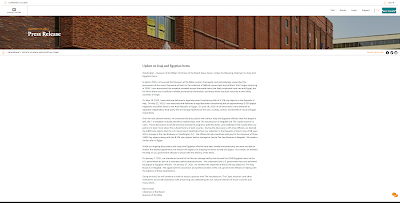
Museum of the Bible Press Release
Screenshot Date:27 January 2021

And so the litigation in these matters, at least as it relates to Iraq and Egypt, appear to be drawing to a close.  

With the flourish of pens in the plump fingers of lawyers, these carefully-timed, and responsibility-for-wrong-doing-absent restitutions by members of the wealthy Houses of Latchford and Green are released to the public without the impediment of contradiction.   Sanitised proclamations which imply good deeds done under trying circumstances, but which impart little about the actual motivations of their delayed generosity.  

Most of us, who have been closely following these events can speculate as to the pressure points behind the disputants' seemingly magnanimous handovers and come away with our own conclusions, but our speculation will never give us their complete stories.  It is reasonable to assume that these individuals, and/or their museum, were motivated, in whole or in part, by a desire to put an end to a publically embarrassing chapter to their respective family's cultural heritage acquisition histories, but their decisions should not be read as merely repentant.  

In relinquishing these artefacts to Cambodia, Egypt and Iraq, the Latchfords and Greens seek to mitigate the damages, financial and reputational, that these scandals have caused them.  And with that in mind, their decisions can not simply be seen in a vacuum of attempting to right past wrongs. They are assuredly more strategic than what is within the purview of the public domain. 

Seen through this narrow lens, these very public announcements of voluntary restitution, published in newspapers with large readership or on museum's websites, serve only to cosmetically cover, not correct, the public blemishes their respective criminal investigations have brought to light over the last ten years.  Actions which, when explored more deeply, can be seen as not only embarrassing, or ethically negligent, but potentially criminal, brought about by the direct involvement of staff and family members who should have, or definitely did know, better.  

Despite these joyous restitutions, we cannot ascertain what catalyst, in each of these drawn-out processes of ensuring restorative justice, brought Mr Green and Ms. Copleston to the restitution table.  Usually, in situations like this, written agreements between the parties make it unlikely that anyone will be at legal liberty to openly discuss the negotiations between the aggrieved parties.  In the MotB case, that includes the unspoken details behind the more than three years of back and forth discussions that the museum itself has admitted took place prior to the culmination of this week's announcement. 

Likewise, by bequeathing his 1,000-year-old Khmer Dynasty collection to his daughter, Douglas Latchford left his offspring with more than just $50 million worth of valuable ancient art.   He left her holding a hand grenade with a pulled pin that she doggedly continued to hold some five months after her father's death.  For no matter how magnanimous Copleston's repatriation gestures to Cambodia may seem in print, her waiting this long to relinquish the sculptures begs its own questions as to motivating factors. 

Why would a lawyer such as herself, who by her own statement in the New York Times defensively admitted that her father "started his collection in a very different era" not have advised her ailing father, who was facing prosecution on his death bed, to clear the family name, if not his own, by simply returning the artefacts to Cambodia himself while he was still living?  Or why,  since Latchford's death, has Copleston, not distanced herself from suspicion by voluntarily doing so immediately after any wills for her father were read?

As regards both of these restitutions I would ask these individuals why, with these grand gestures of reconciliation, did neither party turn over the purchase and sale records for these objects.  Something which would truly make reparations as doing so would allow illicit trafficking researchers and law enforcement investigators to trace and return other pieces of history handled by the individuals responsible for engaging in these two unseemly debacles. 

Instead, like with Green's own statement, we get no real responsibility-taking, only precisely worded announcements with appealing attestations which colour their actions as generous acts of voluntary cultural diplomacy.  This despite the fact that there is so much more they could do, aside from simply cutting their losses by relinquishing material. 

In resignation, I understand that decisions like these, come about as the result of complex cultural arbitration.  And I understand that in such circumstances, the party holding the stronger deck of cards in the dispute, might (still) agree to a more palatable dispute resolution outside the courtroom. One which allows the parties involved to avoid a lengthy, expensive, and in some cases, reputationally damaging legal case, but which also assures an alternatively beneficial outcome for all sides. 

And as much as I want to be privy to these closed conversations, it is important to remind myself that Alternative Dispute Resolutions, known as ADRs in cultural property disputes, often carry with them an adherence to mutually agreed-upon confidentiality regarding the agreements signed off on, even when these types of agreements don't "feel" satisfying to those of us not sitting at the negotiating table. 

As someone who works on the identification of illicit antiquities, I want to see individuals, believed to have behaved criminally, brought to justice.  But I must also understand that these types of quieter negotiations do offer aggrieved parties an opportunity for a speedier and less costly resolution than drawn-out, complex, multi-year litigation which of themselves can be more beneficial to harvest countries such as Egypt and Iraq.   Fighting for restitution in the US court system isn't cheap and the costs can be a financial impediment to some foreign governments who haven't the financial means to represent their interests for years on end, or when the application of legal norms to relevant facts, might fail to deliver any justice at all to them as the aggrieved party. 

Another driving factor to remember in these types of agreements, in contrast to legal proceedings, is that out of court settlements enable the parties involved to, on the surface at least, legally protect their reputations. When cases go to court there is normally a winner and a loser.  And with those court decisions, comes very public case records which can serve to outline, in embarrassing red marker detail, the actions of individuals perceived as culpable, or serve as precedent-setting decisions in future illicit trafficking court cases. 

Lastly, as legislation in the art and cultural heritage field is not fully harmonized, there is always the potential risk that the expensive and protracted court case might not achieve a viable cost-benefit outcome.  Like in legal disputes where the value of the returned artefact is less than the country's legal costs in pursuing the case in foreign courts.  Or, as would have been the case in the Museum of the Bible dispute, or the case against Douglas Latchford, where the sheer number of artefacts being contested, if examined individually and concretised in the court's record, might have resulted in fewer objects going home, or greater exposure of the involved parties to subsequent litigation for their perceived roles in further uncovered, questionable transactions.

So, in the end, I have to accept announcements like those made last week which bring objects home but offer no real retribution against those who behaved badly.  This leaves me, and others who have closely followed these cases, asking:

  • Where are the admissions of fault?  
  • Where are the acknowledgements of harm having been done? 
  • Where are the answers we keep asking as to who sold what, to whom, and when?
I close this overly long rant by saying that when I first learned about these upcoming restitutions and read the press releases, I immediately thought that their announcements reminded me of a rhetorical expression from the 1887 compendium of proverbs called The Salt-Cellars by Charles H. Spurgeon, who once wrote:

“A hog in a silk waistcoat is still a hog.” 

And while I am overjoyed that so many artefacts will finally make their way back to where they rightfully belong, I am in no way fooled that these gestures were magnanimous and selfless, or that in Egypt at least, Ma’at, the goddess of truth and justice, would believe that justice has been well and truly served. 

By:  Lynda Albertson

August 11, 2020

Dying to get away with it: How one defendant's death may thwart justice for the people of Cambodia, Thailand, and India

Douglas Latchford's Facebook page photo
on 9 November 2017, two years
before he was indicted in the USA
Wire fraud,
smuggling,
conspiracy to commit wire fraud,
conspiracy to commit offenses against the United States,
and entry of goods by means of false statements.

These were the five related charges pertaining to the trafficking in stolen and looted antiquities that art expert Douglas A. J. Latchford, a/k/a “Pakpong Kriangsak” had been charged with in the 26-page indictment unsealed by the Department of Justice's U.S. Attorney’s Office for the Southern District of New York last November.  But since deceased persons cannot be prosecuted, the charges against Latchford will likely be dismissed by the court, once his death certificate, attesting to his demise on 2 August 2020, has been submitted to the court through his defense counsel.

Before the investigation into the smuggling and illicit sale of priceless antiquities from Cambodia, Thailand and India cast a long shadow over Latchford's activities, he was once considered a highly respected sponsor in museum circles, a person above reproach.  As such, his donations earned him the Grand Cross of the Royal Order of Monisaraphon in a ceremony held in Cambodia to commemorate the dealer's donation of two sets of gold Angkorian regalia to the National Museum of Cambodia.   Latchford was given the "knight class" grade of Grand Officer, which entitled him to a large yellow ribbon with a pendant medal and was granted the title Okhna, usually bestowed on those who make civic contributions of $100,000 or more. 

A year later he received the Sahak Metrei friendship medal in recognition of having bestowed the National Museum with more gifts, including two other donations, a bronze Naga antefix and a Linga cover, which he credited to the donors, Doris and Nancy Wiener, and Mrs Jeap Rodolitz respectively. These presentations doubled-up with the installation of the museum’s new electrical wiring and lighting system, donated by a who’s who of wealthy individuals in the Asian art scene. 

Apparently unaware of Latchford's role in plundering, Hab Touch, then Director General of the Department General of Cultural Affairs, now Secretary of State and high representative of Phoeurng Sackona, Minister of the Ministry of Culture and Fine Arts in Cambodia once said of Latchford:

“His gifts are very important because these artifacts teach the Cambodian people about their history...We hope his generosity will set a good example for others.”

Other pieces acquired directly or indirectly through Latchford's network also dotted collections at many important art institutions, where, at the time of their acquisitions, questions of provenance didn't seem to bother the museum's renowned curators.

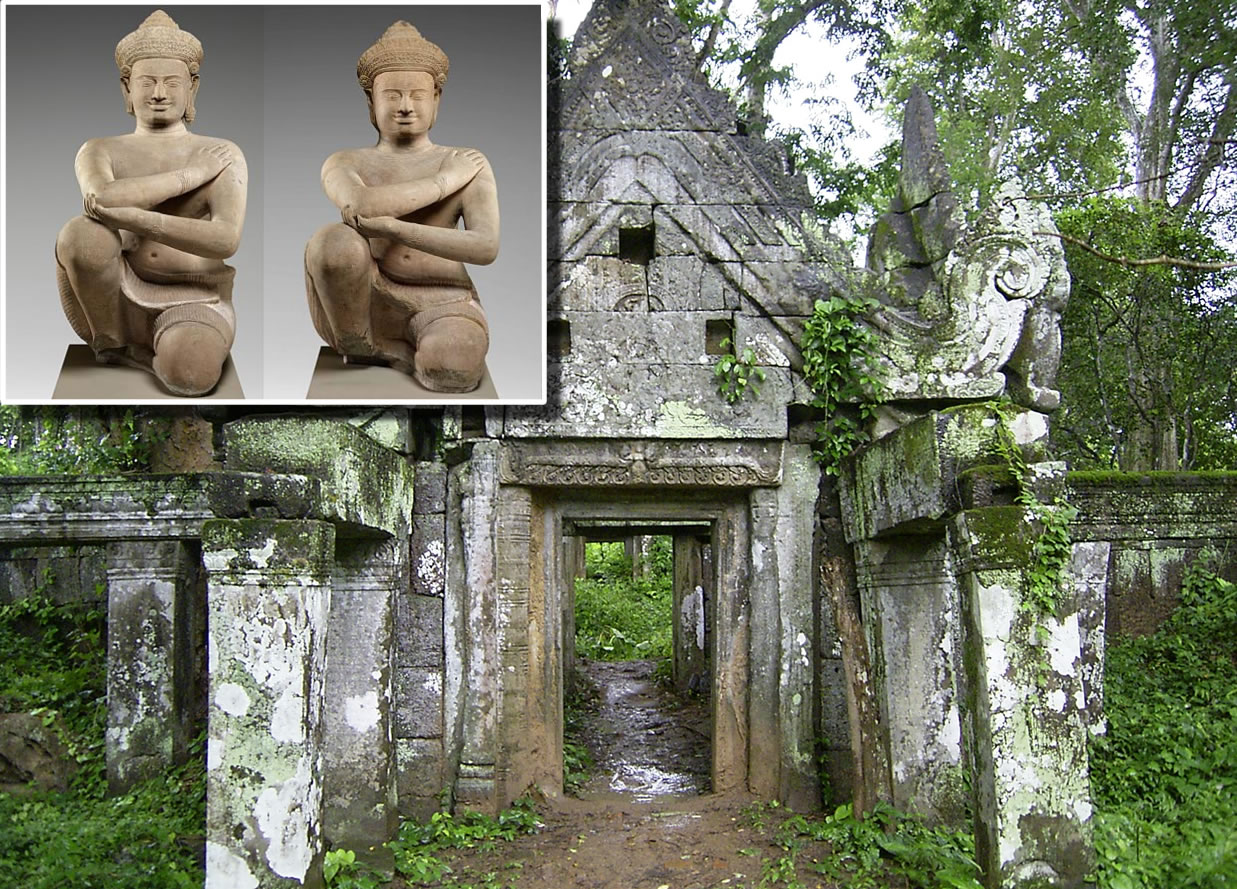
Latchford is known to have donated at least seven objects to the Metropolitan Museum of Art in New York including the Kneeling Attendants (restituted), the stone head of a Buddha, and the bronze head of a Shiva, both from the 10th-century Khmer Angkor period.  He also donated four statues to the Denver Art Museum.

Other Latchford pieces found their way through direct or indirect sales and donations to US collections at the Cleveland Museum of Art, the Norton Simon Museum in Pasadena, the Denver Art Museum and the Kimbell Art Museum in Ft. Worth.  Yet, Latchford's purported acts of generosity were not just for USA museums' benefit.  His hands also touched objects lent to the Berlin Museum for Ancient Art and to the Tropenmuseum in Amsterdam.

By 2012, the tracks of the looters of the tenth-century site of Koh Ker lead repeatedly to Latchford.  Identified in a civil lawsuit as a middleman in the trafficking of looted Khmer sculptures from “an organized looting network,” he was alleged to have conspired with the London auction house Spink & Son Ltd., to obtain false export permits for the temple antiquities he brokered.

Some of the incriminating evidence against the dealer relates to a series of brazenly written emails.  One sent on 23 April 2007,  which left little to no doubt about Latchford's level of direct involvement and knowledge in transnational criminal activity against cultural artifacts.

Douglas Latchford's Facebook
photo on 28 October 2017,
two years before he was
indicted in the USA
In that email, Latchford is reported to have written:

"Hold on to your hat, just been offered this 56 cm Angkor Borei Buddha, just excavated, which looks fantastic. It’s still across the border, but WOW.”

Attached to the same brazen email was a photograph.  It depicted a freshly (and clandestinely) excavated standing Buddha statue, still freshly covered in dirt. 

A Manhattan DA's complaint also asserted that Latchford contrived to traffic in antiquities that coinvolved another ancient art dealer under investigation, Nancy Wiener. Citing another email seized by investigators, Latchford reportedly told Weiner that he would give bronze statues to his colleague Emma C. Bunker, in exchange for false provenance.  Sadly, and as if facilitating the plunder of Cambodia and Thailand were not enough, Latchford is known to have purchased, a Chandrasekara Shiva, a Chola bronze idol, stolen from the Sripuranthan temple in Ariyalur district of Tamil Nadu through another bad actor in the art market, dealer Subash Kapoor,

The same Emma C. Bunker worked closely with Latchford writing three seminal volumes on the art of the Khmer people: “Adoration and Glory: The Golden Age of Khmer Art,” “Khmer Gold,” and “Khmer Bronzes.”  Flipping through each of these image-heavy books one can easily understand the pathway to profit involving the plundered and missing cultural patrimony of Cambodia.

Asked in a 2014 interview, who held most of the orphan artworks depicted in the books, Latchford was cagey.  He answered saying they were held by collectors who trusted him to keep their identities confidential, leaving many unanswered questions that this dealer now takes to his grave, as sadly, dead men tell no tales.

By:  Lynda Albertson

November 27, 2019

"Hold on to your hat": Antiquities dealer Douglas Latchford, a/k/a “Pakpong Kriangsak”

Looted Cambodian art for sale by Douglas Latchford
Image Credit:  US DOJ
In a case being prosecuted by Assistant U.S. Attorney Jessica Feinstein, in the Office’s Money Laundering and Transnational Criminal Enterprises Unit, prominent 88-year-old British art collector and dealer Douglas A.J. Latchford has been indicted in the US Federal Court of the Southern District of New York.  The charges against the Bangkok-based dealer include "wire fraud, smuggling, conspiracy and related charges pertaining to his trafficking in stolen and looted Cambodian antiquities."

Latchford in his home standing next to
a Chola period (880 - 1279) Somaskanda from Tamil Nadu
For 50 years Latchford has been considered one of the world’s leading authorities on Asian Art, and at one point was believed to be the biggest single contributor to the National Museum of Cambodia, one of the very countries outlined in the indictment unsealed today at the US Federal Courthouse in Manhattan.  According to the prosecution, Latchford is believed to have been a major stakeholder, acting as a cross-border conduit in an multi-billion dollar cultural property network which trafficked in plundered artifacts from Southeast Asia to some of the most important galleries, auction houses, and museums in the western world charging him with conspiracy to smuggle, false import statements, wire fraud, and the illicit transport and sale of stolen cultural property.

According to the US indictment it is alleged that "from at least in or about 2000, up to and including at least in or about 2012, Latchford engaged in a fraudulent scheme to sell looted Cambodian antiquities on the international art market, including to dealers and buyers in the United States."

The statue of warrior Duryodhana, which once graced the cover of Sotheby’s Asia Week catalog was returned to Cambodia.  In situ, this warrior was one of two matching statues facing each other in a rendition of the great Hindu epic the Mahabharata. 
Included in that list of fraudulent activity is involvement in the illicit removal and sale of the Angkorian sandstone statues stolen from Prasat Chen, the most northern sanctuary in the remote Koh Ker temple complex in Northern Cambodia.  Koh Ker (Khmer: ប្រាសាទកោះកេរ្ដិ៍) sits 120 kilometres northeast of Siem Reap and was briefly the capital of the Khmer kingdom from 928 to 944 CE.

In 2012, Latchford was already identified in a civil lawsuit, as a middleman in the trafficking of looted Khmer sculptures from “an organized looting network” and said to have conspired with the London auction house Spink & Son Ltd., to obtain false export permits for the sandstone temple antiquities.

Some of the incriminating evidence against the dealer related to charges against him include a brazenly written email sent on/about April 23, 2007, which leaves little to no  doubt about the dealer's level of direct involvement and knowledge in transnational criminal activity against cultural artifacts.  Attached to this email was a photograph of a freshly (and clandestinely) excavated standing Buddha statue, still covered in dirt.  In that email, Latchford is reported as having written "Hold on to your hat, just been offered this 56 cm Angkor Borei Buddha, just excavated, which looks fantastic. It’s still across the border, but WOW.”

It should be noted that by 1996, Cambodia had already enacted its overarching Law on the Protection of Cultural Heritage, which criminalizes both the unauthorized excavation, looting, and unauthorized export of antiquities, defining "movable cultural property found by chance" to be public property. This law, known colloquially as "the 1996 Law" remains in effect and is the relevant governing law, supported by a number of decrees, sub-decrees, and regulations.  Cambodia further demonstrates its determination to protect its cultural heritage by being a signatory to the Convention for the Protection of Cultural Property in the Event of Armed Conflict (joined 1962); the 1970 UNESCO Convention on the Means of Prohibiting and Preventing the Illicit Import (joined 1972); the World Heritage Convention (joined 1991); the Convention on Stolen or Illegally Exported Cultural Objects (joined 2002), and the Convention on the Protection of the Underwater Cultural Heritage (joined 2007).

As part of the present indictment Latchford is also alleged to have created "false letters of provenance and false invoices" misrepresenting the nature, age, country of origin, and/or the value  of an antiquity in order to conceal the illicit nature of the objects he brokered.  It should also be mentioned that he is also mentioned obliquely, though not directly named, as Co-Conspirator #1, in the criminal complaint filed by the Manhattan district attorney against Nancy Wiener, and several co-conspirators in December 2016.

Douglas Latchford at his home in Bangkok, Thailand

In that New York criminal complaint co-conspirator #1 (Latchford)

  • allegedly is an antiquities dealer based in London and Bangkok
  • allegedly entered into an agreement with Nancy Wiener to purchase and sell a looted Baphuon Shiva from Cambodia, dated to the 11th Century C.E
  • allegedly shipped the Baphuon Shiva to London to be “cleaned, put together, and mounted.”
  • allegedly sold Nancy Wiener a bronze Buddha sitting on a throne of Naga stolen from Thailand or Cambodia, dated to the 10th Century C.E.
  • allegedly falsified provenance along with Nancy Wiener and Co-conspirator 2 for the bronze Buddha sitting on a throne of Naga stolen from Thailand or Cambodia, dated to the 10th Century C.E.
  • allegedly is a male 
  • allegedly admitted in email that he gave Co-Conspirator #2 bronze statues in exchange for false letters of provenance
  • allegedly purchased the Krishna Dancing on Kaliya from Subhash Kapoor
  • allegedly colluded with Nancy Wiener to create appraisal report for the Krishna Dancing on Kaliya 
Evidence collected in both cases illustrate a textbook formula of how looted antiquities are laundered onto the licit art market through poor controls and a lack of ethics and transparency among the major dealers working at the highest levels of the ancient art market.

Note: the charges contained in the US indictment are merely accusations and the defendant should be presumed innocent unless and until proven guilty.  For now Latchford, in purportedly poor health, remains at large in Bangkok, though it should be noted that the USA & Thailand signed an agreement on December 14, 1983 in which Article 2 permits extradition for any offense punishable under the laws of both States by imprisonment for more than one year.  By unsealing this indictment, it seems that the US intends to bring Latchford to the US, despite his reported ill health, to stand trial.

In conclusion, ARCA has elected to transcribe the entire SD/NY statement below, to make it searchable by future scholars conducting open source research on known/suspected traffickers.

----------


Geoffrey S. Berman, the United States Attorney for the Southern District of New York, and Peter C. Fitzhugh, the Special Agent in Charge of the New York Field Office of the Homeland Security Investigations (“HSI”), announced today the unsealing of an indictment charging antiquities dealer DOUGLAS LATCHFORD, a/k/a “Pakpong Kriangsak”— with wire fraud, smuggling, conspiracy and related charges pertaining to his trafficking in stolen and looted Cambodian antiquities.  LATCHFORD remains at large, residing in Thailand.

U.S. Attorney Geoffrey S. Berman said:  “As alleged, LATCHFORD built a career out of the smuggling and illicit sale of priceless Cambodian antiquities, often straight from archeological sites, in the international art market. This prosecution sends a clear message to the art market and to those who profit from the illegal trafficking of cultural treasures: the United States and the Southern District of New York will use every legal tool to stop the plundering of cultural heritage.”

HSI Special Agent in Charge Peter C. Fitzhugh said:  “The theft and trafficking of cultural property and priceless national treasures is a global concern. Historical artifacts are living sources of knowledge, objects of worships, and symbols of hope that must be safe guarded for future generations.  Through the investigative efforts of HSI special agents, three stolen artifacts from Cambodia and another from India, valued at a total of $750,000, were successfully recovered and will be returned to their rightful homeland.  In addition, an alleged major player in a multi-billion dollar cultural property transnational criminal network was identified and revealed.   Working hand in hand with our partners at the United States Attorney’s Office, Southern District of New York, HSI will not waiver in its commitment to stopping the illicit distribution of cultural property, both domestically and abroad.”

According to the allegations in the Indictment unsealed today in Manhattan federal court:

Background on Looting of Cambodian Antiquities

From the mid-1960s until the early 1990s, Cambodia experienced continuous civil unrest and regular outbreaks of civil war.  During these times of extreme unrest, Cambodian archeological sites from the ancient Khmer Empire, such as Angkor Wat and Koh Ker, suffered serious damage and widespread looting. This looting was widely publicized and well-known to participants in the international art market.

Looted artifacts usually entered the international art market through an organized looting network.  Local looters, often working with local military personnel, would remove statues and architectural elements from their original locations, sometimes breaking and damaging the antiquities in the process of excavation and transportation. The antiquities would be transported to the Cambodia-Thailand border and transferred to Thai brokers, who would in turn transport them to dealers of Khmer artifacts located in Thailand, particularly Bangkok. These dealers would sell the artifacts to local or international customers, who would either retain the pieces or sell them on the international art market. Widespread looting of ancient Khmer and Cambodian antiquities continued into the 1990s.

The Scheme to Sell Looted Cambodian Antiquities

At all times relevant to this Indictment, DOUGLAS LATCHFORD, a/k/a “Pakpong Kriangsak,” the defendant, was a prominent collector and dealer in Southeast Asian art and antiquities, in particular, ancient Cambodian art. Starting in or about the early 1970s, LATCHFORD supplied major auction houses, art dealers, and museums around the world, including in the United States, with Cambodian antiquities from the ancient Khmer Empire. LATCHFORD, a dual citizen of Thailand and the United Kingdom, maintained residences in Bangkok and London.

From at least in or about 2000, up to and including at least in or about 2012, LATCHFORD engaged in a fraudulent scheme to sell looted Cambodian antiquities on the international art market, including to dealers and buyers in the United States. As part of that scheme, in order to conceal that LATCHFORD’s antiquities were the product of looting, unauthorized excavation, and illicit smuggling, and to encourage sales and increase the value of his merchandise, LATCHFORD created and caused the creation of false provenance for the antiquities he was selling. In the context of art and antiquities, provenance refers to records and other evidence documenting the origin and history of ownership of an object. In particular, LATCHFORD misrepresented the provenance of Cambodian antiquities in letters, emails, invoices, and other communications. As part of the scheme, LATCHFORD also falsified invoices and related shipping documents to facilitate the international shipment of the antiquities to dealers and buyers, and to avoid restrictions on the importation of Khmer antiquities into the United States.

Beginning in or about the early 1970s, LATCHFORD regularly supplied an auction house based in the United Kingdom (“Auction House-1”) with looted Khmer antiquities, including from the archeological site of Koh Ker in Cambodia. LATCHFORD conspired with representatives of Auction House-1 and others to conceal the real provenance of looted Khmer antiquities and to create false export licenses and documentation. Many of the antiquities that LATCHFORD consigned to Auction House-1 were eventually sold to museums and collectors in the United States.  In or about 2011, an auction house in New York (“Auction House-2”) offered for sale one of the Koh Ker statutes that LATCHFORD had originally supplied to Auction House-1, a stone guardian figure called the “Duryodhana.” During the course of preparing to sell the Duryodhana in or about 2010, Auction House-2 asked LATCHFORD and a scholar closely associated with LATCHFORD (the “Scholar”) to help trace the provenance of the Duryodhana back to the early 1970s. LATCHFORD falsely stated to Auction House-2 that he had the Duryodhana in London in 1970, and that he had consigned it with Auction House-1 in 1975; whereas in truth and in fact LATCHFORD had exported the Duryodhana from Cambodia in or about 1972. About a month later, LATCHFORD changed his story, telling Auction House-2, in substance and in part, that he had never owned the Duryodhana. Around the same time that LATCHFORD falsely denied owning the Duryodhana, the Scholar warned LATCHFORD in an email, “I think maybe you shouldn’t be known to have been associated with the Koh Ker Guardian figures[.] . . . Let’s fudge a little, and just put the blame squarely on [Auction House-1] .  .  .  .”

Over the course of his lengthy career, LATCHFORD continued to act as a conduit for recently looted Cambodian antiquities. LATCHFORD advertised purportedly newly discovered and excavated pieces for sale to trusted associates, including a Manhattan-based dealer in Southeast Asian art (the “Dealer”). For example, on or about August 12, 2005, LATCHFORD emailed the Dealer photographs of a bronze seated Buddha, visibly covered in earth. Latchford explained that the photographs showed the statute “before cleaning” by a restorer, and “[w]hen it was found they took off most of the mud, or as it was, a sandy soil, it was found near Sra Srang, the lake in front of Banteay Kedi, right in the Angkor [Wat] Complex.”  Similarly, on or about March 13, 2006, LATCHFORD sent the Dealer an email labeled “PRIVATE AND CONFIDENTIAL -------- FOR YOUR EYES ONLY.” The email contained a photograph of a bronze head. LATCHFORD explained that the head “was recently found around the site of the Angkor Borei group in the N E of Cambodia, in the Preah Vihar area. They are looking for the body, no luck so far, all they have found last week were two land mines !! What price would you be interested in buying it at? let me know as I will have to bargain for it.”  On or about April 23, 2007, LATCHFORD sent the Dealer another email, attaching a photograph of a standing Buddha statute that appears to be covered in dirt. LATCHFORD wrote, “Hold on to your hat, just been offered this 56 cm Angkor Borei Buddha, just excavated, which looks fantastic. It’s still across the border, but WOW.”

In order to facilitate the sale and international transportation of the antiquities to buyers and to conceal that the antiquities were looted, LATCHFORD, created false letters of provenance and false invoices, including letters of provenance purporting to have been drafted by a particular art collector (the “False Collector”). For example, in or about 2000, LATCHFORD sold a 12th Century stone Khmer sculpture to a museum in Colorado (the “Colorado Museum”). LATCHFORD informed the Colorado Museum that he had purchased the piece from the False Collector in June 1999, and provided the Colorado Museum with a letter of provenance purportedly from the False Collector as part of the sale.  However, LATCHFORD also supplied the Colorado Museum with records indicating that the statute was transported from LATCHFORD’s residence in Bangkok to London in 1994, long before he claimed to have purchased it from the False Collector.  The False Collector died in or about 2001. Thereafter, LATCHFORD continued to provide numerous provenance letters purportedly provided by the False Collector, while claiming, falsely, that the False Collector was still alive.

On other occasions, LATCHFORD directed third parties to create false provenance documents and false invoices for him.  For example, in or about September 2005, LATCHFORD sold the Dealer a 12th Century Angkor Wat-style standing Buddha statue for $90,000. LATCHFORD told the Dealer that the Buddha “needs to be cleaned, as there is surface corrosion and earth still on it,” indicia of recent excavation. LATCHFORD arranged to ship the Buddha from Bangkok to an “antique consultant/collector” in Singapore (the “Singapore Collector”), and from Singapore to the Dealer’s gallery in Manhattan. LATCHFORD instructed the Singapore Collector to “re-invoice[]” the Buddha on the Collector’s letterhead, “mentioning it has been in your collection for the past 12 years.” The Singapore Collector followed LATCHFORD’s instructions, creating a new, false invoice and letter of provenance stating that the Buddha had been in the Singapore Collector’s private collection in Singapore for the last 12 years, omitting any mention of LATCHFORD, and falsely describing the statute as a “17th C. Bronze Standing Figure from Laos.” The Singapore Collector then shipped the Buddha with the false invoice and false provenance to the Dealer in Manhattan.

As part of the scheme to sell looted Cambodian antiquities in the United States, from at least in or about 2005 up to and including in or about 2011, LATCHFORD supplied false information to the United States Customs and Border Protection (“CBP”) regarding the antiquities he imported into the United States for resale. In particular, LATCHFORD’s false invoices misstated the nature, age, country of origin, and/or value of the Cambodian antiquities. LATCHFORD misrepresented the country of origin and the age of the goods in particular in order to conceal that they were looted antiquities, and to avoid an embargo on the importation into the United States of Khmer antiquities exported from Cambodia after 1999. Frequently, LATCHFORD listed the “country of origin” as “Great Britain” or “Laos,” rather than Cambodia, and often described the objects as “figures” from the 17th or 18th century.

*                      *                      *


February 29, 2016

How many repatriated (previously looted) Khmer statues can you name?

Torso of the warrior god Rama
On Wednesday February 24, 2016 the Denver Art Museum flew the repatriated tenth-century statue of the warrior god Rama, looted from Prasat Chen temple at the Koh Ker temple complex during the country's civil war in the early 1970s, home. The statue’s torso is missing its head, feet and hands.  Koh Ker (Khmer: ប្រាសាទកោះកេរ្ដិ៍) sits 120 kilometres northeast of Siem Reap and was briefly the capital of the Khmer kingdom from 928 to 944 CE. 

The Torso of Rama is just one of a series of sculptures from the Prasat Chen temple that have been repatriated over the last three years as the result of their identification as being looted. 

2 May 2013 - The Metropolitan Museum announced it will return two 10th century Koh Ker “Kneeling Attendants” which had been displayed as part of the Met’s permanent collection galleries for almost 20 years. 

December 2013 - The statue of warrior Duryodhana, which once graced the cover of Sotheby’s Asia Week catalog was returned.  In situ, this warrior was one of two matching statues facing each other in a rendition of the great Hindu epic the Mahabharata. 

3 June 2014 - The Norton Simon Museum in Pasadena returned Duryodhana’s enemy Bhima. It had been on display at the museum since the 1970’s. 

June 2014 - The Christie’s auction also agreed to return a statue of Balarama which it had sold twice on the licit market, despite its illicit origins, once in 2,000, once in 2009,

May 2015 The Cleveland Museum of Art returned a one meter high sculpture of the monkey god Hanuman acquired by the Museum in 1982.

February 2016 - The Denver museum finally relinquishes the statue of the warrior god Rama at the urging of Unesco’s representative to Cambodia. 

Four more statues from the Prasat Chen temple are believed to be held in private collections.

Anne Lemaistre, Unesco’s representative to Cambodia made a public appeal to all collectors of Khmer antiquities stating,

“To have all of the statues returned to Cambodia is something Unesco has been working hard to achieve, and we appeal to anyone who may currently have one of the remaining statues in their private collection to follow the nice gesture of the Denver museum and return it,” 

For the present time the statues are being housed at National Museum in Phnom Penh. According to Cambodia Daily, the Rama torso is expected to undergo conservation treatment over the next year. 
It is hoped that there will be an opportunity to reconstruct the figure grouping as they were originally placed which can be seen in this video reconstruction.


Prasat Chen Temple at Koh Ker and “Kneeling Attendants” 

Duryodhana

Bhima

Balarama

Monkey God Hanuman


June 30, 2014

His Highness Sisowath Ravivaddhana Monipong presented "The Duryodhana, the Balarama and the Bhima: a Cambodian perspective on the return of three pre-Angkorian sandstone statues from Prasat Chen at the Koh Ker temple complex" at ARCA's Sixth Annual Interdisciplinary Art Crime Conference

These photos were provided by M. Bertrand Porte, French
School for Asian Arts (EFEO), who is the head of the
restoration workshop of the National Museum in
Phnom Penh.
His Highness Sisowath Ravivaddhana Monipong of Cambodia presented "The Duryodhana, the Balarama and the Bhima: a Cambodian perspective on the return of three pre-Angkorian sandstone statues from Prasat Chen at the Koh Ker temple complex" at ARCA's Sixth Annual Interdisciplinary Art Crime Conference.

After apologizing for his accented English (he explained that he usually delivers his talks in French or Italian), he showed a video of archaeologist and cultural property lawyer Tess Davis who for the last decade has documented the plunder of Cambodia's ancient temples and worked for the return of the country's looted antiquities.

The Prince told the audience:
In Cambodia the preservation of the archeological patrimony has become one of the main topics discussed among members of the local intelligensia, but it is a recent phenomenon and it occurs mostly in western-influenced environments. The will of the Royal Governement is to educate in the most accessible way, to make people understand how sacred and holy these artcrafts are in our patrimony as Cambodians, and moreover, as survivors of a genocide, during which art and culture were cancelled. Sculpture schools, archeological trainings and preservation technique lessons are improving in quality and quantity all over the Kingdom. Little by little, more and more people are being educated to the duty to preserve and defend our cultural patrimony. Nevertheless, the wounds of war, poverty and the powerful groups sponsoring lootings and international art traffic are still prevailing and as long as there will be such a taste for Khmer Antiques, we will not be able to eradicate this sadly human lust for money.
Here's a link to Tess Davis' project at Trafficking Culture and another link to an article, "Temple Looting in Cambodia: Anatomy of a Statue Trafficking Network", co-written with Simon Mackenzie and published in the British Journal of Criminology.

His Highness Prince Sisowath Ravivaddhana Monipong, was born in Phnom Penh in 1970; has been living mainly in Italy, in Rome, since 1997. Educated in France, holds a Master of Arts in Contemporary British Literature; founded in 1992 the Institute of the Royal Household of Cambodia with Professor Jacques Népote (CNRS). Recognised specialist of the history and the culture of Cambodia, has published books and articles regarding the social structures of Cambodia and the genealogy of the Khmer Royal Family. After a career as sales officer in various multinational private companies such as IBM and ACCOR, has collaborated as a Programme Officer and Consultant for many years with the United Nations (WFP, FAO & IFAD) and private sector with interests in Southeast Asia; has been for many years representative of the Cambodian Ministry of Tourism for Italy. You may follow him at his blog here: "Ravivaddhana Sisowath: Never Complain, Never Explain".

University of Glasgow's Simon MacKenzie received Eleanor and Anthony Vallombroso Award for Excellence in Art Crime Scholarship for his work on the Trafficking Culture project

Noah Charney (left) and Simon Mackenzie (right) in Amelia
by Catherine Sezgin, ARCA Blog Editor

AMELIA - ARCA Founder Noah Charney presented the 2014 Eleanor and Anthony Vallombroso Award for Excellence in Art Crime Scholarship to Simon MacKenzie, Trafficking Culture project at The University of Glasgow,  at ARCA's Sixth Annual Interdisciplinary Art Crime Conference.

"I would like to thank ARCA for the award and my colleagues and graduate students at the University of Glasgow for their support and their individual contributions to the great research team we now have," Simon Mackenzie said about the award. "It's really valuable to receive peer recognition for research and I take this award as encouragement to continue with our efforts in the Trafficking Culture project to produce systematic and reliable empirical work in support of the development of crime reduction policies in this field."

Simon Mackenzie discussing Temple Looting in Cambodia
Upon receipt of the award, Professor Mackenzie invited attendees to visit the Trafficking Culture website and download the article on "Temple Looting in Cambodia: Anatomy of a Trafficking Network" (free for a limited time) via the British Journal of Criminology website here.

You may read more about Professor Mackenzie here.


Past winners: Norman Palmer (2009), Larry Rothfield (2010), Neil Brodie (2011), Jason Felch and Ralph Frammolino (Jointly – 2012), Duncan Chappell (2013).

June 21, 2014

ARCA '14 Conference, Panel V: Looting, Litigation and Repatriation

The fifth panel at ARCA's Sixth Annual Interdisciplinary Art Crime Conference will feature:

Will it be the Getty Bronze or L'atleta di Fano? Italy's ongoing case for the return of the bronze statue of the Victorious Youth
Maurizio Fiorilli. Avvocato della Stato, Italy (Ret) and Stefano Alessandrini, Consultant

The Duryodhana, the Balarama and the Bhima: a Cambodian perspective on the return of three pre-Angkorian sandstone statues from Prasat Chen at the Koh Ker temple complex
His Highness Sisowath Ravivaddhana Monipong of Cambodia

June 6, 2014

Tess "Indiana Jane" Davis credited with helping return looted Hindu statues to Cambodia in the case of the Looted Temples of Koh ker

In a June 6th article in The Diplomat, journalist Luke Hunt points to the "critical" efforts of American researcher Tess Davis in the successful restitution of three looted Hindu statues returned to Cambodia this week:
Critical to their return was Tess Davis, a U.S. art lawyer and affiliate researcher at the University of Glasgow, who stressed Cambodia had only won the first in a series of battles, in what could prove to be a protracted war over the return of looted art. “The kingdom has taken on the art market, an entire industry, and a powerful one at that,” Davis told The Diplomat. “Collectors, dealers, museums, auction houses, they have deep pockets and top lawyers on their side. But Cambodia has something even more important: the truth and the law. And that’s something no amount of money can buy.”
[...]
Davis, dubbed by some as ‘Indiana Jane,’ said the looting and trafficking of antiquities was a crime that would no longer be tolerated, “not by governments, not by law enforcement, and not by the leaders in the art world itself.” The thefts have also been seen as a symbol of Cambodia’s perennial problems, ranging from corruption to a culture of impunity among the country’s well-heeled and politically connected. Davis said Cambodia had given the art world a simple choice, “to do the right thing or not.” She said the Metropolitan Museum of Art in New York and Christie’s had stepped up and fulfilled their obligations, but others like the Cleveland Museum of Art and Sotheby’s have been more reluctant. “They are fighting with everything they have to stay in the past, a past where they could do whatever they wanted. They act like antiquated colonial relics, while their competitors have entered the 21st-century, and are thriving in it,” Davis said.
Luke Hunt can be followed on Twitter @lukeanthonyhunt [and you can follow Tess Davis @Terressa_davis.

Ms. Davis taught the course, Cultural Property Law, at ARCA's postgraduate certificate program in art crime in 2009.

June 4, 2014

Wednesday, June 04, 2014 - ,, No comments

Cambodia celebrates the reunion of three Hindu statues after four decades

Photo credit to Tess Davis (Facebook)
by Catherine Sezgin, ARCA Blog Editor

Tess Davis, former ARCA lecturer in Cultural Property Law for our program in 2009 and 2010, is in Cambodia celebrating the return of three ancient statues and posting links on Facebook to news headlines.

"Statues 40 year reunion":  Laignee Barron & Vong Sukheng reported for The Phneom Penh Post:
Three of Cambodia’s ancient sandstone warriors were welcomed back to their birthplace yesterday, greeted by lotus wreathes and a troupe of traditional dancers adorned in gold. The ceremony marked the end of a 40-year absence for the Duryodhana, Bhima and Balarama statues. The mammoth, 10th-century characters all belong to the same tableau of mythological Hindu figures once locked in battle at Prasat Chen, a remote jungle temple in Preah Vihear. Over the past year, Cambodia has regained five of the nine statues pillaged from the temple’s Eastern entrance, haphazardly hacked from their pedestals and sold on to international art markets during the Khmer Rouge era. “Surviving civil wars, looting, smuggling and travelling the world, these three have now regained their freedom and returned home,” Deputy Prime Minister Sok An said during yesterday’s repatriation ceremony.
Here's a link to a video of the ceremony.

"Cambodia welcomes back looted 10th-century statues": Kate Bartlett, Anadolu Agency, reported:
With the help of the U.S. government and UNESCO,Cambodia first got the ball rolling in 2012 when it filed a suit against the New York-based auction house Sotheby's after the institution put a statue known as "The Duryodhana" -- valued at about $3 million -- up for sale. Earlier this year, with the case still ongoing, Sotheby's agreed to return the statue. The mighty "Duryodhana" was one of the impressive pieces unveiled at Tuesday's ceremony, alongside statues known as the Bhima and Balarama, returned by the Norton Simon Museum of California and Christie's auction house, respectively. While legal action was originally taken against Sotheby's in the case of the "Duryodhana," Christie's returned its statue voluntarily after discovering it was looted. The Norton Simon Museum did the same. 
Tess Davis, an affiliate researcher at the University of Glasgow who specializes in cultural heritage law, said Tuesday, "It's a very exciting day, not just for Cambodia, but for all countries that have been plundered." "Cambodia's on the right side of history here," she added. 
Anne Lemaistre, head of Cambodia's UNESCO office, called the statues' return "a big coup" for Cambodia and said that it might act as an incentive for other museums and private collectors to return looted antiquities. "Now let's see what Cleveland would say," Lemaistre said, referring to the museum’s recent denial that the Angkor statue in its possession was looted. 
Buddhist majority Cambodia, which has a rich cultural heritage influenced by Indian traditions and Hindu legends, is famed for its temples, and the intricate engravings of graceful traditional dancers and mythological characters adorning their walls. Representatives from Christie's and the Norton Simon who attended the ceremony said they were delighted to have been able to help Cambodia recover some of its valuable cultural heritage. "These statues... were callously hacked... and trafficked on the international art market," Jeff Daigle, deputy chief of mission for the U.S. Embassy in Cambodia, said in a speech, expressing the U.S.’s commitment to stopping the illegal arts trade. "We must not forget that the commercial trade in illicit art remains," he added.
 In 2011, Ms. Davis wrote about the lack of provenance in auction catalogue for objects from Cambodia.

May 21, 2014

LA Times' Mike Boehm on the return of the "Temple Wrestler" from the Norton Simon Museum to Cambodia

Mike Boehm, an arts reporter for the Los Angeles Times, publishes today on the return of the "Temple Wrestler" from the Norton Simon Museum to Cambodia (see here for the museum's announcements earlier this month).

Boehm quoted the museum's legal status in avoiding a lawsuit:
The Norton Simon took a different approach, based on past cordial relations with Cambodia's cultural authorities. Without a suit having been filed, museum representatives went to Phnom Penh for discussions earlier this year. Despite what the museum characterized as "a good-faith difference of views" with Cambodia over whether the Norton Simon was legally obliged to send the statue back, its leaders concluded that there were special reasons to send it home. "While there are extremely strong legal arguments for why we could defeat a claim, and while the Cambodian law is ambiguous at best, in this circumstance it seems appropriate and in keeping with the positive relationship the Norton Simon has had with Cambodia over the years to gift the statue to them," said Luis Li, an attorney for the museum. "They have a very specific archaeological context they want to create, and I think the Norton Simon was moved by that."
And on other Cambodian art at the Norton Simon Museum, Boehm writes:
The Norton Simon Museum will still own 40 ancient Cambodian objects, including a gigantic standing figure of Buddha that serves as a greeter in its lobby, and a lion that crouches on guard near the entrance to the gallery where Bhima will soon no longer preside. It's uncertain whether a dozen other pieces are from Cambodia or from Thailand. "We have not been approached by Cambodian or U.S. officials about other works in the collection and have no indication of future requests," museum spokeswoman Leslie Denk said this week.

May 17, 2014

Norton Simon Museum announces "Temple Wrestler" last day on display in Pasadena will be May 22

by Catherine Schofield Sezgin, ARCA Blog Editor-in-Chief

Today the Norton Simon Museum here in Pasadena sent out an email to the community:
Dear members and friends, 
You may have read in the newspaper that the Norton Simon Art Foundation is making a gift of its “Temple Wrestler” statue to the Kingdom of Cambodia. This monumental 10th-century sandstone sculpture depicting Bhima, a heroic figure from the Hindu masterpiece The Mahabharata, has been exhibited continuously at the Norton Simon Museum for nearly four decades. During this period, the Museum has taken great care to preserve the work, and to highlight its significance through scholarly research and publication. Now, following a compelling request from officials in Cambodia, the piece will return to its country of origin, joining several other sculptures that are believed to have once stood at a temple in Koh Ker. 
We wanted to inform you that the last day this remarkable artwork will be on public view is next Thursday, May 22nd. For those of you interested in seeing it before it makes its journey to Phnom Penh and to the National Museum there, we hope you will visit us in the coming days. 
Kind regards, 
Leslie C. Denk Director of Public Affairs
On May 6, 2014, the museum had issued a press release announcing the return of the "Temple Wrestler" to the Kingdom of Cambodia "in response to a unique and compelling request by top officials in Cambodia to help rebuild its “soul” as a nation, the Norton Simon has decided to make a gift of the Bhima to the Kingdom of Cambodia and to its people":
The Norton Simon properly acquired the Bhima from a reputable art dealer in New York in 1976. However, the facts about the Bhima’s provenance prior to the dealer’s ownership are unclear because of the chaotic wartime conditions in Cambodia during the 1970s. Even though the Kingdom of Cambodia and the Norton Simon have a good faith difference of views in relation to the meaning and scope of Cambodian law and guidelines governing the determination of ownership of the Bhima, the Norton Simon worked directly with Cambodia to come up with a mutually acceptable solution.
Page 287 of the Handbook of the Norton Simon Museum (2003) contains the image of this statue, identified as a sandstone TEMPLE GUARDIAN 'typical of those found at the site of Koh Ker, which for a brief period (921-928) served as the capital of the Khmer empire'. Other than the acquisition date of 1980, no other information is provided about how the statue traveled from Cambodia to the United States.

December 30, 2013

Was the repatriation of a footless 10th century statue to Cambodia this month related to Sotheby's history of selling Khmer pieces with "no published provenance" or "weak" collecting histories?

This month's repatriation of a 10th century footless sandstone statue looted from an archaeological site in Cambodia has a backstory going back a few years. In an academic article published in July 2011, Tess Davis, then assistant director of Heritage Watch, wrote that Sotheby's Auction House had listed 377 Khmer pieces for sale between 1988 and 2010:
Seventy-one percent of the antiquities had no published provenance, or ownership history, meaning they could not be traced to previous collections, exhibitions, sales, or publications. Most of the provenances were weak, such as anonymous private collections, or even prior Sotheby’s sales. None established that any of the artifacts had entered the market legally, that is, that they initially came from archaeological excavations, colonial collections, or the Cambodian state and its institutions. While these statistics are alarming, in and of themselves, fluctuations in the sale of the unprovenanced pieces can also be linked to events that would affect the number of looted antiquities exiting Cambodia and entering the United States. This correlation suggests an illegal origin for much of the Khmer material put on the auction block by Sotheby’s
In the summer of 2011, Jane Levine of Sotheby's objected to Ms. Davis' article and demanded a retraction. About six months later, Cambodia asked that Ms. Levine be removed from a cultural panel based on perceived ethical conflicts.

At the end of February 2012, Tom Mashberg and Ralph Blumenthal wrote in The New York Times ("Mythic Warrior is Captive in Global Art Theft", February 28, 2012) that the Cambodian government had asked the U.S. for help to stop the sale of a reputedly looted 10th century Khmer Koh Ker footless sandstone statue Sotheby's intended to sell in March. This month, almost two years later, an agreement was reached to return the disputed statue, now described as a Duryodhana statue, to Cambodia ("Duryodhana statue from Prasat Chen, Cambodia: "Voluntary" Repatriation by Sotheby's and consigner").

Ms. Davis is now a Researcher in the Scottish Center for Crime and Justice Research at the University of Glasgow.