Blog Subscription via Follow.it

Showing posts with label Egyptian antiquities looting. Show all posts

November 27, 2025

Red Flags Ignored? Seventeen Egyptian artefacts have been formally returned to Egypt from Australia

In a significant victory in the fight against illicit antiquities trafficking, seventeen Egyptian artefacts have been formally returned to the Government of the Arab Republic of Egypt in a handover held at the Australian Parliament House in Canberra on 26 November 2025, where officials marked the return as a milestone for cultural property protection.   Ambassador Nabil Habashi, Deputy Minister of Foreign Affairs, presided over the ceremony, receiving the voluntarily repatriated artefacts from an Australian citizen in the city of Melbourne, in coordination with the Australian side.   Additionally, Egypt and Australia signed the documents for the return of 17 rare Pharaonic artefacts to Egypt.

As Per MP Tony Burk, "most of the objects were purchased online and imported into Australia from the United States of America on separate occasions. A number were detected during a 2019 global operation to combat cultural property trafficking led by INTERPOL and the World Customs Organisation." 


Among the items handed over were:
     • a wooden statue of Isis which dates to the Ptolemaic period (332—30 BCE)
     • a sarcophagus panel depicting the goddess Nut (also Nunut, Nuit), mother of 
      Isis (664—30 BCE)
     • a mummy case (1570—332 BCE)
     • an amulet of Ptah (664−30 BCE) 
     • a matching amulet headrest (1,070−323 BCE) 
     • a range of pottery vessels and funerary jars spanning epochs from Naqada II 
      (c. 3500 – 3200 BCE) to the Ptolemaic era (332 – 30 BCE)
     • and a mummy cartonnage ensemble for a child

These objects had been illicitly acquired and imported into Australia from the United States and were eventually seized under Australia’s Protection of Movable Cultural Heritage Act 1986, which enables the repatriation of cultural property illegally exported from its country of origin.  

Left Image: Artemis Auction sale photo
Right Image:  Restituted cartonnage ensemble

The child's cartonnage ensemble, used for adorning a mummified body, is interesting as it was put up for auction online by Teresa and Bob Dodge at Artemis Fine Arts auction house in Louisville, Colorado where it reportedly sold for $10,000 USD on 13 February 2020.  


The provenance listed for the auction of this artefact was listed as:

Private J.H. collection, Beaverton, Oregon, USA; ex-Relics of the Nile, Lexington, Kentucky; ex-private S.O. Simonian collection, Switzerland, acquired in Egypt and transported to Switzerland in 1972, where they have been held in storage since 2010

J.H. is Jeff Hallen, a part-time collector-dealer in Beaverton, Oregon who, according to his Facebook profile was once affiliated with Yanto Alexander Fine Art.  He has also stated in a social media group that he was selling his collection through Artemis in Colorado.   Relics of the Nile, is a virtual dealer operated by Mike Sigler who in turn has purchased and circulated ancient artefacts which have passed through the hands of at least one suspect dealer operating in Dubai.

One should also note that this online sale took place in 2020, the year after Serop Simonian's name was scandalously linked as the alleged trafficker of the Gold Coffin of Nedjemankh, seized by the D.A.’s Office in Manhattan and HSI New York from the Metropolitan Museum of Art as well as other problematic pieces.  Given the high visibility of that scandal, it is reasonable to question what level of due diligence, if any, was conducted by Dodge when Artemis purchased, or accepted, the cartonnage on consignment, before subsequently auctioning the suspect artefacts onward to the  collector in Melbourne.

Why This Matters for the Global Fight Against Cultural Heritage Crime

The repatriation of these objects highlights a few critical truths for the broader field of cultural heritage protection:

It demonstrates that trafficked artefacts can surface and travel anywhere in the world, even in countries far removed from their origin, and that the illicit trade in cultural property often spans multiple continents, from excavation zones in post-conflict source countries, through transit countries, and on to primary and secondary market countries changing hands multiple times in sales and exports before arriving to private collectors, 

Laws like Australia’s Protection of Movable Cultural Heritage Act, combined with effective enforcement at borders and cooperation between national authorities, is what makes a real difference in recovering cultural property for source nations. And restitution is more than a symbolic act, it allows communities to reclaim part of their collective heritage.  For organisations like Association for Research into Crimes against Art (ARCA), this case serves as a concrete reminder that global vigilance, cross-border collaboration, and robust legal frameworks are essential if we are to put even a small dent in the tide of illicit heritage trafficking.

As we reflect on this satisfactory outcome, we should ask ourselves: how many more objects remain untraced, circulating anonymously through auction houses, private collections, or illicit networks? And if I found it this easy to trace the provenance of just one of these restituted objects, why is it that dealers and auction houses continye to walk around with one eye closed for the sake of a sale? 

By:  Lynda Albertson

August 28, 2025

Six Months for 590 Artefacts: The Case of U.S.-Egyptian Smuggler Ashraf Omar Eldarir

Ashraf Omar Eldarir has recieved a six month prison sentence in US Federal court. 

ARCA has written a lot about Eldarir, a naturalised U.S. citizen from Brooklyn.   The first time was back in 2022 after he was indicted in the United States District Court, Eastern District of New York, on two counts of smuggling, under Title 18 U.S. Code § 545, 2 and 3551 et seq. after he flew into John F. Kennedy International Airport on from an international flight from Egypt with three suitcases filled from top to bottom with illicit antiquities wrapped in protective packaging.

In our second article we published an open source list of many of the Egyptian artefacts actively in circulation on the US and European markets which were traceable to Eldarir, reminding buyers that Caveat Emptor, if the name on the collecting history of their Egyptian artefacts included any of these names or combinations of stories they were likely to be looted.

⇏ Ashraf Omar Eldarir (see our earlier post today).
⇏ Anything with any spelling that says something like ex-private Ezeldeen Taha Eldarir collection; ex-Salahaddin Sirmali collection.
⇏ Anything with "formerly Collection Salah al-Din Sarmali Bey. Acquired by Izz al-Din Tah al-Darir Bey in Egypt.

In our third story, we examined how the insatiable U.S. demand for Egyptian antiquities between 2012 until 2020, and the ease with which illicit pieces could be laundered into the licit market and resold, often for substantial sums—created fertile ground for smugglers like Mr. Eldarir.  We also expanded our growing list of his identifiable imports and published an example of one of his forged provenance letters, and raised the obvious elephant-in-the-room question: catching one man with 590 artefacts in his suitcases is one thing, but what about the 'don’t ask, don’t tell' dealers and auction houses who eagerly absorbed his material into the supply chain? Eldarir’s scheme relied on fabricated attestation letters and never once produced an export license or verifiable proof of ownership, yet the ancient art market had welcomed his goods all the same.

In February 2025 we reported that after a prolonged federal court case, Eldarir had finally elected to do what most federally charged individuals tend to (eventually) do.  Knowing he stood a snowball's chance in hell of being found not guilty, the former doctor-turned-smuggler pleaded out, admitting that he had smuggled ancient Egyptian artefacts into the United States over a series of trips to and from his home country.  In theory, for his role in these affairs, US sentencing guidelines estimated that he could serve as many as three to five years behind bars and might even face denaturalisation, which could send him back to the very country that he so prolifically robbed.

ARCA continued to ask what happened to these two high value pieces sold through Christie's to a dealer in Switzerland. 

One was this portrait head of a man, sold first through Christies New York in 2012 for $52,500.  Despite the trafficker's arrest in the US, this piece was still up for sale during the COVID-affected TEFAF Maastricht art fair in 2020, at the stand of Swiss dealer, Jean David Cahn.  Here the piece was called "a Portrait Head of the Emperor Severus Alexander" with a price on request. 


A second, was also present at TEFAF at Cahn's stand: a Double Life sized Ptolemaic Royal Portrait Possibly Ptolemy III Euergetes.  

To close this story, yesterday Joseph Nocella, Jr., United States Attorney for the Eastern District of New York; announced that Judge Rachel P. Kovner had sentenced Ashraf Omar Eldarir to six months in prison.  

In much of the reporting around this case, some journalists have zeroed in on the fact that the British Museum once purchased an Eldarir-smuggled ushabti through Mousa Khouli’s Palmyra Heritage, a New York gallery run by a convicted trafficker of Egyptian cultural property.  It makes for easy headlines: the BM’s missteps are as consumable in the press as gossip about the British royal family.

But what most of those articles miss is the quieter truth, that it was not scandal but diligence that first turned the tide. Staff at the British Museum recognised that the ushabti in question could be tied directly to a known looting incident in Egypt. Rather than turn a blind eye, this staffer flagged their concerns to law enforcement, providing a crucial lead that put Eldarir on the radar of U.S. authorities.

Forensic investigations often depend on this kind of vigilance: the quiet, careful work of scholars who hardly ever make the headlines, but whose interventions are critical in making cases viable.  In this instance, the unsung hero was not a prosecutor, a journalist, or an independent scholar, but a museum professional working to keep their own museum clean, and who refused to ignore the red flags of objects under their care. 

I for one think they deserve our thanks.

By:  Lynda Albertson

February 11, 2025

Facing Justice: Ashraf Omar Eldarir Pleads Guilty in High-Profile Smuggling Case


In a significant case of cultural property smuggling, previously reported on ARCA's blog, Ashraf Omar Eldarir, a naturalised U.S. citizen from Brooklyn, plead guilty before Judge Rachel Kovner yesterday in US Federal Court, in the state of New York, for his role in the smuggling of hundreds of Egyptian artefacts. 

Upon arriving at John F. Kennedy International Airport on January 22, 2020 from an international flight from Egypt, Eldarir had submitted a customs declaration form to U.S. Customs and Border Protection agency (CBP), as required for all travellers entering the United States.  On that form, he had stated that he was bringing in merchandise and agricultural products worth $300.  However, when CBP officers inspected his luggage, instead of finding low value business related products, they discovered three suitcases filled from top to bottom with antiquities wrapped in protective packaging. 

Inside Eldarir's careful bubblewrap and foam padding were a total of 590 Egyptian artefacts.  Some of these still had sand and soil adhering to them, a telltale sign which underscored their recent excavation, and, in the words of the agents examining his luggage, still smelled of wet earth. 

Along with the antiquities, CBP agents found documents "written in Arabic on watermarked paper with stamps affixed on the top right of the documents, and two-hole punches along the left-hand side" along with blank paper resembling that of the purported provenances, with the same watermark and two-hole punches along the left-hand side and thirteen loose stamps similar to the ones used on the provenances.  When asked if he had ever sold historical artefacts previously, Eldarir replied that he had sold "a few in the last few years", a statement which would turn out to be a gross understatement.

Given that he was unable to provide the customs agents with sufficient proof that the packaged artefacts he was importing into New York had legally been exported from Egypt prior to the enactment of the country's 06 August 1983 Law No. 117 "on the Protection of Antiquities, CBP seized the antiquities pending further investigation.

Eldarir was subsequently arrested on 28 February 2020 and charged in the United States District Court, Eastern District of New York, on two counts of smuggling, under Title 18 U.S. Code § 545, 2 and 3551 et seq.  As part of that investigation, the United States also sought forfeiture of the following antiquities in accordance with: (a) Title 18, United States Code, Section 982(a)(2)(B):

forty-one (41) ancient Egyptian gold artifacts;

nineteen (19) ancient coins;

two (2) Greco-Roman rings;

thirty-one (31) ancient Egyptian talismans (Ptolemaic period);

fourteen (14) ancient beads;

twenty-six (26) ancient Egyptian wooden figures;

four hundred (400) ancient Egyptian faience ushabtis;

three (3) ancient Egyptian wooden panels with painted figures;

one ( I ) ancient Egyptian large stone face;

two (2) Egyptian wooden masks;

two (2) Egyptian stone panels with hieroglyphics; 

three (3) ancient Egyptian canopic jar lids;

two (2) ancient Greco-Roman stela;

one (1) ancient Greco-Roman terracotta headless torso with robes;

seven (7) ancient Greco-Roman terracotta statues; 

three (3) ancient Egyptian large terracotta vases; 

two (2) Egyptian smalIterracotta vases;

two (2) Egyptian alabaster artifacts;

two (2) ancient Egyptian Osiris headpieces/crowns; 

twenty-six (26) ancient Greco-Roman oil lamps; 

one (1) Greco-Roman terracotta pilgrim's flask;

one (1) ancient Egyptian polychrome relief.

For years prior to his arrest, Eldarir had been successfully laundering plundered artefacts onto the licit ancient art market.   Often his pieces carried with them a fabricated provenance claiming that the pieces were part of "The Ashraf Eldarir Private Collection of Ancient Art, New York, USA", or "Acquired by Izz al-Din Tah al-Darir Bey in Egypt December 1946 from Salah al-Din Sarmali Bey" or that they had been inherited through the trafficker's grandfather. 

To disguise their illicit origins, and to cosmetically claim that the pieces were derived from a collection which predated Egypt's ban on export, Eldarir's trafficked artefacts sometimes mentioned that his grandfather or "Ezeldeen Eldarir," was a friend of Prince of Egypt, Omar Tosson, with whom he shared a passion for archaeology or that the collection had been formed during the 1930s-1940s, mostly as gifts from Prince Tosson, which he claimed had been moved to the United States "in 1948 where it remained with the family until the present day."

With no export licenses, and no factual proof which supported his vague claims of long term ownership for the pieces he handled, aside from what would turned out to be self-made documents giving a cosmetic overhaul of legitimacy, Eldarir's smuggled antiquities circulated among US and Europe's prestigious ancient art galleries from 2012 until shortly after his arrest was announced publicly.  After which ARCA published a list of material it had identified as being linked to the suspect trafficker.  This compilation of suspect Egyptian antiquities was made public on 8 July 2020, and can be found here.

One of the more interesting high value pieces was this portrait head of a man, sold first through Christies New York in 2012 for $52,500.  Despite the trafficker's arrest in the US, this piece was still up for sale during the COVID-affected TEFAF Maastricht art fair in 2020, at the stand of Swiss dealer, Jean David Cahn.  Here the piece was called "a Portrait Head of the Emporer Severus Alexander" with a price on request. 


A second Eldarar piece was also present at TEFAF at Cahn's stand: a Double Life sized Ptolemaic Royal Portrait Possibly Ptolemy III Euergetes.   Again with a price on request.  As the fair closed early due to the world-wide pandemic, it is unclear if these pieces sold or remain with the Swiss dealer.

After ARCA's list of Eldarir identifications went public, practically all digital mention of Egyptian artefacts tied to this suspect in Europe and in the United States, began to be removed from receiving dealers' websites.  Dealers with web pages which once openly advertised Eldarir's antiquities sometimes removed the tainted objects altogether from their listings or modified the web page provenance using less damning indicators, such as replacing the background detail on ownership with innocuous phrases such as "private collector, New York" and omitting any of the previously fabricated details which led back to this suspect art market actor or his ties to princely collections.  

Eldarir’s case is one among many that highlight the persistent problems of artefact smuggling. For his role in these affairs, sentencing guidelines estimate that he could likely have to serve three to five years behind bars as well as possible denaturalisation, sending him back to the very country that he so prolifically robbed.

His sentencing date is currently scheduled for 12 June 2025.

The fate of many of the antiquities on our list remain unknown. 

By:  Lynda Albertson


July 7, 2020

Ashraf Omar Eldarir, A US Citizen, indicted for smuggling Egyptian antiquities


The U.S. Immigration and Customs Enforcement (HSI) - Cultural Property, Arts and Antiquities (CPAA) unit within the U.S. Department of Homeland Security has formally released information related to an antiquities trafficking investigation underway in the Eastern District of New York.  The case involves Ashraf Omar Eldarir, a US Citizen residing in Brooklyn who has been charged with smuggling Egyptian antiquities into the United States.

Stopped on 22 January 2020 upon arrival to John F. Kennedy International Airport from overseas, Eldarir provided US Customs and Border Protection authorities at the U.S. port of entry with a CBP declaration form, the double-sided slip of paper everyone entering the US must complete and hand over to  U.S. Customs and Border Protection upon arrival declaring the value of the goods they are bringing in from overseas.  On this form, Eldarir declared that he was only carrying merchandise and agricultural products valued at $300.  Instead, upon inspection of his belonging by CBP personnel, Eldarir was found to be transporting three suitcases full of bubble and foam-wrapped packages.

When unwrapped for further inspection by border patrol agents, the packages were found to contain 590 ancient artifacts, some of which still had adhering sand and soil, a signal which betrays their having been recently excavated.  Questioned by the authorities about the contents of his luggage, Eldarir was unable to produce any documentation which would show that he had obtained authorization from the Egyptian authorities for the exportation of the objects he was transporting.

As a result, Eldarir was subsequently arrested on 28 February 2020 and charged in the United States District Court, Eastern District of New York, on two counts of smuggling, under Title 18 U.S. Code § 545, 2 and 3551 et seq. According to the U.S. Department of Justice indictment, the first charge of smuggling is related to the aforementioned January 2020 seizure.   The second charge us related to an earlier trip, on 18 April 2019, where the defendant is alleged to have smuggled a single artefact from Egypt.

If convicted of one, or both charges, Eldarir will face a penalty of up to 20 years in prison for each count.   The United States will also seek forfeiture of the following antiquities in accordance with: (a) Title 18, United States Code, Section 982(a)(2)(B):

  • forty-one (41) ancient Egyptian gold artifacts;
  • nineteen (19) ancient coins;
  • two (2) Greco-Roman rings;
  • thirty-one (31) ancient Egyptian talismans (Ptolemaic period);
  • fourteen (14) ancient beads;
  • twenty-six (26) ancient Egyptian wooden figures;
  • four hundred (400) ancient Egyptian faience ushabtis;
  • three (3) ancient Egyptian wooden panels with painted figures;
  • one ( I ) ancient Egyptian large stone face;
  • two (2) Egyptian wooden masks;
  • two (2) Egyptian stone panels with hieroglyphics; 
  • three (3) ancient Egyptian canopic jar lids;
  • two (2) ancient Greco-Roman stela;
  • one (1) ancient Greco-Roman terracotta headless torso with robes;
  • seven (7) ancient Greco-Roman terracotta statues; 
  • three (3) ancient Egyptian large terracotta vases; 
  • two (2) Egyptian smalIterracotta vases;
  • two (2) Egyptian alabaster artifacts;
  • two (2) ancient Egyptian Osiris headpieces/crowns; 
  • twenty-six (26) ancient Greco-Roman oil lamps; 
  • one (1) Greco-Roman terracotta pilgrim's flask;
  • one (1) ancient Egyptian polychrome relief.
How long Mr. Eldarir has been at this remains to be disclosed. But these pieces are just the tip of a growing iceberg.  


On 1 May 2013 it seems that Eldarir sold four Egyptian limestone relief fragments for Wahibrenebahet through Bonhams in London for €31,766 claiming they were from his personal collection, inherited through his grandfather who was a friend of Prince of Egypt Omar Tosson.  Curious as to what proof of export he showed then. 


He also sold a Limestone Relief Fragment for £28,750 via Alexander Biesbroek.  Same provenance, same question as to what proof of export Mr. Biesbroek or his buyer reviewed. 


And that's not all, there's more to come.  

Caveat Emptor

My suggestion is for every ancient art dealer or collector who has a piece with Eldarir provenance (and likely nothing to prove its legitimacy aside from its laundering) should really consider contacting HSI's Cultural Property, Arts and Antiquities (CPAA) unit.  They know how to google things as well as I do, and contacting them first might save you from embarrassing seizures, and no one wants that now. 

By:  Lynda Albertson

January 21, 2020

Cairo Criminal Court in Abdin convicts former Italian diplomat for antiquities smuggling

Image Credit Left: https://www.radiolfc.net/tag/m-skakal/
Image Credit Right:  Italian Carabinieri
Today the Cairo Criminal Court in Abdin convicted Cav. Ladislav Otakar Skakal, the former honorary consul of Italy in Luxor, in absentia.  In doing so the courts sentenced the former diplomat to 15 years imprisonment for the smuggling of Egyptian antiquities out of Egypt.  

The Egyptian authorities had previously requested that Skakal's name be placed on INTERPOL's Red Notice in connection with his involvement in the smuggling of some 21,855 artefacts from the port of Alexandria.  These objects had been discovered inside a diplomatic shipping container, of the type used to transport household goods, sent through the port of Salerno in May 2017.  

Prosecutors in Egypt had produced evidence in the court case that Skakal was actively involved in the smuggling of the artefacts, which had been seized from inside a diplomatic container shipped in his own name.  The court also found cause to believe that Skakal had worked in agreement with an official of the shipping and packaging company responsible for shipping his container, specifically with a view of exploiting the privileges of his honorary office to illegally export artefacts from the country of Egypt, without informing the government and with the help of accomplices working inside Egypt.

Cav. Ladislav Otakar Skakal's whereabouts are currently not known. He was last known to have returned to Rome.  The mandate of the former honorary consul has long since expired and since then, Skakal has no longer had ties to the Italian embassy in Cairo. 

January 20, 2020

Trial begins with the testimony of witnesses in the case against Raouf Boutros Ghali, while Egypt continues to seek the arrest of Italy’s former honorary consul in Luxor, Ladislav Otakar Skakal

Image Credit Al Dostor News
During a court hearing on Sunday, January 19, the Cairo Criminal Court of Abdin, headed by Counselor Mohamed Ali Mostafa El-Feky, began hearing the first of witness testimony in the trial against Raouf Boutros Ghali and others on various charges related to the smuggling of Egyptian antiquities into Europe.  During that hearing, the Egyptian prosecution layed out its investigation into the case into the smuggling of 21,855 Egyptian artefacts which had earlier been seized by Italian authorities. 

Holding passports for Italy and San Marino, the defendant, Raouf Boutros Ghali, has been held in custody as a flight risk since his original arrest, February 14, 2019, and was seen held in a caged dock during throughout Sunday's proceedings.  While his trial is underway, Egypt's Prosecutor General, Nabil Sadek had previously requested precautionary custody pending the conclusion of his trial for his alleged involvement in the scheme to illegally export Egyptian heritage in contradiction of the country's laws.  

In total some 21,660 coins along with 195 artefacts were seized, some of which include 151 miniature figurines made of faience, 11 pottery vessels, 5 mummy masks, some gold-plated, 3 Islamic era ceramic tiles, 2 canopic jar heads, two wooden decorative objects, and a wooden sarcophagus. 


In statements given to the court via legal counsel, the defendant Raouf Boutros Ghali confirmed he would be fighting the charges against him and represented that he had inherited the exported pieces from his grandfather, Boutros Ghali Pasha, the first Coptic Prime Minister from 1908 to 1910.  It should be noted that the Supreme Council of Antiquities (SCA) is the institution entrusted with the protection of the Egyptian heritage in accordance with article 8 of the Antiquities Protection Act of Law No. 117 of 1983 which states:

Anyone owns any archaeological object in accordance with the provisions of this Law must notify the Council of such object within six months starting from the beginning of March 2010 provided that such persons are required to preserve such objects until the Council registers it.

Early, on May 25, 2018, Shaaban Abdel Gawad, who heads up Egypt's antiquities repatriation department within the Ministry of Antiquities, confirmed that while the Egyptian authorities had deemed the artefacts to be authentic but the objects did not appear in any of the country's antiquities registries. 

On Saturday, the prosecution also underlined its September 17, 2019 demand for the rapid arrest of Italy’s former honorary consul in Luxor,  Ladislav Otakar Skakal. Egyptian authorities had requested that Skakal be placed on INTERPOL's Red Notice in connection with his involvement in this case as the ancient objects were discovered inside a diplomatic shipping container, of the type used to transport household goods, when it came through the port of Salerno in May 2017.  

September 17, 2019

Egyptian prosecutor requests that former honorary consul of Italy be placed on INTERPOL’s red notice list

Image Credit: https://www.radiolfc.net/tag/m-skakal/
Today, Egyptian Attorney General Nabil Ahmed Sadek ordered the arrest of Italy's former honorary consul in Luxor, Cav. Ladislav Otakar Skakal and requested that his name be placed on INTERPOL's Red Notice in connection with his involvement in smuggling 21,855 artifacts from the port of Alexandria.  The objects were discovered inside a diplomatic shipping container, of the type used to transport household goods, sent through the port of Salerno in May 2017.  The mandate of the former honorary consul (and his diplomatic immunity) is believed to have concluded 21 June 2015. Since then, Otakar has no longer had ties to the Italian embassy in Cairo. 

On May 25, 2018, Shaaban Abdel Gawad, who heads up Egypt's antiquities repatriation department within the Ministry of Antiquities, confirmed that the Egyptian authorities had deemed the artefacts to be authentic but the objects did not appear in any of the country's antiquities registries.  This meant that the ancient objects in the container, dating from the Predynastic to the Ptolemaic, as well as the Islamic era, had not been stolen from any known museum collection, but were likely the unrecorded finds of clandestine excavations of archaeological sites, possibly from the area near the Nile Rover city of Minya in Upper Egypt, 250 kilometres south of Cairo.  The objects were restituted to The Arab Republic of Egypt on  July 30, 2018.

Widely known as INTERPOL, the International Criminal Police Organization's colour-coded "Notices" are law enforcement communication tools used to enable INTERPOL's 194 member countries to share alerts and requests for information worldwide on missing persons, criminal activity and criminals who are believed to have fled to other jurisdictions to try to evade justice. Created to enhance worldwide police cooperation, a Yellow notice is an alert to help locate missing persons.  A Red notice is effectively a request by a member country to other countries asking for help in locating and making a provisional arrest pending extradition, surrender, or similar legal action on a person wanted in a criminal matter.  No country, however, is obliged to act on the notice and INTERPOL itself recognizes that "each member country decides for itself what legal value to give a red notice within their borders".


Raouf Boutros Ghali, who holds passports from Italy and San Marino, is the brother of the former Egyptian Minister of Finance, Youssef Botros Ghaly whose served in that role under then-President Hosni Mubarak from 2004 to 2011.  He is also the nephew of Boutros Boutros-Ghali, Secretary-General of the United Nations from January 1992 to December 1996 who died in 2016.  

The Egyptian Public Prosecutor also ordered the search of the Italian defendant's residence in Cairo as well as his bank's safe deposit box.  In carrying out this search warrant, other artefacts belonging to the Egyptian civilization were subsequently seized.  

February 20, 2019

Egypt-Italy Antiquities Smuggling Case: Detention extended for Raouf Boutros Ghali


As reported on February 14, 2019 Egypt's Prosecutor General, Nabil Sadek, previously ordered 15 days of precautionary custody pending an investigation for Raouf Boutros Ghali for his alleged involvement in the trafficking of 23,000 ancient bronze and silver coins and 195 archaeological finds from Egypt to Italy which were seized by Italian authorities in Salerno in 2017. 

Yesterday, the Egyptian government, via the third chamber of the Cairo Criminal Court, led by Counselor Mohamed Mahmoud El Shorbagy met for a preliminary hearing.  During that judicial session the court decided to extended the defendant's detention for 45 days in order to allow more time for a detailed investigation into the alleged offense.   


February 18, 2019

Arrests made in charges of smuggling Egyptian antiquities in diplomatic bags to Italy


On March 14, 2018, Italy's Carabinieri Command for the Protection of Cultural Heritage, better known as the Carabinieri T.P.C., informed the Egyptian embassy in Rome that during a routine customs inspection in May 2017, law enforcement officials from the TPC, in collaboration with the officials of the Customs Agency and the local Superintendency, had seized a reported 23,700 archaeological finds, all of which were believed to have come from ancient Egypt. The stash had been discovered inside a diplomatic shipping container, sent through the port of Salerno of the type used to transport household goods.


The Italian authorities shared that information with their Egyptian colleagues, including photos of the seized artefacts and promised to provide further clarification regarding the date and place of shipment, as well as details on the sender and the receiver, as soon as it was possible when the disclosure wouldn't hamper their ongoing investigation.  To determine the objects' authenticity, the Egyptian authorities formed a specialized committee to examine pictures of the seized objects and to ensure that the artefacts were authentic.  If they were, their next step was to try to understand where they came from.


When the news of the antiquities seizure hit the press wires, little information was released to the public.  It was only stated that the haul came from a shipment of items belonging to an unnamed diplomat.  As tensions grew between the two states, on May 24, 2018, the Egyptian Foreign Ministry made a formal announcement,  denying that the seized container belonged to anyone affiliated with the Egyptian embassy or authorities in Italy.

On May 25, 2018, Shaaban Abdel Gawad, who heads up Egypt's antiquities repatriation department within the Ministry of Antiquities, confirmed that the Egyptian authorities had deemed the artefacts to be authentic but the objects did not appear in any of the country's registries.  This meant that the ancient objects, dating from the Predynastic to the Ptolemaic, as well as the Islamic era, had not been stolen from any known museum collection, and likely were the unrecorded finds of clandestine excavations of archaeological sites in Egypt.

The objects were believed to have come from an area on the edge of the western desert in the Minya province, located in central Egypt, 250 km south of Cairo.  This artefact-rich area is known to have ancient catacombs that date back to the late pharaonic period, which spans from 664 to 332 BCE.  The area has also been the subject to plunder and looting, which intensified after the country's revolution in 2011.

This confirmation by the Egyptian authorities put to rest early speculation in the press that these objects might have come from the Sinai region, an area where jihadist groups affiliated to ISIS had spread.  After the artefacts' authenticity was confirmed, the General Prosecutor's Office in Cairo sent letters rogatory to Italy requesting formal assistance in early June 2018.


On June 27, 2018, at the headquarters of the Carabinieri Command for the Protection of Cultural Heritage, the Public Prosecutor at the Court of Salerno, Dr. Corrado Lembo and the Commander of the Carabinieri for the Protection of Cultural Heritage, Brigadier General Fabrizio Parrulli, returned a total of circa 23,000 ancient bronze and silver coins and 195 archaeological finds, including funerary masks decorated in gold, a sarcophagus, a "Boat of the Dead" with 40 oarsmen, amphorae, pectoral paintings, wooden sculptures, bronzes, and ushabti statuettes.  These items were handed over to Egyptian Ambassador, HE Hesham Badr, Professor Mohamed Ezzat, Senior Coordinator at the International Cooperation Administration of the General Prosecutor's Office, and Professor Moustafa Waziry, Secretary-General of the Supreme Council of Antiquities for the Republic of Egypt.  


On February 14, 2019, Egypt's Prosecutor General, Nabil Sadek, ordered 15 days of precautionary custody pending investigation for Raouf Boutros Ghali for his alleged involvement in the trafficking of the Egyptian artefacts which had been seized in Salerno.  Raouf Boutros Ghali, who holds passports from Italy and San Marino, is the brother of the former Egyptian Minister of Finance, Youssef Botros Ghaly whose served in that role under then-President Hosni Mubarak from 2004 to 2011.  He is also the nephew of Boutros Boutros-Ghali, Secretary-General of the United Nations from January 1992 to December 1996 who died in 2016. The Boutros-Ghali family are Coptic Christians with deep roots in Egypt's old aristocracy.


The prosecutor general in Egypt has also ordered the freezing assets attributed to the former honorary consul of Italy in Luxor, Cav. Ladislav Otakar Skakal.  Skakal, who by then was believed to be back living in Rome, is believed to have been associated with the seized cargo.  Egyptian authorities have also placed financial constraints on the liquidation of assets on Medhat Michel Girgis Salib, and his wife Sahar Zaki Ragheb. Egyptian news articles state that Salib is the owner of a shipping company.


February 17, 2019

The Metropolitan Museum, Christophe Kunicki and a Luxor dealer names Tawadros: More questions than answers on recent Egyptian acquisitions

In researching details related to the acquisition and current restitution of the 1st century Egyptian B.C.E mummiform coffin, inscribed in the name of Nedjemankh, I came across two other objects which show Christophe Kunicki's relationship as an advisor of ancient art purchases to the Metropolitan Museum in New York.  

One of those objects is:

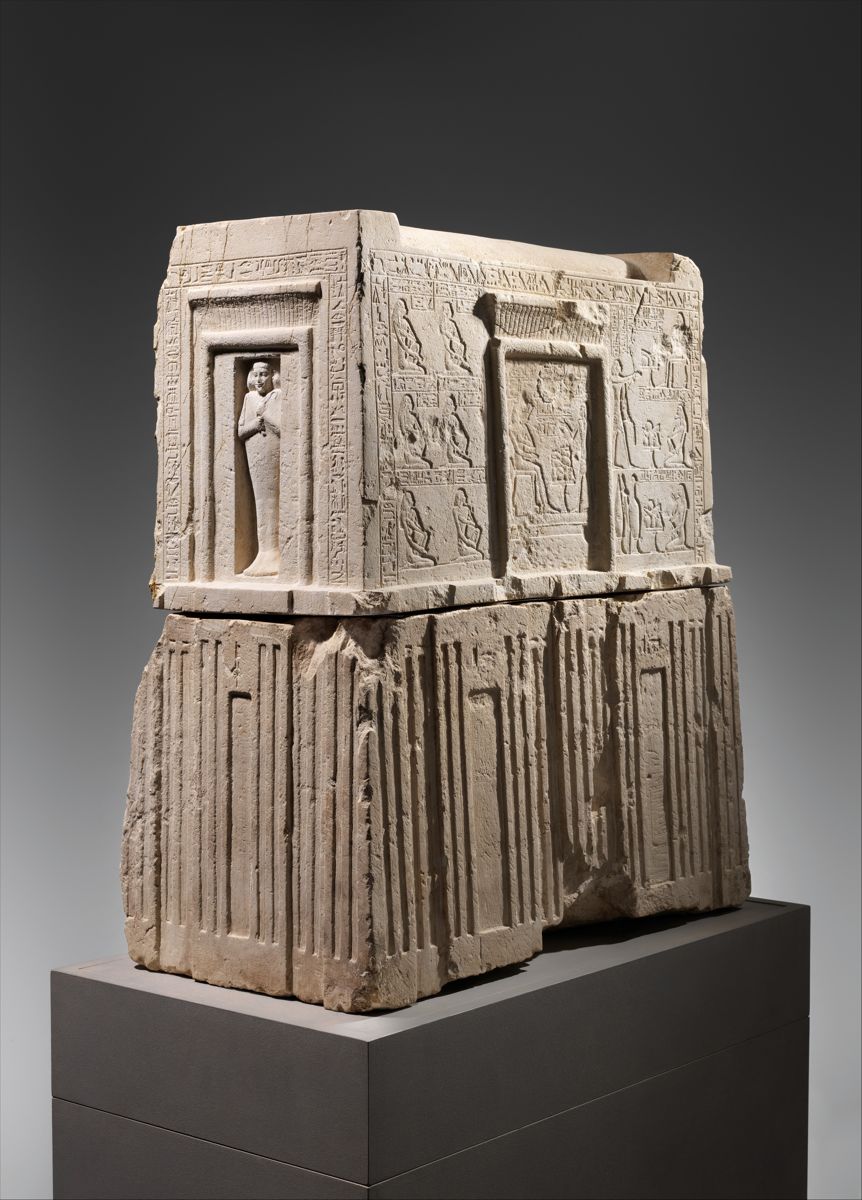
A Monumental Stela of Kemes , ca. 1750–1720 BCE


The provenance currently listed on the Metropolitan's website for the Monumental Stela of Kemes states:


A check of open source records using the names Ewe Schnell, Heinz Herzer and Pierre Bergé & Associés combined only turns up one other antiquity,  a panel painting of a woman in a blue mantle, which is also an acquisition within the Metropolitan Museum's collection. 


Serop Simonian is an art dealer of Armenian origin, born in Egypt and a resident in Germany.  He's interesting in that he has stirred up quite a bit of controversy regarding his involvement with the disputed Artemidorus papyrus, which he managed to sell in 2004 for €2.75 million to the Compagnia San Paolo Art Foundation notwithstanding that some experts have ascertained that it is a fake.  As the statute of limitations on that piece ran out, Simonian was never charged. 

On April 25, 2016 the Metropolitan's website for the Monumental Stela of Kemes stated the provenance as something quite different:


This earlier collection history mentions a "Todrous Collection" of which there is nothing documented in open source records anywhere on the web for any other ancient objects.  A late antique textile fragment of a tunic with the inventory number T 34, from "the Tamerit collection" is on record at the at the Papyrussammlung der Österreichischen Nationalbibliothek at the Austrian National Library though not much else.

Note this Metropolitan Museum record spells the name Todrous, while the recently restituted mummy spells the name Tawadrus, and trade journals spell the name Tawadros.  Later in this post you will also see the name spelled Tadross

Christophe Kunicki's own dealer website listed the provenance as:

Ancient european private collection, 1969.
With Tadross, Luxor, 1960’s

Stepping back even farther, outside of the museum's website, the Monumental Stela of Kemes was published in Volume 25 Number 5 of the journal Minerva: The International Review of Ancient Art & Archaeology.

This trade magazine listed the provenance as follows:

A rare Egyptian limestone chapel-stele of Kemes, superior of musicians (3), from the 13th Dynasty, circa 1770 BC (H. 73cm), in the form of a quadrangular naos resting upon a base carved with façades, was purchased from the Luxor dealer Tawadros during the 1960s. The cover-piece of the sale, it was estimated at €300,000-€400,000, but brought in a hammer price of just €200,00 from the Metropolitan Museum of Art. The expert for both sales was Christophe Kunicki.

Screen Shot: Volume 25 Number 5, Page 53
Minerva: The International Review of Ancient Art & Archaeology
Notice that the involvement of the French dealer Christophe Kunicki via Pierre Bergé & Associés in furthering this acquisition transaction does not appear in any of the Metropolitan Museum's provenance records for the 13th Dynasty Egyptian limestone chapel-stele of Kemes.  It only appears in the bimonthly trade rag for antiquities dealers.  Purchased on 21 May 2014 the Met's record also leaves out the "Luxor dealer Tawadros" connection on this object.  The name of that person is also the name associated on the  now restituted 1st century B.C.E mummiform coffin, inscribed in the name of Nedjemankh.

Note: Kunicki's website lists another egyptian object with the name "Habib Tawadros" giving us a another artefact linked to this mysterious Luxor dealer.

ARCA has notified the Egyptian authorities that this piece too may require closer examination. 

By Lynda Albertson

February 16, 2019

Restitution: Met Museum agrees to return its 1st century B.C.E mummiform coffin, inscribed in the name of Nedjemankh, to Egypt

The Metropolitan Museum has agreed to return its 1st century B.C.E gold-sheathed mummiform coffin, inscribed in the name of the high-ranking priest Nedjemankh.  The late Ptolemaic (or Hellenistic) antiquity was purchased via art dealer Christophe Kunicki, who lists himself on his website as a member of the Syndicat Français des Experts Professionnels en Oeuvres d’Art and the Chambre Européenne des Experts d’Art.  

Purchased for €3.5m in 2017, Nedjemankh’s coffin had reportedly been on consignment with the Paris dealer via an unidentified private collector.  Created out of cartonnage in the last century of the Ptolemaic Kingdom, a material used in Ancient Egyptian funerary objects from the First Intermediate Period to the Roman era, the object is made up of layers of linen stiffened with animal glue and layers of gesso. Evidence presented to the Manhattan District Attorney’s Office and confirmed by the Egyptian Ministry of Culture indicate that the antiquity may have been looted from Egypt in 2011 and exported utilizing fraudulent documents.

Note that the timeframe of the possible plunder, listed by the New York Times, and the Egyptian authorities coincides with the fall of Muhammad Hosni El Sayed Mubarak, Egypt's former military and political leader, who served as president of Egypt from 1981 to 2011.  After the so called Arab Spring, Egyptian authorities reported a significant uptick in heritage looting, exacerbated in part by the country's revolution and subsequent political upheaval.

The spartan collecting history information listed for the artifact on the Metropolitan Museum's website states that the antiquity was "officially exported from Egypt in 1971, the coffin has since resided in a private collection."  A second page on the museum's website, which has since been removed, listed the artifact's provenance as follows:

"The coffin was exported in 1971 from Egypt with an export license granted by the Antiquities Organization / Egyptian Museum, Cairo. It belonged to the stock of Habib Tawadrus, a dealer active since at least 1936, with a shop Habib & Company in Cairo opposite Shepheard’s Hotel, and was exported by the representative of the Tawadrus’ heirs to Switzerland. An official translation of the export license was provided by the German embassy in Cairo in February 1977 for the use of the representative and now owner in Europe. The coffin has remained in the family of that owner until its acquisition by the Metropolitan Museum in 2017."

This spartan amount of information, on an ancient object of this significance, drew the attention of blogger Paul Barford in September 2017 shortly after the purchase was announced.


Christophe Kunicki's relationship as an advisor of ancient art purchases to the Metropolitan Museum in New York goes back at least as far as September/October 2014, when his involvement in two purchases was highlighted in Volume 25 Number 5 of the journal Minerva: The International Review of Ancient Art & Archaeology as having advised the museum on two other purchases. 

Screen Shot: Volume 25 Number 5, Page 53
Minerva: The International Review of Ancient Art & Archaeology
Those objects, memorialized in the screenshot above, were a 26th Dynasty granodiorite head of the Pharaoh Apries, purportedly from the collection of Olivier Cacoub and the 13th Dynasty Egyptian limestone chapel-stele of Kemes in the form of a quadrangular naos resting on a base carved with façades.  The later of these was purportedly from the same "Luxor dealer Tawadros," in the 1960s, whose name is attached to the golden mummiform coffin that has just been repatriated.  It is not known at present if these objects are being given closer examination.

The Met’s management has formally apologized to Dr. Khaled El-Enany, Egypt’s minister of antiquities.

In it's press release the museum added:

 "All of the Museum’s acquisitions of ancient art undergo a rigorous vetting process in recognition of the 1970 UNESCO treaty, in adherence to the Association of Art Museum Director’s Guidelines on the Acquisition of Ancient Art and Archaeological Materials, and in compliance with federal and state laws."

Given that the Met developed a substantial exhibition around this golden-sheathed coffin, one would think that the museum's "rigorous vetting process" would have also included a close analysis of export documentation to check for fabrication and forgery.

A video from the Met Presents series featuring Curator Janice Kamrin and Conservator Anna Serotta talking about the coffin of Nedjemankh can be viewed here.

Upon the artefact's return to Egypt, it has been decided that the repatriated burial coffin will be displayed in the Egyptian Museum of Liberation until the Grand Egyptian Museum opens in 2020.

Notation:  Note this Metropolitan Museum record the name of the Luxor dealer as Tawadrus, while elsewhere in its records it records other objects using the name Todrous.  The trade journal above spelled the name Tawadros.  Another dealer spells the name as Tadross.


By:  Lynda Albertson


June 29, 2018

Italy Returns Trafficked Artifacts to the Archaeological Departments of the Ministry of Antiquities of the Republic of Egypt


In a ceremony held in Rome on June 27, 2018 at the headquarters of the Carabinieri Command for the Protection of Cultural Heritage, the Public Prosecutor at the Court of Salerno, Dr. Corrado Lembo and the Commander of the Carabinieri for the Protection of Cultural Heritage, Brigadier General Fabrizio Parrulli, returned 23,000 ancient bronze and silver coins and 195 archaeological finds, including funerary masks decorated in gold, a sarcophagus, a "Boat of the Dead" with 40 oarsmen, amphorae, pectoral paintings, wooden sculptures, bronzes, and oshabti statuettes, to the Ministry of Antiquities for the Republic of Egypt.  The objects, dating from the Predynastic to the Ptolemaic period, were believed to have been excavated during clandestine excavations in the south of Egypt.

On hand for the ceremony were Egyptian Ambassador, HE Hesham Badr, Professor Mohamed Ezzat, Senior Coordinator at the International Cooperation Administration of the General Prosecutor's Office, and Professor Moustafa Waziry, Secretary General of the Supreme Council of Antiquities in Egypt. 

The pieces were discovered during a seizure which took place in May 2017, at the customs area of ​​the port of Salerno, by the Carabinieri of the Cultural Heritage Protection Center of Naples, in collaboration with the officials of the Customs Agency and the local Superintendency.  The stop, was part of a customs inspection of a container which was marked as being for the transport of only household goods.