Blog Subscription via Follow.it

Showing posts with label Carabinieri Tutela Patrimonio Culturale. Show all posts

November 25, 2025

Italian Authorities Arrest 55 Suspects in Major Archaeological Looting Probe in Sicily


In a major operation targeting two antiquities-trafficking networks, the Palermo unit of the Carabinieri’s Nucleo Tutela del Patrimonio Culturale (TPC), under coordination by the Catania Deputy Prosecutor, Fabio Scavone, has uncovered evidence of extensive clandestine excavations at more than twenty archaeological sites in Sicily and an additional site in Roccelletta di Borgia, Calabria.  These incidences, carried out between 2021 and 2023. resulted in the systematic removal of a substantial number of cultural artefacts, which were then smuggled out of Italy and laundered onto the licit ancient art market.

According to the reconstruction presented by the Italian court magistrates, coordinated by the deputy prosecutor Fabio Scavone and the substitute Giovanni Gullo, a total of 74 suspects have been identified in this large transnational investigation.  All are alleged to have been part of two criminal networks capable of managing the entire clandestine supply chain: from the sourcing of objects through illegal excavation by grave robbers through intermediary smugglers and on to the international sale of the  archaeological finds outside of Italy in contravention of the country's cultural property laws. 

Overall, the Prosecutor's Office examined a total of 292 incidents documented in a 1,700-page crime report produced by the Carabinieri of the Palermo Cultural Heritage Protection Unit.  Having reviewed the evidence surrounding the case, the prosecutor asked for precautionary measures for 55 of the identified suspects, individuals believed to have been directly involved in the sourcing and/or trafficking of archaeological material illegally excavated in Italy and later moved into markets in Europe and the United Kingdom. 

Of these, prosecutors have asked for the pre-trial detention for 12 of the suspects, as well as house arrest pending trial for another 35, and lighter reporting obligations for eight other individuals, pending the resolution of their individual cases through the courts.

The list of suspects released publicly with pretrial precautionary measures or incarceration are:
Maria Lisa Aloi
Filippo Asero
Salvatore Romano Benfatto
Giuseppe Bertolami
Vincenzo Boccadifuoco
Salvatore Bonaventura
Giuseppe Buceti
Filadelfo Calvagna
Salvatore Camonita
Giovanni Castro
Salvatore Cavallaro
Benedetto Chiara
Carmelo De Luca
Fortunata Di Dio
Giuseppe Di Mauro
Alfio Emmanuele
Giuseppe Esposito
Domenico Faranda
Gaetano Faranda
Emanuele Ferro
Vincenzo Filonardi
Filippo Franceschino
Mario Gagliano
Vittorio Emanuele Guzzetta Bongiovanni
Giuseppe Salvatore Insigna
Leandro Insolia
Massimiliano Insolia
Enrico Lo Verde
Massimo Lucca
Settimo Carmelo Minnella
Umberto Moruzzi
Adriano Nicotra
Michele Consolato Nicotra
Salvatore Palumbo
Andrea Panicotti
Gianfranco Paternò
Nicolò Petronio
Giuseppe Pezzino
Sergiu Ionica Pop
Antonio Portale
Simone Adriano Petrin
Alessandro Privitera
Giuseppe Rapisarda
Vincenzo Rau
Antonio Francesco Rotondo
Francesco Salvia
Santo Sambataro
Vito Spitaleri
Vito Stancanelli
Giuseppe Strano
Pietro Tomasello
Salvatore Tomasello (born 1957)
Salvatore Tomasello (born 1967),
Giuseppe Sebastian Viola
It should be noted that the individuals cited by the authorities and documented in this article are for now are simply under investigation and have not been convicted of any crime.  It is also important to remind our readers that there is a substantial and essential difference between being a suspect in an investigation and being adjudicated guilty in a court of law. 

Preliminary Investigations Judge Simona Ragazzi has scheduled hearings in relationship to this trafficking investigation for November 25-29.

According to the 1,700-page report related to this investigation, the Carabinieri utilised surveillance devices and analysed documents, and auctions held in various locations outside of Italy ultimately allowing them to reconstruct the entire chain of thesetwo lucrative trafficking rings which primariy struck sites around Paternò, a town in Catania near Mt. Etna, Kamarina in the Ragusa area, Himera in the Palermo area, Megara Hyblaea in the Syracuse area, and Scolacium in Roccelletta di Borgia in the Catanzaro area.    


Dense in detail the TPC report demonstrates that wire taps placed on the suspects phones revealed that some accomplices used code words to describe the tools of the illicit trade used in their looting activities as well the names of the sites they plundered.  Likewise, on occasion the accomplices lapsed into speaking frankly,  discussing individual artefacts, silver, and jewellery found during their clandestine excavations.

Italian investigators confirmed that many of the objects excavated from these locations made their way into the licit ancient coin markets in the UK and Germany via foreign intermediaries abroad.  In one of several documented incidences 46 ancient coins dating between the 5th and 3rd centuries BCE were sold in 2021 at a Munich auction house, where they brought in more than 42,000 euros.  Part of these assets were seized by the German judiciary, pursuant to a European judicial order issued by the Catania prosecutor's office.

A second grouping of coins chose a path to the UK and were laundered onto the London numismatic market by one suspect where 39 coins minted by the Greek colonies on Sicily including litrae, tetradrachms, denarii, and sestertii were reportedly sold on 7 October 2021, for a total of £88,590.00.

The scale of the arrests underscores not only the risks posed by organised heritage crime and transnational trafficking networks, but also a persistent and uncomfortable reality: despite decades of national awareness, strong legislation, and highly capable investigative units, Italy remains one of the world’s richest source countries for antiquities looting. Tomb raiders and illicit metal detectorists continue to plunder archaeological sites across Sicily, from Himera to Kamarina, Eraclea Minoa, Gela, and beyond, stripping the ground of artefacts valued anywhere from a few hundred euros to several thousand pounds, where they can easily be funnelled into the don't ask-don't tell international market accompanied by forged provenance documents.


By:  Lynda Albertson

October 20, 2025

The Aboutaam Brothers, Phoenix Ancient Art, and the Hidden Routes of Italy’s Lost Antiquities

Phoenix Ancient Art - BRAFA 2019 

With a precautionary seizure order, filed by the Rome Public Prosecutor's Office, led by Prosecutor Stefano Opilio, nearly three hundred ancient Italian artefacts may finally be coming home after years of investigative work marking the judgement as one of Italy's most important cultural recoveries in recent history.  

This recovery finds its roots in a multi-year operation linking the Italian Carabinieri’s Cultural Heritage Protection Command with prosecutors in Rome and the United States, as well as Belgian investigative and judicial authorities.

Acting on a European seizure order issued in July 2025 officials have frozen nearly three hundred artefacts confirmed or strongly suspected to be of Italian origin.  These were identified as being tied to storage facilities in Belgium associated with the owners of the art gallery Phoenix Ancient Art, Hicham and Ali Aboutaam.  

Some of the artefacts identified in this operation coincide with business record documentation police obtained during a lengthy group pf investigations into the illicit dealings of  ancient art dealers Robert Hecht, Giacomo Medici, Gianfranco Becchina and Robin Symes, as well as a large dossier of material recovered from the prolific tomb raider Giuseppe Evangelisti.

While this blog has dedicated ample articles on the problematic art dealers mentioned above, we have never covered Evangelisti in the past.  His involvement in the illicit trade was first identified during Operation Geryon just before Christmas in 2003, when officers overheard a conversation during wire taps which referred to someone nicknamed “Peppino il taglialegna”—Peppino the woodcutter, a name derived from the individual's “day job”, providing firewood to two villages.  At night however, Evangelisti moonlighted as a tombarolo,  scavenging the hillsides for Attic and bucchero ceramics, bronze statues and various terracotta finds primarily used in funerary contexts. 

Luckily for investigators, when they raided Peppino's home near Lake Balsena they found not just the fruit of his recent clandestine labours but a batch of books on a shelf (nine books of agendas and seven albums) which documented the extent of his looting from 1997 to 2002.   A virtual goldmine for investigators, the albums contained photographs of every object he had ever looted, even going so far as to record the depth underground of the objects he illegally excavated.  In her review of these journals and albums, former Villa Giulia employee Daniela Rizzo stated that in her twenty-six years of experience, Evangelisti was the only person, aside from Giacomino (Medici), who recorded such detailed records of his activities. 

But back to the Belgium Recoveries

The recoveries announced today are due in part to the New York investigation into the purchasing activity of problematic hedge fund billionaire Michael Steinhardt who not only surrendered $70 million in plundered antiquities, but was the first collector in the United States to be handed a lifetime ban from antiquities collecting. That District Attorney's Office investigation, conducted by the Antiquities Trafficking Unit in Manhattan, uncovered a series of clandestine networks responsible for supplying looted Mediterranean objects to museums, collectors, and gallerists in the United States. 

Following up on that US investigation, a joint Italian-Belgian investigative team was formed expanding Italy's inquiry into northern Europe’s illicit art-dealing hubs and exploring the Aboutaam's footprint in Belgium.  This European investigation allowed for the cross-referencing of some 283 artefacts identified in Belgium, documented in Italian police databases and dealer archival photos.  That number in turn  demonstrates that despite numerous seizures in the US and Europe, the transnational ancient art market, despite decades of scandals, continues to recycle problematic artefacts extracted from clandestine digs.

According to Italy prosecutors Giovanni Conzo and Stefano Opilio, 132 of the seized works can be definitively linked to Italian sites, while the remaining artefacts almost certainly share the same illicit origin. The order, upheld by the Court of Appeal, described the pieces as the product of “illegal provenance” and repeated violations of cultural-property law.

Through it all Phoenix Ancient Art, long considered one of the most prominent galleries dealing in classical antiquities, once again finds itself at the center of controversy.  While the Aboutaam brothers have not been charged in connection with the Italian-Belgian operation, their business history is inseparable from the problematic story of the antiquities trade. 

In January 2023 at the Geneva police court, Ali Aboutaam was sentenced by the Swiss authorities following a complex and multi-year criminal and procedural investigation by officers and analysts with Switzerland's customs and anti-fraud divisions, working with the Geneva Public Prosecutor's Office.  The Swiss-based merchant had earlier been found guilty of forgery of titles.  In that case the courts also confirmed the seizure of 42 artefacts, confiscated due to their illicit origin. 

For Italian authorities, the current case is less about one gallery than about dismantling a system that has long allowed cultural property to vanish from archaeological landscapes and reappear behind glass cases thousands of kilometres away. The artefacts now bound for Rome belong, by law, to the Italian state’s “unavailable assets,” meaning they can neither be privately owned nor sold and their repatriation signals both a practical and symbolic victory for Italy’s Carabinieri TPC, which has spent decades tracking stolen heritage across the world’s galleries, auction houses and art fairs.

The anticipated return of these objects does more than close a legal chapter, it again  underscores how the same names, archives, and networks continue to bear fruit in terms of recoveries, even twenty years after the Medici conviction and the scandals that rocked museums in the 1990s and early 2000s. The discovery in Brussels suggests that, despite improved international cooperation, large caches of looted antiquities remain hidden in private storage and corporate collections.

July 3, 2025

These legal requirements are designed to prevent the illicit removal of historically or culturally significant objects, allowing authorities to assess each item’s provenance and value before it crosses borders.

Following a two-year investigation, culminating in a coordinated effort between Spain’s Guardia Civil and Italy’s Carabinieri Command for the Protection of Cultural Heritage, 62 valuable cultural assets were repatriated to Spain today under the banner of Operation Altarpiece in a ceremony held at the “Swiss Guards Hall” of the Royal Palace in Turin.  The investigation was directed by Investigating Court No. 1 of Marbella, which worked closely with Eurojust to coordinate international legal cooperation. 

The case began in June 2023 when the Guardia Civil received intelligence via Europol’s Secure Information Exchange Network Application (SIENA), alerting them to the seizure in Italy of a carved polychrome and gilded wood altarpiece, with scenes of the Passion of Christ from the 16th century.  This religious work of art had been illegally exported from Andalusia five years after Spanish authorities had denied its earlier export request, made by the now-deceased German couple who had been residing in Marbella (Málaga).

Under Spanish law, cultural properties of this nature—i.e., artworks over 100 years old, included in the General Inventory of Movable Property of Historical Heritage, or valued above specific monetary thresholds (ranging from €15,000 for drawings, engravings, and photographs to €150,000 for paintings)—require a definitive or temporary export permit.  The seized altarpiece in question lacked any of these necessary authorisations.

As the investigation expanded, authorities focused on tracing how this altarpiece had been removed from Spain and transported into Italy and whether the object's holders had trafficked any additional artworks out of the country.  During their subsequent investigation, officers determined that over 90 cultural objects had been exported from Marbella using a non-specialised transport company which moved Renaissance panel paintings, some configured as triptychs, sculptures, vases, tapestries, French 17th and 18th century furniture, and works attributed to artists such as Amedeo Modigliani, Auguste Rodin, and Pieter Brueghel, (the younger).

Italian investigators located many of these works in the villa of Günter Hans Ludwig Kiss, on the shores of Lake Maggiore in Lesa, the same home where the altarpiece had been recovered.  Other works were traced to art galleries, as well as private residences, in Genoa and Milan.   Still others had been sold onward and re-exported from Italy to a third country.  Kiss, the controversial German garbage magnate, was once listed in the top 300 list of rich businessmen in Switzerland, and died, at the age of 81, on 04 February 2023, a few weeks after his wife's own death.  

While alive, the German entrepreneur was involved in numerous legal cases: both civil and criminal for his waste management activities. In the 1990s, he was placed trial for environmental crimes committed with the commissioning of a Thermoselect plant.  Having sold their properties in Switzerland and Spain, and without heirs, the Kiss assets, contested by creditors, were slated to go to the Kan Foundation, a non-profit organisation only established in the tax haven of Liechtenstein in 2023.

As a result of thier line of inquiry, the Spanish court issued multiple European Investigation Orders to judicial authorities in Italy and Germany, along with an International Letter of Request to the United Kingdom, seeking the restitution of the works located in each of the aforementioned jurisdictions.

On Thursday, 16 December 2021, at least two of the seized paintings on view during today's restitution ceremony had been consigned for sale to Cambi Casa d'Aste for an Old Masters sale held at Castello Mackenzie in Genova (Italy).  The first being this early 16th century painting, representing the Madonna and Child with Saint Anne believed to have been painted by members of the Antwerp School, the painting is estimated to be worth between €30,000 to €50,000. 

and this 16th century, 'Triptych depicting the Holy Family and angels' also from the Antwerp School values at between €20,000 and €30,000.


Given that no provenance details accompanied either advertisement for this auction,  one also needs to look closely, not only at the business mogul Günter Hans Ludwig Kiss, but at the origins of these Antwerp School works in relation to World War II-era claims. 

No rules followed, too few questions asked

This restitution case underscores the importance of applying for, and legally obtaining, export permits for cultural property when transferring art works from one country to another.  Legal requirements such as these are designed to prevent the illicit removal of historically or culturally significant objects, and allows national cultural authorities to assess each item’s provenance and artistic importance to the nation prior to authorising removal. 

The investigation also highlights the lack of consistent due diligence on the part of some art market resellers in verifying the legal status of artworks before accepting them for purchase or agreeing to take them under consignment. 

Due diligence is not simply best practice—it is essential for safeguarding a nation’s heritage and ensuring transparency and accountability within the international art trade.  Institutions and private dealers should be prepared to ask potential sellers and consignors tough questions, and to require proof of proper documentation, including export permits when required, in order to prevent inadvertently facilitating the sale of illicit cultural property.  

Failure to do so, or intentionally turning a blind eye, exposes collectors, art dealers, and auction houses to reputational damage and undermines collective efforts to protect cultural heritage from being lost to illicit markets.

By:  Lynda Albertson

December 16, 2024

From Heist to Cellar: The 45-Year Journey of a Stolen Masterpiece

As mentioned in our last blog post, it can sometimes take decades to recover a stolen artwork, or even longer. Such was the case with the 1979 cat burglar-style painting theft in which the thief abseiled thirty metres from one of the highest windows of the Pinacoteca di Palazzo dei Consoli in Gubbio, Italy, using a mountaineering rope. Once inside, the thief made off with a painting, the Madonna del Melograno, which depicts Mary gazing upon a delicately clothed Christ Child, with a youthful Saint John the Baptist to her left. The artwork was initially associated with the school of Filippo Lippi, but was later attributed to his follower, Pier Francesco Fiorentino (1444–1499).

Forty-five years later, the artwork was identified by the Italian Carabinieri when the painting’s current good-faith owner contacted law enforcement, having discovered the artwork in an underground cellar in the city of Imola.

Art theft cases are often more challenging to investigate than traditional thefts due to the unique nature of the stolen items and the specialised knowledge required to trace them.  Unlike mass-produced goods, artworks are typically one-of-a-kind or part of a limited series, making them harder to sell on the traditional art market, provided sufficient records have been kept by the original owners.  It is for this reason, that stolen paintings sometimes take decades to resurface or, as in this instance, are simply abandoned when the thief realises its a lot harder to sell a "hot" painting than he or she imagined, or when said thief does not have access to the kinds of buyers willing to purchase a stolen painting. 

Likewise, artworks can be concealed and transported across borders before being sold in locations where the source country’s theft records are unavailable, where they can sit unnoticed in good-faith buyer collections for decades.  It is usually during black market circulation that a painting’s provenance is fabricated or obscured and you begin to see stolen paintings in circulation on the licit market.  

Additionally, the high value and cultural significance of stolen art attract sophisticated criminals who often exploit gaps in international law enforcement coordination marketing these works to buyers after the statute of limitations for bad faith dealing has long past. Investigators must also contend with the niche expertise needed to authenticate art and must distinguish genuine pieces from forgeries.

As always, the first step in identifying stolen artwork involves dataset comparisons, as in the case of the Madonna del Melograno.  By finding points of commonality between documented archival photographs of the stolen artwork and close inspection of the suspect work, investigators can confirm on object match or determine if the work presented is a copy or forgery. 

On the left, the image of the stolen work provided to the Carabinieri TPC by authorities in Gubbio. On the right, the image of the seized work.

As can be seen by the highlighted areas, the Carabinieri were able to visually confirm that the painting found in the Imola cellar, was in fact the artwork which had been stolen by the cat burglar in Gubbio forty-five years ago. 

October 15, 2024

Urban Tombaroli and Two Clandestine Excavations: Near the Villa at Oplontis and in Central Naples


The Carabinieri have uncovered a clandestine excavation in Torre Annunziata, believed to be aimed at looting artefacts from the renowned Villa A (“of Poppaea”) at Oplontis, an ancient luxurious Roman seaside villa located a short three kilometers away from the more famous archaeological site of Pompeii. The discovery was made during a coordinated operation led by the Carabinieri’s investigative unit from Torre Annunziata, with assistance from agents specialising in cultural heritage crimes. 

Map from Oplontis: Villa A (“of Poppaea”) at Torre Annunziata, Italy. Volume 1.
The Ancient Setting and Modern Rediscovery
by John R. Clarke and Nayla K. Muntasser

Acting on a tip-off, the Carabinieri officers raided a cellar on Corso Garibaldi, number 106, just one minute's walk from the historic villa.  There the investigators  found three partially collapsed but still accessible tunnels, all leading in the direction of the Villa of Poppea, with its striking wall paintings  The officers also found a striking number of tools used for the illicit excavation, as seen in the video below.  These included aerators, shoring materials used in the tunnels' development, and containers already filled with volcanic lapilli removed during the advancement of the digging operation.

The owner of the cellar, a 53-year-old local carpenter with no prior criminal record, has been charged with conducting illicit works under Article 169 of Italy’s cultural heritage code. 

Investigators believe the tunnels were dug with the intent of reaching and stealing artefacts from the archaeological site, a UNESCO World Heritage Site known for its exceptionally preserved frescoes and structures dating back to ancient Rome.

The Villa of Poppea is a significant part of the Oplontis site and has long been a target for tomb raiders due to its rich archaeological significance. Authorities are continuing their investigation, focusing on whether the carpenter was working alone or, given the abitious nature of materials found, as part of a larger network of artefact thieves.

Earlier this month, a similarly ambitious illicit excavation was uncovered in the heart of Naples.  There officers discovered the remains of an 11th century medieval church eight meters below street level, 2 km away from Naples central train station near Piazza Bovio. 

The raider in this instance is a local entrepreneur, digging directly under an existing palazzo.  Recovered at the scene, officers seized some 10,000 archaeological fragments from the Roman and medieval eras, believed to be from the suburban sector of the ancient Magna Graecia city of Neapolis, as well as 453 intact archaeological finds from the Roman era , including: red-figure craters, amphorae, terracotta lamps and pipes, as well as Roman and medieval coins.

The previously undiscovered church is said to be a rare example of medieval art of the 11th century, whose decoration are similar t the nearby Sacello di Sant'Aspreno. 

Both incidences highlight the significant challenges posed by urban illicit excavations for both law enforcement and cultural heritage protection.  These unauthorised digs, often conducted covertly beneath residential or commercial properties, not only pose safety hazards due to unstable tunnels and potential structural damage, but they also risk irreparable harm to the archaeological context of the site. 

In cities with rich histories like Cairo, Rome or Naples, contemporary city expansion has often built over ancient treasures, making it difficult to monitor such hidden operations.   Looters seeking valuable artefacts frequently destroy layers of history, removing items from their context and severing crucial links to the past.  This not only deprives the public of valuable cultural knowledge but also fuels the black market for antiquities, undermining legitimate efforts to preserve and study historical sites. 

The challenge for authorities is compounded by the difficulty of detecting these operations in densely populated areas, where excavations can go undetected for years, beneath seemingly ordinary locations.

May 3, 2024

Carabinieri Command: Safeguarding Italy's Cultural Heritage for 55 years


Fifty-five years ago today, on May 3, 1969, a crucial chapter in the protection of Italy's rich cultural heritage was written with the establishment of the special department of the Arma dei Carabinieri known as the "Nucleo Tutela Patrimonio Artistico." Since its inception, this unit has been entrusted with the vital task of safeguarding and protecting the nation's artistic legacy. Over the decades, it has evolved into the esteemed "Carabinieri Command for the Protection of Cultural Heritage," earning recognition both nationally and internationally for its unwavering dedication and exemplary work.

At the core of its operations lies a commitment to investigative, informational, and analytical functions aimed at combatting the illicit trafficking of cultural artefacts. Central to its success is the utilisation of the Leonardo Database of illicitly stolen cultural heritage, the largest repository of its kind globally. This database, containing comprehensive information on assets, primarily of Italian origin, and serves as a powerful tool in the ongoing efforts to locate and repatriate stolen treasures.

Moreover, the Carabinieri Command for the Protection of Cultural Heritage extends its expertise and support to other law enforcement agencies, fostering collaboration and synergy in the fight against cultural crime. Its partnership with the Ministero della Cultura ensures a comprehensive and coordinated approach to preserving Italy's cultural legacy for future generations.

As we commemorate their milestone, we salute the men and women of the TPC for their tireless efforts in protecting their country's cultural heritage. Their dedication serves as a model in the ongoing battle against the illicit trade in cultural property and affirms Italy's commitment to preserving its cultural identity.


January 20, 2023

Ceremony on the return of 58 antiquities to Italy

On Monday, January 23, 2023, at 1 pm in Rome, a formal ceremony will be held regarding the return to Italy, from the United States, of 58 antiquities valued at nearly $19 million.  This event will be held at the Ministry of Culture's Sala Spadolini inside the Consiglio Nazionale al Collegio Romano.

The objects returned are the direct result of investigations in the United States regarding international traffickers of antiquities conducted by the Antiquities Trafficking Unit at the District Attorney's Office in New York in Manhattan, in collaboration with the Comando Carabinieri Tutela Patrimonio Culturale (TPC).  

Present for the event will be the Italy's Minister of Culture, Gennaro Sangiuliano,  the Deputy Prosecutor of the Republic at the Court of Rome, Angelantonio Racanelli; the Commander of the Carabinieri TPC, General B. Vincenzo Molinese; and New York Assistant District Attorney Col. Matthew Bogdanos. 

This event will be direct streamed via the YouTube channel of Italy's Ministry of Culture for those who wish to attend the ceremony digitally. 

https://www.youtube.com/watch?v=x-RcYKNBHtk&ab_channel=MiC_Italia

Marble head of Athena, ca. 200 BCE

In discussing these returns in a press release issued by the New York County District Attorney's Office, the New York authorities stated that these artefacts had been trafficked by Giacomo Medici, Giovanni Franco Becchina, Pasquale Camera and Edoardo Almagiá.  Twenty one of the pieces had been seized from the Metropolitan Museum of Art while the other thirty-seven were recovered from a New York collector and an antiquities dealer.

When speaking of these objects homecoming to Italy, Manhattan District Attorney Alvin L. Bragg, Jr., was quoted as saying:

“These 58 pieces represent thousands of years of rich history, yet traffickers throughout Italy utilised looters to steal these items and to line their own pockets. For far too long, they have sat in museums, homes, and galleries that had no rightful claim to their ownership.”  

Discussing the recent Italian restitutions Bragg also addressed the difficulty and time needed to work these complicated cultural property crime cases stating:

“Exposing these schemes takes years of diligent and difficult investigative work, and I applaud our team of prosecutors and analysts, who in coordination with our law enforcement partners, are continuing to make unparalleled progress in returning stolen antiquities.”  

Assistant US District Attorney Col. Matthew Bogdanos, who heads up the Manhattan Office's Antiquities Trafficking Unit, and who will be present at Monday's ceremony, has often related his department's work to an axiom of jurisprudence “that justice should not only be done, but should manifestly and undoubtedly be seen to be done.” R v. Sussex Justices, ex parte McCarthy, 1 KB 256, 259 (1924).  Something this publicly streamable restitution will undoubtedly demonstrate.  

Each of these objects should be viewed as a reminder to collectors, dealers, and art institutions, that the US authorities treat stolen cultural property seriously and public prosecutors continue to pursue the rightful return of plundered goods.

April 8, 2022

What about the well known looted vases in the Altes Museum in Berlin?

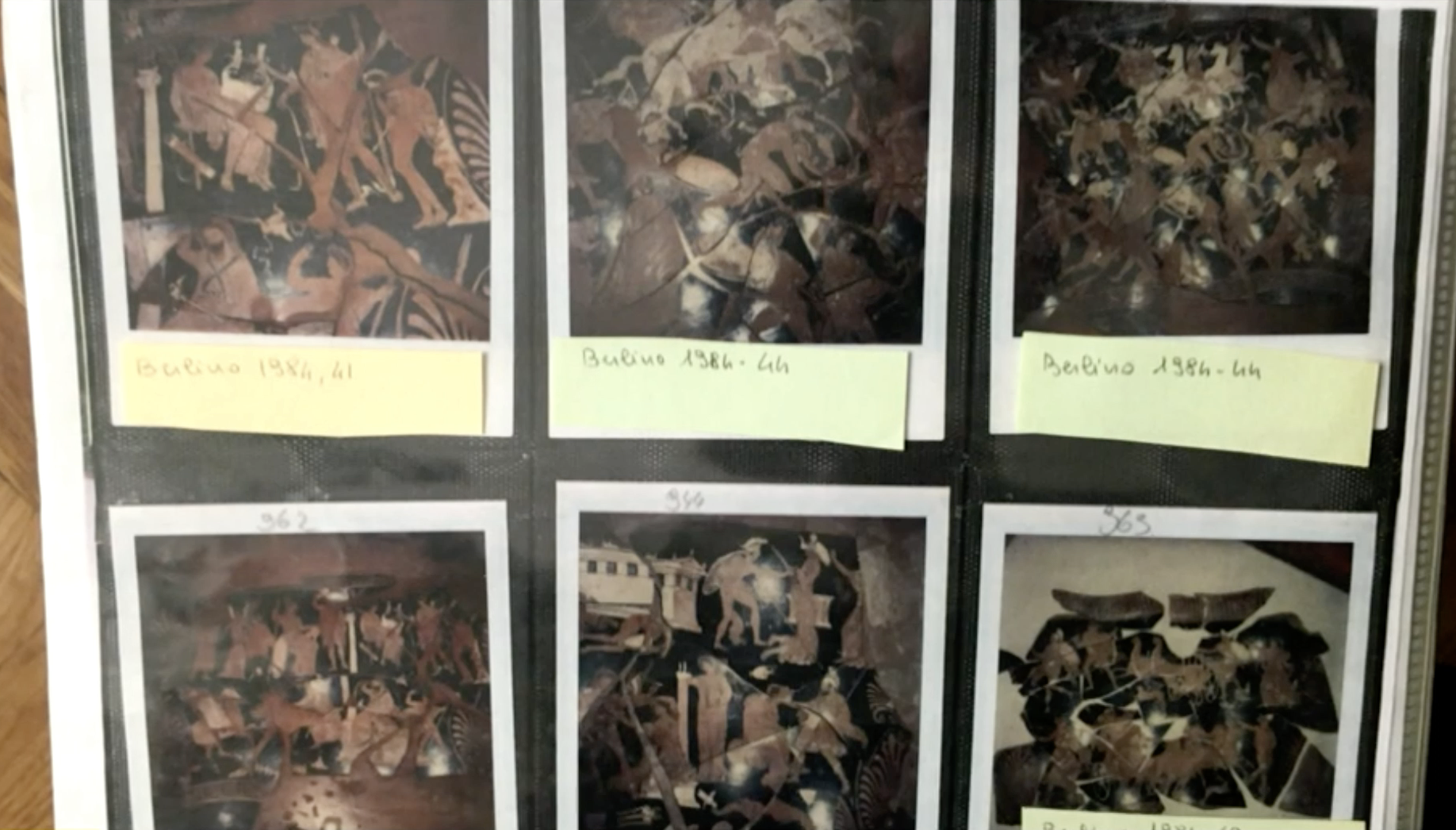
Left: Medici Archive Polaroid with fragments of the Crater of Persephone,
attributed to the Painter of the Underworld,
Right: 4th century BCE crater as seen at the Altes Museum, Berlin

Tonight there was an interesting plot twist to this year's formal demand by the Public Prosecutor's Offices of Rome and Foggia, who in late January 2022 issued two confiscation decrees, the first from the Gip of Foggia, and the second from the Gip of Rome, Alessandro Arturi, at the request of the Procura del Tribunale Capitolino. These European confiscation orders were sent with an international rogatory request through the Directorate General for International Affairs and Judicial Cooperation of the Ministry of Justice asking for the return of 21 ornate South Italian artefacts currently on exhibition in Germany.   Tonight, at 20:30 CET, on RAI tg24  Spotlight, journalists, archaeologists, curators, and carabinieri officers discuss these artefacts' murky origins.  All the while the viewing audience got to see the overly simplified foot-dragging reticence of the management at the Altes Museum in Berlin towards Italy's determination to prove the illicit nature of these pieces, and to get these objects back.  

Many of the spectacular contested artefacts, date to the 4th century BCE and fall into distinct workshop groups, giving us a rich opportunity to examine how the peoples native to southern Italy used Greek myth to comprehend death and the afterlife in their funerary customs.  Some of the Apulian vessels share stylistic markings which demonstrate that they likely were created by the same attributed "hands", leading Italian experts to strongly believe that the artefacts may have been derived from a singular burial grouping.  

The artisans represented include the Group of Copenhagen 4223, the Varrese painter, the Darius painter, and the Underworld painter.  All of the artefacts had at one point been broken into fragments before being carefully restored and sold on to Wolf Dieter Heilmayer between 1983 and 1984, then at the Berlin archaeological museum located in West Germany.  The German museum director purchased these artefacts via Christoph Leon for 3 million German marks, under the pretext that they had been purportedly part of a historic collection belonging to a Basel family named the Cramers. 

In reality, the red figure vases are believed by the Italian authorities to have been looted, having once adorned a large chamber tomb, likely near Taranto, the coastal city and production centre in southern Italy from c. 430 - c. 300 BCE where many of these vases originate.  The single tomb grouping is something that Martin Maischberger, Deputy Director of the Collection of Classical Antiquities of the National Museums in Berlin contested during his interview, saying that most massive volute-kraters are found in pairs, not in groupings of seven, (three alone attributed to the Darius painter) like those purchased with the fictitious Cramer provenance bought by the museum director's predecessors.  

Strikingly, the German director doesn't take into consideration the wealth of material found at other sites in the Southern half of Italy, sites like Ruvo and the richness of its own tomb-groups or other impressive object groupings from the tombs at Gravina and Rutigliano in Peucetia, where contacts with both Greece and Etruscan painters clearly demonstrate tombs proportionately rich in burial goods. 

While not all the artefacts in the Berlin Tomb group appear in photographs in the now famous Medici Archive, four of them are, and point clearly towards the illicit nature of these finds.  

In this case, in three different groupings of Polaroids, specifically:
  • one grouping of fifteen photographs, 
  • one grouping of six photographs,
  • and one grouping of two photographs. 
All three sets of images depict artefacts now in the Altes Museum in various stages of restoration, the most important of which is the exceptional krater by the Darius Painter.

Giacomo Medici archive photos of looted artefacts
presently on display at the Altes Museum

While not all of the Apulian artefacts have a "smoking gun" looter photo, the names attached to this transaction are the same, and have been problematic in the past. 

The former head of archaeology at Geneva Museum, Jacques Chamay had previously announced that his research had begun after he had examined a fragment of one of the vases in the Cramer family’s old library, though in tonight's program, reached by phone, he had nothing to say. 

Discounting the judicially soft, but diplomatically polite, cultural diplomacy negotiations as "informal", which up until January had been the preferred approach of the Carabinieri and the Procura of Foggia,  Dr. Maischberger at the Altes Museum remarked that the European confiscation request was the first time the museum had been formally asked to give back the vases.  In this instance, it seems the museum decided the Italian's less stick, more carrot approach meant they weren't serious or that a decision could be avoided?  In either case, asking nicely didn't incentivise or compel the museum's management towards restitution because only 4 of the disputed artefacts have definitive proof of looting photos seized from Giacomo Medici's storage facility on the fourth floor of the Ports Francs & Entrepôts de Genève, specifically Corridor 17, Room 23, on the 13th of September 1995.   

Giacomo Medici at the Metropolitan Museum of Art

During the Italian Spotlight news broadcast, Italians also heard from someone at the heart of Italy's illicit art market and the original holder of the Medici Polaroids, Giacomo Medici himself. 

Interviewed on camera for the first time, by investigative journalist Raffaella Cosentino, the former antiquities dealer seemed both soundly arrogant and at times cagy, admitting little even under direct questioning.  He avoided answering tough questions and instead preferred to underscore that he had served his time and paid his fines.  He also reminded his interviewer that in some instances the judicial process did not prove conclusively he had committed certain crimes.  

While Medici matter of factly talked about the seven boxes of photographs returned to him at the closure of his court case, he skipped over the fact that these images  represent the massive corpus of some 4000 artefacts that he handled during his years as an antiquities dealer.  He also failed to mention that he cultivated contacts among Italy's impoverished tombaroli, other wealthy corrupt dealers, Museum directors and conservators, who all turned a blind eye to the less than pristine origins of his wares.  Instead he preferred to mention loopholes or that he sold his antiquities of Switzerland, because Italy had rules against selling objects illicitly excavated. 

For what it is worth, and as a reminder, on 13 December 2004 Giacomo Medici was charged with receiving stolen goods, illegal export of goods, and conspiracy to traffic via the Tribunal of Rome. The judge found that more than 95% of Medici’s antiquities—both those found in his Geneva warehouse as well as those depicted in the 4,000 seized photographs— were looted from Italy. Therefore, concerning the 3,800 antiquities recovered from the Geneva warehouse, the judge ordered the confiscation of approximately 3,400. Of the 400 that were not confiscated, 258 were returned to Switzerland: 179 because they had been looted in Greece, from sites on Paros, Crete, and the mainland (and, therefore, not subject to Italian law), and 79 because they were not authentic (and, therefore, were not the subject of the criminal investigation). For fewer than 150 of the 3,800 hundred antiquities—3.9% of his collection—did Medici provide any prior provenance.

On 15 July 2009 the Italian Appellate Court affirmed Medici's convictions for receiving stolen goods and conspiracy relating to the illicit trafficking of antiquities.  The affirmed a sentence of eight years of imprisonment alongside a €10 million fine, while the final count, for trafficking, was eliminated due to the expiry of the statute of limitations. 

Despite appealing the Appellate Court's ruling via Italy's Court of Cassation, on 7 December 2011 Giacomo Medici's final appeal was rejected.   Born in 1938 and already a senior citizen by that point, he was allowed to serve his judicial punishment primarily on house arrest at his villa in Santa Marinella, shortened by time off for good behaviour. 

By:  Lynda Albertson


April 23, 2021

Stealing venerated relics: An ancient pastime that lives on today

The Cistercian abbey of San Galgano

The Carabinieri for the Protection of Cultural Heritage (Comando Carabinieri Tutela Patrimonio Culturale - TPC) have recovered the Reliquary of San Galgano, a work possibly attributed to the 14th-century goldsmith Ugolino di Vieri.  The Medieval Christian object of faith was stolen from the Seminario Arcivescovile Siena more than 30 years ago, in 1989.

Over time, by accident and changes, little remains of San Galgano except for some of the church's relics and a fantastic sword which is a story unto itself.  Most of the accessory structures of the Cistercian abbey are gone, leaving us with only the roofless building's stone skeleton with its grouped piers and ribbed vaults.  Despite its ruin, it is an impressive Gothic architectural masterpiece and one of the most exquisite religious structures in Tuscany. 

Recovered along with ten other stolen works of art, the Reliquary of San Galgano's is believed to have been stolen as a theft to order.   And as sacrilegious as that may sound, given what reliquaries are used for, stealing venerated religious objects is not as uncommon as one would like to think.  

Nor should the theft of these types of liturgical items be underestimated, as their intrinsic worth is more than the sum of their antiquarian value.  Their uniqueness being more that just the costly materials they are made from, or the fame of the artist who crafted them.

Creepy though it may be, their true value lies in the “valueless.” For its the bits and pieces, things like the skull, jaw, left ilium, or even the foreskin of the departed that catch the eye of Church devotees as well as thieves.  In 1087, shortly before the First Crusade, sixty-two sailors from Bari stole the actual bones of St. Nicholas, interred at a church in Myra, a city in modern-day Turkey.  Back then, in the beginning of the High Middle Ages, religious relics were big business. Having a relic brought pilgrims, and with pilgrims came money. So it's no small wonder that a new church, the Pontifical Basilica di San Nicola, was built afer his bones were taken, as Nicholas' disinterred remains drew quite an audience.

St. Catherine of Siena, who died in Rome in 1839 lies buried inside the Basilica of Santa Maria sopra Minerva. Her dismembered holy head however, was parted from her body and secreted back to her home town where her patrons in Siena inserted it into a gilt bust of bronze. Other parts of her body are scattered inside and outside of Italy.

But not all thefts where committed by the religiously well intentioned, intent on veneration.  Flash forward to the modern era and the reliquary of San Franco, known as the Hermit of Gran Sasso, was stolen in Assorgi in 1974 only to be found later with an antique dealer in Milan.  Likewise, the remains of the immensely influential philosopher  St. Thomas Aquinas were stolen in Naples in 1978 with some saying all that was left was an odor of sanctity.  His silver case ended up as a religious novelty on a collector's shelf.

Having said that, not all church thieves steal for a quick and easy payout. Some commit acts which are even more blasphemous, ghoulishly holding the very bones of the venerated hostage.   On November 7, 1981 two men armed with guns struck the Chiesa di San Geremia in the Cannaregio area of Venice. Breaking into a glass coffin on the main altar, the hooligans snatched the wrapped remains of Saint Lucia, one of the early church's most famous martyrs, leaving the scene so quickly they left her head and mask behind.  

Six and a half years later, on April 18, 1988, the remains of Pope Celestino V were swiped from the Basilica of Santa Maria di Collemaggio in L'Aquila.  Thankfully, his bones were recovered two days later in a niche of the cemetery of Cornelle and Roccapassa where the crooks had parked the Pope temporarily, hoping to lay low until the investigation died down.  

A year later thieves also took the bones of the peasant who became a friar, St. Joseph of Copertino (the patron saint of flyers).  And, as recently as 2020, a gold and crystal casing holding droplets of blood from Pope John Paul II was nicked from the  Cathedral in Spoleto.

Despite breaking one of the Church's Ten Commandments, no one but the thief and his maker may understand what provoked each of these individuals to steal a particular relic, or in the case of the Reliquary of San Galgano, why the thief's sponsor coveted this particular item. But it is up against this backdrop that we can understand a little bit why some see the return as a small miracle.

The restitution ceremony for this and the other recovered artworks will be held at 3:00 pm on Monday, April 26th at the Sala del Palazzo Arcivescovile di Siena.  Presided over by Italy's Minister of Culture, Dario Franceschini, as well as the cardinal, his most reverend eminence, Augusto Paolo Lojudice, Roberto Ricciardi, Commander of the Carabinieri for the Protection of Cultural Heritage; Barabra Jatta, Director of the Vatican Museums and Gianluigi Marmora, Commander of the Carabinieri Unit for the Protection of Cultural Heritage of Palermo there is sure to be an interesting story to tell. 

The event will also be "live" streamed on the Archidiocesi di Siena YouTube channel should you like to listen in. 

January 20, 2021

Restitution: Belgian authorities hand over a 1st century BCE Roman statue stolen from Rome in 2011

Today, authorities from the General Directorate of the Economic Inspection of the SPF Economie in Belgium turned over a lifesize 1st century BCE Roman statue of a man to officers from the Carabinieri Command for the Protection of Cultural Heritage.  The seizure, and subsequent restitution, come at the conclusion of an investigation conducted by Belgium's Economic Inspectorate, in cooperation with the Brussels public prosecutor's office.

Stolen during a theft in Rome in 2011, this headless 2000-year-old Roman marble togatus was located in a Brussels' gallery by the Carabinieri TPC and was then determined to be on consignment by an individual already on the radar of the Italian authorities.  According to the report given by the Belgian authorities, the sculpture's restitution is the first result of a series of investigations linked to fraud in the art market, which are currently being carried out by the Economic Inspectorate under the aegis of the Brussels judicial authorities.  It also shows how law enforcement in multiple jurisdictions can, and are, actively working together to investigate and combat cross-border thefts and trafficking of art and antiquities. 

As the Belgian authorities indicated this is just the first of a series of investigations. And given the frequency illicit antiquities continue to penetrate the legitimate art market, frequently in Brussels' Sablon, embroiling its galleries and their owners in the repetitive drama of plausible deniability, it might be wise for dealers to take a look at their consignment practices.   Being complacent when handling stolen and illegally-exported (illicit) antiquities, is never good for one's reputation, even if the items are accepted in good faith.   It would behove dealers to be more stringent when accepting works of art from potential consignors, not only to ensure that they are not support organized criminal enterprise through the illicit antiquities trade but also so their client's don't lose faith in their expertise and ability to satisfactorily vet the artefacts they recommend to their clientele. 

Likewise, the prudent purchaser should do their own homework, carefully vetting the trophy works that they wish to purchase for their collections. In cross-checking all of the accompanying documentation, they should ask themselves, the gallery and where applicable the consignor

  • Does your toga-wearing headless man have an export license? 
  • Does his documentation look authentic? 
  • Might the license be falsified?  
  • Is the country of origin falsified? 
  • Does the country of export match with the country of the object's origin?  
  • Does the object have a known find spot?   
  • How far back can the chain of ownership be demonstrated? 
  • and lastly, are there any other red flags like "property of an anonymous Swiss collector"?

By:  Lynda Albertson


September 28, 2020

Two Arrested for Robbery and Vandalism at Church of Sant’Agata al Collegio in Sicily


Image Credit: Associazione Gesù Nazareno - Caltanissetta

Article By: Lynette Turnblom

For the second time in under two months the Chiesa di Sant’Agata al Collegio in Caltanissetta, Sicily has been damaged by acts of vandalism and the theft of sacred objects.  On 22 September 2020, two suspicious suspects were seen walking at a fast pace away from the zone surrounding the church carrying an unusually shaped wrapped object.  Upon noting patrolling officers nearby, the pair picked up their pace, leading the city police to call for backup in order to stop them for questioning. 

Image Credit Radio CL1

The young men, later identified as Alessio Pio Raul and Giannone Salvatore, were located and stopped by the police ten minutes south of the seventeenth-century Jesuit church.  In their possession, law enforcement officers found a golden brooch, a church reliquary, a container for holy oil, and 161 euros in coins.  

Image Credit: Associazione Gesù Nazareno - Caltanissetta

Reviewing video surveillance cameras installed in the area, police were able to reconstruct the events related to the church burglary, which showed two suspects breaking in through the door of the church library, where the pair went on to ransacked an office and vending machines where they likely removed the large sum of coins they were carrying when stopped by police,  The duo then moved on to the church itself.

In addition to theft and vandalism of the music school and library, once inside the Baroque church the two thieves attacked various altar spaces, removing a chrismarium, (a ceremonial container for holy oil) and a church ciborium used to hold hosts for, and after, the Eucharist.  


Rushing to steal what they could carry, the thieves left communion host wafers scattered in their wake and heavily disrupted the church's sleeping Madonna, a memorial representation of Mary's uncorrupted body and soul representing the moment of transit from earthly life to the Assumption. 

It is from this peaceful representation of the mother of the church that the thieves filched the gold brooch, later recovered when the pair were stopped by police.  And as if that wasn't enough, the marauders had also gathered up all of the church's candlesticks, piling them in a corner, probably in order to return for them at some later time.  Thankfully, at least in this instance, following the suspects' apprehension, all of the stolen items have now been returned to the parish priest. 

Yet, as mentioned earlier, this act of theft and vandalism came less than a month after an earlier attack on the church.  The first occasion was reported on the 23rd of August.  Similar to the second theft, thieves again had entered the vulnerable church through its library vandalizing the parish and taking offering coins.  At the time of this first theft, Father Gaetano Caneletta said, “it is an offense to our faith and a serious wound to our artistic heritage.”

As shown by these two back-to-back attacks on Chiesa di Sant’Agata al Collegio in such a short time frame, churches are can be viewed as easy targets for thieves.  As Domenica Giani, the head of Vatican police has said, “Humanity’s spiritual thirst and desire to praise God have given life to works of inestimable value and to a religious patrimony that gives rise to greed and the interest of art traffickers.”

While the sacrality of churches may prevent some thieves from targeting them, the abundance of invaluable art housed within them may be too tempting a target for others.  The FBI and the Carabinieri TPC have each outlined several ways that churches can help to protect their artworks and sacred objects: 

  1. Develop an inventory This proves crucial in identifying and locating and recovering items of historic, cultural, or artistic value. The house-of-worship staff should retain a comprehensive list of all valuable church property. Detailed written records of objects should include the medium, dimensions, material, proof or artist marks, and any other similar details and should be reviewed periodically to ensure all objects are present and accounted for as not all thefts are not discovered immediately. 
  2. Establish and maintain a current and up to date photographic record: While maintaining written files of artifacts is essential, digital photography makes it easy for staff may store and, if necessary, print high-quality color photos of each item. These pictures can be extremely useful when reporting a loss to the police or notifying registries of objects stolen during a theft or burglary. Photographic records should include all sides of the object.  
  3. Marking items: Initially, it may appear impossible to mark all church related items because of composition or intrinsic value; however, contemporary options to consider for high-value objects could be the use of a forensic asset marking agent, or radio-frequency identification (RFID) which uses electromagnetic fields to automatically identify and track tags attached to objects sounding an alarm when objects are moved. 
  4. Insure property: Where financially feasible, office staff and clergy should review the church's casualty insurance coverage to ascertain that the property protection program includes a clause for all historic artifacts and lists particularly high-value items separately.

Maintaining a relationship with local law enforcement is also integral for church officials and can result in more rapid response time and a smoother investigation in cases of theft.  In the case of the attempted theft at Santa Maria Maddalena in Liguria in 2019 the police and the church were able to work together to replace a targeted painting by the 17th-century Flemish artist Pieter Brueghel the Younger with a copy when they received advanced intelligence of a potential theft.  Through their collaboration, the church was able to continue operating as normal without the risk of losing their €3.4 million masterpiece.  

In this recent case at Sant’Agata al Collegio, the alert police officers in Caltanissetta were able to respond quickly to the robbery and to retrieve the church's stolen objects.  Police are still investigating the involvement of possible co-conspirators including two other suspected accomplices, one male and one female, both also in their twenties. 

---------------

Bibliography:

Arma dei Carabinieri. ‘Linee guida per la tutela dei beni culturali ecclesiastici’. Ufficio Nazionale per i beni culturali ecclesiastici:, November 2014. https://www.beniculturali.it/mibac/multimedia/MiBAC/documents/feed/pdf/Linee%20Guida%20Tutela%20Beni%20Culturali%20Ecclesiastici-imported-48392.pdf.
Comando Carabinieri Tutela Patrimonio. ‘Caltanissetta, vandalizzata la chiesa di Sant’Agata al Collegio. Malviventi rubano anche le offerte’. Seguo News, 23 August 2020, sec. Seguo News - Notizie Caltanissetta. http://www.seguonews.it/caltanissetta-vandalizzata-la-chiesa-di-santagata-al-collegio-malviventi-rubano-anche-le-offerte.
Federal Bureau of Investigation. ‘Theft: A Real Threat to Religious Heritage’. Government. Federal Bureau of Investigation, 7 December 2016. https://leb.fbi.gov/articles/featured-articles/theft-a-real-threat-to-religious-heritage.
Giuffrida, Angela. ‘Italian Police Reveal “€3m Painting” Stolen from Church Was a Copy’. The Guardian, 13 March 2019, sec. Art and design. https://www.theguardian.com/artanddesign/2019/mar/13/thieves-steal-3m-painting-by-brueghel-the-younger.
Polizia di Stato. ‘Caltanissetta, Arrestati Dalla Polizia Di Stato Due Ventenni Responsabili Del Raid Notturno Alla Chiesta Di Sant’Agata al Collegio.’ Government. Polizia di Stato, 23 September 2020. https://questure.poliziadistato.it/Caltanissetta/articolo/7945f6aec1680d6c151646476.
Povoledo, Elisabetta. ‘Thieves Trying to Steal Precious Painting Get Worthless Copy’. The New York Times, 14 March 2019. https://www.nytimes.com/2019/03/14/arts/design/brueghel-crucifixion-painting-stolen.html.
Radio CL1. ‘Arrestati Dalla Squadra Mobile Gli Autori Del Raid Nella Chiesa Di Sant’Agata’. Radio CL1, 22 September 2020. https://share.xdevel.com/.
Stewart, Nan. ‘Thieves Stole a $3.4 Million Bruegel From a Rural Italian Church—or So They Thought. Here’s How the Village Tricked Them’. Artnet News, 13 March 2019, sec. Art and Law. https://news.artnet.com/art-world/pieter-brueghel-theft-1487668.

July 24, 2020

Restitution in the time of COVID-19: A fertility statuette representing a mother goddess returns to Iraq


Modeled from clay and painted, this female figurine replete with voluptuous curves, and depicted naked and sitting with her arms folded under her breasts, in a pose suggestive of childbirth was discovered by officers working for the Comando Carabinieri Tutela Patrimonio Culturale, whose job it is to carry out surveillance of internet sales of suspect art.  

The tiny seated figurine, whose features clearly suggest fertility and the renewal of life, is typical of "mother goddess" figurines originating within the Neolithic culture of Halaf, named more than a century ago after one of the first sites where these types of figurines were found.  The people of the Halaf culture resided in the geographical regions later known as Northern or upper Mesopotamia.  Representations of these types of female figurines have been found as far west as Cilicia in Turkey, to the east along the border of Iran and Iraq, north as far as Lake Van in Turkey, and south as far as the Damascus basin in Syria. This one however made her way much farther.  She was found in fare away Udine, in northeastern Italy. 


Yesterday, in a formal handover ceremony in Rome at the Ministry for Cultural Heritage and Activities and Tourism, the Minister of Culture Dario Franceschini,  alongside General Roberto Riccardi, Commander of the Carabinieri for the Protection of Cultural Heritage, acknowledged the importance of this figurine as representative of the known narrative of sixth-millennium Halaf social practices.  In returning this artifact to the Iraqi people, Franceschini, in his role at Italy's Ministro per i Beni e le Attività Culturali e per il Turismo — MiBACT underscored the ministry's commitment in the field of cultural diplomacy, and the TPC Carabinieri Command's role tracking down and recovering illegally exported heritage from other vulnerable source countries found within Italy's jurisdiction.

These seated Halaf figurines in general range in size from small to tiny, and like this one, are usually less than 10 centimeters tall.  Picking it gently up, the Iraqi ambassador to Rome, Safia Taleb Al-Souhail demonstrated that it would fit comfortably in the palm of someone's hand.  It's tiny size, just 9 X 3 cm along with her suggestive imagery have made portable Mesopotamian antiquities like this one extremely popular among traffickers. So much so that an image of one, almost identical, is printed on the ICOM Emergency Red List of Syrian Cultural Objects at Risk, given that the original site where these types of figurines were discovered was at Tel Halaf in Syria.


In describing the circumstances of this artefact's discovery General Roberto Riccardi, Commander of the Carabinieri for the Protection of Cultural Heritage stated that the Carabinieri TPC squad in Udine first identified the suspect auction in an online sale, and working with historians affiliated with the Department of Humanities and Cultural Heritage at the Università degli Studi di Udine determined that the statuette was an authentic artefact of the Halaf culture.  The Italian authorities, in turn, worked with their Iraqi counterparts to coordinate details for this object's eventual restitution.  How the antiquity was determined to be Iraqi in origin was not discussed.


Ambassador Al-Souhail stated that she appreciated the efforts made by the Italian authorities and the Carabinieri forces in combating organized crime which involve the smuggling of Iraqi antiquities.  She also commended Italy's commitment to activate a Memorandum of Understanding which the parties signed, between both countries in that regard and to Italy's commitment to international agreements and relevant Security Council resolutions.
For those that would like to delve into the locations where seated Halaf sculptures can be found we highly recommend this paper by Dr. Ellen Belcher. In it Dr. Belcher reminds us that:

Many figurines identifiable as Halaf types regularly appear in museum collections, on Internet auction sites, and in antiquities dealers' catalogs in most cases illegally smuggled into Western countries, they can make no contribution to this contextualized study. However it is hoped that this study may prove useful for localizing the ongoing looting of Halaf sites.

Belcher also mentions (page 374) in the aforementioned paper that by the fall of 2013, there were no more ongoing scientific excavations of Halaf sites in Turkey, Syria or Iraq, highlighting that ongoing conflicts in Syria and Iraq had left these historic sites unprotected from looting. 

By Lynda Albertson