Blog Subscription via Follow.it

Showing posts with label Phoenix Ancient Art. Show all posts

October 20, 2025

The Aboutaam Brothers, Phoenix Ancient Art, and the Hidden Routes of Italy’s Lost Antiquities

Phoenix Ancient Art - BRAFA 2019 

With a precautionary seizure order, filed by the Rome Public Prosecutor's Office, led by Prosecutor Stefano Opilio, nearly three hundred ancient Italian artefacts may finally be coming home after years of investigative work marking the judgement as one of Italy's most important cultural recoveries in recent history.  

This recovery finds its roots in a multi-year operation linking the Italian Carabinieri’s Cultural Heritage Protection Command with prosecutors in Rome and the United States, as well as Belgian investigative and judicial authorities.

Acting on a European seizure order issued in July 2025 officials have frozen nearly three hundred artefacts confirmed or strongly suspected to be of Italian origin.  These were identified as being tied to storage facilities in Belgium associated with the owners of the art gallery Phoenix Ancient Art, Hicham and Ali Aboutaam.  

Some of the artefacts identified in this operation coincide with business record documentation police obtained during a lengthy group pf investigations into the illicit dealings of  ancient art dealers Robert Hecht, Giacomo Medici, Gianfranco Becchina and Robin Symes, as well as a large dossier of material recovered from the prolific tomb raider Giuseppe Evangelisti.

While this blog has dedicated ample articles on the problematic art dealers mentioned above, we have never covered Evangelisti in the past.  His involvement in the illicit trade was first identified during Operation Geryon just before Christmas in 2003, when officers overheard a conversation during wire taps which referred to someone nicknamed “Peppino il taglialegna”—Peppino the woodcutter, a name derived from the individual's “day job”, providing firewood to two villages.  At night however, Evangelisti moonlighted as a tombarolo,  scavenging the hillsides for Attic and bucchero ceramics, bronze statues and various terracotta finds primarily used in funerary contexts. 

Luckily for investigators, when they raided Peppino's home near Lake Balsena they found not just the fruit of his recent clandestine labours but a batch of books on a shelf (nine books of agendas and seven albums) which documented the extent of his looting from 1997 to 2002.   A virtual goldmine for investigators, the albums contained photographs of every object he had ever looted, even going so far as to record the depth underground of the objects he illegally excavated.  In her review of these journals and albums, former Villa Giulia employee Daniela Rizzo stated that in her twenty-six years of experience, Evangelisti was the only person, aside from Giacomino (Medici), who recorded such detailed records of his activities. 

But back to the Belgium Recoveries

The recoveries announced today are due in part to the New York investigation into the purchasing activity of problematic hedge fund billionaire Michael Steinhardt who not only surrendered $70 million in plundered antiquities, but was the first collector in the United States to be handed a lifetime ban from antiquities collecting. That District Attorney's Office investigation, conducted by the Antiquities Trafficking Unit in Manhattan, uncovered a series of clandestine networks responsible for supplying looted Mediterranean objects to museums, collectors, and gallerists in the United States. 

Following up on that US investigation, a joint Italian-Belgian investigative team was formed expanding Italy's inquiry into northern Europe’s illicit art-dealing hubs and exploring the Aboutaam's footprint in Belgium.  This European investigation allowed for the cross-referencing of some 283 artefacts identified in Belgium, documented in Italian police databases and dealer archival photos.  That number in turn  demonstrates that despite numerous seizures in the US and Europe, the transnational ancient art market, despite decades of scandals, continues to recycle problematic artefacts extracted from clandestine digs.

According to Italy prosecutors Giovanni Conzo and Stefano Opilio, 132 of the seized works can be definitively linked to Italian sites, while the remaining artefacts almost certainly share the same illicit origin. The order, upheld by the Court of Appeal, described the pieces as the product of “illegal provenance” and repeated violations of cultural-property law.

Through it all Phoenix Ancient Art, long considered one of the most prominent galleries dealing in classical antiquities, once again finds itself at the center of controversy.  While the Aboutaam brothers have not been charged in connection with the Italian-Belgian operation, their business history is inseparable from the problematic story of the antiquities trade. 

In January 2023 at the Geneva police court, Ali Aboutaam was sentenced by the Swiss authorities following a complex and multi-year criminal and procedural investigation by officers and analysts with Switzerland's customs and anti-fraud divisions, working with the Geneva Public Prosecutor's Office.  The Swiss-based merchant had earlier been found guilty of forgery of titles.  In that case the courts also confirmed the seizure of 42 artefacts, confiscated due to their illicit origin. 

For Italian authorities, the current case is less about one gallery than about dismantling a system that has long allowed cultural property to vanish from archaeological landscapes and reappear behind glass cases thousands of kilometres away. The artefacts now bound for Rome belong, by law, to the Italian state’s “unavailable assets,” meaning they can neither be privately owned nor sold and their repatriation signals both a practical and symbolic victory for Italy’s Carabinieri TPC, which has spent decades tracking stolen heritage across the world’s galleries, auction houses and art fairs.

The anticipated return of these objects does more than close a legal chapter, it again  underscores how the same names, archives, and networks continue to bear fruit in terms of recoveries, even twenty years after the Medici conviction and the scandals that rocked museums in the 1990s and early 2000s. The discovery in Brussels suggests that, despite improved international cooperation, large caches of looted antiquities remain hidden in private storage and corporate collections.

April 18, 2025

Final Judgment in Qatar Investment and Projects Development Holding Company & Anor v. Phoenix Ancient Art SA & Ors: A Legal Milestone in Art Market Accountability

I. Introduction

This blog report outlines the legal proceedings and final judgment in the case of Qatar Investment and Projects Development Holding Company & Anor v. Phoenix Ancient Art SA & Ors, culminating in a decision by the England and Wales High Court (King's Bench Division) in April 2025. The case centers on allegations of fraud and misrepresentation concerning the sale of antiquities to Sheikh Hamad Bin Abdullah Al-Thani by Phoenix Ancient Art, based in New York and Geneva.

II. Background

Between 2013 and 2014 Sheikh Hamad Bin Abdullah Al-Thani, through Qatar Investment and Projects Development Holding Company (QIPCO), acquired several antiquities from Phoenix Ancient Art, including:

  • A chalcedony statuette of Nike, purchased for $2.2 million.

  • A marble head of Alexander the Great as Herakles, purchased for $3 million.

al Thani raised concerns in early 2018 about the authenticity of the Nike statue after receiving a report claiming that microscopic inspection detected modern machine tool markings and machine polishing inconsistent with ancient craftsmanship.

III. Legal Proceedings

  • Initial Claims and Limitations: In his initial complaint filed on 22 October 2020 with the high court of London, Sheikh Hamad Bin Abdulla al Thani, represented by the lawyers Pinsent Masons, accused Phoenix Ancient Art of breach of contract and/or negligent misrepresentation on the part of the gallery as the vendor of the $2.2 million Byzantine statuette of Nike whose authenticity is disputed.  Roland Ansermet was also named in the 22 October 2020 UK lawsuit.  In their response, the defendants contested the claims, arguing also that they were time-barred under the Limitation Act 1980. The High Court initially sided with the defendants 27 July 2021 ruling that despite issues related to the Covid 19 pandemic,  the complainant had failed to serve his complaint on Phoenix Ancient Art within the reasonable time limit.  In April 2022 the UK Court of Appeal upheld this decision, emphasising procedural adherence over pandemic-related delays.

  • New Action and Allegations: On 8 September 2023, Sheikh Hamad Bin Abdulla al Thani and QIPCO file a new claim, asserting fraud, fraudulent misrepresentation, and unlawful means conspiracy. The court permitted these claims to proceed, determining they were not clearly time-barred and did not constitute an abuse of process.

  • Summary Judgment: On 4 June 2024, the High Court granted summary judgment in favour of QIPCO, citing Phoenix Ancient Art's failure to disclose critical documents and evidence supporting allegations of fraud and misrepresentation.

IV. Final Judgment and Remedies

On 11 April 2025, the High Court ruled in favour of Sheikh Hamad Bin Abdullah Al-Thani, issuing a summary judgment pursuant to CPR 24.3 against Phoenix Ancient Art, Ali and Hicham Aboutaam, and the retired Swiss antiques dealer, Roland Ansermet concluding that Phoenix Ancient Art had engaged in fraud, dishonesty and fraudulent misrepresentation in relation to al Thani's claim. The court imposed a worldwide asset freeze of $10 million against Phoenix Ancient Art to secure potential damages and costs.

V. Implications

This case underscores the importance of due diligence and transparency in the art and antiquities market.  It highlights the legal responsibilities of dealers to provide accurate provenance information and the potential consequences of misrepresentation. The judgment serves as a precedent for future disputes involving the authenticity of cultural property.

References

  • Qatar Investment and Projects Development Holding Co & Anor v. Phoenix Ancient Art SA & Ors [2024] EWHC 1331 (KB)

  • Qatar Investment and Project Development Holding Company & Anor v. Phoenix Ancient Art SA [2022] EWCA Civ 422

  • "Qatari royal wins court ruling over provenance of £4m antiquities," The Times, April 2025.

By: Alice Bientinesi

March 22, 2025

Bellerophon’s Return: Spain recovers a stolen antiquity after years on the ancient art market

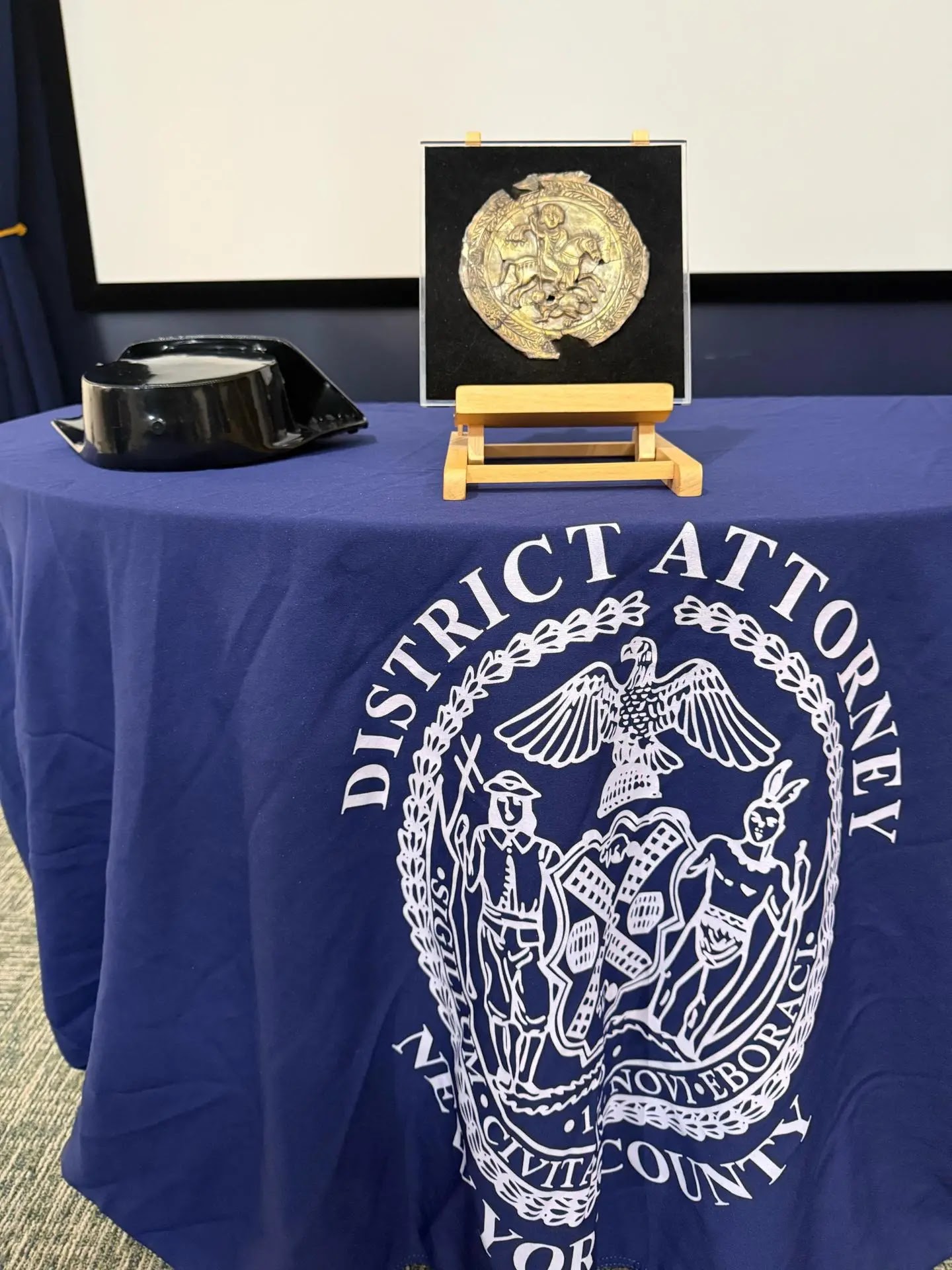
A Visigothic silver medallion, dating between the 5th and 7th century CE and depicting the Corinthian hero of Greek mythology Bellerophon on horseback, slaying a Chimera, has been formally returned to Spain, following an international investigation involving Spanish and U.S. authorities.

The artefact, measuring 13.7 centimeters in diameter, was discovered by a local metal detectorist in the municipality of Peraleda de la Mata, in Cáceres, Spain in 2007.  The individual who unearthed the piece initially reported the find to the regional government of Extremadura and even took a photograph of it still freshly covered in dirt.  However, soon after, the individual withdrew the medallion from the market, refused to cooperate with authorities, and its whereabouts became unknown.

What followed was a series of events that eventually resulted in the Spanish Civil Guard’s Central Operational Unit (UCO), U.S. Homeland Security Investigations (HSI) and the New York District Attorney's Office to formally lead to the object's recovery. 

Sometime after its disappearance, according to the New York District Attorney's Office, the medallion surfaced in the possession of the Barcelona-based antiquities dealer Félix Cervera Bea of Galería F. Cervera.   After that, it was smuggled out of Spain and purchased by Geneva's based Phoenix Ancient Art, where it was circulated publicly to international buyers. 

By 2010, the object was published, in a cleaned and restored state, in a Phoenix Ancient Art catalogue which listed the object with the following provenance: 

Ex Spanish Private Collection, collected ca. 1960, 

While vague provenance omitting a Barcelona dealer is not unusual in the art world, the date given for the purported Spanish collection ownership is completely incongruent to the one recorded with the authorities in the Spanish municipality.  Who, or what, if anything, was provided to Hicham and Ali Aboutaam to seemingly justify this false collection pedigree has not been publicly disclosed. 

By at least 2021,  the medallion had also been published to the Phoenix Ancient Art's website, where the dealers in question advertised an asking price of $210,000.   

The provenance on the webpage again did not match the discovery date of this piece in Spain, and instead stated:

Art market, prior to 1960;
Ex-Spanish private collection, collected ca. 1960

By 2022, the medallion had been featured in an academic article written by Cesáreo Pérez González and Eusebio Dohijo.  This article was published in the academic journal Oppidum, and reconfirmed that the unique Visigothic medallion was in the possession of the New York-Swiss ancient art dealers, and again noting that the artefact came from a private collection.  

The publication of this article came to the attention of the Dirección General de Bibliotecas, Archivos y Patrimonio Cultural of Extremadura who in turn alerted the Spanish Civil Guard’s UCO, a specialised division within the Guardia Civil responsible for the investigation and prosecution of the most serious forms of crime and organised crime.  The GC then reached out to US law enforcement.

When questioned as part of this case, Phoenix Ancient Art provided an invoice linking the silver medallion to the Catalan dealer, however, Spanish officials noted that no export permit had ever been requested or obtained for the object then being offered for purchase through the New York gallery.  Under Spanish law, artefacts removed from the country without a valid permit automatically become the property of the Spanish State. 

As a result of the following international investigation, involving the Spanish government, the Federal Bureau of Investigation (FBI), U.S. Homeland Security Investigations (HSI), the New York District Attorney's Office - Manhattan's Antiquities Trafficking Unit, and the Guardia Civil UCO Historical Heritage section, the owners of Phoenix Ancient Art agreed to voluntarily relinquish the artefact, indicating in doing so that they had purchased it as part of an "old collection of Spanish art."

On March 21, 2025, after 18 years, U.S. authorities officially handed over the long lost medallion to their Spanish counterparts, in a ceremony in New York.  On hand were Captain Juan José Águila, head of the Historical Heritage section of the UCO, Colonel Matthew Bogdanos, head of the Antiquities Trafficking Unit of the New York District Attorney’s Office, and Marta de Blas, Consul General of Spain in New York.

The successful repatriation of the Visigothic medallion marks another milestone in the ongoing efforts by Spanish and international authorities to combat the illicit trade of cultural artefacts and to return stolen heritage to its rightful place.  The case also serves as an example of just how long it takes for smuggled artefacts to be identified and that information relayed onward to the right authorities who can work towards restitution.  It also shows how an object's true origins can be obscured by vague provenance statements which give no hints to unweary buyers that the piece they are considering purchasing, may have left its country of origin in contravention of the national law. 

When looted artefacts like this one do resurface—whether in a gallery, auction house, or academic publication—identifying them requires the expertise of scholars, investigators, and cultural heritage officials.  Their recovery is therefore rarely straightforward, and often demands a coordinated effort between law enforcement agencies, government authorities, and vigilant researchers across multiple countries who are often the first to spot an illicitly exported piece in circulation. 

This case also underscores the immense challenge it takes to monitoring countless sales catalogues, websites, and scholarly publications in the search for artefacts that have been illegally removed, especially when their collection history has been falsified along the way. 

NB:  This article has been updated on 25 March 2025 with facts released in the official New York District Attorney's Office - Manhattan press release on this restitution. 

September 1, 2024

Phoenix Ancient Art: A Summer of Legal Entanglements and Tax Showdowns


ARCA summers are pretty busy as each year.  Since 2009, the Association has hosted its multi-course Postgraduate Certificate Program in Art Crime and Cultural heritage which often means posting new developments in the art and antiquities crime sphere slow while we turn our attention towards trainees.  Now that the 13th edition of this annual PG Cert has concluded, we can take time to reflect on some of the summer's more interesting art and antiquities stories, two which involve the ancient art gallery, Phoenix Ancient Art.

More pieces, More Accusations

Back on the 15th of May, Gotham City, a French-speaking Swiss news website that focuses on white-collar crime reported that Ali Aboutaam, the Geneva-based ancient art dealer was again in hot water with the public prosecutor's office.  Despite his previous conviction in January 2023, where he received an 18-month suspended prison sentence,  Ali Aboutaam is again the focus of a new Swiss investigation.

According to the Geneva public prosecutor's office, Ali is alleged to have possessed two suspect alabaster (brucite) statues, representing a man and a woman, while, according to Gotham's reporting, he “knew that these cultural properties had been illicitly acquired during illegal excavations in Yemen”.  Assessed by art historians, at least one of the small statues is believed to come from an area located in the southern Yemeni plateau known for the immense Himyarite Kingdom .  The area is home to a large necropolis, Shuka, which dates to the 1st-3rd centuries CE and has been the focus of looting in varying periods.

Dat-Hamin Stele
This is not the first time that Phoenix Ancient Art has handled suspect South Arabian artefacts from this war-torn country in the MENA Region.  In 2002, its New York affiliate consigned a third-century CE alabaster stele depicting the fertility goddess Dat-Hamin for auction at Sotheby’s New York.  In that instance, the gallery's owners, brothers Ali and Hicham Aboutaam, had told the auction house that the piece came from a private English collection.

In their research to prepare for their upcoming auction, Sotheby's staff discovered that the stele had been photographed and documented as a part of the Aden Museum's collection in Yemen.  The artefact had been looted in July 1994 during what is referred to as the Summer War, a civil war fought between the two Yemeni forces of the pro-union northern and the socialist separatist southern Yemeni states and their various supporters.  Relinquished by the dealers, U.S. Immigration and Customs Enforcement (ICE) ultimately seized the stele in September 2003, and the stela was officially signed over to the Yemeni ambassador in December 2004.

Following that civil war, Yemen implemented wider legal protections for its cultural heritage, although instability resulting from the present-day civil war continues to make enforcement difficult.  Law Number 21 of 1994 on Antiquities, as amended by Law Number 8 of 1997, is the primary law governing ancient sites and objects in the country.  

This law defines Yemen's “archaeological” materials; vests their ownership in the State, and controls their protection, conservation, restoration, and study.  It addresses aspects of ownership, permissions and obligations for archaeological work, introduces penalties for the illegal trade, and sets duties and guidelines on how to deal with discovered and excavated objects.  

As such, it will be interesting to evaluate what documents Phoenix possesses in support of their circulation of these two objects in Switzerland, which are presently of interest to that country's public prosecutor. 

Moving on to Taxes...

On 18 July 2024 Switzerland's Bundesgericht, the country's Federal Supreme Court in Lucerne issued several ruling impacting Ali Aboutaam.  Judgments 9C_107, 9C_184, 9C_187 and 203/2023 of 18 July 2024, issued by Federal Judges Thomas Stadelmann as the Presiding Judge, along with Judges Margit Moser-Szeless and Michael Beusch, rejected a series of complex appeals, made through the art dealer's attorneys, concerning outstanding tax assessments in relation to the importation of a group of antiquities, some housed outside the gallery and outside the Ports Francs et Entrepôts de Genève. 

In rejecting Aboutaam's appeals, the higher court's final rulings reaffirms that the Swiss-based brother has to pay approximately 3.5 million Swiss francs ($4,125,444.82) in outstanding value-added tax (VAT), as assessed by the Bundesamt für Zoll und Grenzsicherheit (Federal Customs Administration) and largely affirmed by the Federal Administrative Court.  Ali was also ordered to pay late interest payments totalling approximately 900,000 Swiss francs (another $1,060,995.36).

In November 2021, Aboutaam had originally handed a SFr 1.6m fine via Swiss customs, including the costs of the proceedings.  The tax authorities came after the antiquities dealer in that instance after Phoenix Ancient Art imported 37 million Swiss francs worth of antiquities into Switzerland between 2010 and 2017, but without paying the applicable VAT. 

The high court's judges based July's decions on various elements confirmed within the Aboutaam's case files.  First, they noted that some of the artefacts had been stored and displayed within Ali Aboutaam's private home for an average period of between the end of 2012 and 28 February 2017, the date that his home was searched pursuant to two search and seizure orders, one issued by the Geneva Prosecutor and one issued by the Federal Customs Administration of the Swiss Confederation.  That search occurred in relation to a Swiss investigation into the movements of antiquities of suspicious provenance, or chain of title, or for being imported and exported potentially in violation of Swiss law governing cultural property.  

In issuing their taxation decisions, the Swiss high court recalled "that according to art. 30 para. 1 of the Federal Ordinance of 1 November 2006 on customs (OD; RS 631.01; cf.nature. 9 al. 1 and 2 LD), goods for temporary admission into the customs territory are admitted duty-free if they are the property of a person having his registered office or domicile outside the customs territory and if they are used by such a person (let. a), if they can be identified with certainty (let. b), if the admission lasts for a maximum of two years (let. c) and if they are re-exported in the same state, the use is not deemed to be a change (let. d). The procedure for temporary admission is provided for in Articles 162 to 164 OD." 

In rejecting Aboutaams tax-related appeals, the ruling judges and the court affirmed that the Swiss-based dealer had misused the relocation procedure, which allows goods intended for resale abroad to be exempt from import tax, by instead keeping some of these items for personal use.


Dib is the business partner of Hamburg-based dealer of Egyptian art Serop Simonian who was later arrested in Hamburg by German police on suspicion of art trafficking in August 2020 and released after only five weeks behind bars.  Subject to a European Arrest Warrant, Dib was then taken into custody by French authorities on 22 March 2022.   Likewise his business partner Serop, having surrendered in Germany, was extradited to France, where he too has been indicted on 15 September 2023 on charges of fraud and organised gang money laundering as well as for criminal association. 

Fairs, Retirement, Coins, and Wine

Despite these woes, over the summer Phoenix Ancient Art participated in the UK's annual Treasure House fair from 27 June 2024 through 2 July 2024.  When interviewed, Hicham Aboutaam, says that his brother retired two years ago from Phoenix Anicent Art S.A., “to focus on the establishment of a foundation”.  Michael Hedqvist, is now listed as MD/Chief Operating Officer (directeur) of the Swiss gallery.  Ali's own website, aliaboutaam.com, now has a page which states that the Geneva dealer is "Currently developing a collection of ancient Greek and Roman coins and rare wines. Reach out if that sounds interesting to you."   

From the 13,408 likes on the Instagram post at the top of this blog post, it doesn't seem like his social followers are overly perturbed by his legal entanglements. 

By:  Lynda Albertson

January 11, 2023

Not surprisingly, and despite all of his protestations earlier, Ali Aboutaam has been convicted.


In a hearing that took less than an hour at the Geneva police court, Ali Aboutaam, the owner of the Geneva gallery Phoenix Ancient Art SA has been sentenced by the Swiss authorities.  Following on a complex and multi-year criminal and procedural investigation by officers and analysts with Switzerland's customs and anti-fraud divisions, working with the Geneva Public Prosecutor's Office, the Swiss-based merchant has been found guilty of forgery of titles.  A misdemeanour under Swiss law on the transfer of cultural property, his admissions come with an 18-month suspended prison sentence, three years probation and requiring him to pay procedural costs totalling 450,000 francs or approximately €454,410.

The courts also confirmed the seizure of 42 artefacts, confiscated due to their illicit origin which will be devolved to the Federal Office of Culture.  Several dozen other antiquities will be returned to the countries of origin.

Aboutaam's conviction and sentencing comes in response to a conspiracy which proved that the art dealer, with the help of accomplices, produced false certificates of provenance in relation to ancient art objects in circulation. Aboutaam was also found guilty of having knowingly paid at least one accomplice, who sourced antiquities from illicit excavations in various countries of the Middle East.

A statement extracted from the Swiss indictment read: 
"Ali Aboutaam knew or must have assumed that they had been wrongfully acquired". 

This particular Swiss investigation dates back to 20 December 2016 when around 5:10 p.m., at around 17:10 hours, when arriving from France by car, a Swiss border patrol officer stopped a grey Land Rover vehicle, registration No. GE777994 registered to the company Phoenix Ancient Art SA, rue Verdaine 6 & 1204 Geneva at the Veyrier border checkpoint. The car had been driven by Ali Aboutaam's driver and was transporting then-Germany based antiquities dealer Roben Galel Dib as a passenger. 

The testimony of the two persons revealed that Dib was in possession of an antique oil lamp, which neither the driver, nor the purported owner of the lamp, were able to provide documentation for proving the object’s provenance to the officers’ satisfaction.  Dib told authorities he was coming to Switzerland to "meet a girl" and that he was carrying the lamp with him because he had just had an appointment on this subject in Paris to have it restored. The object was sequestered, and an inspection of the car revealed the presence of 3 receipts for the rental of two storage units at the company Flexbox Self Storage, route du Nant-d'Avril 40 in 1214 Vernier, in the name of a conservator in Chanoy. 

Both the driver and Roben Dib were released after questioning around 2:00 AM the following morning, while on or around that same time surveillance footage of the storage warehouse listed on the receipts found in the car captured Ali Aboutaam’s wife, Biljana Aboutaam, the family's chauffeur and a housekeeper participating “several movements of merchandise".  Predicated on the foregoing, Swiss Customs Administration developed a “strong suspicion” that the warehouse was being used to store illegally imported art and antiquities. 

As is publicly now known, Roben Dib is the business partner of Hamburg-based dealer of Egyptian art Serop Simonian.  Dib was arrested in Hamburg by German police on suspicion of art trafficking in August 2020 and released after only five weeks behind bars.  

Subject to a European Arrest Warrant, Dib was then rearrested in Paris, France on 22 March 2022 after traveling there to discuss charges related to dealing in illegally trafficked Egyptian antiquities with French authorities.  

Both Dib and Simonian have been tied to million dollar illicit antiquities which have made their way (illegally) into the Metropolitan Museum of Art, the Louvre Abu Dhabi, and museum and private collections throughout the world on the basis of false provenance documentation, a subject which has been covered with frequency on this blog.  

In January 2016, a 3rd millennium BCE, alabaster plaque was displayed at the European art fair BRAFA after first passing through Port Franc, the free port of Geneva to Inanna Art Services, a subsidiary of Phoenix Ancient Art.  This artefact, according to a qualified Syrian archaeologist, likely came from the ancient Mesopotamian city of Mari.  This artefact was confiscated following an inspection operation, carried out by the Belgian Federal Public Service Economy (French: SPF Économie, Dutch: FOD Economie) along with a marble table in the context of a suspicion of illicit trafficking in antiquities. 


The plaque was first identified in the Aboutaam's Phoenix Ancient Art 2012 - Crystal IV catalogue, which listed the 39.5 cm 3rd millennium BCE plaque with an image of ritual worship as having a provenance of: 

"Ex Elie Bustros Collection, Beirut, 1950s-1960s"

implying that the artefact may have come from the Beirut dealer Elias (Elie) Bustros, purportedly active from at least the 1930s through by some records the 1980s.   

It should be noted that in addition to its Ottoman Empire laws an antiquities, the Syrian Republic's Antiquities Law, Decree No. 222, was enacted in 1963.  That law vested ownership of all antiquities in the State and prohibited the sale or transfer of antiquities without governmental approval. 

This is not, however, the only incidence where "Ex-Elie Bustros Collection" has been used in connection with an artefact handled by Phoenix Ancient Art.


Provenance:
Elias Bustros, Beruit 1950’s-1983;
By descent, 1983-1986?;
(Gawain McKinley, England, on behalf of Selim Dere and Sleiman Aboutaam, 1986)

Selim Dere is the owner of a New York antiquities gallery, Fortuna Fine Arts where Manhattan authorities executed a seizure warrant in June 2018. Erdal Dere (the son of Aysel Dere and Selim Dere), was indicted in the US indicted in relation to a conspiracy to defraud buyers and brokers in the antiquities market with the use of false provenance documentation. 

The Belgian identifications resulted in a separate four-year investigation overseen by the Belgian federal prosecutor's office into the activities of the Aboutaam brothers, who opened a branch of Phoenix Ancient Art in the city of Brussel's Sablon in 2017.  This branch was subject to police raids in 2019 ordered by Judge Michael Claise. 

By June 2021, a Lebanese intermediary of Phoenix Ancient Art had already been condemned by the Geneva public prosecutor for having imported archaeological objects looted in the Middle East.  This individual was identified as having travelled to Geneva four or five times a year, for four years, to deliver ancient objects to Ali Aboutaam. Arrested in Romania, he was extradited at the request of the Geneva public prosecutor's office.

That same year, in November 2021, Ali Aboutaam was handed a 1.6 million francs fine via Swiss customs, including the costs of the proceedings. The tax authorities came after the dealer in this instance for having imported 37 million francs worth of antiquities into Switzerland between 2010 and 2017 without paying the applicable VAT. 

Which brings us back to the present, the Swiss indictment, accepted by Ali Aboutaam within the framework of a simplified procedure, acknowledges the following, verbatim:

"Ali Aboutaam, in his capacity as administrator of Phoenix Ancient Art SA, has asked art experts, or has asked employees of Phoenix Ancient Art SA to obtain from art experts: produce and/or sign false invoices; and/or produce or cause others to produce documents indicating source that are contrary to reality, sometimes contained directly in invoices; and/or provide untrue source indications for use by others."

In another section of the indictment, Aboutaam agrees that the falsification  of provenance documentation was done to launder the artworks, giving them: 

"a pedigree aimed at dispelling suspicion of illicit provenance and/or to facilitate their customs transfer with a view to their sale on the art market through Phoenix Ancient Art SA, Tanis Antiquities LTB and Inanna Art Services SA, i.e. companies of which Ali Aboutaam has Control."

The mention of Tanis is significant.  It helps conceptualise the range of years where this shell company has been linked to questionable transactions and laundered antiquities.  In 13 December 2003 Hicham Aboutaam, Ali's brother, was arrested in the United States and charged with smuggling the silver ceremonial drinking vessel known as a rhyton into the United States from Iran and falsely claiming that it came from Syria.  That 2003 government complaint identified the gallery’s affiliate office in New York as "the Bloomfield Collection" and informed that the invoice for the artefact, declaring Syria as country of origin was issued by Tanis Antiquities, Ltd.  

Tanis Antiquities, Ltd comes up again very recently in the ongoing important French investigation involving materials sold to the Louvre Abu Dhabi.  As reported by the French newspaper Liberation, French investigators discovered that Jean-François Charnier's sister, Marie-Christine Charnier, had received money from the Aboutaam family via an account opened in a Moroccan bank, paid from the offshore structure controlled by the merchants, again, Tanis Antiquities Ltd., based in Saint Vincent and the Grenadines.  

The legal representative for Tanis Antiquities Ltd is, a Canadian citizen, of Lebanese origin, resident of Geneva, Ali Aboutaam.

I will close this article by mentioning that this is not the first occasion where the Aboutaam family, or Ali personally, has had run ins with legal authorities for their involvement  in the circulation of suspect artefacts originating from varying jurisdictions regarding trafficked objects from the Middle East.  In April 2004 Ali Aboutaam was tried in absentia in an Egyptian court and pronounced guilty and sentenced in absentia to 15 years in prison in a long-running trafficking ring that had smuggled Egyptian artefacts through Switzerland to Western dealers and galleries.  That investigation resulted in the convictions of 25 defendants, including several high-ranking Egyptian police and government officials and nine foreigners. 

March 26, 2019

Court dismisses Hicham Aboutaam complaint against Dow Jones & Company's for Benoit Faucon and Georgi Kantchev's Wall Street Journal article discussing the family's ancient art business


In July 2017 antiquities dealer Hicham Aboutaam sued the Rupert Murdoch-owned Wall Street Journal’s corporate parent Dow Jones & Co., in New York County Supreme Court over an article titled “Prominent Art Family Entangled in ISIS Antiquities-Looting Investigations” which was published in the Wall Street Journal on May 31, 2017 claiming his family's business and reputation had been damaged by the article written by WSJ reporters Benoit Faucon and Georgi Kantchev .  The journalists, who shared a byline on the article, were not named as defendants in the lawsuit.

In the filed 30 page complaint, Hicham Aboutaam as Plaintiff requested unspecified damages based on claims of libel and defamation.

In a ruling before the New York State Supreme Court, New York County, dated March 22, 2019 and filed today, Honorable Robert D. Kalish J.S.C granted the Motion of the Defendant, Dow Jones & Company, dismissing the complaint in its entirety.  The Court ruled that "the thrust of the article was that Plaintiff's family –"one of the most storied families in the international antiquities business"– is being investigated and scrutinized about the selling of looted antiquities and whether the family business is dealing in items looted by ISIS and then sold through dealers like Plaintiff and his brother Ali."  

In making his ruling, Kalish added:

"By no means does this Court's decision seek to undermine the serious consequences that sometimes follow a news organization's decision to publish details of an ongoing investigation by law enforcement.  However, the decision to truthfully report on an ongoing law enforcement investigation is ultimately a question of journalistic judgement.  Unless the reporting on such an investigation is materially false or affirmatively creates false suggestions, it is not for the courts to question an editorial judgement to report on an ongoing investigation." 

As the Court dismissed the plaintiff's causes of action for libel and defamation by implication, the Court did not address the Defendant's, Dow Jones & Co., argument that the Plaintiff failed to plead actual malice with regard to both causes of action.

In an email exchange regarding the Court's decision, Steve Severinghaus, Senior Director of Communications with Dow Jones stated "We are gratified by the court's decision to dismiss Mr. Aboutaam’s lawsuit against Dow Jones."

Suspect antiquities, traceable to ancient art sales through Hicham and Ali Aboutaam's companies have been written about with recurring frequency on the Association's blog.

It should be remembered that Hicham Aboutaam was arrested in 2003 for smuggling a looted ceremonial drinking vessel from Iran into the US, claiming that it had come from Syria.  Hicham pled guilty to the charges in 2004, paid a fine, and the vessel was returned to the Iranian authorities. As a result of that incident, Hicham Aboutaam stated that his conviction stemmed from a "lapse in judgment."

In the past, the Egyptian authorities accused Ali Aboutaam of involvement with Tarek El-Suesy (al-Seweissi), who was arrested in 2003 under Egypt’s patrimony law for illegal export of antiquities. Ali Aboutaam was tried in absentia, pronounced guilty and was fined, and sentenced to 15 years in prison in the Egyptian court in April 2004 after he was accused of smuggling artefacts from Egypt to Switzerland.  To date, Ali Aboutaam has not served any of the Egyptian sentence. 

The Aboutaams voluntarily repatriated 251 Antiquities valued at $2.7 Million to the State of Italy in May 2009 when the objects were tied to one of Italy's most notorious smuggling rings.


By Lynda Albertson

January 9, 2018

List of 6 (additional) objects and warrant details on objects seized from Phoenix Ancient Art by New York State District Attorney's Office

Copy of search warrant executed at Phoenix Ancient Art in New York can be viewed here.

On Friday, January 5, 2018, Manhattan district attorney, Cyrus R. Vance Jr., and assistant district attorney Matthew Bogdanos also initiated seizures at Phoenix Ancient Art, New York, in connection with an investigation into the purchase of illicitly trafficked antiquities.

The second-generation family business Phoenix Ancient Art has galleries in New York and Geneva. The business was founded by Sleiman Aboutaam in 1968 and is now operated by his sons, Hicham and Ali Aboutaam.  The Aboutaam name comes up frequently on ARCA's blog. 

The search warrants executed at 47 East 66th street resulted in the seizure of the following objects:


A) Rhodian Seated Monkey with missing arms (the “Seated Monkey”)
Period: dating to 580-550 BCE
Measurement: 5.25 inches tall
Valued at: $150,000


B) Attic Female Head Flask (the Female Head Flask”)
Period: dating to 500-490 BCE
Measurement: 5.5 inches tall by 2 inches wide.
Valued at: $80,000


C) Ionian figural vessel representing a Siren (the”Siren Vessel”)
Period: dating to 500-525 BCE
Measurement: 4 inches tall by 4.5 inches wide.
Valued at: $35,000


D) Teano Ware figural representing a Dove (the “Dove”).
Period: dating to 330-300 BCE
Measurement: 4.5 inches tall by 2.5 inches wide.
Valued at: $25,000


E) Corinthian figural representing a Ram (the “Ram”) painted with black dots.
Period: dating to the 6th century BCE
Measurement: 2 1/8 inches tall by 3 1/8 inches wide
Valued at: $20,000


F) Corinthian figural representing a Sea-Serpent with a human torso and head of a man (the “Sea-Serpent”) painted with black dots.
Period: dating to the 6th century BCE
Measurement: 4.5 inches tall by 1.75 inches wide
Valued at: $140,000

In addition to the antiquities, as with the seizures which were executed at Michael Steinhardt's residence and office, the DA's seizure warrant called for the seizure of:

any and all documentation or other evidence related to the appraisal, consignment, sale, possession, transportation, shipping, provenance, importation, exportation, restoration, marketing, or insurance of the listed antiquities, including but not limited to appraisals, insurance policies, agreements, leases, contracts, emails, letters, invoices, receipts, documents, handwritten notes, internal memoranda, photographs, recordings, financial records, address books, date books, calendars, and personal papers;

found in the premises and that constitutes evidence, and tends to demonstrate that the crime of Criminal Possession of Stolen Property in the Second Degree was committed.

List of 10 objects and warrant details on objects seized from Manhattan billionaire Michael Steinhardt's home and offices by New York State District Attorney's Office

Copy of search warrant executed at the office of Michael Steinhardt can be viewed here.

Copy of search warrant executed at the New York apartment of Michael Steinhardt can be viewed here.

On Friday, January 5, 2018, in the early morning 6:00 am chill of New York, Manhattan district attorney, Cyrus R. Vance Jr., and assistant district attorney Matthew Bogdanos initiated seizures at the office and New York City residence of Michael Steinhardt in connection with an investigation into the purchase of illicitly trafficked antiquities. 

After a series of high-profile raids involving antiquities dealers and ancient art collections owned by private collectors, some of which have been displayed at the Metropolitan Museum of Art, the Manhattan District Attorney's office has shown their resolve in concentrating on deterring the trade in illegal antiquities.  

According to the TEFAF Art Market Report 2017, compiled each year by Dublin-based research and consulting firm Arts Economics, the U.S. represents 29.5% percent of the world’s art market.   Classical antiquities, such as those seized in this month's raids, represent a smaller portion of that figure.

Their Manhattan DA's work, and the collaboration of multiple, mostly unpaid advising research scholars, has resulted in significant repatriations to countries where predation is a problem, including most recently a 4th century B.C.E marble torso, a 6th century BC statue of a Calf Bearer and a Marble head of a bull stolen during the 1970s from Lebanon during the that country's Civil War.

In total since 2012, the Manhattan DA's office has recovered several thousand trafficked antiquities collectively valued at more than $150 million.

The search warrants executed at Michael Steinhardt's home and office resulted in the seizure of the following objects:


A) Greek Attic Monumental White-Ground Lekythos (the “White-Ground Lekythos”), used to pour ritual oils at funeral ceremonies.  Vessel attributed to the Triglyph Painter and depicts funerary related iconography featuring a woman and a youth.  
Period: approximately 420 BCE.  
Measurement: 18 inches tall by 4.5 inches wide.  
Purchased for $380,000 in 2006. 


B) Apulian Rhyton for libations (the “Apulian African Head Flask”) in the shape of the head of an African.  
Period: dating to the 4th century BCE 
Measurement: 7.5 inches tall by 3 inches at base.  
Purchased for $130,000 in 2009. 


C) Italo - Corinthian pottery figural representing a duck with its head turned upwards (the “Italo-Corinthian Duck”). This style of Greek perfume holder flourished at Corinth during the Oriental period 
Period: dating to the 6th century BCE 
Measurement: 4 inches tall by 5.5 inches long by 2.5 wide. 
Purchased for $25,000 in 2011. 


D) Ionian sculpture figural representing a ram’s head (the “Ionian Ram’s Head”).
Period: dating to the 6th century BCE 
Measurement: 2.5 inches tall by 4.7 wide. 
Purchased for $70,000 in 2009. 


E) Attic Aryballos in the form of a Head of an African (the “Attic African Head Aryballos”).
Period: dating to the 5th century BCE 
Measurement: 4 inches tall.
Purchased for $150,000 on or about December 17, 2009.


F) Corinthian terracotta figural vessel representing a lion (the “Corinthian Lion Vessel”). This style of Greek perfume holder flourished at Corinth during the Oriental period 
Period: dating to 600-550 BCE
Measurement: 3.5 wide. 
Purchased for $25,000 on or about November 9, 2011.


G) Proto - Corinthian pottery figural representing an owl (the “Proto-Corinthian Owl”). This style of Greek perfume holder flourished at Corinth during the Oriental period 
Period: dating to 650-625 BCE
Measurement: 2 inches tall by 2.2 wide. 
Purchased for $120,000 on or about October 14, 2009.


H) Proto - Corinthian pottery figural representing a duck with its head turned backwards (the “Proto-Corinthian Duck”). This style of Greek perfume holder flourished at Corinth during the Oriental period 
Period: dating to 650-625 BCE
Measurement: 2 inches tall by 2.7 wide. 
Purchased for $130,000 on or about October 14, 2009.


I) Corinthian Bull’s Head (the “Corinthian Bull’s Head”). 
Period: dating to 580 BCE
Measurement: 2.2 inches tall by 2.8 wide. 
Purchased for $60,000 on or about October 14, 2009.


j) Bronze Handles (the “Bronze Handles”). 
Period: unknown
Measurement: 6.3 inches tall by 9.4 wide. 
Purchased for $40,000 in 1996.

In addition to the antiquities the DA's seizure warrant called for the seizure of:

any and all computers, as defined by Penal Law  § 156.00(1) or electronic storage devises capable of storing any of the above described property as well as their components and accessories, including, but not limited to, cords, monitors, keyboards, software, programs, disks, zip drives, flash drives, thumb drives, and/or hard drives;

any and all books, manuals, guides, or other documents containing Information about the operation and ownership of a computer, cellular telephone, camera, video recorder, video game console or other electronic storage device present in the target location, including, but not limited to, computer cellular telephone and software user manual;

any and all documentation or other evidence related to the appraisal, consignment, sale, possession, transportation, shipping, provenance, importation, exportation, restoration, marketing, or insurance of the listed antiquities, including but not limited to appraisals, insurance policies, agreements, leases, contracts, emails, letters, invoices, receipts, documents, handwritten notes, internal memoranda, photographs, recordings, financial records, address books, date books, calendars, personal papers, video footage, and stored electronic communications or data, whether recorded in physical documents are stored digitally as information and images contained in computer disks, DC or DVD ROMs, USB drives and hard drives that may be found at the target premises;

any and all documentation and non-privileged communication which tend to establish Michael Steinhardt’s intent to commit the crime of Criminal Possession of Stolen Property in the First Degree per which tend to establish his state of mind prior to and during the commission of said crime;

any and all documentation and non-privileged communication which tend to establish (directly or indirectly) Michael Steinhardt’s knowledge that Steinhardt has committed the crime of Criminal Possession of Stolen Property in the First Degree namely the possession of stolen or illicitly trafficked antiquities;

any and all documentation and non-privileged communication which tend to establish that Michael Steinhardt is a person in the business of buying, selling, or otherwise dealing in property, specifically art and antiquities;

any and all documentation or non-privileged communications indicative of or pertaining to inquiries made by Michael Steinhardt, or the lack thereof, that the persons are entities from whom he obtained any art or antiquities had the legal right to possess said items;

any and all documentation and non-privileged communication which contain any references to he purchase, and/or sale, and/or possession of looted, stolen, or illegally trafficked antiquities;

any and all documentation tending to identify, and/or connect Michael Steinhardt with accomplices, co-conspirators, possible accomplices and/or witnesses to the crime of Criminal Possession of Stolen Property in the First Degree;

The aforementioned white collar crimes or theft offenses mentioned in the New York search warrant are described below: 

Criminal Possession of Stolen Property in First Degree – NY Panel Law 165.54

A person is found guilty of criminal possession of stolen property in the first degree when he knowingly possesses stolen property, with intent to benefit himself or a person other than an owner thereof or to impede the recovery by an owner, and when the value of the value of the stolen property exceeds $1,000,000.

Criminal Possession of Stolen Property in Second Degree – NY Penal Law 165.52

A person is found guilty of criminal possession of stolen property in the first degree when he knowingly possesses stolen property, with intent to benefit himself or a person other than an owner thereof or to impede the recovery by an owner, and when the value of the value of the stolen property exceeds $50,000.

There are four legal presumptions associated with New York Penal Law 165.55, the following is the most likely relevant one in this case:


  1. A person who knowingly possesses stolen property is presumed to possess it with intent to benefit himself or a person other than an owner thereof or to impede the recovery by an owner thereof. This presumption is often referred to as recent exclusive possession.” There has been a tremendous body of case law addressing this presumption which argues for the position that if an accused has had the exclusive possession of stolen property after a theft crime has been perpetrated and there is evidence or circumstances which show an inability to explain where the property came from, a negative inference may in fact be drawn. That inference being that there is a strong likelihood that the accused knew that the property he or she possessed was stolen.
By:  Lynda Albertson