Blog Subscription via Follow.it

Showing posts with label tombaroli. Show all posts

November 25, 2025

Italian Authorities Arrest 55 Suspects in Major Archaeological Looting Probe in Sicily


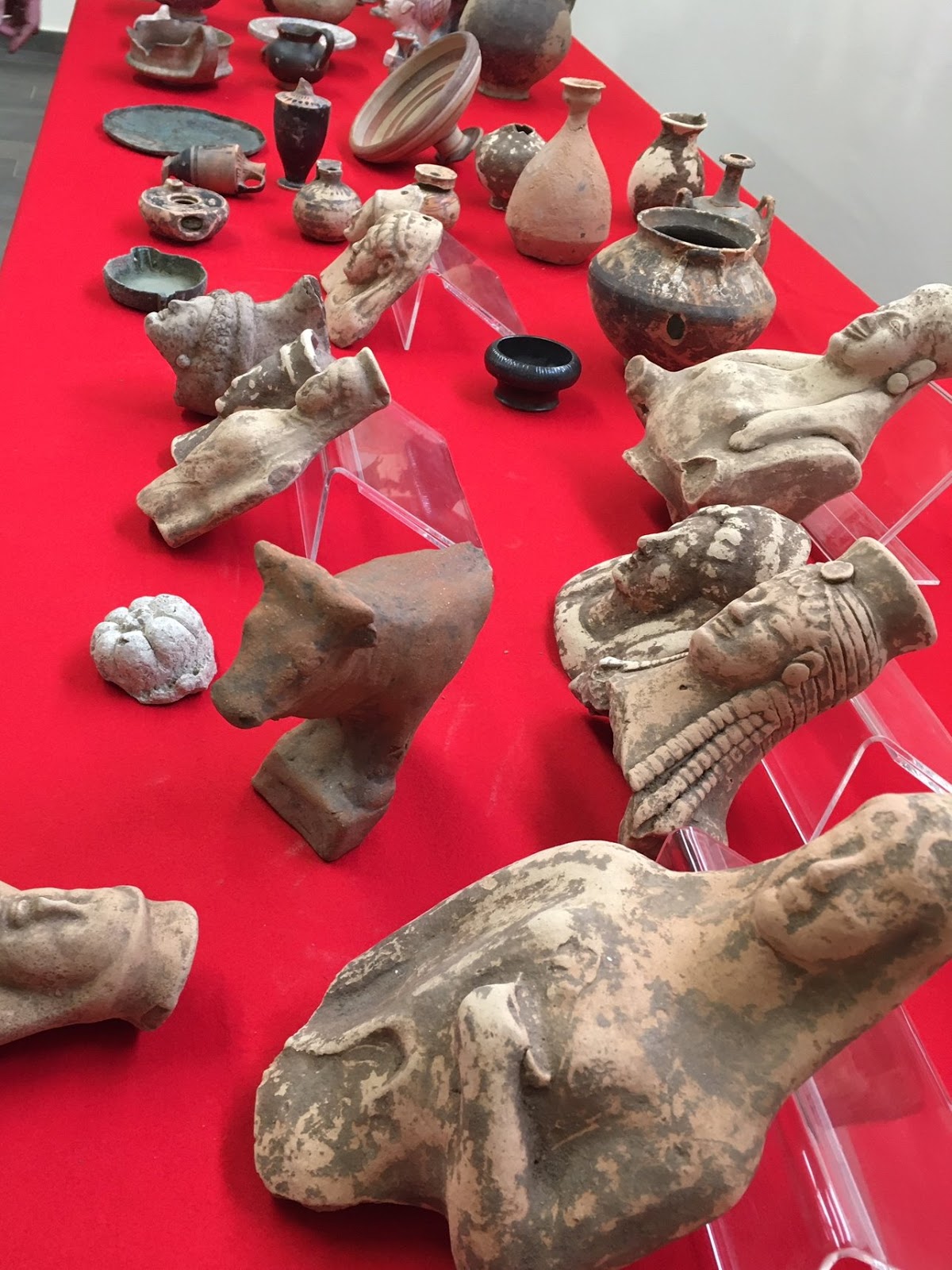
In a major operation targeting two antiquities-trafficking networks, the Palermo unit of the Carabinieri’s Nucleo Tutela del Patrimonio Culturale (TPC), under coordination by the Catania Deputy Prosecutor, Fabio Scavone, has uncovered evidence of extensive clandestine excavations at more than twenty archaeological sites in Sicily and an additional site in Roccelletta di Borgia, Calabria.  These incidences, carried out between 2021 and 2023. resulted in the systematic removal of a substantial number of cultural artefacts, which were then smuggled out of Italy and laundered onto the licit ancient art market.

According to the reconstruction presented by the Italian court magistrates, coordinated by the deputy prosecutor Fabio Scavone and the substitute Giovanni Gullo, a total of 74 suspects have been identified in this large transnational investigation.  All are alleged to have been part of two criminal networks capable of managing the entire clandestine supply chain: from the sourcing of objects through illegal excavation by grave robbers through intermediary smugglers and on to the international sale of the  archaeological finds outside of Italy in contravention of the country's cultural property laws. 

Overall, the Prosecutor's Office examined a total of 292 incidents documented in a 1,700-page crime report produced by the Carabinieri of the Palermo Cultural Heritage Protection Unit.  Having reviewed the evidence surrounding the case, the prosecutor asked for precautionary measures for 55 of the identified suspects, individuals believed to have been directly involved in the sourcing and/or trafficking of archaeological material illegally excavated in Italy and later moved into markets in Europe and the United Kingdom. 

Of these, prosecutors have asked for the pre-trial detention for 12 of the suspects, as well as house arrest pending trial for another 35, and lighter reporting obligations for eight other individuals, pending the resolution of their individual cases through the courts.

The list of suspects released publicly with pretrial precautionary measures or incarceration are:
Maria Lisa Aloi
Filippo Asero
Salvatore Romano Benfatto
Giuseppe Bertolami
Vincenzo Boccadifuoco
Salvatore Bonaventura
Giuseppe Buceti
Filadelfo Calvagna
Salvatore Camonita
Giovanni Castro
Salvatore Cavallaro
Benedetto Chiara
Carmelo De Luca
Fortunata Di Dio
Giuseppe Di Mauro
Alfio Emmanuele
Giuseppe Esposito
Domenico Faranda
Gaetano Faranda
Emanuele Ferro
Vincenzo Filonardi
Filippo Franceschino
Mario Gagliano
Vittorio Emanuele Guzzetta Bongiovanni
Giuseppe Salvatore Insigna
Leandro Insolia
Massimiliano Insolia
Enrico Lo Verde
Massimo Lucca
Settimo Carmelo Minnella
Umberto Moruzzi
Adriano Nicotra
Michele Consolato Nicotra
Salvatore Palumbo
Andrea Panicotti
Gianfranco Paternò
Nicolò Petronio
Giuseppe Pezzino
Sergiu Ionica Pop
Antonio Portale
Simone Adriano Petrin
Alessandro Privitera
Giuseppe Rapisarda
Vincenzo Rau
Antonio Francesco Rotondo
Francesco Salvia
Santo Sambataro
Vito Spitaleri
Vito Stancanelli
Giuseppe Strano
Pietro Tomasello
Salvatore Tomasello (born 1957)
Salvatore Tomasello (born 1967),
Giuseppe Sebastian Viola
It should be noted that the individuals cited by the authorities and documented in this article are for now are simply under investigation and have not been convicted of any crime.  It is also important to remind our readers that there is a substantial and essential difference between being a suspect in an investigation and being adjudicated guilty in a court of law. 

Preliminary Investigations Judge Simona Ragazzi has scheduled hearings in relationship to this trafficking investigation for November 25-29.

According to the 1,700-page report related to this investigation, the Carabinieri utilised surveillance devices and analysed documents, and auctions held in various locations outside of Italy ultimately allowing them to reconstruct the entire chain of thesetwo lucrative trafficking rings which primariy struck sites around Paternò, a town in Catania near Mt. Etna, Kamarina in the Ragusa area, Himera in the Palermo area, Megara Hyblaea in the Syracuse area, and Scolacium in Roccelletta di Borgia in the Catanzaro area.    


Dense in detail the TPC report demonstrates that wire taps placed on the suspects phones revealed that some accomplices used code words to describe the tools of the illicit trade used in their looting activities as well the names of the sites they plundered.  Likewise, on occasion the accomplices lapsed into speaking frankly,  discussing individual artefacts, silver, and jewellery found during their clandestine excavations.

Italian investigators confirmed that many of the objects excavated from these locations made their way into the licit ancient coin markets in the UK and Germany via foreign intermediaries abroad.  In one of several documented incidences 46 ancient coins dating between the 5th and 3rd centuries BCE were sold in 2021 at a Munich auction house, where they brought in more than 42,000 euros.  Part of these assets were seized by the German judiciary, pursuant to a European judicial order issued by the Catania prosecutor's office.

A second grouping of coins chose a path to the UK and were laundered onto the London numismatic market by one suspect where 39 coins minted by the Greek colonies on Sicily including litrae, tetradrachms, denarii, and sestertii were reportedly sold on 7 October 2021, for a total of £88,590.00.

The scale of the arrests underscores not only the risks posed by organised heritage crime and transnational trafficking networks, but also a persistent and uncomfortable reality: despite decades of national awareness, strong legislation, and highly capable investigative units, Italy remains one of the world’s richest source countries for antiquities looting. Tomb raiders and illicit metal detectorists continue to plunder archaeological sites across Sicily, from Himera to Kamarina, Eraclea Minoa, Gela, and beyond, stripping the ground of artefacts valued anywhere from a few hundred euros to several thousand pounds, where they can easily be funnelled into the don't ask-don't tell international market accompanied by forged provenance documents.


By:  Lynda Albertson

October 15, 2024

Urban Tombaroli and Two Clandestine Excavations: Near the Villa at Oplontis and in Central Naples


The Carabinieri have uncovered a clandestine excavation in Torre Annunziata, believed to be aimed at looting artefacts from the renowned Villa A (“of Poppaea”) at Oplontis, an ancient luxurious Roman seaside villa located a short three kilometers away from the more famous archaeological site of Pompeii. The discovery was made during a coordinated operation led by the Carabinieri’s investigative unit from Torre Annunziata, with assistance from agents specialising in cultural heritage crimes. 

Map from Oplontis: Villa A (“of Poppaea”) at Torre Annunziata, Italy. Volume 1.
The Ancient Setting and Modern Rediscovery
by John R. Clarke and Nayla K. Muntasser

Acting on a tip-off, the Carabinieri officers raided a cellar on Corso Garibaldi, number 106, just one minute's walk from the historic villa.  There the investigators  found three partially collapsed but still accessible tunnels, all leading in the direction of the Villa of Poppea, with its striking wall paintings  The officers also found a striking number of tools used for the illicit excavation, as seen in the video below.  These included aerators, shoring materials used in the tunnels' development, and containers already filled with volcanic lapilli removed during the advancement of the digging operation.

The owner of the cellar, a 53-year-old local carpenter with no prior criminal record, has been charged with conducting illicit works under Article 169 of Italy’s cultural heritage code. 

Investigators believe the tunnels were dug with the intent of reaching and stealing artefacts from the archaeological site, a UNESCO World Heritage Site known for its exceptionally preserved frescoes and structures dating back to ancient Rome.

The Villa of Poppea is a significant part of the Oplontis site and has long been a target for tomb raiders due to its rich archaeological significance. Authorities are continuing their investigation, focusing on whether the carpenter was working alone or, given the abitious nature of materials found, as part of a larger network of artefact thieves.

Earlier this month, a similarly ambitious illicit excavation was uncovered in the heart of Naples.  There officers discovered the remains of an 11th century medieval church eight meters below street level, 2 km away from Naples central train station near Piazza Bovio. 

The raider in this instance is a local entrepreneur, digging directly under an existing palazzo.  Recovered at the scene, officers seized some 10,000 archaeological fragments from the Roman and medieval eras, believed to be from the suburban sector of the ancient Magna Graecia city of Neapolis, as well as 453 intact archaeological finds from the Roman era , including: red-figure craters, amphorae, terracotta lamps and pipes, as well as Roman and medieval coins.

The previously undiscovered church is said to be a rare example of medieval art of the 11th century, whose decoration are similar t the nearby Sacello di Sant'Aspreno. 

Both incidences highlight the significant challenges posed by urban illicit excavations for both law enforcement and cultural heritage protection.  These unauthorised digs, often conducted covertly beneath residential or commercial properties, not only pose safety hazards due to unstable tunnels and potential structural damage, but they also risk irreparable harm to the archaeological context of the site. 

In cities with rich histories like Cairo, Rome or Naples, contemporary city expansion has often built over ancient treasures, making it difficult to monitor such hidden operations.   Looters seeking valuable artefacts frequently destroy layers of history, removing items from their context and severing crucial links to the past.  This not only deprives the public of valuable cultural knowledge but also fuels the black market for antiquities, undermining legitimate efforts to preserve and study historical sites. 

The challenge for authorities is compounded by the difficulty of detecting these operations in densely populated areas, where excavations can go undetected for years, beneath seemingly ordinary locations.

November 18, 2019

Carabinieri, EUROPOL , EUROJUST investigation, code named: "Achea"

Image Credit:  Carabinieri TP
NOTE: This article has been updated after the conclusion of the press conference. 

Today at 10:30, the Carabinieri Provincial Command of Crotone, a port city in Calabria, southern Italy, and the region's Public Prosecutor held a press conference to announce the results of a multicountry operation into the illicit trafficking of antiquities which feeds the clandestine market for ancient art.  This after having carried out an order for the application of precautionary measures, issued by the Judge of the Crotone Court, at the request of the local Public Prosecutor who coordinated the investigations.

Begun in 2017 and carried out in coordination with EUROPOL and EUROJUST, the investigation, named "Achea" after the first Hellenic population, involved 350 officers from Italy, France, Germany, Serbia, and the United Kingdom working together to reconstruct an entire criminal chain of actors responsible for the illegal exportation of archaeological material from the areas around Crotone to market countries in Europe.

Image Credit:  Europol
Inside Italy, searches were carried out by the Carabinieri Provincial Commands of Bari, Benevento, Bolzano, Caserta, Catania, Catanzaro, Cosenza, Crotone, Ferrara, Frosinone, Latina, Matera, Milan, Perugia, Potenza, Ravenna, Reggio Calabria, Rome, Siena, Terni, Viterbo as well as with the support of the 8th Carabinieri Core of Vibo Valentia and the helicopter squadron "Cacciatori di Calabria".  Outside Italy's borders, additional searches were conducted by the French Central Police Office for the fight against the international traffic of Cultural Heritage (OCBC -  (Office central de lutte contre le trafic de biens culturels) in France, the German Bavarian LKA (Bayerisches Landeskriminalamt) in Germany, the Serbian Criminal Investigations Directorate in Serbia and the Metropolitan Police (New Scotland Yard) of London in the UK.  According to a EUROPOL statement the Europol Analysis Project FURTUM supported the investigation by coordinating information exchanges, holding operational meetings, preparing the action day and providing analytical support in Italy.

Image Credit:  Europol
The network of criminal actors included a structured group of tombaroli, fences and intermediaries involved in moving illicit antiquities from archaeological sites in and around Crotone, where one of the most important and best known sanctuaries of Magna Graecia is located.  Source locations preyed upon by the squad include the public archaeological sites of Apollo Aleo at Cirò Marina, Capo Colonna, Castiglione di Paludi in the Municipality of Paludi, as well as unmapped areas near Cosentino and Cerasello.  The looters also dug on private lands in the province of Crotone and Cosenza.

During the press conference, it was stated that the criminal group associated with this action appeared to be well organized and had an entrepreneurial approach to structuring their criminal association. As the result of surveillance and wiretaps law enforcement officers were able to determine the top management of the organization, who directed and controlled the activity of the lower members of the association.  They also determined who planned the individual shipments, identified the places of interest for plunder, and worked to prevent, or at least minimize the risk of detection by the police.

Image Credit:  Europol
In Italy searches were conducted against a total of 80 individuals.  In italy, two were taken into custody and 23 have others been reportedly placed under house arrest upon the request of the public prosecutor.  The coinvolved overseas have not been named. 


Held in Custody
Giorgio Salvatore Pucci, from Cirò Marina who was already named in a previous investigation. 
Alessandro Giovinazzi, from Scandale

Released under house arrest
Alfiero Angelucci, from Trevi
Antonio Camardo, from Pisticci,
Giuseppe Caputo,from Dugenta
Sebastiano Castagnino, from Petilia Policastro
Enrico Cocchi, from Castano Primo
Francesco Comito, from Rocca di Neto 
Simone Esposito, from Rocca di Neto
Giuseppe Gallo, from Strongoli
Raffaele Gualtieri, from Isola Capo Rizzuto 
Domenico Guareri, from Isola Capo Rizzuto
Vittorio Kuckiewicz, from Fermo
Franco Lanzi, a numismatic expert from Norcia
Leonardo Lecce from Crotone,
Raffaele Malena, from Cirò Marina, (also named in previous antiquities investigation)
Marco Godano Otranto, from Crotone,
Renato Peroni, from Magnago
Santo Perri, from Sersale
Vincenzo Petrocca, from Isola Capo Rizzuto,
Aldo Picozzi, from Castano Primo
Domenico Riolo, from Scandale
Dino Sprovieri from Cirò Marina

4 others unnamed individuals have been arrested are domiciled abroad

Initial reports state that some of the individuals involved in the criminal conspiracy communicated with one another using a codified language and in some cases accessed archaeological finds using a backhoe, drones, and sophisticated metal detectors from Minelab, despite the fact that the use of metal detectors is completely prohibited in Calabria.


Some of the artifacts recovered include terracotta vases and oil lamps, terracotta plates, fibulas and pieces of ancient jewelry, some dating to the IV and III century BCE.

Italy's Minister of Culture Dario Franceschini gave a statement regarding the investigation saying "Thanks to sophisticated investigative techniques and the collaboration of Europol and the competent foreign police forces, in Italy, France, the United Kingdom, Germany and Serbia, the Carabinieri Command for the Protection of Cultural Heritage has completed with a vast operation to counter the illicit trafficking of archaeological finds from Calabria to Northern Italy and abroad has been successful, recovering thousands of goods and seizing materials used for clandestine excavations, an operation that once again demonstrates the excellence of the Carabinieri Command which has been operating since 1969 in defense of the Italian cultural heritage."


Unfortunately this is not the first time Crotone has been the focal point of such a blitz.  From 2014 until January 2017 an investigation coordinated by the Public Prosecutor of Crotone through Procurator dott. Giuseppe Capoccia and the Deputy Dr. Luisiana Di Vittorio, and conducted by the Police of the Cultural Heritage Protection Center of Cosenza followed up on a number of clandestine excavations conducted in archaeological sites in the areas surrounding Crotone area. While that investigation also served to identify many of the actors of a diffuse and well-structured criminal association it seems that one group dismantled simply made room for another.


January 8, 2018

Venezuela has returned nearly 200 pre-Columbian stone and ceramic archaeological artifacts to Costa Rica

Image Credit: Ernesto Emilio Villegas Poljak,
Minister of Culture, Venezuela @VillegasPoljak
As a welcome start to 2018 repatriations, Venezuela has returned 196 pre-Columbian stone and ceramic archaeological artifacts to Costa Rica created by the indigenous cultures and peoples who once populated the Americas.

The pieces, some 96 crates in total, weighing in at a whopping 5,000 kilos, had been trafficked illegally.  The repatriated cargo includes two of the incredibly mysterious pre-Columbian spheres sculpted from gabbro, the coarse-grained equivalent of basalt, believed to have been created by the Diquís civilization, as well as pottery, vases, human figurines, zoomorphic ocarinas (musical instruments), and metates (grain-grinding stones).

The ancient cargo arrived to Port Moin in Limón, Costa Rica by boat on Tuesday, January 2, 2018 and concretized Guatemala's promise to return plundered goods, once part of a controversial private collector's extensive collection. 


Found deep in the jungles of Costa Rica, the Las Bolas petrospheres (literally "the balls") of the Diquís civilization date back to the Aguas Buenas Period (300–800 CE) and Chiriquí Period (800–1550 CE).  Some researchers believe the round stone balls, varying in size from a few centimeters to over two meters in diameter, may possibly have served as landmarks, though their exact significance remains uncertain. 

The Las Bolas were discovered in the 1930s when Companía Bananera de Costa Rica, a branch of the United Fruit Company, began clearing portions of the nutrient-rich jungle delta in preparation for banana cultivation.  They are unique to Costa Rica. 


In October 2016, La Nacion published a special report titled "Memoria Robata" which revealed a longstanding network of Costa Rican traffickers supplying the illicit market of global archaeological art.

Beginning in 2014 Venezuela began making significant progress in its fight against illicit trafficking in cultural property. One of the country's most important cases included the seizures of archaeological pieces from Case Männil, also known as the Casa de los Jaguares (the House of the Jaguars), a property which belonged to the alleged Estonian Nazi collaborator Harry Männil. 

After the Second World War, Männil, also known as Harry Mannil Laul, spent most of his life in Latin America, and until a few years before his death resided in Venezuela.  During his lifetime he was considered to be one of Venezuela's powerhouse businessman serving as one of the founders of the country's ACO, C.A., a holding company for an umbrella organization of over eighty companies engaged in a wide variety of industries throughout the country.  

Despite being listed as the 10th most wanted Nazi criminal by the Simon Wiesenthal Center for crimes against jews while working for the political police in 1941–1942 during the German occupation of Estonia, Männil was awarded the Order of the Star of Carabobo and the Order of Francisco de Miranda by the Venezuelan government.

As a philanthropist and art collector, Männil was also owner of one of the world’s largest and most coveted private collections of art.  In 1997 his collection of pre-Columbian art, modern Latin American art, and art of the South American Indigenous people influenced Artnews to list him as one of the 200 most important private collectors in the world. 

Despite that art market accolade, the possession, trade and trafficking of pre-Columbian art has been severely banned in Costa Rica since 1982 and the country's laws state that all discovered historic objects from specific periods must be relinquished into the hands of the state.

Costa Rica's national laws define cultural property as: 

National archaeological heritage in Costa Rica is defined as:

As a result of national law, the National Museum of Costa Rica filed a formal complaint against both Harry Mannil Laul and his son Mikhel Mannil D’Empaire, for the “illegal trade in archaeological property” laying claim to significant portions of the family's collection.

After Mannil passed away on January 11, 2010, Costa Rican authorities raided his farm in San Rafael de Heredia on July 22, 2010 and seized 108 pieces of pre-Columbian art, including fourteen additional Bolas. Officials at that time stated that the pieces had been obtained through illegal purchase which broke the country's law against trafficking in archaeological artifacts.

Pre-Columbian pieces seized in 2010 in the San Rafael de Heredia, Costa Rican
home of Harry Mannil. Image Credit: La Nacion
In 2010 fifty-six pieces of Männil’s collection were seized by the Customs Police and the Institute of Cultural Heritage of Venezuela, when the family tried to export the Pre-Columbian objects to the United States.

In 2014, a second seizure of objects was made, this time at Männil's Caracas home, the Casa de los Jaguares (House of the Jaguars). Archaeologist Marlin Calvo, head of the Department of Protection of Cultural Heritage Museum National, traveled to Caracas and surveyed the historic remains recovered during that raid as well as immovable pieces which remained on the property and determined that many of the pieces were from pre-Columbian cultures and originated in Costa Rica.  This including jaguar metate, whose heads had been decapitated and embedded into masonry walls as decorative elements, lending their name to the collector's residence. 

Image Credit: La Nacion

How Männil exported these pre-Columbian pieces from Costa Rico to Venezuela was not clear. 

Image Credit: Museo Nacional de Costa Rica
The Pre-columbian Chiefdom Settlement where the Stone Spheres Las Bolas of the Diquís in Costa Rica were found was inscribed to UNESCO’s World Heritage list in 2014.

While legal mechanisms are currently in place to protect Costa Rica's archaeological heritage and to control the traffic in antiquities, the looting of sites by huaqueros (grave robbers, nighthawks) has been and to a lesser extent still is a significant problem which results in the destruction of archaeological evidence and the loss of knowledge about Costa Rica’s past. 

Between 1983 and 2016, 519 complaints of trade, transport and illegal export  in archaeological material were filed in Costa Rica, 386 of which  resulted in seizures.  

By:  Lynda Albertson