Blog Subscription via Follow.it

Showing posts sorted by date for query douglas latchford. Sort by relevance Show all posts

January 7, 2026

Boris Vervoordt’s TEFAF Appointment Sparks Debate on Leadership, Influence, and Problematic Art

Axel Vervoordt Co is a family-led business.
Boris (left) and Axel (right).Image Credit: TEFAF

In a surprising turn for the international art fair circuit, Dominique Savelkoul  stepped down as Managing Director of the European Fine Art Foundation, (TEFAF), at the end of December in what was described by the foundation this week as "differing views on the strategic direction."  This marks the second leadership change in just over one year at one of the world’s largest fair providers for fine art, antiques, and design, covering 7,000 years of art history.

TEFAF confirmed this week that, Boris Vervoordt, one of the sons of Belgian art and design dealer Axel Vervoordt, and a driving force behind his father's influential Axel Vervoordt Co, has been named chairman since 1 January 2026 and that the fair's executive committee members will each take turns leading the foundation for a period of six months. Vervoordt is the first non-Dutch chairman to steer Europe's prominent art foundation and on paper, brings visibility, experience, and an enviable network of ultra-high-net-worth clients to the foundation's annual New York and Maastricht fairs.  

Well known in the art world for cultivating an enviable black book of high-profile collectors and luxury tastemakers, Vervoordt arrives to TEFAF's management with deep familiarity of the fair’s culture and commercial ecosystem having been a participant from the fairs beginnings. Active in the international world of art, design, and antiques since the late 1960s, the family of Belgian art dealers have sold everything from Egyptian marble bowls, to contemporary Japanese paintings and Le Corbusier armchairs.

In it's current iteration, Axel Vervoordt Co, was founded in Belgium in 2011 (and in Hong Kong in 2014). Their  art gallery, arts and antiques trading organization, interior design and real estate development divisions are headquartered, since 2017, outside Antwerp, at an industrial complex known as Kanaal.  Part gallery, part exhibition space, Vervoordt's showcase institution is housed in a former malting distillery and malting complex built in 1857 on a shipping canal leading to the port of Antwerp, though many Vervoordt-held companies are registered elsewhere. 

Over several decades, Axel and Boris Vervoordts' clients have included Bill Gates, Calvin Klein, Mick Jagger, Givenchy, Calvin Klein, Ralph Lauren and Sting and his wife, Trudie Styler. But their brand extends beyond the art market into interior design, with widely publicised commissions for minimalist fusions of East and West, have been developed for petroleum heiress Betty Gertz in Texas, actor Robert De Niro’s TriBeCa penthouse in New York, and Kanye West and Kim Kardashian's home in the Hidden Hills neighbourhood of Calabasas in California to name a few. 

Vervoordt has also been connected to the interior redesign of a listed villa in Cap d’Ail on the French Riviera associated with shell companies tied to sanctioned 
Russian telecoms oligarch Sergei Nikolaevich Adonev, whose vast financial empire and holding companies have been identified as receiving investment and support from various figures linked to the Kremlin and Vladimir Putin.  These high-end affiliations underscore the breadth of the Vervoordt network, but also highlight the degree to which the family's businesses have profited in proximity to politically exposed or controversial figures.

Rostec boss Sergei Chemezov, Vladimir Putin and multi-millionaire Sergei Adonyev

A Pattern of Troubled Objects

While the Vervoordt name carries clout among the Who's Who in the art world, the family firm can also been linked, in several documented instances, to objects  identified as stolen, looted, or connected to problematic provenance histories, a few of which our outlined here.  Taken individually, these cases reflect the complexities of the art and antiquities market. Viewed together, they reveal a pattern that raises questions about whether Vervoordt's commercial considerations at times superseded rigorous vetting and the ethical stewardship expected in handling the world’s cultural patrimony.

In the 1980s Axel Vervoordt purchased the floor you see in this photo of his library at 's-Gravenwezel castle, the medieval fortress surrounded by 60-hectares of park land he calls home. After the parquet de Versailles floor was restored and published in the October 1986 issue of Architectural Digest, French authorities informed him that the flooring had been stolen from a French château.

Later, in March 1998, at a time when the art world's big players paid little attention to whether an artwork offered for sale could have been stolen during the Second World War, Axel Vervoordt brought the painting Sumptuous Still Life with Lobster, Oysters, Silvergilt Covered Beaker, Silver Mounted Kendi Wine Flask and Glassware by Pieter Gerritsz van Roestraten, (21 April 1630 – 10 July 1700), a Dutch Golden Age painter, apprenticed to Frans Hals to TEFAF's fair at the MECC Exhibition and Convention Center in Maastricht. 

Its provenance, stated:

"Doweswell, circa 1900; A. Schloss Collection, Paris; Private Collection, Belgium"

Remarkably, neither the Vervoordt gallery, nor their buyer raised any eyebrows. 

This despite the fact that the painting is recorded in publicly available wartime asset lists as having been taken during World War II from the renowned Schloss Collection, assembled by Adolphe Schloss—a German-Jewish collector whose family holdings, including more than 300 paintings were seized during the Nazi occupation. Documentation related to the Schloss seizure, including official French postwar recovery reports and international claims lists, identified the still life among the numerous works looted from the Schloss family collection. 

The French Ministry of Foreign Affairs even stated where the then holder of the Van Roestraten painting as: "Private collection, Belgium. Castle of 's-Gravenwezel,  the six-story castle home Axel Vervoordt shares with his wife May in Belgium. Deflecting from its non pristine past, Vervoordt sold the painting at the Maastricht fair along with the silver matching ewer which is depicted in the artist's work.  The painting sold for $800,000 to an unnamed European private collector.

Again, not shying away from World War II sensitivities, in 2011,  Le Monde, art critic and correspondent Philippe Dagen reflected on an exhibition curated by Axel Vervoordt at the Palazzo Fortuny in Venice. He noted that while the inaugural Artempo show had been widely admired, and its successor In-Finitum had leaned heavily into a lavish presentation of works associated with Vervoordt, the Belgian's third installment, TRA, included an absurd work by Cuban artist Tania Bruguera: a heavy iron sculpture emblazoned with the phrase: Arbeit macht frei, translated as "Work makes [one] free." 


Following the rise to power of the the National Socialist German Workers' Party in 1933, this phrase was posted above the entrances of several Nazi concentration camps, including Auschwitz.  According to Dagen, the piece appeared without contextual explanation, leaving visitors to encounter one of the Holocaust's most charged symbols of the twentieth century with no curatorial framing.  This absence of interpretation, he suggested, contributed significantly to the discomfort surrounding the exhibition’s presentation. 

Leaving aside the Second World War, the Vervoordt family has also handled antiquities which can be traced to problematic origins. By 2014 Dr. Morgan Belzic, a leading researcher in conflict antiquities originating from Libya had  identified Vervoordt's firm as having advertised a suspect Greek Hellenistic head (Belzic D.16) which was said to come from a "Private collection F.B., Barcelona, ca. 1970; Private collection, Europe, before 1970." 

Those familiar with Belzic's work on identifying stolen artefacts from Cyrenaica,  the region in North Africa located between Roman Egypt and Tripolitania; today it is part of Libya know that his identifications have lead to restitutions, some of which have been discussed on ARCA's blog.  Often, that same research, in favourable jurisdictions, has resulted in restitutions of cultural property to Libya. Note that the absence of a face, or aprosopy, remains without real parallel in any other location in the rest of the Mediterranean world. Likewise, this object's first appearance in circulation on the international art market coincides with the Second Libyan Civil War (2014–2020), which marked a large uptick in material appearing on the art market from illegal digging around Cyrene, near Shahhat, during the country's instability.

Also in 2014, Vervoordt's firm brought a first century BCE South Arabia (Yemen) alabaster Relief of a Male Figure with Elaborate Hairdo and Horns to TEFAF's Maastrich fair.  For that event, the gallerist listed the object's provenance as: "Ancient collection Belgium, acquired in 1940; Ancient collection M. Abdalla Babeker, Sudan, acquired between 1917 and 1930."

It should be noted that "M. Abdalla Babeker" has been identified as a false-collector name which has come up in provenance records linked to stolen artefacts from Sudan circulated and sold by Jaume Bagot, of J. Bagot Arqueología in Barcelona.  That problematic Catalan dealer, frequently discussed on ARCA's blog, is known for having handled stolen Egyptian shabtis of the Pharaoh Taharqa and Senkamanisken which were illegally exported out of North African country and sold onward in the European ancient art market with this same Babeker provenance.

In 2016 Kayne West visited Vervoordt’s stand at TEFAF in Maastricht ahead of the design firms work on the California mansion he shared with his then-wife Kim Kardashian.  According to U.S. Court documents filed in California, an 11 March 2016 invoice made out by Vervoordt's firm to Noel Roberts Trust, listed the sale of a well worn artefact referred to as "Fragment of Myron Samian Athena."   

This object was seized by US Customs and Border Protection at the Los Angeles/Long Beach Seaport on 15 June 2016 as part of a 40-item shipment weighing more than 5 tons collectively valued at over $745,000.  A form submitted by a customs broker lists the importer and consignee of the items as "Kim Kardashian dba (doing business as) Noel Roberts Trust," an entity linked to Kim Kardashian and Kanye West’s US real estate purchases.

That same Roman sculpture was photographed at Vervoordt's booth in TEFAF by the Italian Carabinieri on 21 March 2011
 as well as next to a second suspect object from Cyrenaica photographed at Vervoordt's  Kanaal exhibition space the following year. 

Nowadays, Vervoordt's family brings fewer pieces of ancient art to their TEFAF fair booth, opts more often than not for contemporary paintings, minimalist furniture and Wabi Sabi artworks, a hat tip to the Japanese philosophy that finds beauty in imperfection.

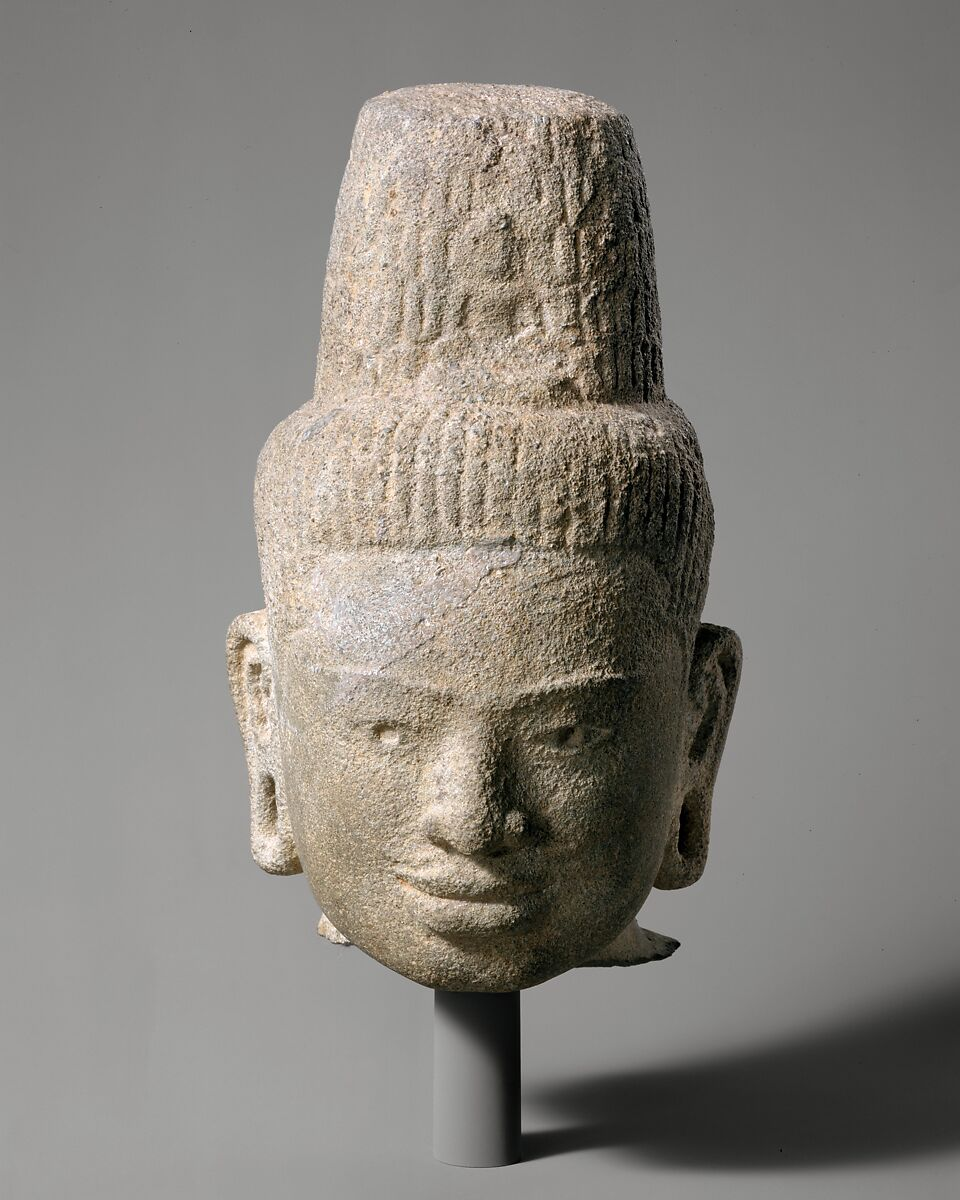
Even so, the few that have been displayed still come from questionable backgrounds, just far enough removed from their illicit circulation as to make them untouchable by Dutch law.  Take for example this 11th century CE sandstone Khmer Figure of a Male Deity on sale at Vervoordt's Maastrich stand in 2023 or the 13th - 14th century sandstone head of Buddha in Lopburi style the family brought in 2025.  


Both ultimately trace back to decades-old transactions involving a corrupt Chinese-Thai antiquities dealer named Peng Seng, also known as Arthorn Sirikantraporn.  Based in Bangkok, Seng was a well-known supplier of artefacts of murky origins, many transiting through France and the UK.  He was known to have worked closely with indicted dealer Douglas Latchford, (1931–2020), as well as Robert Rousset, (1901-1981), of Compagnie de la Chine et des Indes, the dealer in France both of these pieces were shipped to once purchased for the European market.


A letter, mentioned in the 2019 US Federal indictment against art dealer Douglas Latchford and later reported in an article published by the the Australian Broadcasting Company, describes perfectly, how Seng and Latchford agreed to work together to fabricate provenance so plundered material from southeast Asia could be whitewashed into the licit market in London, clearly circumventing source country  cultural property laws. 

That letter, written by a representative from the auction house Spink & Son, casts doubt on the legitimacy of hundreds of items sourced by Seng in the 60s and 70s and later sold  to private collectors, galleries, and museums around the world. 

It read, in part:

"I would consider my visit there most successful. The financial situation being what it is, I was anxious to spend as little money as possible in purchases and get as many pieces on consignment as possible. I am glad to say it worked out better than I expected."

"I bought a beautiful Baphuon female torso from Peng Seng for $ 13'000, a small, but exquisite Baphuon head from Chai Ma for $ 2'000 and four pieces from Douglas Latchford for $ 20'000. These Bangkok purchases, together with a vase from Mayuyama, $ 8'500, bring the grand total of my purchases on this trip to $ 43'500."

"The greater part of my time in Bangkok was spent in numberous [sic] meetings with our friend Douglas, I am getting the following two important pieces on consignment:(they are supposedly already on their way)."

"Pre Angkor Hari Hara, about 35", supposedly recently excavated in Cambodia near the South Vietnamese border, It is a great piece. The selling price will be $ 300'000 or over, still to be decided upon with Latchford."

"Large Koh Ker female torso; another very beautiful and important piece, selling price $ 100 000 or more, to be determined still."

"Douglas has the following 3 bronzes which at this time he is not ready to give me yet, but which I am sure will come in the very near future."

"I have explored extensively with Peng Seng and Latchford how to get legitimate papers for the large Koh Ker guardian and for all subsequent shipments. The following is the best procedure that I can think of at this time:  For the Koh Ker guardian Peng Seng will send us a letter written and signed somebody in Bangkok. He will say that he has seen this piece in Peng Seng's shop three years ago. Peng Seng would like us to give him the exact text we want in this letter. You and I will discuss this when I am in London."

"On all future shipments of important pieces only, both Peng Seng and Latchford, they will ship the pieces the way they have always done, but at more or less the same time will send a modern piece of about the same size and same subject, described on the airway bill in such a way that nobody will know to which this airway bill applies. From my discussions with Sherman Lee I can say that an airway bill which describes the shipment as a sculpture, rather than "personal belongings", would be satisfactory. It also occurred to me that: we are mostly talking about Khmer art from Cambodia, being shipped out of Thailand, which is not the country of origin, this should lessen our problem."

Peng also communicated in detail with Robert Haines, the David Jones Art Gallery director, explaining to him that he would still send the gallerist plundered Ban Chiang pottery, despite the ban put in place by the Prime Minister of Thailand prohibiting their export in 1972.

Although TEFAF’s vetting committees have, over the years, approved the display of long-looted pieces, links like these, to networks identified in criminal investigations into antiquities trafficking, raise serious questions about the consistency and rigour of the fair’s vetting standards. The fact that an object may now fall outside a statute of limitations does not resolve the ethical concerns surrounding its removal, circulation, or sale. For many observers, TEFAF’s willingness to showcase such works suggests that its vaunted vetting procedures risks becoming a matter of form rather than substance, an institutional gesture that satisfies procedural requirements, making objects "legal now", while sidestepping the deeper moral obligations inherent in stewarding cultural heritage.

Can TEFAF uphold its ethical commitments while being led by someone whose professional history intersects with so many provenance disputes?

The answer to this question matters.  Not only for collectors and curators, but for the broader conversation about accountability in what is circulating on the art market.  TEFAF’s next chapter will be judged not just by the quality of works it presents to its wealthier clientele, but by whether it can maintain integrity and transparency at a time when the global art market should be looking at prior ownership and circulation with more scrutiny. 

One thing is clear. TEFAF’s next Management chapter will be closely watched, not just for what exhibitions and sales it delivers under its new management and oversight, but to observe how its new leadership navigates ethical credibility alongside profit. 

December 17, 2023

Lost Time, Found Art: The Decade-Long Pursuit of Restitution for Antiquities Smuggled by Douglas Latchford at the Metropolitan Museum of Art

In 2013 the Metropolitan Museum of Art restituted two,10th-century, Koh Ker stone statues, known as the “Kneeling Attendants” to Cambodia.  These artefacts had been donated in separate stages to the Museum in the late 1980s and early 1990s and had been associated with antiquities collector-dealer-trafficker Douglas Latchford, a/k/a “Pakpong Kriangsak”, who for 50 years, was once considered one of the world’s leading authorities on Asian Art before his unmasking. 

As early as 2012, Bangkok-based Latchford had already been identified in a civil lawsuit, as a middleman in the trafficking of looted Khmer sculptures from “an organized looting network” and was said to have conspired with the London auction house Spink & Son Ltd., to launder looted temple antiquities. 

Douglas Latchford's
Facebook photo
on 28 October 2017,
two years
before he was indicted.
On 21 December 2016, following months of interviews with confidential informants, and the examination of thousands of emails and other seized documents, as well as years of investigations into international smuggling networks, the office of the New York District Attorney's Office in Manhattan filed criminal charges against New York antiquities dealer Nancy Weiner, stating that she used her gallery “to buy, smuggle, launder, and sell millions of dollars’ worth of antiquities stolen from Afghanistan, Cambodia, China, India, Pakistan and Thailand.” In their complaint, it was documented that Weiner “and her co-conspirators, [one of whom was Douglas Latchford], trafficked in illegal antiquities for decades.”  (New York/Manhattan Wiener complaint, p. 2) .

In 2019 charges were filed in the United States against the then 88 year old Latchford by Assistant U.S. Attorney Jessica Feinstein, in the Office’s Money Laundering and Transnational Criminal Enterprises Unit, for his purported role in "wire fraud, smuggling, conspiracy and related charges pertaining to his trafficking in stolen and looted Cambodian antiquities." Many of the suspect objects mentioned in his 25 page indictment passed through his hands en route to the Met and other important collections, during the course of his business operations.  Latchford died on 2 August 2020 before he could be extradited to the United States and his indictment was formally dismissed, due to his death, the following month. 

Last Friday, the United States authorities announced that the Met would be returning fourteen more pieces to Cambodia, dating from the ninth to the 14th centuries, plus an additional artefacts to Thailand.

The pieces going home to Cambodia are:

This 7th century CE pre-Angkor period sandstone Head of a Buddha, which was purportedly with implicated New York dealer Doris Wiener from 1984–2005 until she gifted it to the Metropolitan Museum of Art in 2005, upon which it was given Accession Number: 2005.512.  


This 10th - 11th century CE copper Bodhisattva Avalokiteshvara Seated in Royal Ease. It was given Accession Number: 1992.336 when it was purchased directly from Douglas Latchford using funds from the Annenberg Foundation Gift. 


This 11th century sandstone Standing Female Deity, (probably Uma), Accession Number: 1983.14 was sold by Douglas Latchford to Spink & Son Ltd., London,  who in turn sold it onward to the Metropolitan Museum of Art. 

This 10th century sandstone Standing Female Deity, which was given Accession Number: 2003.605. This artefact was purportedly with Doris Wiener from 1998 through 2003.  Various saved accession record dates show it was either donated to the Metropolitan by Doris Wiener, in honour of Martin Lerner or was purchased through this New York dealer. 

This partially fragmented 930 - 960 CE  bronze Face from a Male Deitycame to the museum via a Latchford donation in honour of Martin Lerner.   It was given Accession Number: 1998.320a–f.


This ca. 920–50 CE stone Head of a Buddha, was also donated to the museum by Douglas Latchford in 1983 (with no provenance listed), where it was given Accession Number: 1983.551. 

This 10th century, Angkor period bronze Head of Avalokiteshvara, the Bodhisattva of Infinite Compassion was in circulation with Spink & Son Ltd., London until 1998, when it was then sold to an undisclosed private collector who donated the artefact to the Metropolitan the same year, and was given Accession Number: 1998.322.

This 11th century, Angkor period, bronze Four-Armed Avalokiteshvara (Bodhisattva of Infinite Compassion)  This bodhisattva is often depicted with multiple heads and arms symbolising his limitless capacity to help alleviate grievances and is venerated as the ideal of karuna, the willingness to bear the pain of others.  Given Accession Number: 1999.262, the statue was directly purchased by the museum from Douglas Latchford via funds from Friends of Asian Art Gifts, Cynthia Hazen Polsky Gift, and Josephine L. Berger-Nadler and Dr. M. Leon Canick Gift. 


This 11th century architectural Lintel with Shiva on NandiAccession Number: 1996.473. This doorway topping was previously purchased in 1993 by Steven M. Kossak, owner of the prominent "Kronos Collections", who then loaned the piece to the Met for three years before eventually donating it to the museum in 1996. 


This late 9th century, stone Angkor period, Khmer style of Bakong, Headless Female Figure, Accession Number: 2003.592.1, is said to have been in the possession of Latchford's friend, Alexander Götz.  Originally living in Bali, then for a time in Germany, Götz and his family moved to London in 1990 where he opened a gallery specialising in Southeast Asian art, with Indonesia as the main focus. He closed his London gallery in 2015 and has since moved back to Indonesia.


This late 12th century, stone Angkor period, Standing Eight-Armed Avalokiteshvara, the Bodhisattva of Infinite Compassion. Given Accession Number: 2002.477, this stature was sold by Douglas Latchford to Jeffrey B. Soref, heir to the Master Lock fortune, who sits on the Board of Directors at the Metropolitan.  Soref in turn loaned his purchase to the Met from 1999–2002 before gifting it to the museum in 2002.  Authorities in Cambodia had received information from a reformed looter named Toek Tik, who admitted to personally stealing this, as well as other artworks from Cambodia over a span of 20 years during his time as a smuggler.


This 7th–8th century, bronze pre-Angkor period, Ardhanarishvara (Composite of Shiva and Parvati), depicts the god as half male and half female representing the Shakta as worshipper and Shakti as devotee relationship which gives the Ardhanarishvara male and female characteristics.  Assigned Accession Number: 1993.387.4 the female side of this sculpture depicts Parvati’s elegant hairstyle and flowing skirt and exposed breast, while the male side gives us half of Shiva’s moustache, as well as his third eye.  Originally, the public accession record listed only the donation of this object as coming from Enid A. Haup (who had purchased and donated another problematic piece).  The more recent the Met's record was updated to state that the statue was sold by Spink & Son Ltd., London to Haupt who gifted it to the Met in 1993.


This 9th century, stone Angkor period depicting the Head of Bodhisattva Avalokiteshvara. Given Accession Number: 1997.434.1, it was previously owned by American pipeline billionaire George Lyle Lindemann, a collector who frequently bought Khmer artefacts from individuals, some of whom were later implicated in the trade and trafficking of Cambodia's cultural heritage.  Lindemann gifted the object to the Met in 1997, who listed the object with no prior provenance, aside from the name of the wealthy donor.


This 11th century, sandstone Angkor period, Male Deity, probably Shiva.  Depicted with four-arms and a high chignon of jatamukuta, wearing a pleated sampot, this statue was given Accession Number: 1987.414.  The Met's website listed that the statue as previously owned by Margery and Harry Kahn who gifted the object to the Met in 1987 and that the statue "likely formed the centerpiece of a triad in a chapel of an unidentified temple in the vicinity of Angkor Thom.  Its style relates to sculptures recorded from the Baphuon temple, a monumental step-pyramid dedicated to Shiva, built as the state temple by King Udayadityavarman II."

The Artefacts Returning to Thailand are:


This 11th century Gilt-copper alloy, with silver inlay, possibly miss-named statue of a Standing Shivais believed to be the most complete extant gilded-bronze image from Angkor.  Given Accession Number: 1988.355, it belongs to a small group of metal sculptures of Hindu deities associated with royal cult practices that were discovered in Khmer territories including Cambodia and northeastern Thailand.  The statue was purchased by Walter H. and Leonore Annenberg via Spink & Son Ltd., London in 1988 and donated that same year to the Met. 


This 11th century bronze inlayed with silver and traces of gold statue of a Kneeling Female Figure, perhaps a Khmer queen, who kneels in a posture of adoration with arms raised above her head and palms pressed together.  Given Accession Number: 1972.147, she was sold to the museum by Doris Wiener. 


When the Metropolitan Museum of Art announced the return of 16 Khmer sculptures to Cambodia and Thailand known to be associated with Douglas Latchford with great fanfare on "X" the social media site formally known as twitter it stated that :

"Every one of the 1.5 million objects in our collection has a unique history, and part of the Museum’s mission is to tell these stories. When, how, and where was it created? Who made it and why? What was going on at that time and place in history? The Met also examines the ownership history or provenance: where has the object been and in whose care?" 

and that through research, transparency, and collaboration, the museum was committed to responsible collecting and goes to great lengths to ensure that all objects entering the collection meet its strict standards. 

ARCA would like to underscore that it took the Metropolitan Museum of Art from 2013, when the “Kneeling Attendants” were first relinquished to Cambodia, through the Nancy Weiner and Douglas Latchford's respective indictments of 2016 and 2019, alongside numerous gentle, and then more insistent requests by Cambodia, as well as the continued campaigning of heritage activist groups before the museum moved forward with their restitution on Friday, a decade later.

It is worth remembering that there is an imperative need for justice and ethical stewardship by institutions responsible for the world's cultural heritage and it should not take ten years for a museum, the size and scope of the Metropolitan to do-the-right-thing.  Prolonged processes only contribute to the perpetuation of injustice and swift restitution is essential for rectifying historical wrongs, fostering international cooperation, and preserving the cultural identity of affected communities. Lengthy delays such as this one serve to exacerbate diplomatic, as well as cultural, tensions and perpetuate a sense of cultural entitlement on the part of certain western museums. 

When illicitly acquired objects are identified in a museum's collection, expedient restitution processes are the litmus test which, in ARCA's eyes, truly serve to demonstrate a museum's genuine commitment to holding themselves accountable to their past acquisitions.  When doing so, they foster goodwill among the claimants,  and serve as a positive example which in turn amplifies and reinforces the importance of respecting rightful ownership when it comes to cultural treasures. 

To end on a positive note, ARCA is pleased to see that the Metropolitan Museum of Art has taken a step forward in its documentation protocols and has elected to leave the accession records for these relinquished objects online and visible to the public with notations of "Deaccessioned by The Metropolitan Museum of Art for return to the Kingdom of Cambodia, 2023 or Deaccessioned by The Metropolitan Museum of Art for return to the Kingdom of Thailand, 2023."  This action promotes transparency and accountability in the global effort to combat the illicit trade of cultural artefacts.

One small step for a single museum, one giant leap for museum archival documentation. 

By:  Lynda Albertson

October 14, 2021

Caveat Venditor takeaways during the guilty pleas of New York ancient art dealers


New York-based ancient art dealer Mehrdad Sadigh, AKA Michael Sadigh, who had operated Sadigh Gallery out of the Jewelry Building (Buchman and Fox: 1910) on 5th avenue for decades before his August 2021 arrest, has appeared in the New York State Supreme Court in Manhattan this week and entered his guilty plea.

At the time of his arrest, on August 6th,  Sadigh's warrant listed a host of alleged crimes including:

  • Scheme to Defraud in the First Degree, Penal Law §190.65 (1)(b),
  • Two counts of Grand Larceny in the Third Degree, Penal Law §155.35(1)
  • Two counts of Criminal Possession of a Forged Instrument in the Second Degree, Penal Law §170.25
  • Two counts of Forgery in the Second Degree, Penal Law §170.10(1)
  • Two counts of Criminal Simulation, Penal Law §170.45(2) and Conspiracy to commit the same crimes as defined under Penal Law 105.05(1)
Details regarding why these charges were brought can be viewed in our earlier article here.

Just over two months later, on 12 October 2021, the controversial dealer admitted defeat, making no further protestations about the legitimacy of his business transactions.  In what may have been the fasted cultural property crime judicial cycle in New York history,  Sadigh plead guilty Tuesday to seven felony counts including Grand Larceny in the Third Degree and Forgery in the Second Degree. 

Interestingly, the dealer also gave damning statements showing just how easily he manipulated the underinformed buying public, duping them into purchase modern reproductions he stoically insisted were ancient.  Driven by financial greed Sadigh admitted, “over the course of three decades I have sold thousands of fraudulent antiquities to countless unsuspecting collectors.” 

Sadigh also admitted to manipulating his gallery's satisfaction ratings on ratings platforms, by having contacts post false positive reviews as well as hiring a specialised reputational defence firm to manipulate Google's ratings so that negative comments from bilked clients complaining about their purchases or that Sadigh Gallery was a font of fakery were harder for the average Joe to find. 

In our previous article, we posited the assembly-line nature of Sadigh's fakes, which he admitted to in his court hearing.  The dealer openly admitted that he aged modern reproductions to make them appear plausibly authentic, by adding layers of paint, grime, and chemicals to their surfaces. 

Having been caught red-handed and having admitted to crimes that stretched for decades, the Manhattan District Attorney's office, through their Antiquities Trafficking Unit, filed what some might see as a relatively lenient sentencing memorandum.  Citing Sadigh as a first offender, the District Attorney's Office recommended five years probation and a ban on businesses related to the antiquities or reproductions trade.  

While some of the general public are angry that the prosecutor didn't recommend jail time, given that he has likely ripped off hundreds or thousands of people, others have commented that they were happy that the dealer was selling fakes rather than plundering actual archaeological sites to fill his client's burgeoning demands. 

Here at ARCA were are more sanguine. 

In less than one month we have had two members of the antiquities trade finally, and publically, take the opaque wrappings off of the business practices which go on within the antiquities trade, showing that they are not as pristine or above board, as years of paid art market lobbying has attempted to whitewash.  This was also made clear in statements of wrongdoing made at the end of September by ancient art dealer Nancy Weiner,  at her own sentencing hearing, who on openly admitted to buying antiquities from Douglas Latchford knowing they had been looted and who told the court “these false provenances were meant to facilitate the sale of these objects by obscuring the fact of their illegal export.”

For now, these folks both look forward to life sentences of looking over their shoulders, considering just how many people they have swindled.  Caveat venditor, Mr. Sadigh and Ms. Weiner, caveat venditor. 


July 21, 2021

A "Homeland" welcome for Neil Perry-Smith in New York


We are standing in front of a single-piece sand-stone sculpture of a serenely smiling cross-legged Shiva being worshipped by the small, dumpy Skanda (Fig. 3), the one the Guimet questioned. It was probably made in the second quarter of the 10th century for Jayavarman IV's new capital at Lingapura, today's Koh Ker, and is possibly a symbol of the king and his son. 'This is spectacular. I was shown a picture of it in pieces in the mid-Eighties. The head of Shiva was off, the arms broken, Skanda's feet broken. I bought it. It arrived in three pieces. Neil Perry-Smith, one of the leading restorers of stone, metal and gold, put it together. These had been clean breaks, there's no restoration.' Indeed, the breaks are invisible. 'Go by the wall so you can see Skanda's face', he says, so that I can observe how the artist has trapped religious bliss in the face. 'I sum it up in one word: adoration.'

After boarding a plane in the UK for New York and arriving yesterday, Neil Perry-Smith surrendered voluntarily to officers from U.S. Immigration and Customs Enforcement (ICE) Homeland Security Investigations (HSI) in relation to an arrest warrant issued against him through the Manhattan District Attorney’s Office for his alleged role in an international smuggling ring that trafficked in stolen works of art.  According to Manhattan Assistant District Attorneys Matthew Bogdanos and Christopher Hirsch, the well-organized smuggling network is believed to have laundered hundreds of objects out of India and other source countries onto the licit art market in an operation that is believed to have lasted for as long as thirty years. 

On 8 July 2019 arrest warrants were issued for eight defendants involved in the scheme listing a total of 213 Counts, ranging from grand larceny to criminal possession of stolen property.  The original 28 counts listed against Perry-Smith in the Manhattan complaint were:

1. PL 165.54 Criminal Possession of Stolen Property in the First Degree (7 counts)
2. PL 155.40(1) Grand Larceny in the Second Degree (5 counts)
3. PL 165.52 Criminal Possession of Stolen Property in the Second Degree (13 counts)
4. PL 165.50 Criminal Possession of Stolen Property in the Third Degree (1 count)
5. PL 105.10(1) Conspiracy in the Fourth Degree (1 count)
6. PL 190.65(1)(b) Scheme to Defraud in the First Degree (1 count)

**Note:  It there now seems to be an additional 29th count. 

In that previous DANY's painstakingly detailed felony arrest warrant, it is alleged that Perry-Smith was one of at least seven individuals identified through their investigation who participated in an international criminal network handling material later sold by disgraced ancient art dealer Subhash Kapoor and his former gallery Art of the Past, once located at 1242 Madison Avenue, in New York. 

As a result of this ongoing international investigation into this network's operations, officers with DHS-HSI, working with the District Attorney's Office in Manhattan conducted a total of twelve raids, resulting in the seizure of 2,622 objects valued at no less than $107,682,000 from Kapoor's gallery and numerous storage locations within the jurisdiction of the state of New York. 

The July 2019 Felony Arrest Warrant document listed 72 stolen antiquities possessed by Subhash Kapoor or members of his network from 1986 to 2016 giving an estimated value to the pieces at $79,101,000.  Of those 72, only 33 had been identified and seized by law enforcement as of the summer of 2019.   Thirty-nine other artefacts had still not been located and were estimated to be worth no less than $35,835,000.  Investigators suspect that Kapoor orchestrated to have the missing objects hidden sometime following his initial arrest in Germany in 2011 and prior to his extradition from Europe to India to answer to the charges he faces for the trafficking in ancient artefacts from his home country. 

In July 2020, the Manhattan DA’s Office also filed extradition paperwork for Subhash Kapoor, in answer to their previous arrest warrant relating to his alleged crimes carried out in the United States.  In the meanwhile, Kapoor remains in the high-security block of Tiruchirapalli Central Prison in the South Indian state of Tamil Nadu pending the completion of his first trial in India. 

As it relates to Neil Perry-Smith's alleged role, little detail was mentioned in the lengthy July 2019 Felony Arrest Warrant document.  It stated simply that Subhash Kapoor shipped artefacts with forged bills of lading, first to a company in Hong Kong, while arranging for the antiquities to be restored. Those artefacts would then be shipped from Hong Kong onward to either Neil Perry-Smith in London or to Richard Salmon in New York for restoration, who would then work on the objects before forwarding the conserved artefacts on to Kapoor for sale through his New York gallery. 


But yesterday's confirmation of Perry-Smith's surrender to New York authorities elaborates further on the charges awaiting the London restorer.  In their press release,  Manhattan District Attorney Cy Vance, Jr. states that "Smith" is "charged with possessing and restoring 22 stolen pieces, with an estimated value of more than $32 million" including bronze murti, normally housed in temples, representing the goddess Uma Parvati, Naga Buddha, and Shiva as Lord of Dance (Nataraja).  Laundered onto the licit art market, the bronzes Perry-Smith is alleged to have handled have an estimated market value of more than $32 million, all of which were subsequently shipped on to the conspiracy ringleader Subhash Kapoor for sale in his Manhattan gallery. 


But as we can read from the November 2008 quote excerpted at the top of this blog post, we know that Neil Perry-Smith also restored works of ancient art for at least one other suspect ancient art dealer also previously under indictment for the handling of looted antiquities. 

Shiva and Skanda
10th Century CE 130 cm
Taken from an interview article in Apollo Magazine, we learn that Perry-Smith restored a 10th century Cambodian  Khmer sculpture of Shiva & Skanda for the deceased British art collector and dealer Douglas A.J. Latchford.  One that, in Latchford's own words, arrived to the Thai-based collector-dealer broken in three pieces, with clean breaks.  Clean breaks are a tell-tale sign that the artwork may have been intentionally broken, with breaks such as these, along specific, easily repairable points being done to ease transport and future reassembly, when large cumbersome sculptures are removed from their find spots by looters. 

Prior to his death, Bangkok-based Latchford, had himself been indicted, in November 2019,  in the US Federal Court of the Southern District of New York for wire fraud, smuggling, conspiracy, and related charges pertaining to his own alleged trafficking in stolen and looted antiquities from India and Southeast Asia.  Once considered a pre-eminent collector and expert of Cambodian antiquities, the disgraced 88-year-old Latchford died on 2 August 2020 at his home in Bangkok before his case could be brought to trial in the United States.

Prior to Latchford's indictment, the Cambodian Ministry of Culture also identified Neil Perry-Smith's UK-based Private Limited Company Neil F. Perry as the restorer who worked with Jonathan Tucker and Antonia Tozer's London firm Asian Art Resources.  Tucker and Tozier had brokered the sale of 10 restored Angkorian-era gold jewellery pieces that, like so many others, had appeared on the ancient art market via Douglas A.J. Latchford's network, with no known legitimate provenance.  These pieces had been published in Latchford's and Emma C. Bunker's 2008 book:  Khmer Gold: Gifts for the Gods and were ultimately forfeited voluntarily to the Kingdom of Cambodia in April 2017. 

It remains to be seen what concrete evidence, if any, Neil Perry-Smith can, or will, choose to share with the authorities about the pieces he handled originating from both Douglas Latchford's and Subhash Kapoor's networks.  But with 29 counts now racked up against him, we suspect he won't feel ambivalent about giving up what he knows, trading testimony for the expectation of possible sentencing discounts. 

January 31, 2021

Sometimes restitution is a little like putting lipstick on a pig

Left: Steve Green and the Controversial Coptic Galatians fragment
first offered on eBay in 2012 by Yakup Ekşioğlu.
Right: Douglas Latchford and the two plinths with the broken feet of ancient sandstone statues looted from the Prasat Chen temple complex in Koh Ker

Last week we have seen two eye-popping notices of "voluntary" restitution of  ancient artefacts and papyri framents believed to have been plundered from their respective countries of origin.

In one instance, an article by Tom Mashberg, written for the New York Times on January 29th reported that Julia Ellen Latchford Copleston a/k/a Nawapan Kriangsak, has agreed to relinquish a total of 125 artefacts to Cambodia which had been acquired by her father, controversial antiquities dealer Douglas A.J. Latchford, a/k/a “Pakpong Kriangsak.”  Prior to his death, Latchford's handling of suspect material from Cambodia, Thailand and India resulted in the US government filing a 26-page indictment via the Department of Justice's U.S. Attorney’s Office for the Southern District of New York on 27 November 2019.  This case, unfortunately, concluded in advance of any possible legal ruling against the Thailand-based dealer, who died on 2 August 2020 before the bulk of the evidence gathered in the federal case against him could be heard in court. 

The second announcement, delivered two days earlier by Steve Green, Chairman of the Museum of the Bible, was more discreetly posted on the museum's website and highlighted the return of a number of questionable acquisitions which have been discussed with some regularity on  ARCA's blog as well as in greater detail on Faces & Voices, a specialist blog by Papyrologist and ancient historian Roberta Mazza.  Mazza has more articles about the Green's acquisitions than I can link to, so I recommend our readership take some time exploring them all but perhaps starting here with one where she questions (again) the ever-changing provenance story surrounding the P.Sapph.Obbink fragment purportedly sold through a private sale treaty by Christie’s.  

In Green's press announcement, he states that as of 7 January 2021, the Washington DC-based museum had transferred control of the fine art storage facility that housed the 5,000 Egyptian items to the U.S. government as part of "a voluntary administrative process."   Unfortunately, the philanthropic founder of the museum has said very little about whether or not his museum will be more forthcoming about exactly whom the museum paid when purchasing the 8,106 clay objects with suspect or no provenance from the Republic of Iraq or the approximately 5,000 papyri fragments and accompanying mummy cartonnage which also came with suspect or no provenance from the Arab Republic of Egypt.  All we know is that these objects are now, finally, going home.  And while that is a great success for the countries they were taken from, it tells us practically nil about the men who engaged in their sale and profited from these same countries' exploitation.  

At the end of their announcement, the Museum of the Bible's Chairman stated that going forward they would continue to look for ways to "partner with The Iraq Museum, The Coptic Museum, and other institutions, to provide assistance with preserving and celebrating the rich cultural histories of those countries and many others."  I truly doubt, given the circumstances, that the Egyptian government will be taking Mr. Green up on this proposal. 

Museum of the Bible Press Release
Screenshot Date:27 January 2021

And so the litigation in these matters, at least as it relates to Iraq and Egypt, appear to be drawing to a close.  

With the flourish of pens in the plump fingers of lawyers, these carefully-timed, and responsibility-for-wrong-doing-absent restitutions by members of the wealthy Houses of Latchford and Green are released to the public without the impediment of contradiction.   Sanitised proclamations which imply good deeds done under trying circumstances, but which impart little about the actual motivations of their delayed generosity.  

Most of us, who have been closely following these events can speculate as to the pressure points behind the disputants' seemingly magnanimous handovers and come away with our own conclusions, but our speculation will never give us their complete stories.  It is reasonable to assume that these individuals, and/or their museum, were motivated, in whole or in part, by a desire to put an end to a publically embarrassing chapter to their respective family's cultural heritage acquisition histories, but their decisions should not be read as merely repentant.  

In relinquishing these artefacts to Cambodia, Egypt and Iraq, the Latchfords and Greens seek to mitigate the damages, financial and reputational, that these scandals have caused them.  And with that in mind, their decisions can not simply be seen in a vacuum of attempting to right past wrongs. They are assuredly more strategic than what is within the purview of the public domain. 

Seen through this narrow lens, these very public announcements of voluntary restitution, published in newspapers with large readership or on museum's websites, serve only to cosmetically cover, not correct, the public blemishes their respective criminal investigations have brought to light over the last ten years.  Actions which, when explored more deeply, can be seen as not only embarrassing, or ethically negligent, but potentially criminal, brought about by the direct involvement of staff and family members who should have, or definitely did know, better.  

Despite these joyous restitutions, we cannot ascertain what catalyst, in each of these drawn-out processes of ensuring restorative justice, brought Mr Green and Ms. Copleston to the restitution table.  Usually, in situations like this, written agreements between the parties make it unlikely that anyone will be at legal liberty to openly discuss the negotiations between the aggrieved parties.  In the MotB case, that includes the unspoken details behind the more than three years of back and forth discussions that the museum itself has admitted took place prior to the culmination of this week's announcement. 

Likewise, by bequeathing his 1,000-year-old Khmer Dynasty collection to his daughter, Douglas Latchford left his offspring with more than just $50 million worth of valuable ancient art.   He left her holding a hand grenade with a pulled pin that she doggedly continued to hold some five months after her father's death.  For no matter how magnanimous Copleston's repatriation gestures to Cambodia may seem in print, her waiting this long to relinquish the sculptures begs its own questions as to motivating factors. 

Why would a lawyer such as herself, who by her own statement in the New York Times defensively admitted that her father "started his collection in a very different era" not have advised her ailing father, who was facing prosecution on his death bed, to clear the family name, if not his own, by simply returning the artefacts to Cambodia himself while he was still living?  Or why,  since Latchford's death, has Copleston, not distanced herself from suspicion by voluntarily doing so immediately after any wills for her father were read?

As regards both of these restitutions I would ask these individuals why, with these grand gestures of reconciliation, did neither party turn over the purchase and sale records for these objects.  Something which would truly make reparations as doing so would allow illicit trafficking researchers and law enforcement investigators to trace and return other pieces of history handled by the individuals responsible for engaging in these two unseemly debacles. 

Instead, like with Green's own statement, we get no real responsibility-taking, only precisely worded announcements with appealing attestations which colour their actions as generous acts of voluntary cultural diplomacy.  This despite the fact that there is so much more they could do, aside from simply cutting their losses by relinquishing material. 

In resignation, I understand that decisions like these, come about as the result of complex cultural arbitration.  And I understand that in such circumstances, the party holding the stronger deck of cards in the dispute, might (still) agree to a more palatable dispute resolution outside the courtroom. One which allows the parties involved to avoid a lengthy, expensive, and in some cases, reputationally damaging legal case, but which also assures an alternatively beneficial outcome for all sides. 

And as much as I want to be privy to these closed conversations, it is important to remind myself that Alternative Dispute Resolutions, known as ADRs in cultural property disputes, often carry with them an adherence to mutually agreed-upon confidentiality regarding the agreements signed off on, even when these types of agreements don't "feel" satisfying to those of us not sitting at the negotiating table. 

As someone who works on the identification of illicit antiquities, I want to see individuals, believed to have behaved criminally, brought to justice.  But I must also understand that these types of quieter negotiations do offer aggrieved parties an opportunity for a speedier and less costly resolution than drawn-out, complex, multi-year litigation which of themselves can be more beneficial to harvest countries such as Egypt and Iraq.   Fighting for restitution in the US court system isn't cheap and the costs can be a financial impediment to some foreign governments who haven't the financial means to represent their interests for years on end, or when the application of legal norms to relevant facts, might fail to deliver any justice at all to them as the aggrieved party. 

Another driving factor to remember in these types of agreements, in contrast to legal proceedings, is that out of court settlements enable the parties involved to, on the surface at least, legally protect their reputations. When cases go to court there is normally a winner and a loser.  And with those court decisions, comes very public case records which can serve to outline, in embarrassing red marker detail, the actions of individuals perceived as culpable, or serve as precedent-setting decisions in future illicit trafficking court cases. 

Lastly, as legislation in the art and cultural heritage field is not fully harmonized, there is always the potential risk that the expensive and protracted court case might not achieve a viable cost-benefit outcome.  Like in legal disputes where the value of the returned artefact is less than the country's legal costs in pursuing the case in foreign courts.  Or, as would have been the case in the Museum of the Bible dispute, or the case against Douglas Latchford, where the sheer number of artefacts being contested, if examined individually and concretised in the court's record, might have resulted in fewer objects going home, or greater exposure of the involved parties to subsequent litigation for their perceived roles in further uncovered, questionable transactions.

So, in the end, I have to accept announcements like those made last week which bring objects home but offer no real retribution against those who behaved badly.  This leaves me, and others who have closely followed these cases, asking:

  • Where are the admissions of fault?  
  • Where are the acknowledgements of harm having been done? 
  • Where are the answers we keep asking as to who sold what, to whom, and when?
I close this overly long rant by saying that when I first learned about these upcoming restitutions and read the press releases, I immediately thought that their announcements reminded me of a rhetorical expression from the 1887 compendium of proverbs called The Salt-Cellars by Charles H. Spurgeon, who once wrote:

“A hog in a silk waistcoat is still a hog.” 

And while I am overjoyed that so many artefacts will finally make their way back to where they rightfully belong, I am in no way fooled that these gestures were magnanimous and selfless, or that in Egypt at least, Ma’at, the goddess of truth and justice, would believe that justice has been well and truly served. 

By:  Lynda Albertson