Blog Subscription via Follow.it

Showing posts with label Bruce and Ingrid McAlpine. Show all posts

October 8, 2025

Caveat Emptor: What the Dancing Maenad Can Tell Us About the Market for Looted Art

Christie's 2019 Auction
In November 2019, ARCA published a blog post raising questions about a 5th-century BCE polychrome antefix depicting a dancing maenad, which had been consigned to a Christie’s auction and that I believed the piece warranted closer scrutiny. For those unfamiliar, an antefix is a decorative architectural element once placed along the eaves of ancient roofs to conceal the joints between tiles.

What drew my attention was the striking resemblance between the object at right and three other Etruscan antefixes, also portraying maenads, that had previously been repatriated to Italy after being identified as having been illegal excavated and removed from Italy.


The provenance of the previous, 2019-consigned, antefix up for auction at Christie's read:
Provenance:

In terms of its circulation history, that sparse entry left roughly 2,500 years unaccounted for as nothing prior to 1994 was specified.  Knowing a bit about the consignor's background, I knew, that before her death, Ingrid McAlpine had been married to the ancient art dealer Bruce McAlpine, and that prior to their divorce, both were listed as proprietors of McAlpine Ancient Art Limited in the United Kingdom.

The McAlpines’ names have surfaced in connection with other trafficked antiquities that passed through the legitimate art market. Among these is an Attic black-figured hydria which reached the McAlpines through Palladion Antike Kunst, a gallery operated by disgraced dealer Gianfranco Becchina. Their names also appear alongside the red flag names of Robin Symes and Barbara and Lawrence Fleischman, in relation to the donation of a looted Apulian bell-krater, both objects of which were later restituted to Italy. 

In addition, former Judge Paolo Giorgio Ferri, the Italian judge who worked heavily on these looting cases, showed me a letter, seized by the Italian authorities during their investigations which was written by the staff of Bruce and Ingrid's McAlpine Ancient Art Gallery.  This letter, dated 8 July 1986, tied the couple to at least one transaction with Giacomo Medici and Christian Boursaud and referred obliquely to companies that the later convicted Rome dealer operated through third parties, fronts, or pseudonyms. 

Despite my suspicions I still didn't know where that Etruscan dancing maenad came from.  

Villa Giulia, 1937 Excavation
A few weeks into that investigation, and following a notification from the Carabinieri Command for the Protection of Cultural Heritage, curators Leonardo Bochicchio and Daniele F. Maras of Italy’s Ministry of Culture identified the likely find spot of the disputed object: Campetti Nord. They were able to pinpoint the location precisely, as the National Etruscan Museum of Villa Giulia already held another headless antefix of a dancing maenad, featuring the same polychrome details and stylistic traits.  The museum’s specimen had been uncovered during authorised excavations by the Italian Superintendency at the Etruscan sanctuary of Campetti Nord in the autumn of 1937 — a site previously worked over by tombaroli.

The sanctuary lies within the ancient urban area of Veio, also known as Veii, one of the major cities of Etruria and a formidable rival to early Rome. Its ruins rest quietly near the medieval village of Isola Farnese, about fifteen kilometers northwest of Italy's capital, amid the rolling hills and woodlands of what is now the Veio Regional Park.  For archaeologists, the city is a treasure of discovery, offering rare insight into the architecture, rituals, and daily life of the Etruscans on the frontier between the  Etruscan and Latin worlds.

After much finagling, the story of the first looted antefix was brought to light in an art crime documentary Lot 448, directed by Bella Monticelli which highlighted the objects lack of legitimate paperwork or export license and which exposed how difficult it is to identify and document an object with only a few days notice before an appraching sale.  Fortunately, with some help from Bulgari SpA, (who purchased the artefact at auction and donated it, through the Ministry of Cultural Heritage and Activities and Tourism, to the Italian State) the 2019 auctioned dancing maenad joined her sister at the National Etruscan Museum of Villa Giulia, reunited with other ancient artworks from the same archaeological context from which both figures originated.

Fast forward to a 2nd Christie's Antquities auction, scheduled for later this month and it seems we have a third headless lady dancer from Veio. 


The provenance for this third Etruscan antefix, equally headless, but less intact reads:  Elsa Bloch-Diener (1922-2012), Bern, 1975 (Antike Kunst, no. 113).

If you look carefully, by her feet you can make out the hoof of the Silenos this lady would have been dancing with.  

This detail is remarkably similar to the antefix in the form of a Maenad and Silenos Dancing which once graced the cover of the exhibition catalog A Passion for Antiquities: Ancient Art from the Collection of Barbara and Lawrence Fleishman.  

After careful restoration that antefix was first seen on the market with Robert Hecht who sold it to the Hunt collection.  Next it was circulated via Sotheby's with that collection was liquidated and bought by Robin Symes, who immediately resold it to the Fleischmanns.  In1994 the couple exhibited the piece , along with their entire collection, at the J. Paul Getty Museum, before it was formally acquired by   the museum in 1996 (96.AD.33).  The piece was restituted to Italy after it was matched by Daniela Rizzo and Maurizio Pellegrino to a polaroid in the Giacomo Medici archive.  Like the one up for sale at Christie's now, both artefacts were broken along the lower half and when whole, depicted a Silenos dancing behind the Maenad.


Now let's look at the provenance the auction house has cited.

Elsa Bloch-Diener (1922–2012) was a Swiss art dealer who operated a gallery at Kramgasse 60 in the old town of Bern.  She is known to have collaborated with Ines Jucker (née Scherrer, 1922-2013), the scholar and sometimes ancient art dealer responsible for the exhibition catalogue Italy of the Etruscans, cited in the Christie’s lot description as an exhibition where this piece was on view to the public. 

Jucker not only authenticated works for Bloch-Diener but also curated the 1991 Etruscan exhibition at the Israel Museum in Jerusalem referenced in the Christie's sale.  Also contributing to that exhibition's catalogue were entries by Giovannangelo Camporeale, Fiorella Cottier-Angeli, George Ortiz, and Christoph Reusser, names that have, at times, prompted debate and concern within the field.

In May 2002, when Swiss and Italian authorities raided Gianfranco Becchina's Antike Kunst Palladion, as well as three of Becchina’s storage facilities in Basel, authorities seized documents which identified transactions between the Sicilian and Ines Jucker which documented that she purchased artefacts from this dealer and sold them onwards.

Along the same theme Jucker studied an Attic Red-Figured calyx krater signed by Syriskos (painter); donated by Lawrence Fleischman and his wife to the J. Paul Getty Museum which had been acquired from Robin Symes in 1988.  Pictured on Medici Polaroid it was restituted to Italy.   Likewise a Black-Figure Cup Fragment with the Capture of Silenus in the Tondo which Jucker sold to Dietrich von Bothmer was also returned to Italy.

In the Israel exhibition Jucker curated, which featured the antefix up for auction and identified it as coming from the ancient site of Veio, some four hundred Etruscan objects were presented, none of large format, some with an inscriptions.  Among them were small bronzes, ceramics, jewellery, terracottas (architectural, votive, and cinerary urns), and sculptural fragments in nenfro.  In total they represented all periods and regions of Etruscan art. 

The main nucleus of the Israel displayed ensemble came from the collection of the late Ivor and Flora Svarc, many of whose holdings would be donated to the Israel Museum.  Svarc's objects were complemented by pieces already in Israeli collections, along with loans from the collector-dealer Jonathan Rosen and other private collectors, mainly in Switzerland.  

As cited by Drs David Gill and Christopher Chippindale in Material Consequences of Contemporary Classical Collecting the vast majority of the artefacts exhibited during this exhibition were previously unpublished.  This made this public display of the items their first concretising stop towards having an art marketable pedigree. 

The fact that we know this object comes from the context of Veio, can also be found in the same catalogue as the restituted Getty atefix, A Passion for Antiquities: Ancient Art from the Collection of Barbara and Lawrence Fleishman.


Page 197 refers specifically to the artefact currently up for auction:

A number of fragmentary examples of antefixes of this type, as well as of molds for producing them, have come to light at Civita Castellana (Falerii) (see Andrén; Sprenger/Bartoloni), finds which clearly prove their local manufacture. But the votive deposit of Campetti at Veii has yielded the head of a silenos of identical type and made of Veian clay (see Vagnetti 1971), which led P. J. Riis to suggest that this type of antefix was invented at Veii. The lower half of an antefix of this type with a provenance from Veii is in a private collection in Switzerland (see Jucker), and similar fragments have recently been excavated in Rome (see Cristo fani). 

With that in mind, it is necessary to return to the same question previously directed at Christie’s: 

On what evidentiary basis, supported by what verifiable documentation, did the auction house authorise the consignment of this artefact?  In the absence of any demonstrable chain of custody or export records, the decision to green-light its sale raises serious concerns regarding the robustness of the auction house’s internal due diligence procedures.


In this case, the question is not rhetorical but fundamental. Is Christie’s in possession of any concrete paperwork supporting the legitimacy of this Dancing Maenad’s appearance on the market, or was the absence of evidence simply overlooked given its publication in an exhibition, in the hope that the object’s passage through the auction process would escape closer scrutiny.


By:  Lynda Albertson

July 30, 2020

Restitution: Lot 448, Christie's


Early last November we wrote a blog post asking Christie's about an interesting polychrome painted 5th century BCE antefix in the form of a dancing maenad.  It had been scheduled to come up for sale in their December 4, 2019 auction and I felt the artefact deserved a closer examination regarding its legitimacy on the ancient art market.  For those who do not know, an anteflix is a decorative upright ornament, used by ancient builders along the eaves of a roof to conceal tile joints.


The provenance of the antefex was listed by Christie's as follows:

Provenance:

While nothing before 1994 was specified in Christie's single-line collection history, we know that before she died Ingrid McAlpine was once the wife of Bruce McAlpine, and for a time, before their divorce, both were proprietors of McAlpine Ancient Art Limited in the UK. 

While not completely identical, the Christie's antefix closely resembles another ancient Etruscan antefix in the form of a maenad and Silenus.  This one once graced the cover of the exhibition catalog "A Passion for Antiquities: Ancient Art from the Collection of Barbara and Lawrence Fleischman" depicted to the left.  

That South Etruscan, 500-475 BCE, polychrome anteflix was purchased by the J. Paul Getty Museum from the Barbara and Lawrence Fleischman collection via Robin Symes for a tidy sum of $396,000 and displayed in an exhibition at the Cleveland Museum of Art back in 1995.  In 2007, that antefix was restituted back to Italy by the J. Paul Getty Museum after a Polaroid photo, recovered during a 1995 police raid on warehouse space rented by Giacomo Medici at Ports Francs & Entrepôts in Geneva, was matched to the artefact in the California museum's collection.

The Christie's auction dancing maenad also closely resembled another pair of suspect polychrome antefixes depicting a maenad and Silenus.  This grouping was once part of the collection of the Ny Carlsberg Glyptotek museum.  Like with the J. Paul Getty purchase, an image of one of the Copenhagen antefix and a foot were matched with photos law enforcement seized in the dealer Giacomo Medici's business dossier.  Eventually, as with the J. Paul Getty Museum, the Danes relinquished the pair of objects back to Italy.

Bruce and Ingrid McAlpine's names also comes up with other plundered antiquities later identified as having been laundered through the licit art market and accessioned into the prestigious Museum of Fine Arts in Boston collection.   An Attic black-figured hydria, (no.3) came through McAlpine via Palladion Antike Kunst, a gallery operated by Ursula Becchina, the wife of disgraced dealer Gianfranco Becchina.  The couple's names also appear alongside Robin Symes AND (again) Barbara and Lawrence Fleischman for the donation of an Apulian bell-krater. Both of which were restituted to Italy.

In addition, former Judge Paolo Giorgio Ferri, the Italian judge who worked heavily on these looting cases, showed me a letter, seized by the Italian authorities during their investigations which was written by the staff of Bruce and Ingrid McAlpine Ancient Art Gallery.   This letter, dated 8 July 1986, tied them once again to at least one transaction with Giacomo Medici and Christian Boursaud and referred obliquely to companies the convicted dealer operated through third parties, fronts or pseudonyms. 

All of which lead me to several (more) questions.

Why was Bruce Alpine's name, and the name of his ancient art firm conveniently omitted from the provenance record published by Christie's ahead of the December 4th auction?  
Was this omission an accidental oversight on Christie's part or an elective decision, perhaps as a way to reduce the possibility of the object's previous owners connections to the above mentioned dealers drawing unnecessary attention?    
What collection history did the auction house have, if any, that shows where or with whom this artefact belonged prior to the 1994 McAlpine acquisition date to demonstrate its legitimacy in the ancient art market?

Given that three antefixes depicting satyrs and maenads had already been returned to Italy as coming from clandestine excavations I brought my concerns to other Italian experts collaborating with ARCA, and to experts from the Villa Giulia, the Louvre,  and to the Carabinieri TPC.  Each acknowledged I had a right to be suspicious.

ARCA forensic researchers and a forensic archaeologist affiliated with the Louvre Museum pointed me to examples of molds that have been discovered at Etruscan excavations which also depict maenads and helped with comparison imaging.  Researchers in Rome who worked on the Becchina and Medici case identifications with the Rome courts pointed out similar antefixes from the ancient Etruscan cities of Veii and Falerii Veteres, which are part of Rome's Villa Giulia collection.  Both zones, situated on the southern limits of Etruria, were looted extensively.

But I was running out of time and without a smoking gun photo of the object in a looted state, I was also running out of evidence and leads.

I watched the days tick down until the item went up for auction and then sold, in just under two minutes of bidding.  Frustrated, and thinking this little lady was lost for the present, I filed my research away, hoping that down the road she might reappear and that by that point the Carabinieri, MiBACT or I might have more evidence, enough to build upon to make a case for restitution.

Surprisingly, BVLGARI, the Italian luxury brand came to the aid of its country and one frustrated antiquities researcher.  They too had been watching the auction and knew of our efforts to try and bring our girl home. Unbeknownst to me the jewelry firm had purchased the antefix, and then working through cultural diplomacy channels, donated it, through the Ministry of Cultural Heritage and Activities and Tourism, to the Italian State and to the Villa Giulia specifically.

Looking back, with a view from the client's side of the equation:

When one wants to bid at an auction at Christie's, over the telephone, or online, a buyer has to prove that he or she is legitimate. To do so they must email the auction house a digital photo or PDF scan of a valid photo ID (eg. Driver’s Licence, Passport), and a proof of address.  For this proof, they will accept a recent utility bill or bank statement or corporate documents.  With these verifiable and valid documents, the auction house then trusts the potential buyer enough to open up an account in his or her name.

But Christie's seemed to need much less convincing paperwork before accepting the antefix of the dancing maenad for consignment.  Having reviewed the provenance paperwork for this antiquity, this antiquity came with only two, not very convincing documents, one of which had no dates whatsoever.

Those were:

1.) An undated document, which Christie's referred to as a "McAlpine stock card" for stock No. 2/114 noting a vendor in the name of ‘Kuhn’ of a "Terracotta antefix in the form of an akrotère."  
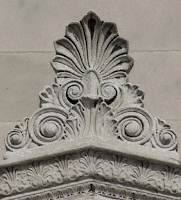
As mentioned above, an antefix, which comes from the Latin word antefigere, (to fasten before), is an architectural fixture which caps then end tiles of a tiled roof.

An akarotère is an architectural ornament placed on a flat pedestal called a plinth and is an ornamental sculpture or pedestal such as the one to the right. These sit above the pediment of a Classical temple and do not extend from the ends of roof tiles.  I also failed to find any Akarotères that picture a dancing maenad.

2.) An 8 February 1994 pricing document with no company names listed anywhere, which listed 15 carefully redacted artworks and one final artefact at the very bottom which listing item  2/156 as "an Antefix with musician, height 40 cm" with a list price of $35,000.

As with the first document, this second is puzzling.  The height of the listed object is slightly off, the stock number doesn't match, and the price indicated is three times higher than the antefix at Christie's sold for. And while the paper is dated 1994 in keeping with Christie's stated provenance, this document by no means shows that the document references the McAlpine's acquisition as it lists no company the purchase was made through and seems merely to be an price listing from some unidentified entity.  The visible item's description is also a bit puzzling.  While the Christie's maenad does depict her carrying a crotalum (a kind of clapper) in her right hand, it would be a stretch to call her a musician. Even if she could be described as a musician, generally speaking if you know the word antefix, its reasonable to assume you would be familiar with their depictions in history.  Why use the word pairing "with musician" instead of using "of a musician" or "of a maenad"?

This was all the documentation Christie's needed to consider an object valid for sale to a willing buyer?

They should be ashamed of themselves. 

Yet, at least we have a somewhat happy ending BVLGARI's donation.  Despite being auctioned and despite a long delay due to the COVID pandemic, she's finally home, and today, at 4pm, at a formal restitution ceremony, this lovely dancing lady took her place with her companions, in the Etruscan exhibition Colors of the Etruscans** at Rome's Centrale Montemartini.  


On the left the antefix as offered for sale by Christies. On the right the antefix at the Museo Nazionale Etrusco di Villa Giulia. This antefix was found in 1937 in Veii, in the course of regular excavations of the Soprintendenza at the Etruscan sanctuary of Campetti North: a site previously looted by tombaroli. It seems evident that both antefixes were cast from the same mould and decorated in the same workshop. Therefore, most probably were originally part of the decoration of a single building.


On hand for the restitution celebration were:

Claudio Parisi Presicce, Capitoline Superintendency for Cultural Heritage -Director of Archaeological and Historical - Artistic Museums

Valentino Nizzo, Director of the National Etruscan Museum of Villa Giulia

Margherita Eichberg, ABAP Superintendent for the Metropolitan area of Rome, the Province of Viterbo and Southern Etruria

Sara Neri, Direzione Generale Archeologia Belle Arti e Paesaggio (Service IV, Circulation)

Lt. Col.. Nicola Candido, Carabinieri Command for the Protection of Cultural Heritage

Leonardo Bochicchio, Daniele F. Maras, curators of the exhibition


I for one am glad she's home, and to also have been a part of her journey.  She's travelled a long way, from the Etruscan city of Veii, to London, and back home again.  May her bare feet forever dance on Italian soil.

By:  Lynda Albertson

** This exhibition will be open at the Centrale Montemartini museum through 01 November 2020.

November 3, 2019

Dear Christie's: What's the story on your provenance on this antefix?


An interesting antefix has been published with Christie's as part of their December 4, 2019 sales event which deserves a closer examination regarding its legitimacy on the ancient art market.  For those who do not know, an anteflix is an upright ornament, used by ancient builders along the eaves of a tiled roof to conceal tile joints.

The provenance for the antiflix is listed as follows:

Provenance

While not specified in Christie's very brief collection history, Ingrid McAlpine was the wife of Bruce McAlpine, husband and wife proprietors of McAlpine Ancient Art Limited in the UK. 

While not completely identical, the soon to be auctioned anteflix on consignment with Christie's, closely resembles another ancient Etruscan antefix in the form of a maenad and Silenus.  This one once graced the cover of the exhibition catalog "A Passion for Antiquities: Ancient Art from the Collection of Barbara and Lawrence Fleischman."   That South Etruscan, 500-475 BCE, terracotta and pigment antiflix was purchased by the J. Paul Getty Museum from the Barbara and Lawrence Fleischman collection via Robin Symes for a tidy sum of  $396,000 and exhibited at the Cleveland Museum of Art in 1995.  Later, in 2007, that antiquity would be relinquished to Italy by the J. Paul Getty Museum after the antefix was matched to a Polaroid photo recovered during a 1995 police raid on warehouse space rented by Giacomo Medici at Ports Francs & Entrepôts in Geneva. 

The Christie's auction antefix also closely resembles another pair of suspect terracotta and pigment antefixes depicting a maenad and Silenus.  This grouping was once on display at the Ny Carlsberg Glyptotek museum.  Like with the J. Paul Getty purchase, an image of the Copenhagen antefix showing a fragmentary antefix were matched with photos in the seized Medici dossier.  As with the Getty terracotta, this object too was eventually restituted to Italy. 

Bruce McAlpine's name also comes up with other illicit objects later identified as having been laundered through the licit art market which were later assessioned into a collection at a prestigious museum.  An Attic black-figured hydria (no.3), once on display at the Museum of Fine Arts in Boston came through McAlpine via Palladion Antike Kunst, a gallery operated by Ursula Becchina, the wife of Gianfranco Becchina.  In addition, the Italian authorities working on these restitutions seized a copy of a letter, written by the staff of Bruce and Ingrid McAlpine Ancient Art Gallery dated 8 July 1986 which tied them to at least one transaction with Giacomo Medici via companies the disgraced dealer operated through third parties, fronts or pseudonyms. 

One final illustration of the triangulation in the world of illicit transactions


The names of Bruce and Ingrid McAlpine appear alongside Robin Symes AND Barbara and Lawrence Fleischman for the donation of an Apulian bell-krater to the Museum of Fine Art in Boston. This vase too was restituted to Italy in October 2006.

All of which leads to several questions

Why was Bruce Alpine's name and the name of his ancient art firm omitted from the provenance record published by Christie's ahead of the December 4th auction?   

Was this omission an accidental oversight on Christie's part or an elective decision, perhaps as a way to reduce the possibility of the object's previous owners drawing unnecessary attention?    

What collection history does the auction house have, if any, that predates the 1994 McAlpine acquisition date?

and lastly,

What steps, if any, did Christie's take to contact the Italian authorities , in order to crosscheck whether or not this object might or might not be acceptable for sale? 
By:  Lynda Albertson
